Which Orlando Patios Are Actually Tolerable in July
We contacted and visited restaurants across Thornton Park, Mills 50, Ivanhoe Village, and the Milk District to assess shade infrastructure, cooling systems, and storm protocols. What follows reflec…

We contacted and visited restaurants across Thornton Park, Mills 50, Ivanhoe Village, and the Milk District to assess shade infrastructure, cooling systems, and storm protocols. What follows reflects what we could verify — and names what we could not.
Eat outside before 2pm at a handful of heavily covered properties, or wait until after the afternoon storm passes. Everything in between is miserable, and most restaurant recommendation lists won’t tell you that.
Orlando’s July heat index regularly hits 105–110°F in direct afternoon sun. The city’s convective storm pattern fires almost daily between 2 and 5pm, typically clearing by 6:30 or 7:30pm. Those two facts alone should reshape every outdoor dining decision you make from now through August. Almost no published guide — local or national — accounts for either of them. Tourism roundups treat patios as permanent lifestyle amenities. In July, they’re time-sensitive infrastructure problems.
This field report is structured accordingly. We contacted or visited properties across four neighborhoods to assess what actually exists: solid roof or decorative pergola, working misting system or none, ceiling fan coverage or wishful thinking, and what a restaurant does with your party of four when the sky turns green at 4:15pm.
What “Covered” Actually Means in This Heat
The word “covered” does enormous amounts of misleading work in most restaurant descriptions. Let’s be specific.
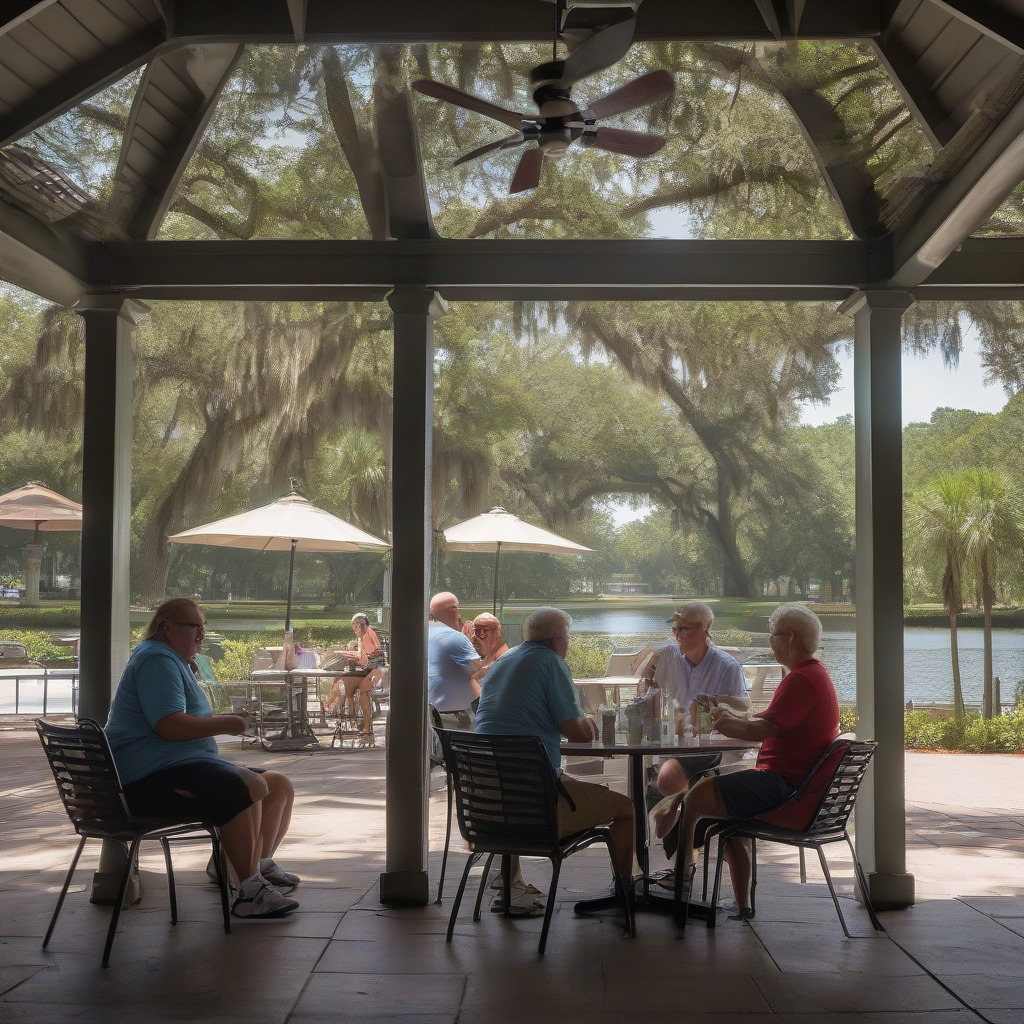
Solid insulated roof with ceiling fans. This is the category worth seeking out if you’re eating before 3pm. A solid overhead surface stops radiant solar gain. Add ceiling fans and you have actual air movement, which cuts perceived temperature. It’s not comfortable exactly — it’s July in Central Florida — but it’s survivable.
Tensile sail shades. Aesthetically clean and genuinely useful for blocking direct overhead sun. But at high ambient temperature and humidity, blocking sun from one angle while hot air moves freely underneath only gets you so far. You’re not comfortable. You’re just slightly less cooked.
The pergola with gaps. The most common patio cover in Orlando, and the most misleading. A pergola with decorative cross-slat construction at 30–50% open sky is not meaningfully cooler than sitting in the open. It filters some direct overhead sun and does absolutely nothing when the afternoon storm arrives. Many well-regarded Orlando patios have exactly this type of cover. They’re not viable from noon to 7pm in July. Worth repeating.
Mature tree canopy. Surprisingly effective in specific spots — particularly in Thornton Park near Lake Eola and in Audubon Park where old oak coverage is dense. Shade from a mature tree differs from a pergola because transpiration from the tree actually lowers ambient temperature a few degrees. The problem is lightning. Most restaurants with tree-shaded patios clear them at the first sign of electrical activity, as they should.
One thing worth knowing: no Florida or City of Orlando patio permit requires shade infrastructure or cooling systems. A restaurant can describe its seating area as a “covered patio” no matter how little actual coverage exists. Many do.
The Two Usable Windows — and the Hours to Avoid
Only patios with solid roofs and active cooling — ceiling fans, misting, or both — work between 11am and 3pm. At a heat index of 105–110°F, unshaded patio dining isn’t a comfort question. It’s a health question. The National Weather Service heat index guidelines make clear that prolonged exposure above 103°F carries real risk of heat exhaustion, even for healthy adults. When you call ahead, ask specifically whether the patio has a solid overhead roof, not a pergola, and whether a misting system is operational. That single question cuts the viable list considerably.
The real opportunity arrives after 7pm. Post-storm, with cloud cover still hanging and surface temperatures falling, a covered and fanned patio becomes genuinely tolerable. Most of this article’s useful recommendations belong in that window.
The stretch from roughly 2:30pm to 6:30pm is the worst of both conditions: peak heat overlapping with storm development and clearing. Build your dining plan around that window, not into it.
The 4pm Problem: Storm Protocols and Indoor Fallbacks
Restaurant managers across these neighborhoods described their storm protocols as routine July operations rather than emergencies — which is the right attitude. Patios get cleared, guests move inside or come back later. Fine.
What matters just as much is what happens next. The critical variable is indoor fallback quality. A restaurant with a 60-cover air-conditioned dining room handles a storm gracefully. A restaurant whose indoor space is a standing-room bar does not. That distinction is almost never communicated in advance unless you ask.
When you call, ask what happens to patio guests when the patio closes, and how much indoor seating is actually available. This tells you whether a storm ends your evening or just pauses it.
Neighborhood Breakdown: Verified Candidates
The following restaurants appear in our reporting as having patio infrastructure worth investigating. Confirm details by phone before you go — operating status and patio configurations shift, and the research basis for each listing is a starting point, not a guarantee.
Thornton Park (32801)
Thornton Park is the city’s most reliable summer patio neighborhood, and it’s not particularly close. The proximity to Lake Eola matters — evening air movement off the water is measurable, the kind you can actually feel — and it makes the restaurant cluster along Central Avenue and the surrounding blocks the most consistently comfortable post-storm outdoor dining area in Orlando from June through August. If you’re picking one neighborhood this July, this is it.
Stubstub Mule, near 100 S. Eola Dr., has a corner patio worth assessing. The Lake Eola proximity may provide a marginal evening breeze; southeast-facing exposure could intensify afternoon sun. Call and ask specifically: solid roof or pergola, ceiling fan coverage, misting, and indoor bar capacity if the patio closes. Don’t assume.
Ceviche Tapas Bar & Restaurant, 125 W. Church St., has a large courtyard-style patio. The key questions here are whether it’s partially enclosed and what the roof situation actually is. Courtyard framing can mean anything from a roofed loggia to an open pit. Confirm before you go.
Harp & Celt Irish Pub, 130 S. Orange Ave., has a street-facing patio with awning coverage. Awning is better than pergola, but confirm its extent and whether there are ceiling fans. Also ask about indoor bar capacity — if the storm hits during happy hour and 40 people pile inside, you’ll want to know what you’re walking into.
Entrées at full-service Thornton Park restaurants generally run $15–30. For a broader look at what Orlando’s drink scene costs around the neighborhood, our coverage of Orlando happy hour verified prices and hours has neighborhood-specific breakdowns worth reviewing before you book.
Mills 50 (32803)
Mills Avenue’s density of independent restaurants makes it the city’s most varied patio scene. Summer sorts properties with real infrastructure from those without faster than any Yelp review will. Most entrées here range from $12–22.
Hawkers Asian Street Fare, 1103 N. Mills Ave., has a substantial patio with an overhead structure that shows up consistently in local dining coverage. Whether that structure is a solid roof or a pergola with gaps is the question — and it’s one Hawkers should be able to answer in about ten seconds when you call. As a high-volume operation, they probably handle patio-to-indoor transitions more systematically than the smaller places around them. Ask about indoor seating capacity during storm events. Hawkers moves people, but it helps to know where.
Will’s Pub / Lil Indies, near 1042 N. Mills Ave., has an outdoor area used for both shows and casual drinking. The interior is a tight bar — genuinely fun, but tight. If you’re planning a sit-down meal around this patio, confirm indoor overflow capacity first, because a storm will compress everybody into a small room fast.
Pig Floyd’s Urban Barbakoa, 1326 N. Mills Ave., has a large converted rear patio. Barbecue operations tend toward more substantial outdoor infrastructure by necessity — you can’t run a smoker inside — so there’s reason for cautious optimism here. Verify shade sails or roof, fan situation, storm policy, and indoor seating capacity.
Tako Cheena, 932 N. Mills Ave., is a small sidewalk patio situation. Minimal shade infrastructure is likely. If you’re going in July, go indoors.
Ivanhoe Village and Audubon Park (32804)
The neighborhood’s strongest summer asset is mature tree canopy on several Corrine Drive and N. Orange Ave. properties. Dense oak coverage in the Audubon Park Garden District provides biological shade that keeps evening temperatures measurably lower after storms clear — this is genuinely one of the more pleasant pockets of Orlando on a July evening, if the timing is right. Entrées typically run $10–25.
Redlight Redlight Beer Parlour, 2810 Corrine Dr., has a rear patio where tree canopy coverage is reported as significant. One thing to flag clearly: this is a beer bar. It’s a great beer bar, but it’s not a restaurant. Clarify expectations before arrival. For the patio itself, verify actual canopy density, fan presence, storm policy, and indoor bar capacity.
The Sanctum Cafe, 745 N. Magnolia Ave., has a garden-style patio with a plant-forward menu. Garden patio can mean anything from a trellised enclosure to an open yard. Verify actual shade structure, misting capability, and how the restaurant handles storms. Also confirm July hours — this property may operate on daytime or early-dinner timing that sidesteps the storm window entirely, which would actually make it a stronger candidate than some of the places open later.
Kasa Tapas in Ivanhoe Village is worth a call to assess current patio setup. Confirm address and operating status before including it in any plans.
Milk District (32806)
The Milk District’s patio scene skews casual and creative. Shade infrastructure investment is uneven — to put it charitably. Most of the district’s patios function as time-of-day plays, post-7pm when ambient temperature has dropped, rather than infrastructure plays. Plan accordingly, and confirm indoor fallback quality before building a July dinner reservation around any specific property here. Most places charge $12–22 for entrées, with bar-focused spots running lower.
The Pinery on S. Orange Ave. is a candidate worth a direct call to assess infrastructure and summer viability. Verify coverage, fans, and storm policy before booking.
Rooftop Options: An Honest Assessment
In coastal cities, rooftop dining delivers because elevation brings breeze. In inland Orlando — flat, humid, surrounded by land mass — elevation mostly delivers sun exposure and removes whatever ground-level tree cover was moderating the heat below. The breeze advantage that exists in Tampa or Miami doesn’t reliably show up here. “Rooftop bar” in this city is often more aesthetic than functional. I’d be skeptical by default.
Highball & Harvest at the Ritz-Carlton Grande Lakes is the elevated dining candidate most likely to deliver genuine July comfort, based on resort-grade infrastructure and the microclimate created by the surrounding resort grounds — substantial water features and mature vegetation that most standalone rooftop bars don’t have nearby. It’s not inexpensive. If you want a confirmed high-comfort outdoor option and are willing to pay resort pricing, this is the property to call first. Ask specifically about shade coverage, misting, and storm policy before committing.
Several hotel rooftop bars downtown offer views with minimal shade and no misting. They’re fine for one drink after 8pm. They’re not dinner venues in July unless you have confirmed shade infrastructure before you go. Separately, if you’re planning around a set-price evening out, our preview of Magical Dining 2026 in Orlando is worth checking — several participating restaurants have indoor fallback dining rooms worth knowing about.
Patios to Approach With Caution in July
Some of Orlando’s most-photographed patio scenes don’t function from noon to 7pm in July. The pattern to watch for: west-facing exposure, pergola-style cover, no misting system. This combination describes a number of well-regarded Orlando patios and produces genuinely unpleasant conditions from roughly noon until the afternoon storm arrives. If a patio you’re considering faces west and the shade description is a pergola or decorative overhead structure, treat it as evening-only in July.
This isn’t a criticism of anyone’s food or service. It’s specific information about July infrastructure that most published guides skip. There’s a real difference between a bad restaurant and a good restaurant with an unusable patio. July in Orlando collapses that distinction fast.
What to Ask Before You Go
One phone call, three questions:
- “Is your patio cover a solid overhead roof, or is it a pergola?” This one question separates viable midday options from everything else.
- “Do you have a misting system or ceiling fans on the patio?” Clarifies active cooling versus hoping the wind picks up.
- “What’s your storm policy, and how much indoor seating is available if the patio closes?” Tells you whether a storm ends your evening or just pauses it.
Several properties are adjusting patio hours and storm protocols week-to-week based on heat and storm forecasts. Call the day of your visit, especially for weekend reservations.
The information gap this article addresses is real. Tourism sites and general restaurant roundups aren’t built to verify shade infrastructure or account for July weather patterns. Those gaps are exactly what we try to close in our food & hospitality coverage. The restaurants that have invested in solid cover, misting systems, and workable storm protocols have earned the business. One phone call gets you most of what you need to know.