Orlando's Water Is Quietly Destroying Water Softener Resin — Here's What to Do About It
Orlando homeowners spend a lot of time troubleshooting water softeners that seem to be failing. They adjust salt levels. They break up bridges in the brine tank. They reset regeneration timers. And…

Orlando homeowners spend a lot of time troubleshooting water softeners that seem to be failing. They adjust salt levels. They break up bridges in the brine tank. They reset regeneration timers. And they do all of this without ever addressing what’s actually wrong. In many cases, the resin inside the tank has simply worn out. In Central Florida, that happens faster than most manufacturers’ literature will tell you — for reasons that are specific to this market and almost never explained in the generic content that dominates search results on this topic.
This guide is written for Orlando-area residents who want to understand what’s really going on with their softener, what it’ll cost to fix it, and how to make a sound decision about repair versus replacement.
Why Orlando’s Tap Water Is Unusually Hard on Water Softeners
The water flowing into most Orlando-area homes comes from the Floridan Aquifer System, one of the most productive limestone aquifers in the world. That geological reality has a direct consequence for anyone running a water softener: the water is exceptionally hard. Most of the Orlando metro receives water testing between 15 and 25 grains per gallon (GPG). For context, water above 7 GPG is classified as “very hard” by the Water Quality Association. What most Central Florida homes receive is roughly two to three times that threshold.
What this means operationally is straightforward. A softener in an Orlando household must remove substantially more mineral load per gallon than the same unit would in a lower-hardness market. The resin bed works harder, regenerates more frequently to stay effective, and burns through its useful life faster as a result. More regeneration cycles mean more mechanical stress on the resin beads, more salt consumption, and a faster overall timeline toward resin exhaustion. A unit sized for a national average — which many installers rely on as a baseline — may already be undersized for what Central Florida water actually demands. If you moved here from another state with your existing softener, or if a contractor installed a unit without accounting for local hardness levels, you may already be behind.
The Chloramine Problem and Why Your Resin May Be Wearing Out Years Early
Here’s the piece of information that almost no competing guide, product listing, or DIY forum post will give you: the way Orlando’s municipal water is disinfected is actively degrading the resin in your softener faster than the manufacturer’s lifespan estimate assumes.
Orlando Utilities Commission (OUC) uses chloramines — a compound of chlorine and ammonia — rather than free chlorine as the primary disinfectant. Chloramine treatment has become increasingly common nationally because it produces fewer disinfection byproducts and maintains residual disinfection power across long distribution systems. From the perspective of your water softener’s resin bed, though, it’s significantly more destructive than free chlorine.
Standard water softener resin has an 8% cross-link structure, meaning the polymer chains in the resin beads are bonded at roughly 8% of their contact points. Free chlorine degrades this resin over time, which is why the traditional industry lifespan estimate of 10 to 15 years was established with a chlorinated supply in mind. Chloramines attack the same polymer structure more aggressively and more thoroughly. Field experience from water treatment professionals in chloramine-treated markets has consistently shown accelerated resin degradation — and not the marginal kind. The real kind that compresses that 10–15 year estimate to something closer to 7–10 years under real-world conditions.
For an Orlando homeowner whose softener was installed in 2015 or 2016, the resin may already be spent or approaching the end of its useful life. The tank looks fine. Regular salt service has been maintained. There have been no repairs. And yet the resin inside is functionally exhausted. The tank, the valves, the brine system — all of that remains in perfectly serviceable condition while the core component has quietly degraded past usefulness. This is the most important local-specific fact in this entire article, and it’s almost universally absent from the information homeowners find when they start searching for answers.
How to Tell When the Resin Tank Is the Real Problem
The symptoms of spent resin aren’t subtle once you know what to look for, but they do overlap with other softener problems. Homeowners often waste time on the wrong fixes first — and honestly, that’s an easy mistake to make, because the cheaper fixes feel reasonable to try.
The clearest indicator is the return of hard water symptoms in a home where the softener had previously been working well. Scale buildup reappears around faucets and showerheads. Soap stops lathering the way it used to. Laundry feels stiff or looks dingy despite normal detergent use. Spots show up on dishes coming out of the dishwasher. Sound familiar? These are the same symptoms that prompted the original softener purchase, and if they’re coming back, the softener has stopped doing its job.
Many homeowners respond by checking the brine tank. Salt bridges — a hard crust forming across the top of the salt that prevents the brine from forming properly — are real problems. Salt mushing — a sludgy accumulation at the bottom — is also real. Breaking a salt bridge or cleaning out a mushed brine tank is a legitimate fix when that’s the actual cause. But if you’ve done that and the hard water symptoms return within a few weeks, the resin is the likely culprit. Regeneration cannot restore what isn’t there.
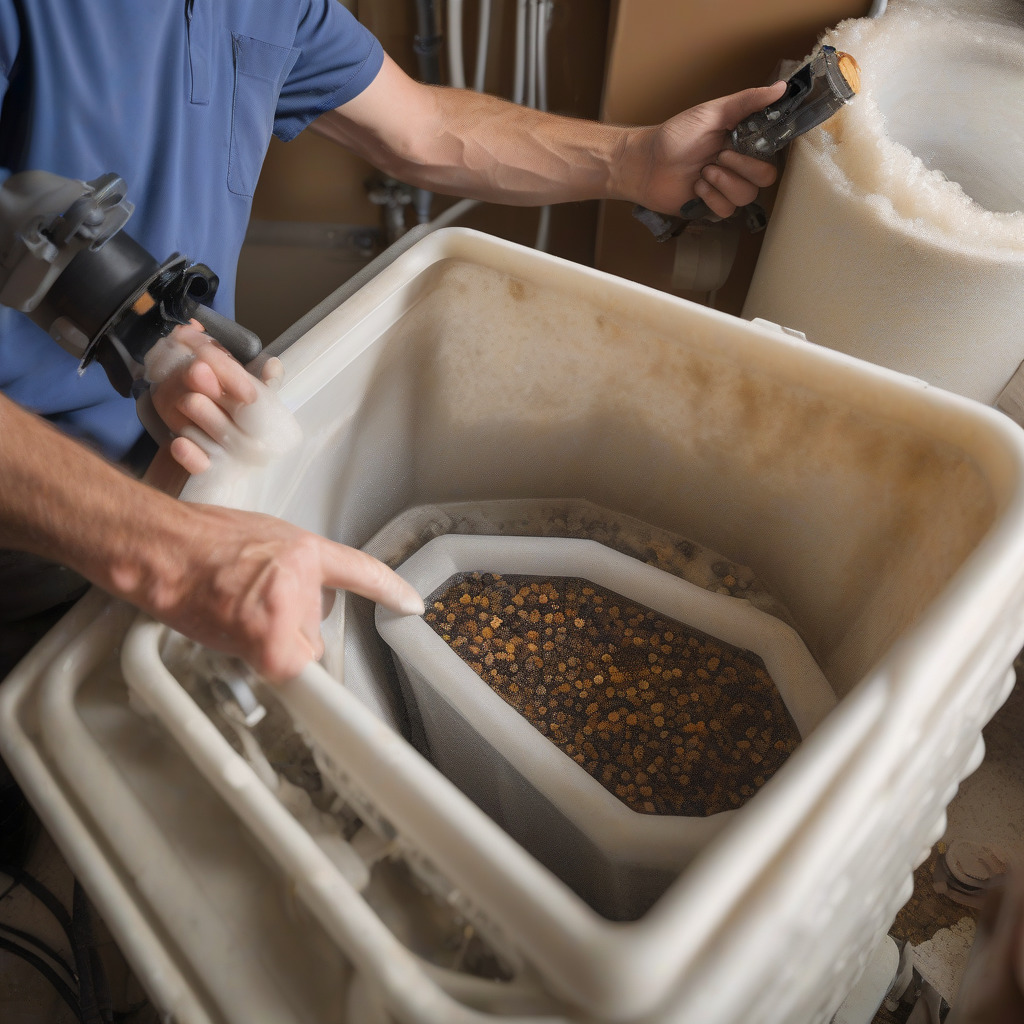
Two other symptoms point more directly at the resin itself. The first is resin beads appearing in tap water — tiny amber or gold-colored spheres that you’ll often notice first in ice trays, toilet tanks, or aerator screens. As resin degrades, the beads fracture and can migrate past the tank’s distribution basket into the home’s supply lines. If you’re finding them, the resin is physically breaking down. No exceptions. The second is water that takes on a slight discoloration or an off taste even after regeneration — a sign that the resin’s ion exchange capacity has degraded to the point where it’s affecting water quality rather than improving it.
A water hardness test, available inexpensively at most hardware stores or through many local plumbers and water treatment companies, can confirm the diagnosis. Test the water coming out of your softener’s outlet. If it’s reading anything close to what you’d expect from untreated tap water in this market, the resin isn’t doing its job.
Resin Replacement vs. Full Tank Replacement vs. New System
Once you’ve confirmed that the resin is the problem, the decision tree is fairly straightforward: replace just the resin, replace the whole tank assembly, or install an entirely new system. Each option has a legitimate use case, and the right answer depends on the age of your unit and the condition of its other components.
Resin-only service — where a technician drains and removes the old resin, flushes the tank, and repacks it with fresh media — typically runs between $150 and $400 for parts and labor, depending on tank size and whether the technician sources standard or upgraded resin. Orlando-area labor rates tend toward the higher end of that range. This works best when the tank itself is in good shape and the control valve is functioning correctly. It makes economic sense on a unit that is 5–8 years old with no other mechanical issues.
Full tank assembly replacement — swapping out the entire mineral tank while keeping the existing control head and brine tank if they’re serviceable — runs roughly $300 to $700 or more for parts and labor, depending on tank size and whether you’re buying a standard or premium unit. Ionex Water LLC, an Orlando-based water treatment supplier, covers the scope and cost considerations of Water Softener Resin Tank Replacement in detail, which is useful reference material if you’re trying to understand what a full tank swap actually involves before talking to a technician. This option is worth considering when the existing tank has physical damage, when the tank’s internal distributor is compromised, or when resin repacking has been done before and the technician has concerns about the tank’s integrity.
New system installation — complete replacement of softener, brine tank, and control valve — ranges from approximately $800 to $2,500 or more installed in this market, with significant variation based on capacity, brand, and whether the installer is a franchise operation or an independent. This is the right call when the unit is 10 or more years old, when the control valve has become unreliable or parts are difficult to source, or when the original system was undersized for the home’s actual water usage and hardness load. Paying several hundred dollars to repair a system that’ll need full replacement in two years just wastes the repair budget.
Get at least two opinions before committing to a new system. Some service companies will recommend replacement when repair is entirely viable, while others underestimate the age and degradation of what they’re evaluating. A written diagnosis with specific findings about the control valve and tank condition gives you a basis for comparison.
The Resin Upgrade Worth Paying For
When resin is being replaced — whether as a standalone service or as part of a full tank installation — Orlando homeowners should seriously consider paying for 10% cross-link resin rather than the standard 8% cross-link product. The difference is structural. Ten percent cross-link resin has more bonding between its polymer chains, which makes the beads physically harder and more resistant to oxidative attack. In a chloramine-treated water supply like OUC’s, that added durability translates directly into extended resin life.
The material cost difference between 8% and 10% cross-link resin at the installer level is typically in the range of $30 to $80 depending on the volume required for your tank. That’s a modest increment relative to the total cost of a resin service call. Given that chloramine exposure is the primary driver of premature resin degradation in this market, the upgrade pays for itself by extending the time before the next service. It’s one of those cases where the cheap option is a false economy.
A secondary consideration applies to homeowners in parts of Osceola County and rural Orange County who are on private well supply rather than municipal water. Well water in these areas frequently carries dissolved iron at levels that can foul resin beds, coating the beads and progressively reducing their exchange capacity. Elevated iron concentrations can significantly shorten resin life. For these households, the solution typically combines 10% cross-link resin with a dedicated iron pre-filter or an iron-specific resin blend. A technician who assesses well water without asking about iron levels, or without recommending a test, is skipping an important diagnostic step.
Permits, Licenses, and Florida Law
Florida Statute Chapter 489 governs the licensing of contractors who work on plumbing systems. Connecting a water softener to a home’s plumbing — specifically, making connections to the water supply lines — constitutes plumbing work under Florida law. Any contractor performing that work for compensation must hold a Florida Certified Facility Contractor (CFC) license. A handyman, unlicensed technician, or general contractor without the specific plumbing endorsement can’t legally perform this work.
The practical implication is straightforward: when you hire a water treatment company or softener service provider, confirm that the technician making plumbing connections is appropriately licensed. Ask to see the license number, and verify it against the Florida Department of Business and Professional Regulation’s online lookup tool. Unlicensed plumbing work creates liability exposure for homeowners, can affect homeowner’s insurance claims, and may complicate disclosures in a future sale. It’s a five-minute verification that’s worth doing.
On the permit question: Orange County Building Division requires permits for new water softener installations that involve modifications to the home’s plumbing. A straight resin service — where no plumbing connections are disturbed — generally doesn’t require a permit. A full new system installation that requires cutting into supply lines, adding bypass valves, or modifying drain connections typically does. If you’re inside an incorporated municipality within the metro, check with that city’s building department rather than the county, as requirements can vary. Orange County Building Division can be reached at 407-836-5550 to confirm the threshold that applies to your specific scope of work.
The homeowner exemption under Florida law allows owner-occupants of single-family homes to perform their own plumbing work without a contractor’s license. This exemption does not extend to rental property owners, landlords, or anyone performing the work on a property they don’t personally occupy as their primary residence. If you’re a rental property owner or an investor managing units in the Orlando market — a substantial segment of this city’s housing stock — you’re legally required to use a licensed contractor for any plumbing connection work, regardless of how straightforward it appears.
Where to Buy a Resin Tank or Get Service in Central Florida
The big-box stores are useful for some things, but not really for this. The Lowe’s and Home Depot locations throughout the metro — including the Home Depot on Colonial Drive — stock salt, resin cleaner, and in some cases complete small-capacity softener units intended for light residential use. What they generally don’t carry is replacement mineral tanks in the range of sizes needed for a standard Central Florida household. Stock of 10% cross-link resin in bulk is sparse or absent. Control valve components needed for a repair typically aren’t in inventory. If you’re doing a resin replacement service, the parts are almost certainly coming from a specialty supplier, not a home improvement chain.
For equipment and parts sourcing, the Goldenrod Road and Orange Blossom Trail commercial corridors include plumbing supply houses that serve the trade. These are wholesale-oriented operations that may or may not sell to the public directly, but a licensed contractor you hire will typically have accounts with them. It’s worth asking any service provider where they source their resin and whether they can show you the product spec sheet — that’ll confirm whether they’re installing 8% or 10% cross-link material, which is exactly the kind of detail that gets glossed over if you don’t ask.
The metro is served by a mix of national franchise operations and independent local dealers for full service work. Franchise brands offer consistency in process and product, and most carry the standard range of service options. Independent water treatment companies operating in the Central Florida market sometimes offer more flexibility in equipment sourcing and may be more willing to discuss upgrades or non-standard configurations. The Osceola and rural Orange County well-water market in particular includes established independent operators with specific expertise in iron and sulfur treatment alongside softening. Details like current pricing, specific brand availability, and service area should be confirmed directly before scheduling. When you contact a provider, ask whether the technician holds a CFC license, what resin cross-link percentage they install as standard, and whether the service includes a post-installation hardness test to verify performance.
Seasonal Timing and Why It Matters Here
Water softener performance in Orlando doesn’t operate on a flat annual curve, and the seasonal factors here affect both when problems become noticeable and when it makes sense to schedule service. Central Florida’s dry season, roughly October through April, brings lower rainfall, reduced aquifer recharge, and in many areas a measurable increase in mineral concentration in the water supply. This is when homeowners are most likely to notice the symptoms of a struggling softener, because the system is being asked to process water that’s toward the harder end of the range it was sized for.
A resin bed that was marginally adequate during the rainy season may fall noticeably short during a dry winter, creating a false impression that the system failed suddenly when it was actually declining gradually. It’s a slow slide that looks like a cliff. Post-hurricane periods introduce a different risk. Extended power outages disrupt regeneration cycles, and in some cases storm-related pressure surges or backflow events can physically disturb the resin bed or contaminate the brine tank. If your home went without power for more than a couple of days following a significant storm, run a manual regeneration cycle and test your outlet water hardness before assuming the system is operating normally.
The broader context matters here. Central Florida’s year-round warm temperatures, high irrigation demand, and outdoor water use patterns mean that households run more water through their softeners than equivalent households in lower-demand markets. Seasonal pools, irrigation systems running on extended schedules, and the absence of months-long reductions in water use all keep demand on the softener consistent and high. The annualized throughput of a Central Florida softener often significantly exceeds what the same unit would process elsewhere — which is one more reason why the national lifespan estimates embedded in manufacturer literature don’t translate directly to this market. If your softener is approaching the 7-year mark, arrange for a professional assessment during the dry season when performance pressure is highest. A system that passes at low demand in the wet season may struggle noticeably when conditions tighten.
Orlando’s water supply conditions are unusual enough that generic national guidance on water softener maintenance falls genuinely short of what the actual situation requires. The hardness levels are extreme. The chloramine treatment is aggressive. The year-round demand is relentless. A resin bed operating in this market may reach the end of its useful life years ahead of the manufacturer’s estimate, and the symptoms of that decline can be misread for a long time before the actual cause is identified. Understanding the specific dynamics of this market puts homeowners in a better position to make timely decisions — and to avoid paying for the wrong repairs.
For more local coverage, explore our Home & Property section.