What Orlando Drivers Must Do in the First 14 Days After a Crash
Summer storms and tourist traffic make I-4 and SR-436 more dangerous than ever. Florida's PIP statute gives you exactly 14 calendar days to seek treatment before you lose your benefits permanently.…

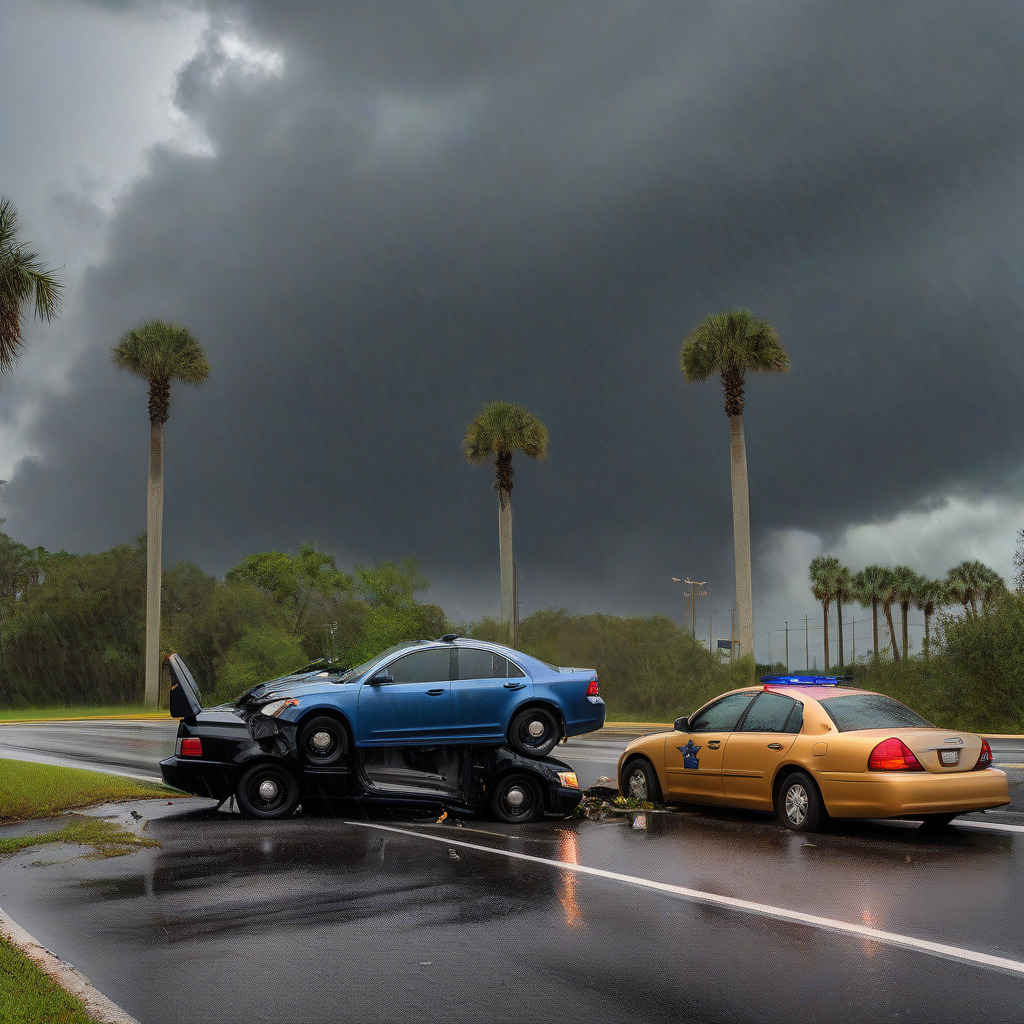
Summer storms and tourist traffic make I-4 and SR-436 more dangerous than ever. Florida’s PIP statute gives you exactly 14 calendar days to seek treatment before you lose your benefits permanently. Most drivers don’t know the clock is running.
The Clock Starts at the Crash Scene
It happens dozens of times every afternoon in July and August. A thunderstorm rolls in around 3 p.m., drops a quarter inch of rain on I-4 in about six minutes, and the stretch between the Central Florida Greeneway and the SR-436 interchange turns into a brake-light gauntlet. Someone follows too close. Someone’s tires are bald from summer heat. A chain-reaction rear-ender takes out three cars before the rain even stops.
By the time the tow trucks clear the scene, most drivers have exchanged information, photographed the damage, and started thinking about whether they need a rental. Almost none of them are thinking about a specific provision inside Florida Statute § 627.736 that is now, silently, running against them.
The deadline is 14 calendar days. It starts at the moment of the crash. It does not pause for the weekend, for a holiday, or for the fact that you felt fine at the scene and your neck didn’t stiffen until the next morning. If you don’t seek medical treatment from a qualifying provider within those 14 days, your Personal Injury Protection benefits are gone. All $10,000 of them. Florida’s no-fault insurance system has no mechanism to restore them.
This deadline appears nowhere in the insurance documents most drivers actually read. It’s enforced as written by Florida insurers and courts. And it’s the one most Orlando drivers discover only after they’ve already blown it. That last part should bother us more than it does.
The No-Fault System and What It Actually Covers
Florida requires every registered vehicle to carry at least $10,000 in Personal Injury Protection coverage. That coverage pays your first-dollar medical and wage-loss costs after a crash — without waiting for fault to be determined, without requiring you to sue anyone. The whole point is speed. Get care. Sort out blame later.
The trade-off built into that system is the 14-day rule. Under § 627.736(1)(a), PIP benefits are available only if the insured receives initial services and care within 14 days after the motor vehicle accident. The statute is blunt: “Benefits shall not be payable if the insured does not receive initial services and care within 14 days after the motor vehicle accident.”
No extension. No hardship waiver. No argument that symptoms were delayed — even though delayed-onset soft-tissue injuries are genuinely common after rear-impact crashes. The Florida legislature built the deadline in and courts have enforced it that way ever since. It’s a hard rule in a world where almost nothing is.
For Orlando drivers, this matters most in July and August. The Florida Department of Highway Safety and Motor Vehicles consistently records elevated crash volumes in Central Florida during summer, when afternoon thunderstorms combine with peak tourist traffic on I-4, US-192 in Kissimmee, and the SR-436 corridor through Casselberry and Apopka. An out-of-state visitor navigating an unfamiliar interchange in a rental car during a downpour is operating at a real disadvantage. You may feel fine at the scene. Adrenaline is a powerful anesthetic. The 14-day clock doesn’t care.
You File Against Your Own Insurer First — Even If the Other Driver Was Clearly at Fault
This is the point that produces the most confusion, particularly on corridors like US-192 where a collision may involve an out-of-state driver, a rental vehicle, or an international tourist carrying no Florida coverage at all.
Florida’s no-fault system means exactly what it says: fault is temporarily irrelevant to your initial claim. Even if the other driver ran the red light on Colonial Drive in front of two witnesses and a traffic camera, your first call after seeking medical treatment is to your own insurer, not theirs. Your PIP coverage pays 80 percent of your reasonable medical expenses and 60 percent of your lost wages, up to the applicable cap — regardless of who caused the crash.
This is not optional. Under Florida law, PIP is primary coverage for medical costs after a crash. It pays before your health insurance, before any liability policy, before any lawsuit proceeds. Your insurer cannot deny your PIP claim on the grounds that the other driver was at fault. They can deny it if you miss the 14-day deadline. They can deny it if you don’t comply with their claims procedures. Fault is not a valid denial basis for PIP.
The liability claim — your claim against the at-fault driver’s insurer for pain and suffering, for damages exceeding PIP limits, for property damage — is a separate legal matter you can pursue simultaneously. But PIP first. For drivers on US-192 or International Drive who collide with a rental car operated by a visitor from out of state, this is especially important. The at-fault driver may have left Florida by the time the claim is filed. The liability path may take months. Your PIP claim, filed promptly with your own insurer, is the coverage you actually control.
The $10,000 and $2,500 Split — and the Provider Rule Nobody Warns You About
Not every crash victim qualifies for the full $10,000. The statute creates two coverage tiers based on whether a physician determines that the injured person suffered an Emergency Medical Condition.
If a qualifying medical provider diagnoses an EMC, the full $10,000 in PIP benefits is available: 80 percent of covered medical bills, 60 percent of documented lost wages. If no EMC is established, the maximum benefit drops to $2,500. Same formula, but against a ceiling less than a quarter the size.
Here is the detail that almost no consumer-facing coverage explains clearly: under Florida Statute § 627.736(1)(a), a chiropractor cannot make an Emergency Medical Condition determination. The statute limits that authority to physicians licensed under chapters 458 (MDs) or 459 (DOs), dentists, physician assistants, or advanced registered nurse practitioners. A crash victim who drives directly to a chiropractic clinic — an entirely understandable instinct after a rear-end collision that leaves your neck aching — and is treated only by a chiropractor, without ever being seen by an MD, DO, PA, or ARNP, is automatically capped at $2,500. It doesn’t matter how serious the injury turns out to be. The statute doesn’t care about your actual condition. It cares who assessed it.
Chiropractic treatment itself qualifies for PIP reimbursement. That’s not the problem. The problem is specifically the EMC determination. If you want access to the full $10,000 tier, you must be evaluated by a physician, PA, or ARNP who can make that call — at an emergency room, an urgent care facility with physician staff, or your treating physician’s office — before or alongside any chiropractic care. As part of our legal and finance coverage, we’ve covered related consumer protection gaps that Orlando residents frequently encounter too late.
Don’t let your first and only post-crash visit be to a freestanding chiropractic-only clinic.
Which Orlando Urgent Care Facilities Accept PIP Assignment — By Corridor
⚠️ Editorial note: The facility-level PIP billing details in this section must be confirmed directly by a reporter before publication. PIP assignment policies change. Individual locations within a chain may vary. Billing desk confirmation at each named location is required. What follows is a framework based on the brief’s research, with the reporting steps needed to complete it.
The question to ask any urgent care facility before you check in after a crash: “Do you accept assignment of PIP benefits, and is there a physician on site who can make an Emergency Medical Condition determination?”
“Accepting assignment” means the clinic bills your PIP insurer directly and doesn’t require out-of-pocket payment from you at the time of service. Some clinics accept PIP but don’t take assignment — they’ll treat you and hand you a bill to submit yourself. That’s a meaningful distinction for someone who doesn’t have cash reserves after a crash.
CentraCare operates as the urgent care arm of AdventHealth, with locations in the greater metro including sites near SR-436 in Altamonte Springs, the Kissimmee corridor, and SR-50 in east Orange County. Reporter confirmation of PIP assignment policy is required at each specific location before publication.
Orlando Health operates its own urgent care network across Orange County. PIP billing policies require confirmation by location.
AFC operates multiple Central Florida locations as independently owned franchises — and that “independently owned” part matters, because PIP acceptance varies by franchise owner. Call each location directly before you drive there.
Concentra operates occupational and urgent care clinics in the Orlando metro, with PIP assignment confirmation needed at each specific location.
The Orlando metro also has a significant number of clinics that market specifically to auto accident patients and bill almost exclusively on PIP assignment. These clinics — some operating near the tourist corridors on US-192 and International Drive — vary significantly in quality and physician availability. Before using any injury-specific clinic, ask the billing desk directly whether a physician (MD or DO) is on staff full-time, not just on call.
The reporting question for each facility: confirm in writing that (1) the clinic accepts assignment of PIP benefits, (2) a physician licensed under Chapter 458 or 459 of Florida Statutes is on site during operating hours, and (3) the clinic’s billing department is familiar with the Florida PIP fee schedule under § 627.736.
What the $10,000 Actually Pays For — and How Fast It Disappears
The $10,000 PIP cap sounds like meaningful coverage. In practice, for anything beyond a truly minor collision, it’s a floor. A low one.
The 80-percent reimbursement formula means your PIP insurer pays eighty cents on each covered dollar of medical bills. To exhaust the full $10,000 in PIP medical coverage, you’d need approximately $12,500 in billed charges. A Central Florida emergency department visit can eat most of that before imaging or specialist consultations are factored in. Add follow-up care and the math becomes clear pretty fast.
A typical post-crash treatment sequence for a moderate rear-end collision — ED visit, cervical X-rays, spine imaging, a specialist consult, physical therapy — can exhaust the $10,000 cap within weeks. Throw in lost wages at 60-percent reimbursement and it goes faster. For residents in Pine Hills, the OBT corridor, and west Orange County, where uninsured motorist rates run above the Florida average, the stakes are higher. When the at-fault driver carries no liability insurance, PIP isn’t just the first layer of coverage. It may be the only one available for initial treatment. Every dollar of that $10,000 matters more in those neighborhoods, and the 80-percent formula erodes it faster than most people expect.
The statute also provides a separate $5,000 death benefit payable under PIP in a fatal crash. It’s a fixed benefit, separate from the $10,000 medical and wage-loss cap, payable to the estate of the insured regardless of fault.
After PIP Runs Out — The Remaining Options in Florida
When PIP is exhausted, Orlando drivers have four realistic options, in roughly descending order of how quickly you can actually access them.
If you purchased Medical Payments Coverage (Med-Pay) as a policy add-on — optional in Florida, not required — you have supplemental coverage, often in the range of a few thousand dollars, that isn’t subject to no-fault rules and doesn’t require a deductible. Med-Pay pays the portion of your medical bills PIP didn’t cover, up to its limit. It’s inexpensive to add and genuinely underutilized. Check your declarations page now, before you need it.
Once PIP is exhausted, your personal health insurance becomes the next payer for ongoing treatment. The coordination rules between health insurance, Medicaid, and PIP can affect any eventual liability settlement. Consult an attorney before settling any third-party liability claim.
Uninsured and Underinsured Motorist Coverage matters most on the OBT corridor, in Osceola County’s tourist zones, and anywhere in Central Florida where the risk of a collision with an uninsured driver is elevated. UM/UIM is optional in Florida — you can waive it in writing, and a lot of drivers do, without fully understanding what they’re giving up. If the at-fault driver has no liability policy or carries inadequate coverage, UM/UIM pays for ongoing medical expenses, pain and suffering, and lost wages beyond what PIP covered. It’s probably the most important optional coverage a Florida driver can carry, and probably the most commonly skipped. That combination should make any reasonable person uneasy.
Florida law also allows crash victims to sue the at-fault driver directly for damages exceeding PIP coverage, but two significant changes under HB 837, effective 2023, have tightened the picture. The statute of limitations for negligence actions dropped from four years to two years — if you were injured in October 2023 and don’t file by October 2025, your claim is time-barred. Florida also moved to a modified comparative fault system: if you’re found to be 50 percent or more at fault, you recover nothing from the other party regardless of their actual liability. ⚠️ These HB 837 provisions require attorney confirmation of current applicability, as ongoing litigation over the statute’s effective date and retroactivity may affect cases from specific time periods.
The Costliest Mistakes Orlando Drivers Make in the First 14 Days
⚠️ This section requires a direct, confirmed quote from a licensed Florida personal injury attorney — ideally a Board Certified Civil Trial Attorney practicing in Orange or Osceola County — before publication. The following represents the anticipated framework based on established Florida PIP case law and practice patterns.
The most consequential mistake is simply waiting. Picture a driver who feels some stiffness at the scene of a rear-end collision on SR-436, chalks it up to tension, and drives home. Two days later, the neck pain is real. By day five, they call their primary care physician, who can’t see them for 12 days. On day 15, they finally sit down with a doctor. The 14-day window closed the day before. The $10,000 in PIP benefits is gone. It’s a genuinely cruel outcome for what was an entirely reasonable sequence of decisions — and the statute does not care.
The second-costliest error is going only to a chiropractor. As discussed above, a chiropractor cannot establish an EMC determination under Florida law. Drivers who receive exclusively chiropractic treatment and never see a physician are capped at $2,500, even when their injuries would clearly have qualified as an EMC under proper evaluation. The statute creates this trap quietly. Insurers enforce it without remorse.
Giving a recorded statement to an adjuster before consulting an attorney is the third recurring problem. Your PIP insurer has a right to take a recorded statement, and in some circumstances refusing entirely can complicate your claim. But what you say in that initial statement can affect not only your PIP claim but any subsequent liability claim. An attorney consultation — many Orlando personal injury attorneys offer free initial consultations — will help you understand what to include before you commit it to the record.
Florida’s PIP statute also gives insurers the right to demand an Examination Under Oath — a formal, sworn proceeding, typically attended by the insurer’s attorney — when fraud is suspected or the claim is contested. An insured who ignores an EUO demand can have their PIP benefits suspended or voided entirely. Florida has a documented PIP fraud history that has made insurers aggressive about claims review statewide. An EUO is a serious legal proceeding. Don’t walk into one without an attorney.
Your 14-Day Action Checklist
For drivers who found this article the day of or the day after a crash, here is the specific sequence that protects your coverage.
Seek medical treatment within 14 days from a physician-staffed facility. The facility must have an MD, DO, PA, or ARNP on site to preserve access to the full $10,000 PIP tier. An urgent care center with a physician on staff, an emergency room, or your primary care physician’s office all qualify. Don’t let the first and only visit be to a chiropractic-only clinic.
Document the scene. Photograph damage to all vehicles, the positions of the vehicles before they’re moved, any skid marks or road debris, and street signs or landmarks that establish the location. If police respond, get the officer’s name and badge number. If they don’t — common in minor crashes — use the Florida Driver Exchange of Information form.
Request the crash report from floydacrashportal.gov. The Florida Crash Portal is the official source. Reports are typically available about 60 days after the crash date. Your PIP insurer and any attorney you retain will need this document.
Notify your own insurer promptly. Florida PIP policies require prompt notice of a crash as a condition of coverage. Call your insurer’s claims line as soon as you’ve sought medical treatment. You’re reporting the crash; you’re not yet giving a detailed recorded statement.
Don’t give a recorded statement before consulting an attorney. You can tell your insurer the date, location, and basic facts without committing to a full recorded statement. Many Orlando personal injury attorneys offer free initial consultations and can walk you through what to say — and what not to. Readers who also want to understand how professional billing practices work in related contexts may find our coverage of how to choose the best accountant for your Orlando small business useful for understanding what good professional vetting looks like.
Check your declarations page for Med-Pay and UM/UIM coverage. Pull up your policy now and confirm whether you have Med-Pay and UM/UIM coverage, and in what amounts. If you don’t have it accessible, call your insurer’s customer service line and ask. Knowing your full coverage picture before you start incurring bills is not optional.
Check your insurer’s PIP complaint history before filing. The Florida Office of Insurance Regulation maintains a consumer complaint database at floir.com, including PIP-specific complaint history by insurer. If your insurer has an elevated complaint rate for PIP denials, document every interaction in writing from the start.
A Final Note on the Season
July and August in Orlando mean crowded highways, daily thunderstorms, and a driver population that includes people who have never navigated a Central Florida interchange in their lives. The afternoon storm cycle on I-4 and its arterials is as predictable as the tourist traffic. What isn’t predictable is which of those crashes will involve you.
Florida’s PIP system was designed to provide immediate, no-fault medical coverage so injured drivers get care without waiting for lawyers and liability determinations. What it was also designed with is a 14-day deadline that functions as a claims killer for drivers who don’t know it exists. Call it an accident if you want. The insurers who enforce it don’t seem confused about what it does.
The clock starts at the scene. Know it before you need it.
CityDesk Orlando covers local business, legal, and civic issues affecting Orange, Osceola, and Seminole County residents. This article is informational and does not constitute legal advice. Readers with specific questions about a pending PIP claim should consult a licensed Florida attorney.