Understanding Florida Documentary Stamp Tax on Home Sales
Most Orange County sellers see the charge appear a few days before closing and don't know what hit them. Here's the rate, the math, and what's negotiable.

Understanding Florida Documentary Stamp Tax on Home Sales
Most Orange County sellers see the charge appear a few days before closing and don’t know what hit them. Here’s the rate, the math, and what’s negotiable.
If you’re selling a home in Orange County and you’ve just gotten your Closing Disclosure, there’s a decent chance you’re staring at a line that reads “State of Florida Documentary Stamp Tax on Deed: $2,520” and wondering what, exactly, you agreed to pay and when you agreed to pay it.
You didn’t miss a disclosure. Your agent probably mentioned it at some point, or didn’t. Either way, it showed up without much ceremony a few days before closing, and now it’s real money leaving your proceeds. For a $360,000 sale — right around where Orange County’s median has been running — that’s $2,520. For a $400,000 sale, it’s $2,800.
These aren’t rounding errors. And the name doesn’t help. “Documentary stamp tax” sounds like something out of a 1940s property records office, which, in fairness, it essentially is.
This piece explains what the tax is, who pays it, how the math works at current Central Florida prices, when it doesn’t apply, and where it fits in the full picture of what it actually costs to sell a house here.
What the Documentary Stamp Tax Is — and What It Isn’t
The Florida documentary stamp tax on deeds is a state excise tax on the transfer of real property, governed by Florida Statute §201.02 and applied to the deed itself — the legal document transferring ownership from seller to buyer. The state charges a fee for recording that transfer, and the amount scales with the price paid.
This is primarily the seller’s obligation under standard Florida residential contracts.
A separate documentary stamp tax applies to mortgage notes and loan documents. It’s assessed at $0.35 per $100 of the mortgage amount and falls to the buyer. These are two different taxes on two different instruments, appearing as separate line items on your Closing Disclosure. A lot of published coverage conflates them, which doesn’t help anyone trying to make sense of their own closing costs.
When your agent or title company says “doc stamp,” ask which one they mean. On the seller side, it’s always the deed doc stamp under §201.02.
The Rate — and Why You Can Ignore the Miami-Dade Exception
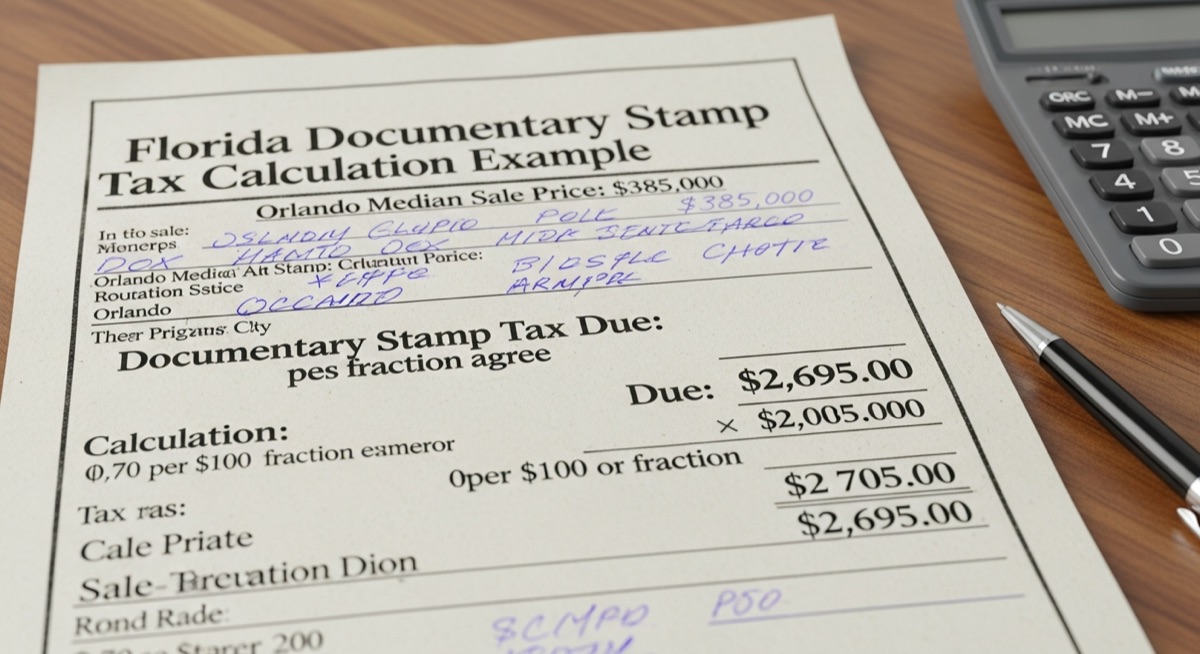
The statewide rate for documentary stamp tax on deeds is $0.70 per $100 of consideration. That rate applies uniformly across Orange, Osceola, and Seminole counties. Florida doesn’t allow counties to layer local surcharges on top of it. Orange County cannot add its own assessment. Neither can Osceola or Seminole.
The rate is $0.70 per $100.
You may have seen articles about Miami-Dade County, where the doc stamp on deeds is calculated at a lower base rate plus a separate surtax, producing a combined figure higher than what applies elsewhere in the state. That has no application to anything happening in Central Florida. If you’re selling in Orlando, Kissimmee, Sanford, or Winter Park, your rate is $0.70 per $100. Stop reading about Miami-Dade.
The Math at Current Orlando Prices
The taxable base is the consideration paid for the property — in almost all residential transactions, that’s the contract sale price. Florida rounds up to the nearest $100 when calculating the tax, so a sale price of $361,400 is treated as $361,500. Small thing, but it’s the kind of small thing that will bug you when the number on your Closing Disclosure doesn’t match what you calculated on your phone.
Here’s what the tax looks like at sale prices representative of the current Orange County market:
- $350,000 sale: $350,000 ÷ $100 × $0.70 = $2,450
- $360,000 sale: $360,000 ÷ $100 × $0.70 = $2,520
- $380,000 sale: $380,000 ÷ $100 × $0.70 = $2,660
- $400,000 sale: $400,000 ÷ $100 × $0.70 = $2,800
The Orlando Regional REALTOR® Association publishes monthly market reports with current Orange County median sale data. At a median in the vicinity of $360,000, most sellers in the county are starting at roughly $2,520 in deed doc stamp.
One practical note: in a straightforward cash or financed purchase, consideration equals the purchase price, and the calculation above applies directly. Complications arise when a buyer assumes existing debt, when seller-paid closing costs adjust the net proceeds, or when a transaction involves non-cash consideration. If your situation involves anything other than a clean sale at a stated price, have a specific conversation with your closing attorney before you get to the table. “I’ll figure it out at closing” tends to go poorly here.
Who Pays — Custom, Contract, and the FAR/BAR Default
If you are selling a home in Florida, you almost certainly owe the documentary stamp tax on the deed. That’s the short answer.
But precision matters, because the answer is “custom and contract” more than “law.” Florida Statute §201.02 imposes the tax on the deed instrument but does not specify which party must pay it. The seller-pays convention exists because it’s the default in the standard Florida Realtors/Florida Bar residential contracts — the FAR/BAR contracts — used in virtually every conventional home sale in Central Florida. Those contracts assign documentary stamp taxes on the deed to the seller as part of closing cost obligations.
When a seller in Orange County accepts a standard FAR/BAR offer, they accept that obligation. It’s in the contract. But it’s not a state mandate the way income tax is. The allocation is negotiable. That doesn’t mean you’ll negotiate it. It means you could.
Is It Negotiable — and What Does That Actually Look Like?
Technically, yes. In the current Orlando residential market, as tracked in our legal & finance coverage, rarely.
A buyer could request a closing cost credit equal to all or part of the doc stamp obligation, or the parties could restructure who pays which closing costs. For that to hold up, the language has to appear in the contract itself — specifically and clearly. A verbal understanding doesn’t work. The FAR/BAR contract has designated fields for seller concessions and deviations from default cost allocations; that’s where it needs to be.
This surfaces occasionally in investor transactions in the Kissimmee corridor and parts of east Orange County, where distressed properties and as-is sales are more common. A buyer acquiring below market may roll the doc stamp into a broader closing cost negotiation. In a multiple-offer situation on a well-priced listing in Winter Garden or Oviedo, the conversation doesn’t arise.
If you receive a non-standard offer that departs from the FAR/BAR default on closing costs, read the cost section carefully. If doc stamp responsibility has shifted, you want to see that before you sign — not at the table.
Exemptions: When the Tax Doesn’t Apply
Not every deed transfer in Florida triggers the documentary stamp tax. Florida Statute §201.02 and related administrative guidance recognize exemptions, several of which come up regularly in Central Florida.
Transfers between spouses are generally exempt. This applies when adding a spouse to title, removing one following divorce under a court order, or restructuring ownership within a marriage. It’s one of the cleaner and more commonly used exemptions.
Transfers to wholly owned entities sit on narrower ground. If an individual transfers property to a corporation or LLC in which they own 100% of the interest, and there is no consideration paid, the transfer may qualify for exemption. The single-member LLC exemption is narrowly construed by the Florida Department of Revenue. Real estate investors in the Kissimmee and Lake Nona markets have run into this: not every entity transfer qualifies, and the consequences of getting it wrong show up after the deed is already recorded. If you’re moving property into or out of an LLC for estate planning or asset protection, get a Florida real estate attorney to review the specific facts before anything is recorded.
A deed conveying property as a genuine gift — no monetary consideration, no debt assumed — is not subject to doc stamp. The Department of Revenue will look at the transaction to confirm nothing changed hands. Property transferred by will or through intestate succession doesn’t trigger documentary stamp tax, and neither does a transfer from an estate to a beneficiary.
A deed recorded solely to correct a clerical error in a previously recorded deed — misspelled name, legal description problem — is not a new transfer and doesn’t create a new tax obligation.
Two common misreads worth flagging. Refinancing a mortgage does not involve a deed transfer and does not trigger deed doc stamp, though the note doc stamp on the new loan does apply to the borrower. A mortgage assumption — where a buyer takes over the seller’s existing loan — increases the taxable consideration base, since assumed debt counts as consideration. Confirm the specific implications with your closing attorney based on your transaction structure.
The Osceola and Seminole Wrinkle
For readers beyond Orange County, local differences matter mainly at the margins.
Osceola County has the same $0.70 per $100 rate, but the local market makes certain edge cases more common. The Kissimmee corridor, Reunion Resort, and the short-term rental belt around Walt Disney World attract significant investor activity — LLC-to-LLC transfers, portfolio sales, entity restructurings — that brings the entity-exemption question into practical play far more often than in a typical Orange County residential neighborhood. If you’re buying or selling a short-term rental property in Osceola County and any kind of entity sits on either side of the deal, the doc stamp implications deserve specific legal review before you structure the transaction.
Seminole County is also $0.70 per $100, but Seminole’s higher baseline prices mean the absolute dollar figure is proportionally more significant. A $500,000 sale in Winter Park generates $3,500 in deed doc stamp. A $650,000 sale — not unusual in parts of the Winter Park and Maitland market — produces $4,550. At that level, doc stamp deserves explicit treatment in the seller’s net proceeds calculation at the time of listing, not three days before closing.
How and When It Gets Collected
Sellers have no separate filing obligation with the Florida Department of Revenue. Your title company collects the documentary stamp tax at the closing table, paid from your proceeds. It appears as a labeled line item on your Closing Disclosure — typically in the seller’s column under “taxes and other government fees.” The title agent then remits the collected tax to the Florida Department of Revenue on your behalf.
You’ll see the charge on your Closing Disclosure when that document is sent to you, typically a few business days before closing. That is not when the obligation arises — it arose when you signed the contract — but it is usually when sellers first encounter the actual dollar figure. Which, if nobody warned you, is an unpleasant way to meet a $2,500 line item.
If you want to avoid that, ask your listing agent for a seller’s net sheet at the time you price and list the property. A competent net sheet will show doc stamp as a line item, calculated at the expected sale price. If yours didn’t include it, ask for a revised one.
How Doc Stamp Fits Into Your Total Seller Costs
Documentary stamp tax on the deed is a meaningful closing cost, not the largest one. It’s the one sellers are most consistently blindsided by, partly because the name is opaque and partly because it scales visibly with price in a way that feels arbitrary when you first encounter it.
For a $360,000 sale in Orange County, the seller’s cost picture includes several categories before negotiated credits. Documentary stamp tax on the deed runs approximately $2,520. Owner’s title insurance — customarily paid by the seller in Central Florida — comes to roughly $1,800 to $2,200 depending on the title company and whether simultaneous issue rates apply. Real estate commissions are variable and worth discussing specifically with your agent. Recording fees, HOA estoppel letters, home warranty if offered, and miscellaneous items add incrementally.
Total closing costs for a seller in the $360,000 range — excluding mortgage payoff — typically fall somewhere in the 7–9% of sale price range, depending on commission structure and concessions. Doc stamp at $2,520 is about 0.7% of the sale price on its own. Not the biggest check you write at closing, but a real number that belongs in your calculation from day one. The costs that don’t show up in the calculator are exactly the kind that turn a confident seller into a surprised one at the closing table.
The sellers who feel blindsided are almost always the ones who received a net sheet that omitted it, or who didn’t receive one at all. If you’re in early conversations about listing your home in Orange, Osceola, or Seminole County, ask specifically: what is the projected documentary stamp tax on the deed, and is it on my net sheet? At $0.70 per $100 of your expected sale price, the math is straightforward. There’s no reason to meet that number for the first time at the closing table.
CityDesk Orlando covers local business, real estate, and economic development in the greater Orlando metro. This article is for informational purposes and does not constitute legal or tax advice. Readers with questions about specific transactions, entity transfers, or exemption eligibility should consult a Florida-licensed real estate attorney or tax professional.