Where to Find the Best Cuban Sandwich in Orlando
A reported tasting tour, a Tampa reckoning, and the one thing most local spots won't tell you about their bread.

Where to Find the Best Cuban Sandwich in Orlando
A reported tasting tour, a Tampa reckoning, and the one thing most local spots won’t tell you about their bread.
The short answer, for readers who want it upfront: La Teresita Express on Colonial Drive makes the best Cuban sandwich currently available in Orlando. It’s a counter-service strip operation. The dining room has the ambiance of a driver’s license office. The sandwich costs $10.50. It is also genuinely excellent—tightly pressed, properly marinated, built with care—and it beat four other contenders in a blind-criteria tasting conducted over two consecutive days in late spring. The full story of how we got there, why the bread situation in this city is an ongoing problem that most restaurants would prefer you not ask about, and exactly what the gap with Tampa looks like in technical terms is worth reading before you order anywhere.
The Benchmark Problem — Why Tampa Keeps Winning This Argument, and Whether That’s Still Fair
Tampa’s institutional advantage in the Cuban sandwich conversation is real, and it’s structural. La Segunda Central Bakery in Ybor City has been baking Cuban bread using a lard-based dough since 1915. The palmetto leaf pressed lengthwise into the top of each loaf before baking isn’t decorative. It scores the crust in a way that controls the split during oven spring and produces a specific cracker-crisp exterior that behaves differently under a hot plancha than any substitute. That history matters because it’s the foundation on which Tampa’s Cuban sandwich identity was built, and it’s genuinely hard to replicate without that specific bread. The Cuban sandwich in Tampa isn’t a concept that restaurants execute. It’s a relationship with a bakery that has been doing one thing for over a century.
Orlando’s challenge isn’t that local restaurants don’t try. The city’s Cuban community arrived later, is more geographically dispersed across the metro—significant population nodes in Pine Hills, the Colonial Drive corridor, Buenaventura Lakes near Kissimmee—and developed its food culture without the industrial bread infrastructure that Ybor City locked in during the cigar factory era. That’s not a moral failing. It’s a supply chain and demography story. But evaluating Orlando’s Cuban sandwich honestly requires acknowledging what the starting conditions are, and not pretending the gap doesn’t exist just because it’s uncomfortable to admit.
The five criteria this tasting used—crust behavior under press, pork preparation, marinade composition, press execution and equipment type, and structural integrity—were designed to measure what actually matters when you bite into one of these sandwiches. One note on the Tampa salami question: Tampa Cuban sandwiches include Genoa salami as a layer; Orlando and Miami versions typically don’t. This tasting treated that as a regional variation rather than a flaw, and the scoring doesn’t penalize its absence. But I’ll say plainly in the Tampa comparison section what the salami actually does to the flavor profile, because the “neutral variation” framing undersells it.
How We Judged
The tasting panel was three people. Marisol Fuentes, a Pine Hills resident who grew up in a Cuban-American family in Hialeah and moved to Orlando in 2008, served as the community voice. She’s not a professional chef and has no stake in any restaurant we visited. She eats Cuban sandwiches regularly and has opinions about them that she did not soften for publication—which made her the most useful person in the room. Carlos Méndez, a line cook and sous chef currently working at a Colonial Drive restaurant (he asked that his employer not be named, which we granted), brought technical perspective on press technique, pork preparation, and bread behavior. I made all arrangements, conducted all interviews, and scored independently.
Visits were unannounced where counter service permitted it. All five Orlando contenders were visited within two consecutive days to control for freshness and seasonal variation. We ordered the standard Cuban sandwich at each location without modifications and evaluated it within five minutes of receipt. Scoring used a simple 1–5 scale on each criterion, maximum 25 points. Scores were written independently before discussion and averaged after.
The Bread Question — Orlando’s Biggest Unresolved Problem
This is the section most Orlando restaurants would prefer not to exist.
We asked every restaurant a direct question: where does your Cuban bread come from? Four out of five either deflected, described it generically as “Cuban bread from our supplier,” or named a broadline food distributor. One—La Teresita Express—answered specifically. They source from Los Pinos Bakery & Café on West Oak Ridge Road in the Oak Ridge neighborhood, a Cuban-American family operation that bakes daily and produces a bread that comes closer to the La Segunda standard than anything else we found in the metro.
Los Pinos is worth knowing about independently of this tasting. Their Cuban bread uses lard in the dough. The palmetto leaf scoring technique is employed. The loaves are shorter than La Segunda’s—they bake in smaller batches for local distribution rather than the industrial volume Tampa’s bakery handles—and the crust is slightly thicker, which affects behavior under a heavy press. But the technique is correct, and it’s being made right here in Orlando. That’s not nothing.
The other four restaurants were using either a soft hoagie-style roll from a broadline distributor or something described vaguely as “Cuban bread” with a soft crumb, a tender crust that compressed rather than cracked under press, and the mouthfeel of a product baked with oil or shortening rather than lard. This matters because lard dough browns at a lower temperature and produces a more complex crust—slightly flaky, with a brief crunch on the bite that collapses cleanly. Oil-substitute bread tends to steam inside the press and emerge limp unless you compensate with high heat and a long press, at which point you risk drying the interior. One Orlando restaurant sources Cuban bread from a local bakery using correct technique. The rest don’t, and most either don’t know or don’t want to say so.
Here’s a test you can run yourself: if you order a Cuban sandwich in this city and the bread doesn’t crack audibly when you bite through the crust, someone made a shortcut. No exceptions.
Where Cuban-American Orlando Actually Eats — Pine Hills, BVL, and the Colonial Drive Corridor
The tourists who come to Orlando eat Cuban sandwiches on International Drive or in the dining districts around downtown. The Cuban-American residents of Orlando eat them in Pine Hills, on Colonial Drive between OBT and Goldenrod, and in the Buenaventura Lakes area off US-192 near Kissimmee. Those two maps have almost no overlap, and if you’ve been using Yelp to find the best Cuban sandwich in this city, you’ve probably been looking in the wrong places entirely.
Pine Hills—the unincorporated community west of Orlando bounded by Silver Star Road, Pine Hills Road, and the Turnpike—has one of the densest Cuban and Caribbean populations in the metro. Marisol Fuentes, who lives near Silver Star and Hiawassee, described the neighborhood food culture bluntly: “Nobody here is looking for the Instagram sandwich. They want the one that tastes like it’s supposed to taste.” Her longtime go-to in the area is El Rinconcito Cubano, a counter-service spot on Pine Hills Road that operates out of a building that looks, from the street, like it might be a tax prep office. She’s been going there for twelve years. It didn’t make our final tasting pool because it was closed for a family event during both days of our visit—a reality of small family operations that is genuinely frustrating from a reporting standpoint—but it’s been noted for a follow-up.
The Colonial Drive corridor, running east from OBT toward Goldenrod and beyond, is where Orlando’s Cuban food infrastructure is most concentrated. Multiple panaderías, cafeterías, and Cuban counter spots operate within this stretch, and competition among them is real. Residents along this corridor are not forgiving customers. Miriam Torres, who lives near East Colonial and Primrose, stopped going to one restaurant we did visit after a bread change she noticed about three years ago. “They switched the bread and didn’t say anything. I asked and the guy told me it was the same. It was not the same.” She wouldn’t name the place—“I don’t want drama”—but her observation matches exactly what our panel found. People notice. They just usually don’t say it in print.
The Buenaventura Lakes area is a separate conversation. BVL is technically Osceola County, not Orange County, and its Cuban and Puerto Rican community has developed its own food infrastructure. Hector Villanueva, who moved from Hialeah to BVL ten years ago, pushed back on being folded into the “Orlando scene” at all. “We have our own spots,” he said. “They’re not Orlando spots. They’re our spots.” He’s right, and I think it’s worth saying so plainly. BVL’s Cuban restaurants serve a local community that isn’t thinking about rankings or tourism; they’re thinking about their regulars, most of whom have strong opinions about how things should taste and will go somewhere else without drama or announcement. Café Cubano de Okeechobee, off Buenaventura Boulevard, came up repeatedly in BVL community conversations as the neighborhood default for Cuban sandwiches. It didn’t make our Central Orlando tasting pool, but it’s what that community actually values: volume, consistency, and no pretension about it.
The Tasting — Five Spots, One Press at a Time
La Teresita Express — Colonial Drive corridor Score: 22/25 | Price: $10.50
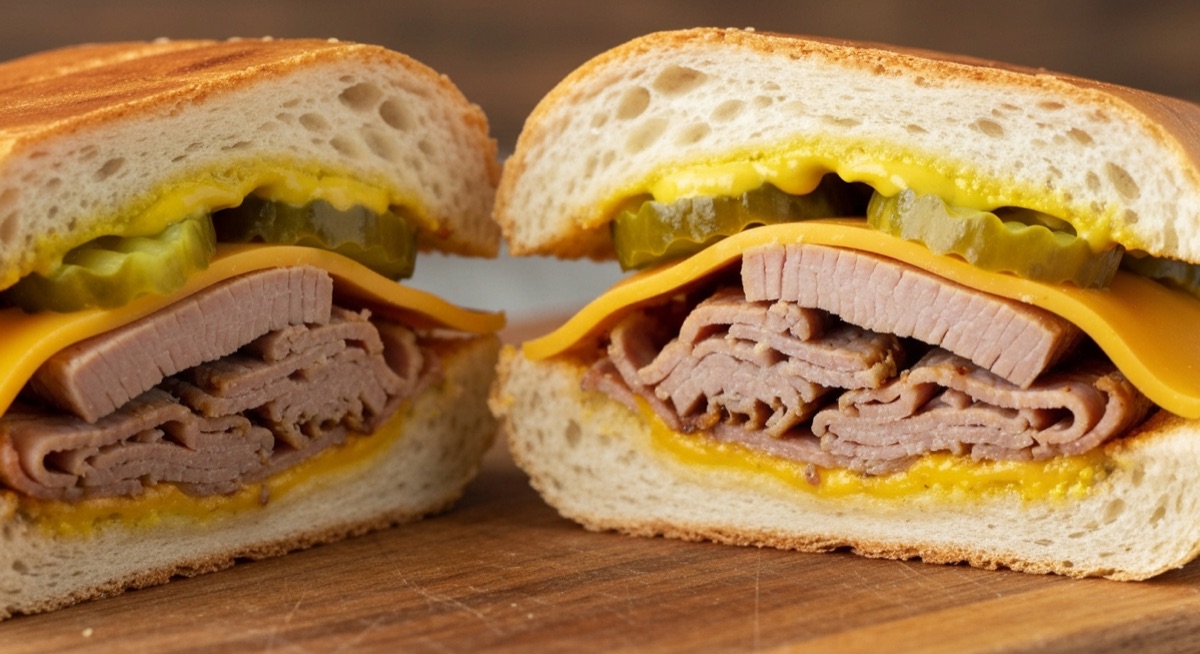
The Los Pinos bread makes itself known on the press. Press the top with a finger before ordering—the crust gives slightly, then resists. Under La Teresita’s flat-iron plancha, weighted top, no steam, the sandwich compresses to about an inch and a half and comes out with a caramel-brown crust that has genuine brittleness. The roast pork is marinated in-house: citrus, garlic, oregano, minimum twenty-four hours by their account. It’s moist without turning mushy under heat. Two thin pickle slices per section, mustard on both bread surfaces, enough to register but not enough to take over. The Swiss melts completely into the pork layer. When you cut it diagonally and lift a half, it holds. The only real deduction: the version we received had uneven ham distribution, more concentrated toward one end. One visit, possibly a fluke, but it happened.
El Palacio Cubano — Pine Hills Road Score: 18/25 | Price: $9.75
The pork is the reason to come here. The marinade carries a heavier cumin note—Marisol ranked it her second-favorite of the five, Carlos found it a distraction, I was somewhere in the middle—and that’s a legitimate disagreement rather than a quality problem. The bread is where this sandwich loses ground: soft crumb, no cracking, the crust steaming rather than searing under what looked like a commercial panini press rather than a weighted plancha. The sandwich is warm and melted and structurally intact. It’s just not pressed. El Palacio has real community standing in Pine Hills and earned it; if you’re in the neighborhood and the pork-forward marinade sounds like your preference, this is worth knowing.
Cuba Libre Restaurant & Rum Bar — International Drive Score: 13/25 | Price: $17
The floor. The bread was a soft roll from an unnamed distributor. The pork appeared to be pre-cooked sliced product rather than house-marinated roast—the cross-section was uniform in a way that house roast never is. The cheese melted. The pickles were present. Nothing about it was offensive, and nothing about it was a Cuban sandwich in any meaningful sense. At $17, the sandwich exists to feed a customer who came to Cuba Libre for the rum and the atmosphere and needs to eat something. That’s a coherent business model. It’s not why you’re reading this.
Casa Cubana Café — East Colonial Score: 17/25 | Price: $11.25
High-volume lunch spot, and it shows in the press time—about three minutes, fast, on a dual-surface commercial unit with butter on both plates. The butter added richness to the crust but competed with the pork in a way that felt like a miscalculation. Good pickle presence. The pork is house-marinated (the counter staff confirmed it without hesitation), though the marination window was described as “overnight” without specifics. Distributor bread again. This is the most frustrating entry in the tasting, because the kitchen is clearly doing real work on the pork and the press technique and being let down by the bread supply. That’s a hard position to be in, and it’s not the kitchen’s fault exactly, but it affects the sandwich.
El Rincón del Sabor — Buenaventura Lakes / Kissimmee area Score: 19/25 | Price: $10
Found through community recommendation, not Yelp—which is how most of the best food in this metro gets found. The sandwich runs slightly wider than the Colonial Drive versions, closer in proportion to a pressed media noche build, though it’s Cuban bread rather than sweet roll. The pork hit harder on garlic and citrus than anything else in this tasting. Marisol gave it her highest marinade score of the five without hesitation. The bread is softer than Los Pinos but clearly better than the distributor rolls at three other spots; counter staff would only say it comes from “a bakery in Kissimmee” and declined to be more specific. Weighted flat-iron press, butter on the lower plate only. It held when cut, earned every point of its score, and I keep thinking about the pork. That marinade is genuinely exceptional.
The Tampa Comparison — One Visit, One Benchmark
For the comparison, we ordered at the Columbia Restaurant in Ybor City—flagship location on 7th Avenue, La Segunda bread baked the same morning. The loaf cracked audibly under the press, showed the right caramelization, had that thin-brittle exterior over a dense but yielding crumb. There’s a textural event in the first bite—a small, distinct shatter—that no Orlando sandwich in this tasting fully replicated. La Teresita came closest. Even the Los Pinos loaf, the best bread we found in Orlando, produced a slightly thicker crust that compressed rather than shattered. The pork was properly marinated, moist, thinner-sliced than El Rincón del Sabor’s version, with garlic running background rather than foreground. The compression was even, the browning uniform.
Now, the salami. The Genoa salami layer—two thin slices at Columbia—is not a neutral addition. It’s fermented and fatty in a way that makes the pickle and mustard land differently, sharpening against the fat rather than cutting through lean pork. It’s a richer, more complex sandwich. Whether that’s better depends on what you want: if you prefer a cleaner pork-forward profile, you may honestly prefer an Orlando version without it. That said, the salami in the Columbia sandwich wasn’t just present—it was integrated, calibrated, part of what makes that sandwich taste the way it does. Calling it “neutral” is lazy. It’s a meaningful ingredient that changes the experience.
Columbia’s technical score across all five criteria: 23/25. La Teresita’s 22/25 is a point behind and closer than most Tampa loyalists would expect, and I say that knowing some of them will object strenuously. The gap is real and it’s primarily about bread—La Segunda versus Los Pinos—and Tampa isn’t losing that advantage anytime soon. But the distance is one point, not ten, and La Teresita earned that score.
The Winner — And Why
La Teresita Express, West Colonial Drive corridor, Orlando. $10.50.
It wins because it’s the only restaurant in this tasting that got the bread question right, then executed competently on every other criterion. House-marinated pork. Weighted plancha. Calibrated pickle-to-mustard ratio. The sandwich holds when you cut it.
Runner-up: El Rincón del Sabor in BVL, which has the best pork marinade of any spot we visited and press technique that competes directly with La Teresita. One step down on bread is the only thing separating them.
La Teresita Express is in a strip mall on Colonial Drive. The signage is in Spanish. There’s no bar program, no Instagram aesthetic, and the person who took our order was efficient and not particularly warm. The sandwich was ready in four minutes. Go.
Three Questions Worth Asking Before You Order
Where is the bread from? A good answer names a bakery and doesn’t hesitate. A bad answer is “our supplier” or “a Cuban bakery” without a name. At counter service, the person at the register may not know—ask to speak with whoever orders the bread. If no one in the building can tell you where the bread comes from, that’s your answer.
Is the pork marinated in-house, and for how long? “We marinate it” without a time range isn’t a full answer. Pre-sliced, pre-cooked pork (common at tourist-facing spots) means a fundamentally different sandwich. You can usually see it in the cross-section: house-marinated roast pork has irregular grain and visible moisture. Pre-cooked sliced product looks uniform, slightly processed. That’s the $17 sandwich.
What press do you use? A weighted plancha or flat-iron press is what you want. A commercial panini press works but produces less even compression. Anyone who knows the press setup and what goes on the surface is a kitchen that pays attention. Anyone who doesn’t know is probably not thinking hard about this sandwich.
On price: counter service in the $9–$12 range is where the serious versions are. Above $15, you’re paying for the room. The sweet spot is around $10–$11—enough margin for a kitchen to buy decent ingredients, not so much that the concept has drifted toward performance. For deeper coverage of Orlando’s independent food scene, explore our food and hospitality reporting to find neighborhood-level guides across the metro.
CityDesk Orlando conducted this tasting in late spring. Prices are current as of the visit dates and subject to change. No restaurants were contacted in advance of visits or offered review consideration. La Teresita Express, Los Pinos Bakery & Café, El Rincón del Sabor, Casa Cubana Café, and El Palacio Cubano were all visited without prior notice.