What Buyers Are Actually Finding in Thornton Park Orlando in 2026
A reported buyer's guide to one of Orlando's most walkable neighborhoods — with real numbers, flood zone specifics, and the things the listing brochure skips.

What Buyers Are Actually Finding in Thornton Park Orlando in 2026
A reported buyer’s guide to one of Orlando’s most walkable neighborhoods — with real numbers, flood zone specifics, and the things the listing brochure skips.
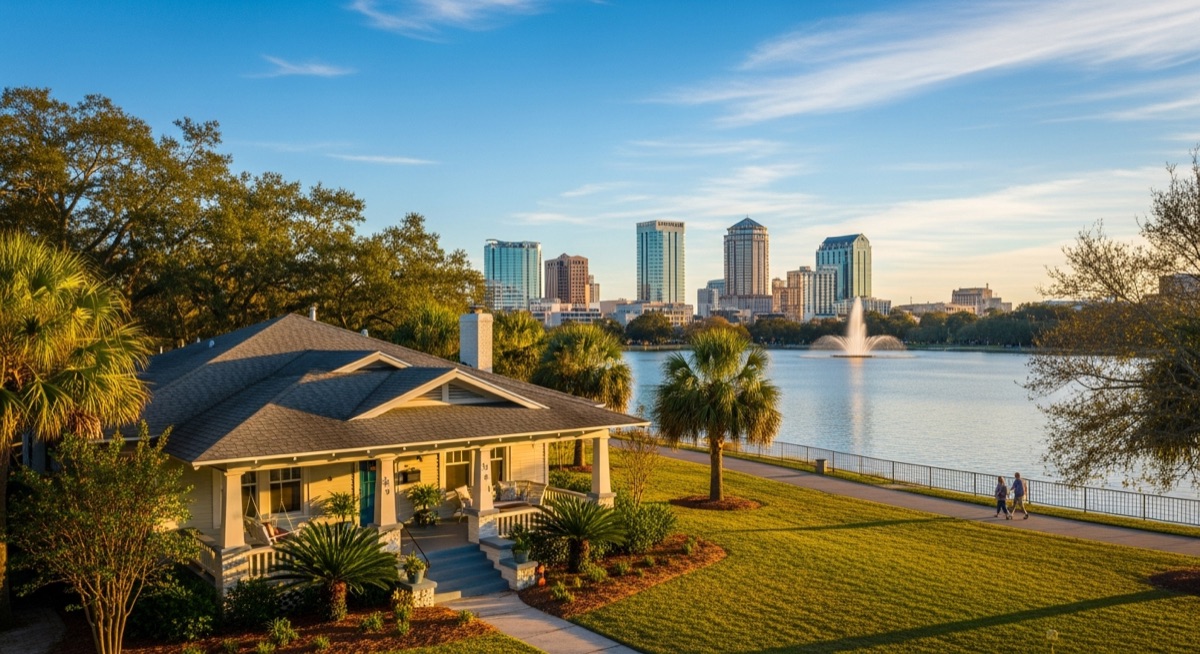
Thornton Park sells itself well. The Spanish moss, the bungalow porches, the Sunday farmers market circling Lake Eola, the ability to walk to dinner without arguing about parking — it’s one of the most livable urban pockets in Central Florida, and the market price reflects that.
What the listing photos don’t show is harder to quantify but no less real. Flood insurance bills run into five figures. The Certificate of Appropriateness process constrains renovation. A reserve-fund shortfall at a mid-rise condo can cost a buyer tens of thousands who didn’t ask the right questions before signing.
This guide covers all of it. Whether you’re cross-shopping Thornton Park against SODO or the Milk District, trying to figure out what $600,000 actually buys you on the lake perimeter versus two blocks east, or wondering why your insurance agent went quiet after you told him the address — here’s what buyers are actually finding when they go past the Zillow listing in 2026.
What Thornton Park Actually Is — and Where It Ends
Geography matters more here than in most Orlando neighborhoods. The small footprint is the whole point — and the name gets applied loosely in ways that distort pricing comparisons.
The core boundaries run roughly from East Robinson Street on the north to Michigan Avenue/Gore Street on the south, Bumby Avenue on the east to Rosalind Avenue and Lake Eola’s western shore on the west. A few dozen blocks, a couple hundred residential parcels, and a commercial node along East Central Boulevard and Summerlin Avenue. That’s it.
What gets lumped in — and shouldn’t — is Lake Davis/Greenwood directly south of Gore Street, and Colonialtown North to the northeast. Both are distinct neighborhoods with their own pricing. A listing described as “Thornton Park area” that turns out to be past Bumby toward Colonialtown is not the same product as a bungalow on Eola Drive. It’s a meaningful difference, and some listings are counting on you not to notice.
The small footprint matters structurally because Thornton Park sits inside the Lake Eola Heights Historic District, which prevents the teardown-and-build cycles that have reset pricing elsewhere in Orlando. You cannot scrape a contributing structure and replace it with new construction. That constraint preserves the neighborhood’s character, and it’s a hard ceiling on supply that keeps demand pressure elevated regardless of broader market conditions. When a well-maintained bungalow on a prime block hits the market, it typically does not sit.
The Numbers Right Now
The Thornton Park single-family market heading into mid-2026 is thin. Active listings within the core boundaries typically number in the single digits to low double digits at any given moment. A meaningful share of those are priced at or above $700,000, with lakefront and lake-view parcels routinely asking $1 million to $2 million-plus.
The realistic price range for single-family homes runs from around $450,000 on the low end — a smaller bungalow with deferred maintenance or a less desirable block — to $900,000 and above for turnkey historic restorations with off-street parking, and into seven figures for anything with a direct lake orientation. Verify current figures against ORRA’s monthly market reports and active MLS data for zip code 32801 before making assumptions on any specific property.
Days on market for well-priced listings have been running under 30 days. Listings at the upper end of ask — particularly those pricing in a lake-view premium on properties with partial or seasonal sightlines — have seen more price-reduction activity. “Lake view” can mean a lot of things. A sliver of blue between two live oaks in December is not an unobstructed panorama, and some sellers are testing whether buyers will pay as if it is.
On the condo side, the Waverly on Lake Eola, 101 Eola, The Grande, and The Sanctuary are the primary sources for buyers wanting a mid-rise or high-rise address. Asking prices at the Waverly have ranged from around $350,000 for smaller units to $700,000-plus for larger lake-facing configurations. 101 Eola is a boutique building with fewer units and similar or slightly higher per-square-foot figures. HOA fees at these buildings are not small, and they’ve been climbing in response to reserve requirements tightened by recent state legislation — more on that below.
The Premium Over SODO, Milk District, and Lake Davis
Price comparisons across neighborhoods require careful attention to what you’re actually comparing. Thornton Park’s core runs roughly $350–$550 per square foot for historic structures, with lake proximity embedded in the upper end of that range. The Milk District, concentrated along Colonial Drive about a mile east, runs $250–$380. SODO carries $280–$400 depending on renovation status and historic restrictions. The Lake Davis/Greenwood corridor immediately south along Gore Street typically tracks lower per square foot while maintaining similar bungalow architecture. For broader context on where Orlando real estate prices stand in mid-2026, check the most recent market report before relying on any of these figures — they move.
A buyer with a $600,000 budget in Thornton Park core is competing for a tight supply of historic bungalows, likely with an updated kitchen, one or two bathrooms, a small yard. Probably without a garage. That same $600,000 in the Lake Davis corridor — a short walk south — buys more square footage with somewhat more renovation flexibility, because fewer parcels there carry the historic designation. In the Milk District, lower per-square-foot costs mean more space per dollar, though the character is more eclectic-commercial than residential-urban. SODO has absorbed buyers priced out of Thornton Park and has seen its own appreciation run as a result.
What you get with Thornton Park ownership is specific: walkability to Lake Eola, the Sunday farmers market, Dexter’s, Harp & Celt, and the Summerlin Avenue cluster. The lake as a practical backyard. Intact bungalow streetscapes you don’t find in newer or less restricted corridors. The tradeoff is also specific: parking stress that isn’t theoretical, renovation constraints that are real, two substantial insurance bills annually. I’ve talked to buyers who paid the premium happily and never looked back. I’ve also talked to buyers who were surprised by what they’d signed up for. The difference, almost always, was how much the walkability and lake access actually mattered to their daily life — not how much they thought it would matter when they were making the offer.
The Flood Zone Question — Block by Block
This is the section most listing brochures skip entirely.
FEMA’s Flood Insurance Rate Maps designate properties directly abutting the lake along East Central Boulevard, Eola Drive, and North Eola Drive in Zone AE — the high-risk category with a formally established base flood elevation. Zone AE properties carry mandatory flood insurance requirements for any federally backed mortgage. One to two blocks east and south of the immediate lakeshore, the designation typically shifts to Zone X, the moderate-to-minimal risk category where flood insurance isn’t federally required. Many buyers get it anyway. Given what Florida storm seasons have looked like, that’s probably the right call.
The boundary doesn’t follow a clean line around the entire lake, and it’s not always where you’d intuitively expect it. Use the Orange County Property Appraiser’s website (ocpafl.org) to pull the parcel record, then cross-reference the FEMA Flood Map Service Center using the property’s address or coordinates. You’re looking for the FIRM panel number and the flood zone designation. Do this yourself. Do not rely on a listing agent’s characterization.
If you’re making an offer on any parcel within two blocks of the lake perimeter, make the seller’s elevation certificate a non-negotiable due-diligence item. An elevation certificate, prepared by a licensed surveyor, establishes the structure’s lowest floor elevation relative to the base flood elevation — and that number determines your actual insurance premium. A property with a favorable elevation certificate in Zone AE pays materially less than one where the first floor sits at or below the BFE.
Sellers who have an elevation certificate and will provide it are telling you something useful. Sellers who don’t have one, or who are vague about it, are also telling you something. That something should concern you.
What Flood and Homeowners Insurance Actually Costs
Run these numbers before you run your mortgage payment.
Under FEMA’s Risk Rating 2.0 — the updated pricing methodology implemented in 2021–2022 — Zone AE flood insurance premiums are individually calculated based on flood type, property characteristics, and distance to the water source. For Lake Eola perimeter properties in Zone AE, budget somewhere in the range of $3,000 to $8,000 per year for NFIP flood coverage as a rough planning figure, with the actual number driven by the elevation certificate result. A property with its first floor well above the BFE may land toward the lower end. A property at or below BFE can push past $8,000 annually without difficulty.
Private-market flood insurance alternatives exist and are worth getting quotes on. Several carriers have entered Florida with products that undercut NFIP premiums on well-elevated properties and offer higher building coverage limits. Availability in 32801 has been inconsistent — some carriers have pulled back from Central Florida after recent loss years.
Homeowners insurance is a separate line item and also not small. Thornton Park’s housing stock is largely wood-frame construction from the 1920s through 1940s. Roof age is the central underwriting concern in 2026: Florida insurers routinely decline to write new policies on roofs more than 15 years old. Deals are dying at the insurance contingency stage in 2026 — not always from flood exposure, but from buyers discovering that the replacement-cost homeowners premium on a wood-frame bungalow with an aging roof runs $4,000–$8,000 or more per year from the carriers still willing to write it. On top of the flood policy. For a full rundown on why premiums are this high, see our coverage of Florida property insurance rate increases and what they mean for homeowners.
Get the insurance quotes before you make the offer. Not after you’re in love with the house. I mean that literally — call your agent with the address before you go to contract.
Historic District Rules — What You Can and Cannot Do
The Lake Eola Heights Historic District is locally designated and administered by the City of Orlando’s Historic Preservation Office, with partial overlap with the National Register of Historic Places. If you’re buying a contributing structure, there are real constraints on exterior changes. Buyers who don’t understand them before closing sometimes find themselves unable to execute the renovation they had in mind. It’s a frustrating situation that’s entirely avoidable.
The mechanism is the Certificate of Appropriateness. Any exterior alteration visible from a public right-of-way requires COA review before work begins — window and door replacements, roofline or roof material changes, additions, fences, siding or exterior finishes. The Historic Preservation Office has published design standards, and they enforce them. COA processing for straightforward approvals has been running roughly four to eight weeks in 2026 — a window replacement or fence permit that clearly meets the standards. Longer for additions or anything requiring more extensive review. Build that into your renovation timeline. It does not move faster because you’re in a hurry.
Interior renovations are not subject to COA approval. Kitchen and bathroom remodels, floor refinishing, HVAC, electrical, plumbing — all yours to do without historic district permission. Buyers often conflate the exterior constraints with a broader prohibition on renovation, and that misunderstanding leads to passed-on properties that were actually very workable.
One thing that’s not a gray area: a contributing structure in the Lake Eola Heights Historic District cannot be demolished for new construction. If a buyer’s investment thesis involves tearing down the existing structure and building new, that parcel is the wrong parcel. Non-contributing structures may have more flexibility, but each parcel’s designation must be verified with the Historic Preservation Office before assuming anything.
Condo-Specific Risks in 2026 — The Reserve Assessment Question
Buyers considering the Waverly on Lake Eola, 101 Eola, The Grande, or The Sanctuary need to understand the post-Surfside legislative situation. It has direct financial implications right now.
Florida’s SB 4-D requires condominium associations in buildings three stories or taller to complete a Milestone Structural Inspection by a licensed engineer if the building is 30 or more years old (25 years for coastal buildings). Associations must also complete a Structural Integrity Reserve Study and fund reserves based on it at levels that can no longer be waived by a unit-owner vote. The waiver mechanism that kept HOA fees artificially low for decades is gone, and buildings that were chronically underfunded are now catching up — on the backs of current owners.
Before any offer goes in at one of these buildings, you need specific answers: Has the building completed its Milestone Inspection, and what did it find? Has the association completed a SIRS, and what are the fully-funded reserve requirements? What is the current reserve account balance as a percentage of fully-funded? Is there an existing or pending special assessment, and what is the per-unit exposure?
At the Waverly — a high-rise tower completed in 2001, well into milestone inspection territory — HOA fees have been moving upward through 2025 and 2026 as reserve requirements come into compliance. Request the most recent board meeting minutes, the reserve study, and the current reserve funding percentage before making an offer. A building that’s significantly underfunded is a different purchase from one that’s nearly current. That gap represents real special assessment exposure that will land on whoever owns the unit when the bill arrives. If your buyer’s agent isn’t running these questions as standard procedure on any condo offer in 2026, that’s worth noting.
Walkability, Parking, and the Day-to-Day Reality
Thornton Park consistently scores a Walk Score of 88–92, among the highest in the Orlando metro. That number reflects actual proximity to things residents actually use: the Sunday Lake Eola Farmers Market, which runs year-round and functions as the neighborhood’s town square; the East Central Boulevard and Summerlin Avenue commercial strip within a quarter-mile of nearly every address in the core; Lake Eola Park itself, which operates as a genuine front yard in a way no other Orlando neighborhood can claim. If you’ve spent time there on a clear January morning, you already know what I mean.
But the parking problem is real, and buyers coming from car-dependent suburbs need to internalize it before they close. Street parking on interior residential streets is competitive on weekday evenings when restaurant traffic fills the Central Boulevard strip, and genuinely crowded on weekend nights and during Lake Eola events. Many bungalows were built before the car was the primary consideration — no off-street parking, or a single-car alley-access space at best.
Properties with alley-access garages or established off-street parking command a premium, and they earn it. A two-car garage at this address is not a throwaway amenity. Buyers who overlook parking in pursuit of more square footage or a better kitchen tend to regret it within six months of move-in. I’ve heard that specific complaint enough times that it’s worth stating plainly rather than burying in a footnote.
Condo buyers should verify guest parking availability and the building’s resident parking ratio before assuming the situation is workable. The Waverly and 101 Eola both have garages, but guest space is limited and street overflow is common during peak periods.
Who Should Buy Here — and Who Should Look Elsewhere
Thornton Park makes sense for owner-occupants — not investors running short-term rental numbers — for whom walkability, lake access, and genuine urban neighborhood character are primary considerations, not tiebreakers. You need real budget headroom above the mortgage payment to absorb flood and homeowners insurance as significant annual costs. If you’re buying a condo, you’ve done the reserve-fund homework. If you’re buying a historic bungalow, you’ve verified that the COA process is compatible with your actual renovation plan.
If budget is tighter, look at Lake Davis/Greenwood first. It’s immediately south of Gore Street, shares most of Thornton Park’s residential character and bungalow architecture, and doesn’t carry the full lake-proximity premium. For the buyer who wants the neighborhood feel without the full freight, it’s the most direct alternative — and genuinely underrated.
If renovation flexibility matters more than historic character, Colonialtown North is worth serious consideration. Better parking situations on many parcels, no historic district constraints to navigate.
If you need a lower price point in the same general corridor and can accept a more mixed housing stock, SODO has absorbed real demand in recent years and still offers reasonable access to the same part of the city.
On the longer-term case for Thornton Park: the structural supply constraint — the historic overlay that prevents demolition and new construction — has supported price floors through multiple market cycles better than less-restricted neighborhoods have managed. That dynamic isn’t changing. Buyers who can afford the full carrying cost and intend to hold for five or more years have a real argument in their favor. Buyers stretching to get in at the edge of their budget and counting on appreciation to subsidize insurance and maintenance are taking on genuine risk in a neighborhood where carrying costs are not low. For buyers weighing this decision against other parts of the city, our moving & real estate coverage tracks neighborhood-level market conditions across the metro.
The honest summary: Thornton Park is worth the price for the buyer whose finances can genuinely support it and whose actual daily life will use what the neighborhood offers. It’s not worth it as a compromise purchase made because the neighborhood photographs well.
Go look at the flood map. Request the elevation certificate. Ask about the HOA reserve study. Walk the block at 9 p.m. on a Friday night and figure out where you’re going to park. If those answers still make you want to live there — and for a certain kind of Orlando buyer, they will — Thornton Park remains one of the few places in this city where urban neighborhood life is fully real rather than aspirational.
CityDesk Orlando covers local real estate with reported data and no advertiser relationships with brokerages. Historical price-per-square-foot ranges reflect ORRA data and MLS comps; all figures require verification against current Q1/Q2 2026 MLS data and should not be used as appraisal or valuation inputs. Buyers should verify flood zone designations parcel-by-parcel using FEMA’s Flood Map Service Center (msc.fema.gov) and the Orange County Property Appraiser (ocpafl.org), and consult a licensed insurance agent for property-specific premium estimates before making any offer.