How to Prepare Your Car for Orlando's Rainy Season
What to inspect, what to replace, and which Orlando streets and parking lots to avoid — a practical guide for the June–September storm window

How to Prepare Your Car for Orlando’s Rainy Season
What to inspect, what to replace, and which Orlando streets and parking lots to avoid — a practical guide for the June–September storm window
If you live in Central Florida long enough, the rainy season stops feeling like weather and starts feeling like a commute condition. From June 1 through September 30, Orlando averages roughly 53 inches of rainfall annually. About 60 percent of that falls in these four months — often in under four hours on any given afternoon. The storms don’t ease you in. They arrive hard and fast, and they expose every deferred maintenance decision you made over the winter.
This is not a generic car-care checklist repackaged for a local audience. The specific combination of UV intensity, ambient heat, humidity, and road drainage failures that defines an Orlando summer produces failure patterns that national advice doesn’t anticipate. Tires that would pass inspection in a temperate climate hydroplane on wet I-4 at 35 mph. Wiper blades bought in March crack by June from dashboard sun exposure alone. Parking lots that look fine in April turn into retention ponds by July. I’ve watched people in perfectly maintained-looking cars make every one of these mistakes.
Here’s what to do — and where to go — before the first storm hits.
What Orlando’s Rainy Season Actually Demands From Your Car
The June–September window isn’t a single weather event. It has three distinct phases, and each stresses different vehicle systems.
Early June brings scattered afternoon storms — unpredictable, sometimes severe, but not yet daily. The risk is being caught off guard on roads that haven’t been stress-tested yet for the season. This is also when brake and tire problems that developed quietly over the winter make their first wet-road appearance. A rude way to find out you needed new pads six months ago.
July and August are the core of convective storm season. Daily afternoon downpours, typically between 2 and 5 p.m., routinely drop one to three inches of rain in under an hour. These aren’t showers you can wait out in a parking garage. They hit while you’re already on the road, they drop visibility within seconds, and they overwhelm stormwater infrastructure on specific streets throughout the city. This phase destroys marginal wiper blades, exposes compromised brakes, and turns worn tires into a genuine highway hazard.
September adds hurricane-adjacent conditions. Slower-moving, more intense systems can flood areas that handle a typical summer storm without issue. Coverage questions, drainage limits, and parking decisions all become more consequential.
Orlando’s UV index runs 10 to 11 for much of the summer. UV load degrades rubber faster than heat alone — faster than most people who moved here from a northern state expect. National standards call for replacing wiper blades annually, but that timeline is wrong here. Belts and hoses fail on timelines that surprise drivers who assume Florida is just warm, not punishing. The May service window matters more than it might seem.
Step 1: Test Your Tire Tread Before June
Florida law sets minimum legal tread depth at 2/32 of an inch. On wet roads, that’s not enough. Tire industry data consistently puts the hydroplaning threshold at 4/32 — the point where tread grooves start losing their ability to channel water away from the contact patch fast enough to maintain grip.
The difference isn’t academic. On wet pavement at highway speed, tires worn to the legal minimum can add more than 100 feet of stopping distance compared to tires with adequate tread. On I-4, where afternoon rain is a near-daily occurrence from July through August, 100 feet is the distance between a close call and a collision.
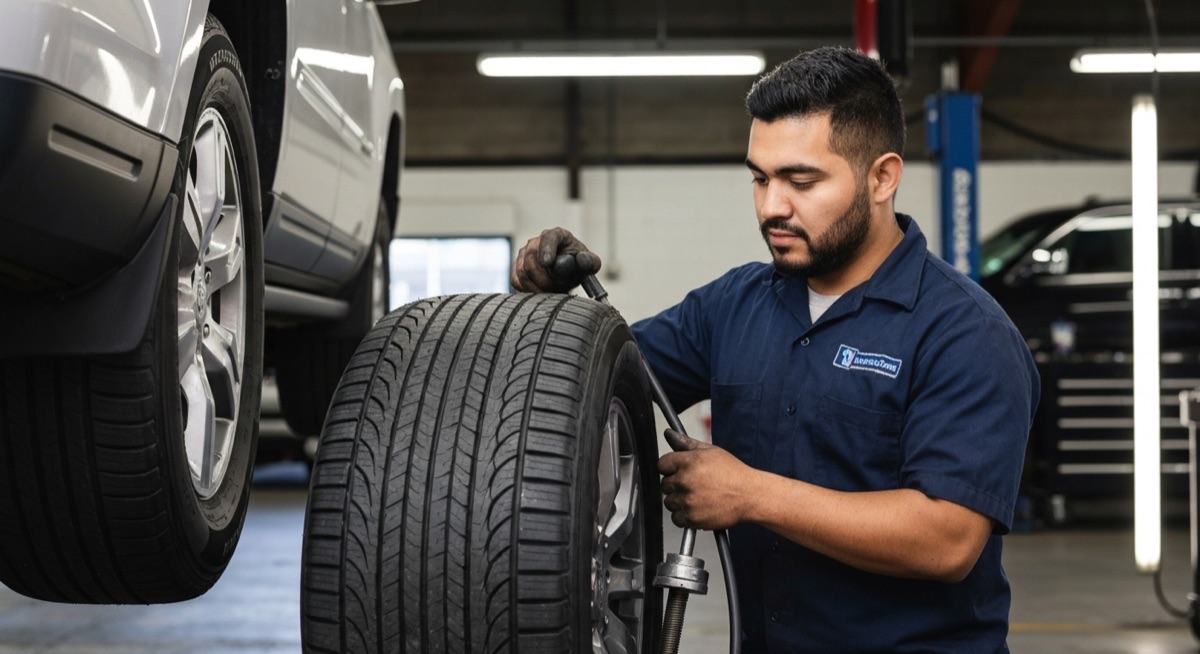
You can check tread depth yourself with a penny and a quarter. The faster approach: drive into any Discount Tire — the locations on Semoran Boulevard and East Colonial Drive both do free tread-depth inspections, no appointment. They check all four tires with a gauge, give you actual numbers in 32nds, and you make a real decision instead of a visual guess. The whole thing takes about five minutes.
Hydroplaning doesn’t require standing water, which is the part most people don’t realize until it happens to them. On I-4 during a typical afternoon downpour, a thin film on the road surface is enough to lift worn tires off the pavement. NHTSA research indicates hydroplaning can begin at speeds as low as 35 mph on tires worn to 2/32 — well below interstate speed. At the higher speeds typical of the Millenia stretch or the downtown interchange, 2/32 tires offer a fraction of the wet grip of tires at 4/32.
If your tread is borderline — right at 4/32 or just above — think honestly about your commute. Drivers who run I-4 or SR-408 during the 2–5 p.m. window face more exposure to high-speed wet-road conditions than someone primarily on surface streets. You know your own driving. Do the math.
Step 2: Replace Wiper Blades Now — and Buy Beam, Not Framed
Buy beam-style blades. Traditional framed wipers have two failure modes that Central Florida accelerates: the metal frame traps debris and corrodes in high humidity, and the frame’s segmented pressure points let the rubber warp unevenly under sustained UV and heat. A blade installed in October can look intact in March and be chattering and streaking by June. It happens faster than seems reasonable.
Beam blades use a single tensioned piece of rubber or composite with no frame. They apply even pressure across the full blade length, they don’t collect the seed pods and road debris that accumulate between storms, and they resist the heat distortion that makes traditional blades useless in a heavy downpour. Three options hold up well here: Bosch ICON (available at AutoZone, O’Reilly, and Discount Tire, consistently top-rated in independent testing), Rain-X Latitude (adds a water-repellent coating that actually helps in the kind of downpours July produces), and Michelin Stealth Ultra (widely available at mass retailers, competitive on price). Any of the three will outlast a framed blade.
Replace blades every six months — May before rainy season, November before winter fog. That schedule sounds aggressive until you’ve tried to drive through a July storm on blades you haven’t thought about since last fall.
One habit worth developing: lift your wiper blades off the windshield before long parking sessions in direct sun. It’s a small thing. It extends blade life. Once you start doing it, you stop thinking about it.
On price: AutoZone and O’Reilly charge roughly $18–$45 for beam blades and install them free. Walmart on Semoran or Kirkman runs $12–$28 if you’d rather handle it yourself. Discount Tire prices competitively and includes installation. Dealership service departments charge $45–$80 or more installed — occasionally worth it, mostly not for wiper blades.
Step 3: Know Which Orlando Roads and Parking Lots Flood — by Name
Flood avoidance is as much a parking decision as a driving one. Leaving your car in the wrong surface lot before a 2 p.m. storm in July is how you come back to find the interior soaked, or worse, file a comprehensive claim on a vehicle parked in a documented flood zone. It happens every summer. Sometimes to the same people twice.
The following locations have documented flood risk during heavy rainfall. Some are confirmed via Orange County stormwater reporting and city infrastructure records; others come from consistent local news coverage and reported flooding patterns. Verify current conditions against Orange County and City of Orlando stormwater resources before relying on any of these for routing decisions.
John Young Parkway between Colonial Drive and Oak Ridge Road is one of the most consistently flooded corridors in the city. The road sits low through this stretch and the drainage infrastructure is chronically overwhelmed. Use Orange Blossom Trail or South Orange Avenue when storms are developing. Orange Blossom Trail southbound near Sand Lake Road has its own flooding history, particularly in the service roads and turn lanes around that interchange — the I-Drive corridor’s commercial density has added impervious surface faster than drainage capacity has expanded, which is exactly as unsustainable as it sounds.
Semoran Boulevard near Goldenrod floods regularly enough to show up in local news archives multiple times per season. Lee Road in north Orlando and Winter Park, particularly the low sections through the residential connector, collects water during moderate-to-heavy events and is heavily trafficked during afternoon commute hours. Edgewater Drive near Lake Adair in College Park becomes a problem in heavy rain — the road’s proximity to the lake and the elevation profile through that neighborhood mean water has nowhere to drain quickly.
I-Drive service roads behind the convention center corridor flood regularly during peak storm events. If you’re headed to an event there and a storm is developing, use the garage. It’s not that much more expensive, and surface parking on that side of I-Drive during a July downpour is a genuinely bad situation.
SR-408 on-ramps at Bumby Avenue and Curry Ford Road have documented flooding that can trap vehicles trying to access the expressway during heavy rain. If water is covering the ramp, don’t try it.
For surface parking downtown: lots east of Orange Avenue between South Street and Gore Street sit in a low area that pools during significant rain events. The Camping World Stadium lot floods during heavy events — the stadium sits in a low-lying area and this is well-documented. Millenia Mall’s west surface lots pool in heavy rain because the grade on that side drains poorly. For all three, use a garage during storm season rather than gambling on surface lots.
The neighborhoods with the highest flood exposure include Pine Hills, Holden Heights, Conway, and Azalea Park. Which specific streets flood first is block-level knowledge that rarely makes it into city reporting. If you’re new to any of these neighborhoods, ask a neighbor who’s been through a few summers. They’ll know.
Before June, bookmark the Orange County Stormwater Management flood map at the county’s public works website and the City of Orlando’s stormwater portal. Then call your insurer. The details of what’s covered under what conditions vary by policy, and a five-minute conversation before the first storm is more useful than the same call in August after a loss.
Step 4: Get a Brake Inspection Before Wet Roads Make Problems Urgent
Brake problems that are manageable in dry conditions become dangerous on wet roads. Orlando’s summer has a specific failure mechanism: roasting midday temperatures followed by sudden heavy afternoon downpours. This heat-then-wet cycle glazes rotors and accelerates pad wear faster than dry-climate patterns would suggest.
Here’s what to pay attention to. Pulsing or vibration under braking means glazed or unevenly worn rotors — uncomfortable in dry conditions, and a real problem on wet roads where consistent brake contact matters most. Longer pedal travel before braking engages suggests pad fade or a hydraulic issue; stopping distances are already extended on wet pavement. Pulling to one side under braking points to uneven pad wear or a sticking caliper, and on wet pavement with reduced traction, that can send a vehicle into an adjacent lane. Grinding is an emergency. If you hear it, don’t drive the car until it’s addressed.
A thin layer of surface rust on brake rotors after sitting overnight — especially after rain — is normal in Florida’s humidity. It clears after your first few stops. What you’re actually looking for is pitting, deep grooves, or flaking that doesn’t clear with normal driving. That’s rotor degradation.
Independent shops in the Orlando area are currently quoting front brake pads with labor at $150–$250, rotor resurfacing per axle at $75–$120, and a full front brake job with new rotors at $300–$500. Dealerships run higher. If your vehicle is under warranty or you have a specific reason to want OEM parts, the premium can be justified. For most drivers, it isn’t.
Christian Brothers Automotive — with locations in Oviedo, Dr. Phillips, and Waterford Lakes — provides written estimates and a consistent inspection process. Tuffy Auto Service (multiple Orange County locations) handles brake work regularly. When you’re at any shop, ask this: “Are my rotors within spec, or are they showing glazing?” A shop that answers in measurable thickness is giving you real information. One that says “they look okay” isn’t. That distinction matters more than which brand of pad they install.
Step 5: Four More Items Worth Doing in May
These don’t need extended explanation, but skipping them is how you end up making a reactive repair call in the middle of a July downpour.
Air filter. Central Florida’s summer combines high humidity with post-storm debris — pollen, seed matter, road particulate — that moves through your engine air intake faster than it does in drier climates. A clogged filter reduces engine efficiency and in severe cases affects idle stability. It’s an inexpensive part and a straightforward swap. This one’s easy; don’t make it the thing you skip.
Belts and hoses. Radiator hoses and serpentine belts degrade under heat and humidity on an accelerated schedule here. A hose that looks fine externally can be soft and cracked internally. If you don’t have documentation of recent replacement, have them inspected before June. A failed radiator hose in July traffic on I-4 means standing in the heat waiting for a tow. Avoidable.
Exterior and interior lights. Florida’s rainy season produces two distinct low-visibility windows daily: morning fog over low-lying areas and lakes, and afternoon downpours that drop visibility within seconds. Walk around the car. Confirm headlights (low and high beam), taillights, brake lights, and hazard flashers all work. Check headlight aim too — a properly aimed headlight on a rain-soaked road does significantly more work than one that was knocked off by a previous fender-bender and never corrected.
ABS warning light. If your ABS light activates during early wet driving, treat it as urgent. The anti-lock system exists specifically to prevent wheel lockup on low-traction surfaces. A disabled ABS system on wet Orlando roads means your vehicle can’t do one of the things it’s specifically designed to do in the conditions you’re about to drive through for four months. Don’t defer this one.
When to Go, Where to Go, and What to Ask
Every shop in the Orlando metro gets busier in June and July with reactive repairs. People wait until something fails in the rain, then everyone calls at once. Schedule in May and you get shorter waits, better scheduling flexibility, and a car that’s actually prepared before the first storm — not after.
Bring specific questions. “What’s my tread depth in 32nds on each tire?” — you want a number, not “they look okay.” “Are my rotors within spec or showing glazing?” — a real answer references measurable thickness. “Do you stock beam-style wiper blades?” — if they only carry framed blades, buy yours at AutoZone or Discount Tire before the appointment.
Free tread-depth check: Discount Tire on Semoran Boulevard or East Colonial Drive. No appointment, five minutes, real numbers.
Wiper blade purchase and installation: Discount Tire (installation included), AutoZone or O’Reilly (free installation with purchase), or Walmart on Semoran or Kirkman if you prefer to self-install.
Brake inspection: Christian Brothers Automotive (Oviedo, Dr. Phillips, Waterford Lakes) or Tuffy Auto Service for written estimates at independent shop pricing.
Flood zone and insurance verification: Orange County Stormwater Management portal and City of Orlando stormwater resources; your insurance agent by phone before June 1.
Orlando’s rainy season doesn’t care whether you’re ready. The storms show up on the same schedule regardless of whether your wiper blades are three years old, whether your tires are at 2/32, whether you know the Camping World Stadium lots flood or you’re finding that out in real time with wet seats and a phone call to your adjuster.
Do this in May. It costs less than doing it in response to a failure, it takes less time, and you spend the next four months driving a vehicle that can actually handle what’s coming — rather than one that’s one hard afternoon storm away from teaching you something expensive.
CityDesk Orlando covers local business, infrastructure, and consumer affairs across the greater Orlando metro. For questions about specific shop recommendations or local road conditions, reach us at the contact below.