Understanding Heat Index and Humidity in Orlando Summers
Your guide to heat index, humidity, NWS advisories, and what real exposure risk looks like in Central Florida — with tools to check conditions in your neighborhood.

Understanding Heat Index and Humidity in Orlando Summers
Your guide to heat index, humidity, NWS advisories, and what real exposure risk looks like in Central Florida — with tools to check conditions in your neighborhood.
The Number on Your Phone Is Not the Weather You’re Walking Into
You check your phone before heading out on a Tuesday afternoon in July. It reads 92°F. Hot, but manageable. You’ve tolerated 92 before. Then you open your car door.
The air hits you like a wall. Whatever the thermometer is measuring, it isn’t what’s happening to your body.
That gap — between the stated temperature and what your body actually experiences — is the central fact of an Orlando summer. On a standard July afternoon in Central Florida, the heat index routinely runs 10 to 18 degrees above the air temperature. So on a day that sounds like an ordinary hot afternoon, you’re frequently sitting in the National Weather Service’s formal “Danger” category. That’s the third tier on their four-level scale. Not a caution label. Danger.
This piece walks through why that happens, what it means for your body, how the NWS advisory system maps onto your actual afternoon, and where to find accurate local data for your specific neighborhood rather than a regional average.
What Heat Index Actually Measures — And the Shaded Condition Caveat Nobody Mentions
Air temperature is exactly what it sounds like: the temperature of the air, measured in shade, with no accounting for humidity, wind, or sun exposure. Your weather app measures this number. It’s useful but incomplete.
Heat index is what the NWS uses to estimate what a human body actually experiences. It combines air temperature and relative humidity to model how efficiently sweat evaporates from skin. That evaporation is the body’s primary cooling mechanism. When humidity is high, sweat evaporates more slowly, the body retains heat, and your core temperature climbs faster than it would in dry air at the same reading. The heat index captures that reality as a single “feels like” figure. The underlying formula traces back to Robert Steadman’s 1979 research, later refined into the Rothfusz regression equation.
Here’s the part almost no weather coverage mentions: the heat index is calculated for shaded conditions. The NWS is explicit about this. Direct sun adds another 10 to 15 degrees on top of whatever the calculated heat index shows. That means the number on weather.gov is a floor for anyone standing in unshaded space, not a ceiling.
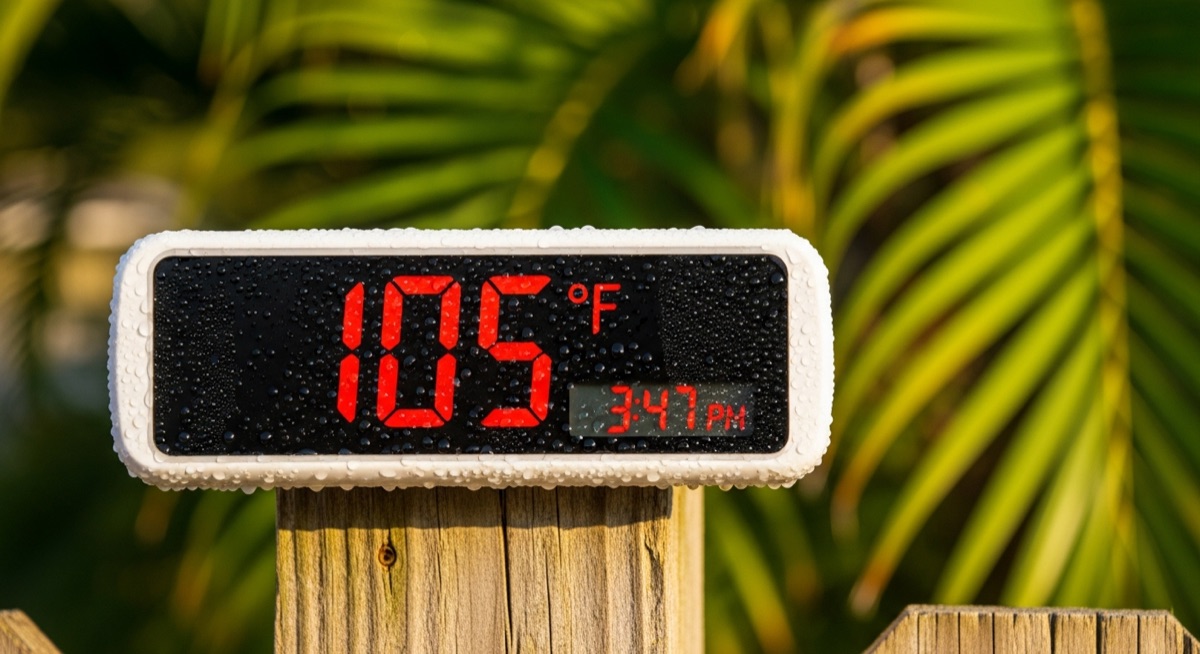
In Orlando, that distinction matters constantly. A queue line on International Drive under an open Florida sky is not shade. A bus stop in Parramore is not shade. A roofing job in Kissimmee, a youth soccer practice on a sun-baked field in late July — the 105°F heat index your app shows is the starting point for what your body is dealing with, not the worst case.
Why Orlando Is One of the Most Dangerous Summer Heat Environments in the Continental U.S.
The honest answer involves dew point. Most weather coverage buries it, which is genuinely frustrating given how much it matters here.
Relative humidity is the number you see most often — 65%, 70%, 75%. It fluctuates significantly with temperature across the day and can mislead as a standalone figure. Dew point is more stable and more meaningful. It measures actual moisture content in the air. Above 65°F dew point, most people feel uncomfortable. Above 70°F, the body’s cooling capacity is significantly impaired. Above 75°F, even a healthy adult sitting still in the shade will struggle to maintain safe core temperature during extended outdoor exposure.
Orlando’s summer afternoon dew points routinely hit 72 to 76°F. That puts Central Florida among the highest sustained dew point environments in the continental U.S. during June, July, and August. The Florida Automated Weather Network’s Apopka station — one of the most reliable monitoring points for Orange County conditions — records these readings consistently all summer. This isn’t occasional humidity. It’s the baseline every single day.
Geography makes it worse. Orlando sits more than 60 miles inland from both coasts. Miami, Tampa, and Fort Lauderdale get sea breeze relief most summer afternoons — differential heating between land and ocean drives cooler air onshore and briefly drops both temperature and humidity. Orlando doesn’t get that. The heat builds without interruption.
Then there’s the surface problem. The I-Drive corridor, the SR-528 interchange cluster, the Convention Center district, the arena zones near downtown — acres of asphalt and concrete that absorb solar radiation all day and radiate it back through the evening. UCF researchers and UF IFAS have both examined thermal variation across the Orlando metro. The conclusion isn’t surprising: a neighborhood near Lake Conway or along College Park’s older tree-lined streets runs measurably cooler than a parking lot on Sand Lake Road. When you’re already in the Danger tier of the heat index scale, those extra degrees aren’t trivial. For a broader look at how neighborhood characteristics affect everyday living costs and conditions, see our home & property coverage tracking these tradeoffs across the metro.
Orlando vs. Phoenix, Miami, and Tampa: The Same Temperature Is Not the Same Risk
The dry-heat comparison is the most persistent misconception among people who move here from the Southwest. Phoenix at 108°F with 10 percent humidity is genuinely dangerous and requires real precautions. But the body’s cooling mechanism still works. Sweat evaporates. The system is stressed but functional.
Orlando at 92°F with 70 percent humidity is a different problem. At that humidity level, sweat doesn’t evaporate efficiently. The phase change from liquid to vapor — the entire mechanism by which your body sheds heat — slows. Heat accumulates faster than it can be shed. You can be sitting in shade, not exerting yourself, and your core temperature will creep upward. That doesn’t happen at the same temperature in dry air. It’s the part that surprises people most: you don’t have to be running sprints for this to become a medical situation.
The NWS heat index chart shows this numerically. At 92°F with 30 percent humidity, the heat index is roughly 90°F — the number and the experience are close. At 92°F with 70 percent humidity, the heat index reaches approximately 105°F. That’s not a rounding difference. It’s a categorical shift in risk. And 92°F at 70 percent humidity is an ordinary Orlando July afternoon.
Compared to Miami and Tampa: both share Florida’s subtropical humidity and can generate dangerous heat index values. The difference is the sea breeze. Biscayne Bay, the Atlantic coast, Tampa Bay — all drive afternoon onshore flow that regularly drops air temperature several degrees and briefly cuts humidity. That relief arrives inconsistently, but it arrives. Orlando, sitting in its inland basin, doesn’t get it. On days when the sea breeze stalls and pushes only partway inland, Tampa and Miami residents experience something close to what Orlando deals with every afternoon. For Orlando, that’s just Tuesday.
What “Caution,” “Danger,” and “Excessive Heat Warning” Actually Mean
The NWS heat index risk scale has four tiers.
Caution (80–90°F heat index): fatigue possible with prolonged exposure and physical activity. Extreme Caution (91–103°F): heat cramps and heat exhaustion become possible. Danger (103–124°F): heat cramps and heat exhaustion become likely; heat stroke becomes possible. Extreme Danger (125°F+): heat stroke highly likely.
Map Orlando’s typical summer conditions onto that. By late morning on a July day, the heat index in unshaded conditions is already in Extreme Caution. By early afternoon, calculated heat index in Orange County routinely sits between 103 and 110°F — the Danger tier. For shaded conditions. Add direct sun and you’re in a range the NWS classifies as life-threatening for vulnerable populations and dangerous for healthy adults under exertion.
Central Florida falls under NWS Melbourne (office identifier MLB), which covers Orange, Osceola, Seminole, and Lake counties and issues the advisories that actually apply here. The national threshold for a Heat Advisory is a heat index of 108°F for two or more hours. Melbourne has applied localized thresholds for the Orlando area, calibrated for what is already a hot and humid baseline — check weather.gov/mlb for their published criteria. What’s not in question: formal advisories here get issued on a significant number of July and August afternoons, and a Heat Advisory is not a novelty notice. It’s an official determination that outdoor exposure without active mitigation carries real medical risk.
Track MLB advisories in real time at weather.gov/mlb and by following @NWSMelbourne on X, which pushes advisory text fast.
The Hour-by-Hour Window: When Is the Day Actually Dangerous?
“Avoid the midday heat” is advice you’ll find everywhere. It’s not wrong, but it’s vague in a way that matters when you’re trying to plan outdoor work or schedule a kid’s practice.
Orlando’s air temperature typically peaks between 2 and 4 PM in July and August. The heat index doesn’t always peak at the same moment. As the afternoon goes on, ground-level heat radiating off pavement and rooftops keeps the felt temperature elevated even as the sun angle drops. Some of the highest heat index readings of the day fall between 2 and 5 PM, not at the temperature peak itself. If you’re timing your outdoor work around “past the hottest part of the day,” you may be cutting it closer than you think.
Before 9 AM is a genuinely different environment. Humidity is already high, but the combination with lower air temperatures produces heat index values that are uncomfortable — often in Extreme Caution rather than Danger. Morning is the real window for outdoor exercise, hard physical labor, and youth sports in July. It closes by 10 AM, when conditions are trending dangerous on most summer days.
The seasonal arc matters too. June is when humidity builds steadily and the heat index gap widens. July is peak sustained risk: high air temperature, maximum humidity, long daylight hours. August is still dangerous, but the afternoon thunderstorm pattern becomes more reliable. When storms fire, they drop air temperature by 10 to 15°F and briefly cut humidity — not safe, but interrupted. If you’ve ever stepped outside at 6 PM in July and thought it somehow felt hotter than noon, that’s not your imagination. That’s July.
At What Heat Index Level Should You Actually Modify or Stop Outdoor Activity?
The answer differs depending on who you are and what you’re doing.
Recreational exercisers: The NWS Danger threshold — a calculated heat index of 103°F, which corresponds to roughly 92°F air temperature at 70 percent humidity — is a genuine modification point for healthy adults. Below it, hydration and shade access are the main tools. At or above it, your body’s capacity to shed heat may not keep pace with what sustained exercise generates, and heat exhaustion becomes a realistic outcome. This isn’t excessive caution. It’s what the physiology dictates.
Heat exhaustion presents as heavy sweating, cold or pale or clammy skin, weakness, a fast but weak pulse, nausea, and muscle cramps. It’s the warning sign. Push through it and heat stroke follows — core temperature above 104°F, hot skin, confusion, rapid strong pulse. This is the emergency. Don’t drive to the ER at normal speed. Call 911 and start cooling the person immediately.
For runners and cyclists: the pre-9 AM window is the safe window for sustained outdoor effort in July. Running after 10 AM is a risk calculation. That’s your call to make — but make it consciously, not by default.
Outdoor workers: This is where Orlando’s regulatory picture has a specific and significant gap that doesn’t get nearly enough attention. Florida has no state heat illness prevention standard. California mandates shade, water, rest breaks, and supervisor training when heat index thresholds are crossed. Washington State has similar requirements. Florida doesn’t. Construction workers, landscapers, roofing crews, and outdoor hospitality staff in Orange County work in conditions that would trigger mandatory protective measures in other states. Here, the legal backing is the federal OSHA general duty clause — which requires a workplace free from recognized hazards but sets no specific numerical triggers and requires no written plan. The practical burden falls almost entirely on individual workers to advocate for breaks and water, and on employers willing to do the right thing voluntarily. Advocacy organizations and some Central Florida labor groups have pushed for a local outdoor worker heat ordinance in Orange County; confirm the current status directly with the county.
Vulnerable populations: Older adults, children under four, people on medications that impair sweating — common antihistamines, diuretics, certain blood pressure drugs, psychiatric medications, anticholinergics — and people with chronic cardiovascular or kidney disease face elevated risk at heat index levels that a healthy adult handles with discomfort rather than danger. For these groups, the Extreme Caution range (91–103°F) is a serious flag. If you’re helping an elderly family member plan their day, or picking up a standard allergy medication at Walgreens without a second thought, it’s worth knowing some of those drugs are on that list.
Where to Find Accurate Real-Time Heat Index Data for Your Part of Orlando
Your phone’s default weather app pulls from regional station data and models. It gives a reasonable approximation of broad conditions, but it misses local variation. There’s a real difference between a shaded, lake-adjacent neighborhood in Dr. Phillips and an exposed stretch of Orange Blossom Trail. The app won’t tell you that.
NWS Melbourne (weather.gov/mlb): Pull the hourly forecast for your county zone and you’ll find heat index figures alongside temperature and humidity. This is where Heat Advisories and Excessive Heat Warnings post when issued. Start here.
WeatherStem (weatherstem.com): A network of monitoring stations at schools and public facilities across Orange and Osceola counties, with neighborhood-level real-time readings including dew point and relative humidity — the two inputs you need to understand actual heat index conditions where you are.
Florida Automated Weather Network (fawn.ifas.ufl.edu): Built primarily for agricultural monitoring, but its stations are useful for understanding sustained humidity patterns rather than spot readings. The Apopka station is the most relevant for northern Orange County.
@NWSMelbourne on X: The Melbourne office posts advisory alerts faster than most other sources. Follow it if you want immediate notification when an advisory is issued for Orange County.
Spectrum News 13’s app: Surfaces “feels like” temperature prominently in their local forecasts, with context grounded in actual Orlando conditions. Best option if you want one source and don’t want to navigate weather.gov.
The reason these beat national weather apps isn’t local pride. National platforms often draw on station data that isn’t representative of conditions across the metro. When the stakes involve your body temperature, that gap matters.
What This Means for Theme Park Visitors, Jobsite Operators, and Youth Sports Coaches
An outdoor queue line at a theme park is one of the highest heat exposure environments in Orlando for a straightforward reason: you’re standing still in an unshaded space surrounded by concrete and pavement that has been absorbing solar radiation for hours, with no ability to modulate your own exposure. The calculated heat index is the floor there. The sun exposure premium — 10 to 15°F above the calculated index — applies fully. A 105°F calculated heat index becomes a 115 to 120°F experienced environment in an open queue. That’s not dramatic framing. That’s the math.
Plan your day accordingly: early-morning arrival, indoor attractions during peak afternoon hours, return to outdoor areas after 5 PM when conditions begin to ease. Bring water. Theme parks engineer their environments to discourage outside food and beverages, but no park can legally prevent you from carrying water. Bring the water.
Jobsite operators in Orange County: the absence of a Florida state heat illness standard is not a minor technical detail. It means that the specific water-rest-shade requirements enforceable in California or Washington are not enforceable here in the same way. OSHA’s general duty clause provides a legal avenue after someone gets seriously ill, but it requires documentation of a recognized hazard and employer failure to address it. That’s a high bar in a crisis. The practical baseline OSHA has outlined — water, rest, shade, and gradual acclimatization for workers in their first week — is the reasonable minimum. Workers who don’t receive it have fewer immediate remedies than they would in most states with specific heat standards.
Youth sports coaches and parents: children thermoregulate less efficiently than adults and are frequently poor self-reporters of early heat illness symptoms. A kid determined to stay on the field often won’t tell you something is wrong until it’s further along than it should be. For Orange County Public Schools programs, request the district’s specific written heat policy before the season begins. It should include the heat index threshold at which outdoor practice is modified or canceled, who is responsible for monitoring conditions, and who holds the authority to call it. OCPS has addressed outdoor heat activity in its guidance — get the current version directly from the district. “We use common sense” is not a heat illness prevention plan. If the threshold number, the monitoring responsibility, and the cancellation authority aren’t specified in writing, push until they are.
The 92°F on your phone is accurate. It just doesn’t tell you much about what you’re actually walking into. In July in Orlando, that gap between the number and the reality is wide enough to put you in the hospital if you’re not paying attention. Now you have the tools to close it.