What to Expect From Car Wrap Shops in Orlando for Fleet Pricing
From a single contractor van to a five-truck fleet, here's what you'll actually pay — and what separates the shops that can handle the work from those that can't.

What to Expect From Car Wrap Shops in Orlando for Fleet Pricing
From a single contractor van to a five-truck fleet, here’s what you’ll actually pay — and what separates the shops that can handle the work from those that can’t.
Orlando’s wrap market looks, from the outside, like any other mid-sized city’s. Yelp listings. Google reviews. Instagram full of color-change Mustangs. None of that tells you what a commercial buyer in this metro needs to know.
The real shape of this market: Central Florida has one of the highest concentrations of licensed contractors per capita in Florida, driven by sustained construction demand across Orange, Seminole, Osceola, and Lake counties. The Disney and Universal subcontractor networks run dozens of service fleets — HVAC, electrical, landscaping, pest control — that need identifiable vehicles on job sites where appearance signals legitimacy to property managers and venue security. Then there’s the tourism layer: shuttle operators, charter companies, airport ground transportation. All of them need commercial wraps. Most of them aren’t finding useful information on Yelp.
What makes Orlando specifically harder on wraps than most markets is the climate. Central Florida sits among the highest UV-exposure zones in the continental United States. A work truck parked on an exposed job site in Osceola County in July absorbs solar load that a vehicle in Atlanta or Dallas simply doesn’t — and if you’ve ever touched a black cargo van door in August around here, you already understand the scale of what we’re talking about. That UV load, combined with ambient humidity, is what separates shops using materials appropriate for this environment from the ones undercutting them on price. You won’t see the difference the day the vehicle rolls out of the bay. You’ll see it in year two.
This guide is built for the commercial buyer: the plumbing company adding a second van, the electrician who needs five F-250s wrapped before a contract kicks off, the property management company trying to get consistent branding across a mixed fleet. Personal vehicle buyers will find it useful — the quality markers are identical — but the pricing, turnaround, and warranty questions are framed around commercial use because that’s where the information gap is widest.
What a Wrap Actually Costs in Orlando — By Vehicle and Scope
Pricing in this market varies more than most buyers expect, and the variance isn’t random. It tracks almost directly to material quality, installer certification, and whether a shop has built its workflow around commercial volume or around personal vehicles.
About the figures below: These ranges reflect market estimates for Central Florida and comparable Florida markets. Use them as planning benchmarks. Before committing to anything, get a written quote on your specific vehicle from the specific shop. A pricing comparison based on identical-vehicle quotes from the shops in this guide is in progress and will be published separately.
The spread within each range usually comes down to one thing: cast vinyl versus calendered vinyl. Cast is the appropriate choice for most commercial applications in Florida. Calendered is cheaper and shorter-lived, and some shops use it without flagging it. That distinction is explained fully in the climate section below. Read it before you accept a quote — it’s the part of this guide that will save you the most money over time.
Cargo van / Sprinter / Transit
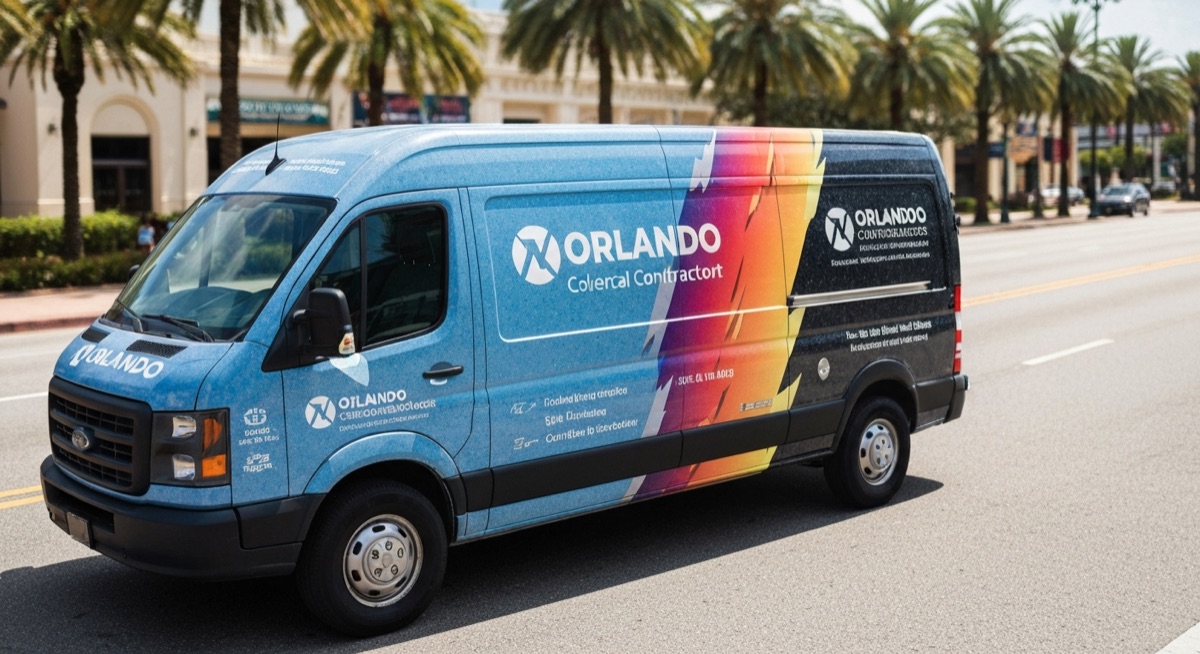
This is the core commercial unit for most Orlando fleet buyers. A full wrap in cast vinyl runs roughly $3,500 to $5,500. A partial wrap covering sides and rear with a logo field lands closer to $1,500 to $2,800. Full commercial graphics with color field and integrated branding: budget $2,500 to $4,000.
Full-size truck or SUV (F-250, Silverado 2500, Tahoe)
Full wraps run about the same as a Transit — $3,500 to $5,500 for cast vinyl. Partial wraps often come in slightly lower, around $1,200 to $2,000, because despite the larger vehicle you’re covering fewer total surface areas given the profile.
Mid-size sedan
Full wraps in cast vinyl start around $2,800 and top out near $4,500. Partial wraps vary more widely — $800 to $2,000 — depending on scope and how complex the graphics are.
Fleet pricing (5+ units, same spec)
Shops that handle commercial volume typically discount 10 to 20 percent starting at five units of the same vehicle type and wrap scope. How that discount gets applied matters: some shops reduce per-unit cost, others cut the overall contract value. Ask the specific shop to confirm whether any discount applies to your exact scenario, and get it in writing.
One thing worth flagging: if a full Transit wrap is quoted well below the low end of the cast-vinyl range, you’re probably looking at calendered vinyl. Some shops quote this without mentioning it. That’s worth knowing before you sign anything.
Shop-by-Shop Roundup: Commercial Fleet Capabilities
The shops below were identified through local business listings, map-pack results, and commercial references as active Orlando-area operations with relevant fleet or commercial capabilities. Pricing, warranty terms, turnaround, and certification status for each require direct verification — call or visit with a defined project before drawing any conclusions about fit.
A note on this section: wrap shops in Orlando don’t publish verified fleet pricing, and most won’t discuss competitors. What follows is an honest account of what’s publicly verifiable about each operation, what their location tells you about commercial fit, and what to press them on when you call. It’s less than I’d like to publish, and a follow-up piece with direct quotes and comparable quotes on identical vehicles is in progress.
Wrap Innovations
Location: North Orlando / Sanford area
Sanford is a useful place for a wrap shop to be. The northern suburbs run a heavy concentration of trades and contractor businesses, and the Seminole County commercial corridor feeds a lot of fleet work. Wrap Innovations has appeared in contractor fleet contexts in local listings. When you contact them, push specifically on whether fleet work is a core service or something they fit around personal vehicle jobs — that distinction determines how your multi-vehicle project gets scheduled. Also ask whether they can stagger returns on a fleet job, meaning you get the first van back after three days rather than waiting until all five are done. Most operators can’t afford to run their whole fleet off the road at once, and not every shop has built a workflow that accommodates that.
Zilla Wraps
Location: East Orlando
Zilla has a visible portfolio presence in the Central Florida market with work that appears to span both personal and commercial applications. The honest read on their commercial fleet capacity is unclear from public information alone, which makes a direct call essential. The question to ask: is commercial fleet work a primary service or something they do when capacity allows? The answer affects scheduling priority, how your job gets slotted against personal vehicle work, and whether multi-vehicle timelines are something they’ve actually built a process for or are figuring out as they go.
FASTSIGNS (Colonial Drive and Lake Mary)
Locations: Central Orlando (Colonial Drive); north suburbs (Lake Mary)
FASTSIGNS is not a boutique wrap shop. It’s a commercial graphics franchise that does wraps as part of a broader signage and branding offering, and that distinction matters depending on what you need. The franchise model means design, print, and installation are coordinated through an account manager — which is genuinely useful if you need documentation, consistent branding across a fleet, and a single point of contact. It’s less useful if your priority is lowest per-unit cost; compare directly against independent shops to see whether the infrastructure justifies any premium.
Two things to confirm before committing: film specifications and warranty terms, in writing, at your specific location. The franchise model means Colonial Drive and Lake Mary aren’t necessarily offering identical terms. What one branch guarantees may not be what the other does. Ask at the branch you’re actually using.
Orlando Wraps
Location: South Orlando / Kissimmee area
The Kissimmee location puts this shop squarely in Osceola County’s contractor, landscaping, and tourism-fleet geography, as well as the shuttle and hospitality operators running out of the International Drive corridor. If your fleet operates in that part of the metro, proximity matters. Transporting a vehicle across the metro for installation adds up when you’re doing five units — and it slows down staggered returns if the shop needs to coordinate pickups. Ask explicitly whether fleet work is a core capability and request a reference from a comparable commercial job. Also ask how they handle return timing on multi-vehicle projects: whether you get vehicles back as they finish or wait until the last one is done.
Auto Image 360
Location: Longwood (north Orange / south Seminole)
Auto Image 360 shows up in automotive customization listings in the Orlando area, with work that skews toward personal vehicle modifications and paint protection film. That’s worth understanding before you call. Shops oriented toward customization often have limited bay capacity for fleet jobs, or push commercial work into longer lead times when personal vehicle work is heavy. That doesn’t mean the work isn’t good — it means fleet buyers should confirm scheduling bandwidth before assuming they can move a five-van job through quickly. Worth contacting for single-vehicle commercial work; fleet buyers should press hard on capacity and timeline before committing.
A consistent test across all these shops: Ask for a quote on the same vehicle — a 2022 Ford Transit, full wrap versus partial — and ask separately what fleet pricing looks like for five identical units. That’s the only way to make their pricing directly comparable. The question checklist below will do the rest of the work.
Turnaround Time and What It Costs You to Be Without That Van
A single Ford Transit, design already approved, takes two to three days in the bay at a quality shop. Getting to that point takes longer. For a first-time customer with a finalized design direction, a realistic window from “I want to do this” to vehicle back in service is five to eight business days.
Design is where most buyers lose time. Shops that handle fleet work will tell you the same thing: customers who show up without a vector-format logo file, without confirmed brand colors in CMYK or Pantone, without a clear decision about what portions of the vehicle get wrapped — they add three to five days before installation even starts. If you arrive with a clean logo file and know exactly what goes where, that timeline compresses fast. This isn’t something to negotiate around. It’s something to plan for before you’ve promised a client you’ll show up in a branded truck.
A fleet of five identical Transits runs roughly two to three weeks from design sign-off to last vehicle returned. Some shops stagger returns — handing back the first vehicle partway through so you’re not running your entire operation on zero wrapped trucks while the rest queue up. Not all shops do this as standard practice. When you call, ask explicitly: do vehicles come back staggered, or do you hold everything until the last one is done? And how many units can they run concurrently?
One thing worth understanding: rushing an installation in Florida’s summer humidity creates real quality risk. Vinyl adhesion during install depends on ambient temperature and moisture. Reputable shops maintain climate-controlled bays for exactly this reason — a hot, humid bay in August creates adhesion problems. Bubbling, edge lifting, seam failure. These show up weeks after the vehicle leaves the shop, which is the worst possible moment to discover them. If a shop installs in an open bay without climate control, that’s a quality risk specific to this market. Not a minor inconvenience — it’s how you end up replacing a wrap in year two instead of year five.
What Florida’s Climate Does to a Wrap — And What to Ask About It
The cast versus calendered distinction is the single most important material decision for a Florida commercial buyer, and it’s often obscured by shops competing on price.
Cast vinyl is manufactured by casting liquid PVC onto a flat surface, producing a dimensionally stable film that conforms to curves without memory. Once applied over a curved surface, it doesn’t try to return to flat. Calendered vinyl is pressed through rollers, which builds in internal stress. In a mild climate, that stress matters less. In Central Florida — where summer temperatures hold above 90°F and pavement temperatures can exceed 150°F — that internal stress accelerates. Calendered film on curved surfaces will lift at edges, shrink at seams, and degrade visually well before cast film would. Cast vinyl properly installed lasts three to five years on a commercial vehicle parked outdoors in this UV-heavy climate. Calendered film, under the same conditions, shows visible degradation in two to three years. That’s not a minor difference when you’re pricing a fleet.
Three to five years outdoors in Orlando is the honest planning horizon for quality cast film. That’s meaningfully shorter than manufacturer warranties on premium cast films, which is one reason to understand what “warranty void” conditions actually mean for your use case.
For a commercial vehicle in Florida, the most consequential exclusions are these. Extended uncovered outdoor parking: some film warranties distinguish between normal-use parking and vehicles stored outside permanently. A contractor van living in a lot seven days a week falls into the harder category. Pressure washing at seam edges: high-pressure water at exposed seams creates mechanical stress no adhesive is designed to resist over the long term. And solvent-based cleaning agents, which degrade adhesive over time — warranties assume mild soap and water.
A shop that can’t explain these distinctions, or waves them off as fine print, is telling you something about how seriously they take material selection.
Warranties — What’s Covered, What Isn’t, and How to Read the Fine Print
Get two separate warranty documents before signing anything: the film manufacturer’s warranty and the shop’s installation warranty. They cover different failure modes and have different exclusions.
The film manufacturer’s warranty — from 3M, Avery Dennison, or Oracal — covers material defects: premature fading, delamination, cracking from film failure. Cast films from major manufacturers typically carry three-to-five-year warranties. But this warranty is only available through certified installers using that manufacturer’s film. A shop using 3M film without 3M certification cannot offer you the 3M manufacturer warranty. This is why installer certification isn’t a marketing detail — it determines whether the manufacturer warranty is actually on the table. Both 3M and Avery Dennison run certification programs for exactly this reason, and our automotive coverage tracks local shops’ certification status as it changes. If your shop isn’t in one, you’re losing critical protection in a high-UV market.
The shop’s installation warranty covers workmanship: edge lifting, seam failure, bubbling caused by install error rather than material failure. Reputable shops typically offer one to two years on labor. On a vehicle, these two warranties can look identical — until something goes wrong, at which point the claims path is completely different. Know which applies before that moment.
Exclusions matter most for commercial buyers. Brush car washes void installation warranties at most reputable shops — the mechanical stress at edges and seams is more than adhesive is designed to handle. Make sure your drivers know this the day they pick up their vehicles. Directing a pressure washer at a seam edge is a common explicit exclusion; standard washing is fine. Uncovered parking functions as a warranty modifier rather than an automatic void at most shops, but extended outdoor storage may shorten effective coverage. Ask specifically how warranty terms change if your van is parked outside permanently.
Fleet buyers need one additional answer: are warranty claims handled per-vehicle or per-contract? A fleet job that finishes on different dates creates staggered warranty start dates. Three years later, your first vehicle’s warranty may have expired on a different date than your third vehicle’s, with no system for tracking it. It sounds like an edge case until it happens to you.
10 Questions to Ask Before You Sign Anything
Generic wrap shop question lists ignore Florida’s climate, the commercial vehicle use case, and the warranty complexity. These don’t.
1. Is the film you’re quoting cast or calendered vinyl, and what’s the brand and product code?
If a shop can’t answer with a specific product code, it isn’t operating at commercial quality standards. The product code lets you independently verify the film is cast and manufacturer-warranted. Don’t accept “premium film” or “good quality vinyl.” Ask for the manufacturer and specific product line. If they fumble this, move on.
2. Are you a certified installer for that film manufacturer?
Without certification, the manufacturer warranty isn’t available to you. In Florida, where UV degradation is accelerated, that warranty is not a formality. Both 3M and Avery Dennison run certification programs. If the shop isn’t enrolled, you’re unprotected in the market that needs protection most.
3. What are the warranty void conditions for a vehicle that parks outdoors full-time?
“What happens to my warranty if this van lives in an uncovered lot in Kissimmee?” is the right question. Don’t let the shop generalize. You need the specific exclusions in writing.
4. How do you seal edges, and what’s your process for high-wear areas like door handles and wheel arches?
Edge sealing is where installation quality separates good shops from everyone else. Unsealed or poorly sealed edges are where Florida’s heat and humidity get in and start the delamination process. A shop with a specific, describable answer is doing it right. Vague language is a sign they’re improvising.
5. Do you have a climate-controlled install bay?
In Orlando’s summer, this is a quality requirement, not a preference. Vinyl adhesive needs stable temperature and humidity during installation. A shop installing in an open bay in August is accepting elevated failure risk that you will pay for later. If they don’t have one, find a shop that does.
6. What’s your realistic turnaround on a single Transit from design sign-off to vehicle return?
“Design sign-off” is the operative phrase — not “when you call us.” Ask what happens to the timeline if you need a revision, and what format your logo file needs to be in. This is the only way to get actual elapsed time rather than best-case scenario.
7. For a fleet of five units, do you stagger returns or complete all vehicles before any come back?
The answer tells you whether the shop has built a genuine fleet workflow or is just doing five individual jobs in sequence. Staggered returns require scheduling infrastructure. If your business can’t function without at least some wrapped vehicles on the road, this answer determines whether the job is even workable.
8. What’s excluded from your installation warranty — specifically automatic car washes, pressure washing, and outdoor parking?
Get this in writing. What a salesperson says in conversation and what appears in the signed warranty document aren’t always the same. Florida’s climate makes these exclusions consequential.
9. If I need the wrap removed at lease return, what’s the process and what adhesive residue should I expect?
Cast film in good condition, within its warranty period, typically removes cleanly. Calendered film that’s been baking in Florida sun for three years may not. Ask whether the shop provides written documentation — material type, installation date, removal instructions — that you can hand to the leasing company. Any shop that’s done this regularly should answer without hesitation.
10. Can you provide a reference from a commercial fleet customer at a similar scale?
Any shop doing serious fleet work has customers it can name. If a shop can’t produce one or declines to try, that’s your answer about the depth of their fleet experience.
Two Things Worth Knowing Before You Call
Wrapped Leased Vehicles
Leased vehicles are common in contractor fleets, and wrapping them is legitimate — but with conditions worth understanding upfront.
Vinyl wraps are removable, and that removability is what makes them compatible with leased vehicles. The question isn’t whether you can do it but what the removal will look like at lease return. A well-installed cast vinyl wrap removed within its warranty period, by a competent installer, should leave no adhesive residue and no paint damage. Calendered vinyl that has baked in Florida heat for several years is a different story. Adhesive degrades under UV, and aged calendered film can leave residue or, in worst cases, damage clear coat.
Use cast vinyl on leased vehicles. Confirm the shop will provide written documentation — material type, installation date, removal instructions — that you can give to the leasing company if they ask. Plan the removal before the lease’s final months, not at the moment of return. Leasing companies have seen bad removals before. You don’t want to be explaining why the clear coat looks wrong on a vehicle you’re handing back.
If your company is still at the stage of choosing a business structure before expanding a fleet, the cost to start an LLC in Orlando in 2026 is worth understanding before you add vehicles and signage to the budget.
Sign Ordinances for Commercial Vehicles
Orange County and the City of Orlando regulate commercial signage, and buyers whose plan involves parking a wrapped vehicle primarily as a stationary advertisement — rather than as an actively driven work vehicle — should verify their situation with Orange County Development Services before spending money on the wrap. If your use case is a working van that happens to carry your company logo, this almost certainly doesn’t apply. If your plan is closer to using a wrapped vehicle as a fixed-location billboard substitute, it may.
Confirm current sign code requirements directly with Orange County Development Services. Ordinance details change, and this article is not legal or regulatory guidance.
Sidebar: Wrap vs. PPF — A One-Paragraph Distinction
Paint protection film and vinyl wraps are different products. PPF is a thick, optically clear urethane film applied to painted surfaces to protect against rock chips and road debris. It’s a protective product. Vinyl wraps change a vehicle’s appearance — color, graphics, branding. They’re not meaningful protection against physical damage. Some high-end personal vehicles get both: PPF on impact-prone surfaces, vinyl for color or graphics elsewhere. In Orlando, shops in the Winter Park and Maitland corridor skew more heavily toward PPF for luxury personal vehicles. The shops profiled here are evaluated on wrap capabilities; their PPF offerings are a separate assessment.
A note on pricing and shop details: Pricing figures reflect market estimates for Central Florida and should be treated as planning benchmarks, not price guarantees. Shop-specific pricing, warranty terms, turnaround commitments, and certification status require direct verification. Call each shop with a defined project before drawing conclusions. No shop was compensated for inclusion in this guide, and none reviewed the piece before publication.