What Dealer Add On Fees Can You Refuse in Florida
Florida has no cap on dealer fees and no requirement to disclose them until you're sitting in the finance office. Here's what Orlando buyers need to know before they sign.

What Dealer Add On Fees Can You Refuse in Florida
Florida has no cap on dealer fees and no requirement to disclose them until you’re sitting in the finance office. Here’s what Orlando buyers need to know before they sign.
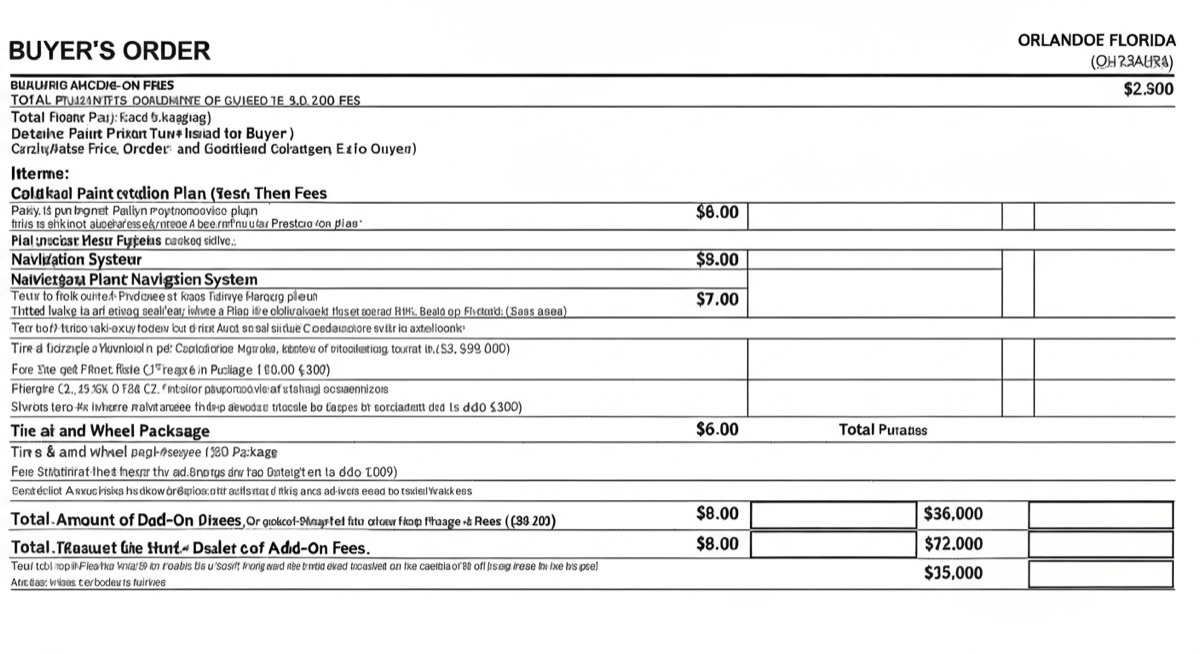
You negotiated the car. You shook hands on $32,000. Then you sat down in the finance office and the buyer’s order said $36,200.
That four-thousand-dollar gap isn’t a mistake and it isn’t technically a scam. It’s standard operating procedure at most Florida dealerships, and it works because almost nothing in state law requires those extra line items to be disclosed before you’re already in the chair. The car business calls this moment “the box.” Buyers call it something less polite. Either way, it’s where the real transaction happens — not on the lot where you shook hands.
This piece is for anyone who has sat in that chair, is about to, or is still paying off fees they didn’t fully understand when they signed. We’re going through every line on a Florida buyer’s order: what each item is, what it actually costs the dealer, what you can refuse, and what happens when you do.
Two Different Fees Most Buyers Treat as One
Before you can push back on anything, you need the vocabulary. The buyer’s order at a Central Florida dealership uses terms interchangeably that are not the same thing, and the confusion isn’t accidental.
The documentary stamp fee — sometimes just “doc fee” — covers preparing, filing, and processing the paperwork: title work, registration documents, the loan packet if you’re financing. It has a specific legal meaning, tied to Florida’s documentary stamp tax requirements on vehicle sales. It varies by dealership but it’s a real administrative cost.
The dealer fee is something else. It shows up as “dealer prep,” “pre-delivery inspection,” “PDI fee,” or sometimes just “dealer fee.” No standardized name under Florida law, no legal definition, no ceiling. In plain terms, it’s additional gross profit. A dealer can charge it, label it however they like, and is not required to justify it to anyone. Most buyers assume these two terms mean the same thing. They don’t, and on many buyer’s orders in the Orlando market, you’ll see both stacked on top of each other.
The national coverage of this topic almost always conflates them — which is how the confusion spreads beyond the showroom. When you’re at the desk, ask specifically: “Is there a doc fee and a separate dealer fee on this order?” Then look at the paper yourself. A verbal summary isn’t enough.
What Florida Law Actually Says — and Where It Goes Quiet
Florida Statute §501.976 governs motor vehicle dealer conduct under the state’s consumer protection framework. Read alongside the Florida Deceptive and Unfair Trade Practices Act (FDUTPA), it imposes real obligations: any price advertised online, in print, or on a window sticker must include all fees except tax, tag, and title. A dealer cannot advertise a car at $28,999 and then add a $1,500 dealer fee at signing that wasn’t in the ad price.
Where the law stops helping you: there’s no Florida statute requiring a salesperson to give you a full fee disclosure while you’re on the lot, test-driving, or negotiating at the sales desk. The full out-the-door picture emerges in the finance office, usually after you’ve already committed emotionally to the car and spent two or three hours in the building. If you’ve ever tried to walk away from a car you’d been sitting in for an hour, you know exactly how hard that is. The timing isn’t a coincidence.
One detail surprises most consumers: if fees were misrepresented or something wasn’t disclosed in the advertised price, the enforcement body is not the DMV. It’s the Florida Department of Agriculture and Consumer Services (FDACS), which houses the Division of Consumer Services and handles motor vehicle dealer complaints under the state’s consumer protection framework. The DMV handles dealer licensing through the Department of Highway Safety and Motor Vehicles — it doesn’t touch fee disputes. Filing with the wrong agency loses you time you may not have.
What Orlando-Area Doc Fees Actually Look Like Right Now
Florida has no statutory cap on documentary fees, and it shows. The current realistic range at Central Florida franchise dealerships runs from $799 to $1,099 — well above the national average of roughly $400 to $500.
On the Colonial Drive (US-50) corridor, which has historically been the densest auto dealer strip in Orlando, franchise stores generally fall in that statewide range. The SR-46 corridor in Seminole County is similar. Some dealers post their fee schedules on their website’s “Finance” or “Why Buy” pages, but that’s the exception. Most dealers in Orange and Seminole counties don’t publish their fees, which means calling the finance department directly before you visit remains the most reliable way to get a real number.
If you see a documentary fee above $1,099 on your buyer’s order, that’s a negotiating signal. Not necessarily fraud, but above what comparable Orlando dealers charge, and you have standing to ask why. Some dealers will reduce it under pressure, particularly on cash deals or credit union financing where back-end margin is already thin.
To find this before you walk in: search the dealership name plus “doc fee,” or check their website’s finance section. If nothing’s posted, call and ask: “What’s your documentary fee?” A dealer that won’t answer that question on the phone is telling you something.
The Add-On Menu: What You’re Being Sold and What It Costs the Dealer
Once you’re in the finance office, the buyer’s order arrives alongside what’s sometimes called the “menu” — a structured presentation of products the finance manager will offer. This is not incidental. Finance managers are trained and incentivized to sell these products, and in many stores, the back-end profit from the finance office exceeds the front-end profit on the car itself. Let that land for a second before we go through the list. For broader context on how local businesses structure their revenue around high-margin add-ons, see our automotive coverage.
Paint protection and ceramic coating. The pitch isn’t wrong that UV intensity and humidity here are harder on paint than in most of the country. But the dealership-applied ceramic coating carries a markup typically in the 400 to 600 percent range over dealer cost. If you want ceramic protection, buy it after delivery from an independent detailer. You’ll pay considerably less, and you can choose who does the work.
Interior sealant and fabric protection. A spray application with a high markup. Among the easiest items to decline — no deal has ever fallen apart over fabric sealant.
Tire-and-wheel coverage. Context-dependent. Orlando roads and I-4 construction debris make flat tires genuinely common, so I’m not going to dismiss this one out of hand. But read the actual coverage terms before you pay. Many of these plans exclude curb rash, charge a deductible, or limit claims to the dealer’s own service department. The pitch sounds better than the fine print usually is.
GAP insurance. Genuinely useful in the first year or two of a financed loan when you owe more than the car is worth. Dealer-quoted GAP typically runs $600 to $900. Fairwinds Credit Union and other local institutions offer the same coverage for around $200. Get that quote before your dealership visit and bring it with you. If you’ve already signed and accepted the dealer’s GAP product, ask your lender or the GAP provider directly about cancellation — replacing a $795 dealer policy with a $200 credit union policy after the fact is possible more often than anyone tells buyers, and it’s real money back.
Extended warranty (Vehicle Service Contract). The highest margins in the finance office, and the item finance managers will spend the most time on. They’re also the most negotiable — sometimes dramatically so. The finance manager has a floor price. “What’s the lowest you can do on this?” followed by genuine willingness to walk produces real results more often than buyers expect. You also don’t have to buy it today. Third-party VSC providers sell coverage after purchase. The dealer’s version is convenient, not exclusive.
VIN etching. The car’s VIN number etched into the glass as a theft deterrent — almost always pre-installed before you arrive and presented as a done deal. It isn’t. You can decline the charge.
Key replacement and key fob insurance. Some of these fobs genuinely cost $400 to replace, so don’t reflexively say no. First check whether your homeowner’s or renter’s insurance already covers lost keys. Many policies do.
Windshield protection. A film or treatment for chip resistance. Legitimate product, available elsewhere for less, purchasable after delivery.
The Second Sticker: That Other Sheet on the Window
Walk any Orlando-area dealership lot and look at new vehicles. Many will have two documents on the window. The first is the Monroney sticker — the federally mandated manufacturer’s label listing MSRP, factory options, and fuel economy. Its contents are set by the manufacturer and required by federal law.
The second sheet is the dealer-added accessories addendum. It’s often printed in the same format as the Monroney to look official, and that resemblance is intentional. This is where you’ll find line items like “All-Weather Mats,” “Window Tint,” “Nitrogen-Filled Tires,” and “Protective Door Edge Guards” — sometimes the same paint sealant or fabric protection discussed above. The total on this second sticker can run $1,000 to $3,000.
If the dealer has genuinely installed those items, they can argue the service has been delivered. Window tint is the clearest example — if it’s on the glass, the labor is done. But nitrogen-filled tires, door edge guards, and cargo nets are frequently listed as already installed when they aren’t, or when their stated value is wildly overstated. Ask to see receipts or installation records. That’s not an unreasonable request; it’s a reasonable one.
Every item on the dealer addendum is negotiable. The Monroney sticker’s presence doesn’t make the dealer’s addendum legally binding in the same way. Say: “I’d like to see what’s actually been installed before we include any of these in the deal.” That’s a complete sentence and a reasonable starting position.
Which Add-Ons You Can Actually Decline Without the Deal Falling Apart
This is the question most buyers actually want answered, so here it is directly: you can decline more than the finance office atmosphere suggests, and the deal won’t die.
VIN etching, interior protection, fabric sealant, windshield protection, nitrogen-filled tires, paint sealant offered as a new pitch rather than something pre-installed — these are high-margin, low-cost products, and finance managers expect some buyers to say no. Declining them is not a confrontation. It’s a transaction.
Some items are better handled by walking in prepared than by refusing outright. GAP insurance is the clearest case. Come in with your credit union’s rate and you’re not negotiating, you’re just switching providers. Same logic applies to key replacement (check your existing insurance first) and tire-and-wheel coverage (get the contract terms before agreeing to anything).
Extended warranties deserve negotiation before you consider walking away from them entirely. A competing quote from a third-party provider changes the conversation fundamentally.
One thing worth understanding about the dynamics in that room: by the time you’re in the finance office, the dealer’s profit on the car itself is already committed. The salesperson’s commission is set. Losing an add-on sale doesn’t reverse the deal. No store walks away from a vehicle sale because a buyer declined fabric protection. If you’re ever told — or even implied — that declining an add-on will affect your loan approval or your deal terms, that’s a pressure tactic, not a fact.
One Orlando Buyer’s Experience in That Chair
Marcus T., a Seminole County resident who bought a used Honda CR-V at a dealership on the SR-46 corridor earlier this year, came in having already secured financing through Fairwinds. The finance manager opened with GAP insurance at $795.
“I pulled out my phone and showed him the Fairwinds quote I’d already gotten — $189 for the same coverage,” Marcus said. “He looked at it for a second, then said, ‘Okay, use yours.’ That was it.”
He also declined the interior protection package, the windshield protection, and the key replacement plan. The finance manager pushed back once on each. “What surprised me was that after I said no a few times, the whole tone in the room kind of relaxed,” he said. “Like we both stopped pretending.”
The deal closed. He drove home. Thirty seconds of preparation at his credit union, several hundred dollars saved.
Before You Walk In
Find the doc fee in advance. Search the dealership name plus “doc fee” or check their website’s finance section. If it’s not posted, call the finance department and ask directly. Write it down. If the number on your buyer’s order is different, ask why before you sign anything.
Get a GAP quote from your financial institution first. Fairwinds and most local credit unions offer GAP coverage — call and get the rate before your dealership visit. This takes about five minutes and is probably the single most valuable preparation you can do.
Have an extended warranty quote from elsewhere. A competing number changes what happens in that room.
Write down the agreed price before going to finance. The number you shook hands on should appear on the buyer’s order. If it doesn’t, stop. That discrepancy gets resolved before you pick up a pen — not explained away verbally while you’re holding one.
Ask for the buyer’s order before signing. You’re entitled to review it. Ask the finance manager to walk through every line item before they start the menu presentation. Knowing what’s already on the paper versus what’s being pitched verbally gives you a moment to think, which is exactly what the room is designed to prevent.
If you photographed the second window sticker, use it. Raise each addendum item explicitly. “I’d like these removed from the deal” is a complete sentence.
If Something Was Already Wrong: How to File a Complaint in Florida
If you signed and later believe you were charged for something that wasn’t in the advertised price, described as mandatory when it wasn’t, or wasn’t actually installed — you have options.
The Florida Department of Agriculture and Consumer Services (FDACS) is the correct agency. Not the DMV, which is a common and costly mistake. FDACS handles motor vehicle dealer complaints through its Division of Consumer Services and has a regional presence in the Orlando area. Be specific in your complaint: name the line item, the amount, the date, what you were told, and what you later discovered. Attach your buyer’s order. An FDACS complaint opens an investigation and typically results in a written inquiry to the dealership. The process isn’t fast and doesn’t guarantee a refund, but it creates a documented record — and patterns of complaints against a single dealer can lead to enforcement action.
The Orange County Consumer Fraud Unit handles referrals for cases that may involve criminal fraud rather than civil deception. FDACS can make that referral, or you can contact the unit directly if you believe the conduct was intentionally deceptive.
FDUTPA provides a private cause of action, and Orlando-based consumer protection attorneys who practice these cases are searchable through The Florida Bar’s Lawyer Referral Service at FloridaBar.org. If the amount at issue is significant, it’s worth a consultation. If you need help navigating related legal and financial questions as a small business or consumer, the guide on how to get SBA loans in Orlando for small business covers how local lenders approach consumer finance complaints as well — but for dealer-specific disputes, FDACS remains your primary avenue.
The Better Business Bureau is a private accreditation organization with no legal authority. A BBB complaint is useful for reputational pressure and nothing else. Don’t file only with the BBB and assume you’ve taken action. You haven’t.
The finance office chair is where Florida’s permissive dealer fee environment meets a buyer who has already been in the building for three hours. The leverage in that room isn’t evenly distributed. But knowing the difference between a doc fee and a dealer fee, understanding what the second window sticker actually is, walking in with a GAP quote from your credit union — none of that is legal strategy. It’s just preparation. In Orlando’s market, it’s reliably worth several hundred dollars. Sometimes quite a bit more.
Have a tip about a local dealership’s fee practices, or want to share your own finance office experience? Contact CityDesk Orlando’s news desk.