Electric Vehicle Incentives Available to Florida Buyers in 2026
Florida has no state EV program, the federal credit landscape shifted significantly during 2025 legislative activity, and most guides you'll find online are out of date. Here's what's verifiable ri…

Electric Vehicle Incentives Available to Florida Buyers in 2026
Florida has no state EV program, the federal credit landscape shifted significantly during 2025 legislative activity, and most guides you’ll find online are out of date. Here’s what’s verifiable right now — and where the picture is still unsettled.
If you’ve searched for EV incentives in the last few months and landed on a page that confidently explains the Inflation Reduction Act’s $7,500 tax credit as though it’s still January 2023, you’ve already run into the core problem. It’s stale. It’s national. It doesn’t tell you what an Orlando buyer sitting across from a finance manager in June 2026 can actually put on the table.
This piece fixes that. It’s based on direct contact with OUC, conversations with Central Florida dealers, and a review of what the 2025 budget reconciliation process did — or may have done — to the EV credit structure the IRA established. Some of what follows is confirmed and settled. On the federal credit question specifically, the picture remains genuinely uncertain as of publication. We’ll tell you that plainly rather than paper over it.
The Dollar Stack: What May Be on the Table for a Central Florida Buyer Today
Before the fine print, here’s the realistic range of what a qualifying Orlando buyer could access in June 2026. This assumes the federal credit picture is clarified in buyers’ favor — that’s the critical unknown, addressed in the next section.
A buyer who is an OUC customer, earns under the applicable AGI cap, purchases a federally eligible new EV under the MSRP threshold, and installs a Level 2 home charger could access:
- Up to $7,500 in federal tax credit on a qualifying new EV (§30D) — verify current status at IRS.gov and fueleconomy.gov before any purchase decision. The 2025 legislative process introduced significant uncertainty about whether this credit survived intact.
- Up to $200–$400 in OUC rebate for a qualifying Level 2 home charger — confirm current figures with OUC directly at 407-423-9100, as amounts have been updated.
- Manufacturer incentives varying by brand and model, ranging from reduced-rate financing to cash-back offers, particularly on slower-selling inventory.
What’s not on the table: a Florida state rebate. More on that shortly.
Federal Tax Credit Status in 2026: What the 2025 Legislative Changes Actually Did to the $7,500 Credit
This is where most guides fail. They haven’t caught up with what happened — or may have happened — during 2025 budget reconciliation.
Here’s the honest answer as of June 2026: you need to verify the status of the §30D new EV tax credit before any purchase. The 2025 reconciliation and budget process introduced significant legislative activity around IRA provisions, including the EV credit. Whether the $7,500 §30D credit survived intact, was modified, or was eliminated is the single most important thing you need to confirm before walking into a showroom. I’m not being dramatic about that.
Do not rely on any guide, dealership advertisement, or online calculator that references these credits without a clear date stamp after January 2026. Check fueleconomy.gov and the IRS website directly before you buy. Dealer finance managers are not always current on federal tax law changes — and frankly, why would they be? Some advertise credit availability that no longer applies. Others don’t know whether a modified credit has been reinstated. Ask explicitly: “Is there a federal tax credit currently in effect for a new EV purchase in June 2026, and is this dealership enrolled to process it?”
The point-of-sale transfer mechanism deserves specific attention. Under the IRA, buyers could transfer the §30D credit to the dealer at time of purchase as an upfront price reduction, rather than waiting until tax filing. This approach is subject to uncertainty. Verify with your specific dealer whether they’re enrolled as a registered IRS dealer to process point-of-sale transfers. Ask whether the underlying credit is in effect for your purchase date. This distinction matters operationally. If your dealer isn’t enrolled to process transfers, you’d receive the credit as a tax deduction when you file your return, not as an immediate price reduction at signing. The outcome is identical over a full tax year, but the cash flow is completely different.
The used EV credit (§25E) requires current verification as well. It provides $4,000 or 30% of sale price, whichever is less, for qualifying used EVs priced under $25,000. Confirm its status at IRS.gov before you buy.
Income Caps and MSRP Limits: Who Gets Cut Out at Orlando’s Income Levels
The income thresholds under the IRA as enacted were: $150,000 AGI for single filers, $225,000 for heads of household, and $300,000 for joint filers. These were based on the current year or prior year’s AGI, whichever was lower. For most Orlando-area households, this threshold was largely academic. Orange County’s median household income runs approximately $65,000–$70,000, so the vast majority of local buyers cleared the income threshold when the credit was available. The income cap mainly affected affluent buyers in neighborhoods like Dr. Phillips or the luxury corridors of Lake Nona — and those same buyers were more likely shopping vehicles that ran into the MSRP problem anyway.
The MSRP limits under the IRA were: $55,000 for sedans, hatchbacks, and wagons; $80,000 for SUVs, trucks, and vans. This created real friction in the market for certain popular vehicles. Some Tesla Model Y configurations pushed against the ceiling depending on options. The Rivian R1T and R1S generally stayed under $80,000 on base models but could exceed it quickly with upgrades. BMW and Audi EV lineups frequently exceeded caps entirely. A buyer who wanted a Genesis GV60 faced the reality that it simply wouldn’t qualify under the MSRP ceiling, regardless of how the vehicle was financed. That’s a frustrating discovery to make at the point of sale.
For the used EV market, the income caps tightened considerably: $75,000 single / $150,000 joint, with a vehicle price cap of $25,000. These thresholds covered a different buyer base than the new vehicle credit — lower incomes, tighter budgets, vehicles with less power and range. If federal legislation maintains or reinstates an EV credit in some form, these or similar income and price caps will likely remain present.
Which EVs at Orlando Dealerships Are Worth Knowing About
Regardless of the current federal credit status, dealer-level and manufacturer-level incentives operate independently of federal law and are worth understanding on their own terms. In our automotive coverage, we track how these incentive structures evolve alongside inventory conditions at local dealerships.
David Maus Chevrolet carries the Chevrolet Equinox EV at roughly $35,000 base MSRP. That’s comfortably under the former $55,000 sedan/hatch cap and well-positioned for middle-income Orlando buyers even without federal incentives. The dealership carries inventory regularly, and David Maus periodically runs manufacturing-backed financing rates on the Equinox EV line when federal credit uncertainty makes cash incentives a harder sell. The finance desk will need to confirm what current promotions apply to your specific trim and purchase date — these shift monthly based on inventory levels and corporate incentive calendars.
Universal Hyundai’s IONIQ 5 and IONIQ 6 gained a critical advantage when Hyundai brought manufacturing of both models to its Georgia plant. Before that facility came online, these vehicles faced assembly-location eligibility questions under the IRA’s North American content requirements. Now that they’re built in Georgia, they meet the assembly standard and are positioned well if federal credits are confirmed in effect. Universal Hyundai, located on the south OBT corridor, is the primary Central Florida location for the brand. Hyundai incentive structures vary seasonally. The brand has periodically offered lease specials that route manufacturer discounts directly to the consumer, sometimes with remarkably low monthly payments. The lease-versus-buy math here changes significantly depending on whether federal credits are available to the lessor — more on that in the stacking section.
Greenway Kia’s EV6 shares platform architecture with Hyundai’s EVs, built on the same Georgia manufacturing line. Before you commit to either vehicle, though, check the specific VIN on fueleconomy.gov. Eligibility is determined at the VIN level, and model-year transitions or production shifts can change eligibility even within the same nameplate. Greenway Kia on East Colonial is the volume Kia location in the metro area. Kia has run competitive lease offers on the EV6 that can represent meaningful savings independent of federal credits, often undercutting Hyundai’s rates despite the vehicles’ shared underpinnings.
Greenway Ford’s Mustang Mach-E carries a complicated eligibility history. Ford adjusted Mach-E pricing multiple times since 2023. The Mach-E is assembled in Mexico, a fact that created eligibility complications under the IRA’s North American assembly requirement. Verify current assembly status for any specific model year you’re considering, as manufacturing locations shift with product cycles. Ford’s dealer-level discounts on slower-moving inventory can be substantial, especially on higher trims where inventory sits longer. Ask what the dealer invoice looks like and whether any fleet pricing applies to consumer purchases. Some Ford dealers will extend fleet rates to retail customers if it helps turn inventory — it doesn’t hurt to ask.
Tesla’s Lee Road direct sales location operates under the direct-sales model, meaning no franchised dealership middleman. Tesla’s eligibility for the §30D credit was historically inconsistent, varying by model, trim, and configuration. The Model 3 RWD and some Model Y configurations qualified during certain periods while higher-trim variants did not. Check the specific VIN and configuration you’re considering on fueleconomy.gov before assuming any credit availability. Tesla periodically offers its own discount programs and referral incentives that appear and disappear without formal announcement — sometimes without much explanation either way. Check Tesla’s website directly for current offers rather than relying on secondhand information.
OUC Rebates: What Orlando’s Municipal Utility Offers, What It Costs You to Charge, and Who’s Eligible
This is where Central Florida buyers have something real and confirmed on the table, regardless of whatever’s happening with federal credits.
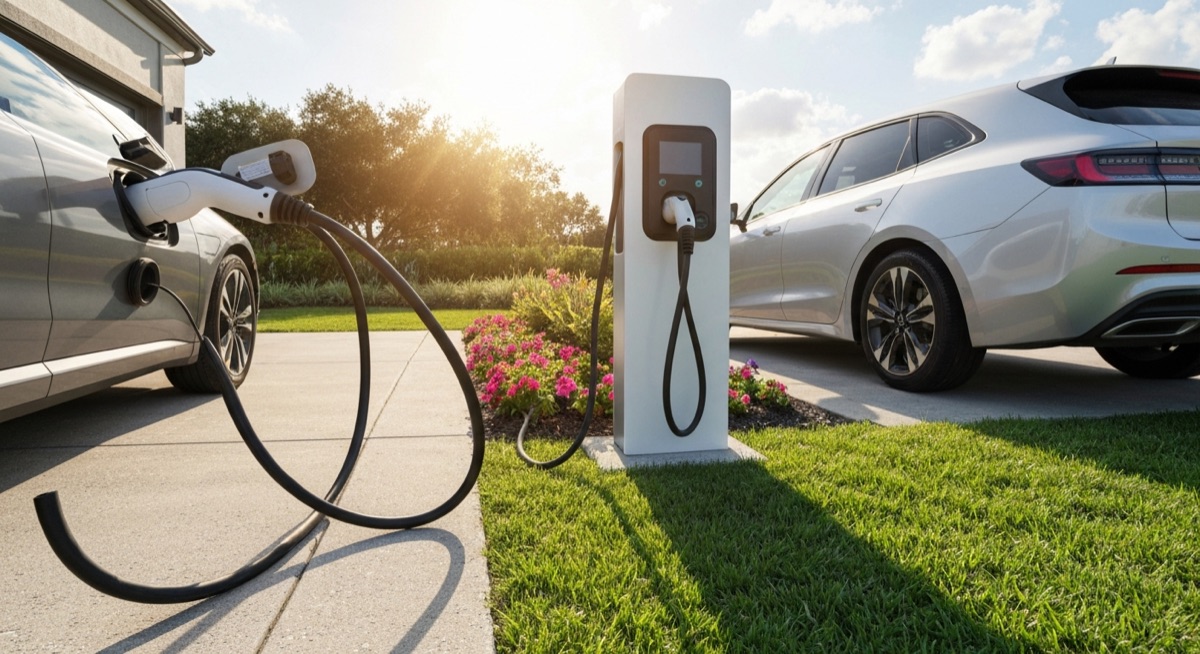
OUC’s Level 2 home charger rebate remains one of the more accessible local incentives for EV buyers in the city’s service territory. The utility has offered rebates on qualifying Level 2 (240-volt) home chargers — typically a UL-listed ENERGY STAR-certified unit — along with partial installation cost support in some program versions. Reported rebate amounts have ranged from $200–$400 for the charger, with additional amounts toward installation in some versions. Call OUC directly at 407-423-9100 to confirm current rebate amounts before purchasing or scheduling installation. The program terms have been updated, and any figure published here may not reflect the current offer by the time you act on it.
The rebate application process generally requires that you be an OUC residential customer and that the charger be on OUC’s approved equipment list. You’ll need to submit proof of purchase. Some program versions require that installation be performed by a licensed electrician. Confirm this upfront, because it affects whether you can DIY or must hire out. OUC’s website lists current approved charger models. Check it before you buy to avoid purchasing equipment that doesn’t qualify — that’s an annoying mistake to make after the fact.
Beyond the rebate itself, OUC’s Time-of-Use (TOU) rate program may deliver more value than the rebate over the life of EV ownership. Under the TOU structure, electricity rates are lower during off-peak hours — typically overnight — and higher during peak hours on weekdays. For an EV driver who charges primarily overnight, the savings compared to the flat residential rate can be meaningful. Overnight rates under a TOU plan can run 30–40% less than peak-hour rates. That translates to real cost reductions for a vehicle that charges daily. Confirm OUC’s current TOU rate schedule on their website to calculate your specific savings based on your expected charging volume and time of day.
OUC service territory matters operationally — more than people realize. OUC serves the City of Orlando and portions of Orange County, but a significant portion of the metro area is not in OUC territory. If you live in Apopka, Ocoee, Winter Garden, Windermere, or parts of east Orange County, you’re likely a Duke Energy Florida customer. Duke has its own EV programs, rate structures, and home charger incentives. Check Duke Energy Florida’s website or call their customer service line. Buyers in Kissimmee or Osceola County should check with Kissimmee Utility Authority (KUA), which has also offered EV-related programs. Don’t assume you’re an OUC customer just because you live in “the Orlando area.” Check before you file your rebate paperwork.
Florida Has No State EV Rebate. Full Stop.
Florida has no statewide EV purchase rebate, tax credit, or point-of-sale incentive program. None. There is no Florida Department of Environmental Protection EV rebate. There is no Florida Department of Transportation EV incentive. There is no state income tax credit for EV buyers — partly because Florida has no state income tax at all.
The Florida Legislature has consistently resisted state-level EV purchase mandates or subsidy programs. Legislative sessions in recent years have produced no meaningful movement toward a state EV rebate, and the political posture in Tallahassee makes near-term movement on this front unlikely. Nothing in the 2025 legislative calendar altered this dynamic.
The City of Orlando and Orange County both have sustainability goals and have invested in public EV charging infrastructure. You’ll find Level 2 chargers in several city-owned garages downtown and at county facilities. Neither office operates a direct consumer rebate or purchase incentive program for residents buying EVs. A direct call to the City of Orlando’s Office of Sustainability and the Orange County sustainability team confirmed this absence. If anything changes, it’ll be announced through those offices’ communications channels.
NEVI corridor funding — federal infrastructure money flowing to Florida to build out public fast-charging stations along interstate corridors — is producing new charging locations along I-4, the Florida Turnpike, and SR-417/408 corridors. That’s genuinely useful for range anxiety. But NEVI involves charging infrastructure investment, not a consumer purchase incentive. It doesn’t reduce what you pay for your car or your home charger. It’s valuable as a range-anxiety mitigator, but it’s not a dollar in your pocket at the dealership.
Stacking Incentives: What the Combination Looks Like at the Transaction in 2026
The value of stacking incentives depends entirely on whether the federal §30D credit is in effect for your purchase. Verify that first before assuming any particular combination.
If the federal credit is confirmed to be in effect, the potential stack for a qualifying buyer is: federal §30D credit (up to $7,500) plus OUC home charger rebate (currently $200–$400, confirm at 407-423-9100) plus manufacturer financing or cash-back incentive. For a buyer purchasing a qualifying vehicle like the Chevrolet Equinox EV and installing a home Level 2 charger through the OUC rebate program, that combination represents $8,000–$9,000 in total savings before any dealer price negotiation. That’s real money — and the OUC rebate alone represents real money on the charger installation that buyers would otherwise absorb entirely.
If the federal credit is not currently in effect, the stack is substantially thinner. You’re looking at OUC home charger rebate plus manufacturer financing incentive. That may mean $200–$400 plus a 0% APR financing offer or a small manufacturer cash-back. Real, but considerably less dramatic than the stacked scenario.
The leasing angle matters here. When the §30D credit was in effect, leasing created a specific incentive dynamic because the lessor owned the vehicle and could claim the commercial clean vehicle credit (§45W). This had different eligibility rules than §30D — notably no MSRP caps and no income caps. Automakers then had the option to pass that value to the consumer through lower lease payments. Some did openly. Many did not. If federal credits are currently in effect in any form, the lease-versus-buy question around credit eligibility will matter operationally. Ask your dealer finance manager explicitly: “If this vehicle qualifies for any manufacturer or tax incentive, how is that being reflected in the lease payment? Can I see the gross cap cost before and after any manufacturer discount?”
Get the out-the-door price in writing before discussing financing. No exceptions. Dealer financing offers, cash-back incentives, and subsidized lease rates are often not volunteered — they’re revealed when you ask directly. Write the numbers down so you can compare. A 0% APR for 72 months from Ford Finance might beat a $2,000 cash rebate if you’re financing long. The math depends on your specific term and rate from other lenders.
Orlando-Specific Factors Worth Knowing Before You Buy
HOA and Condo Charging Rights
A significant share of Orlando-area EV buyers live in HOA-governed communities or condominiums. This describes much of downtown Orlando’s high-rise market, Baldwin Park, Lake Nona, the Dr. Phillips corridor, and countless townhome communities throughout Orange County. If that’s you, the home charger rebate doesn’t do you much good until you’ve solved the installation problem first.
Florida law provides protection here. Under Florida Statutes §718.113 (condominiums) and §720.304 (HOAs), residents have rights to install EV charging equipment in their designated parking space. The law has been strengthened in recent years to prevent HOAs from broadly prohibiting EV charger installation. However, “can’t prohibit” is not the same as “will be easy or cheap.” HOAs can still regulate the process, require licensed contractors, mandate specific equipment, and charge the resident for installation costs in shared electrical infrastructure. Residents in older buildings with limited panel capacity may find that upgrading electrical service to a dedicated 240-volt circuit is a significant expense that no incentive covers. Getting an electrician into a condo building, getting the work approved by the association, and paying for a panel upgrade can run $2,000–$5,000 before the charger itself is even installed.
If you live in a condo or HOA community, talk to your property manager before purchasing your EV. Understand what the installation process looks like in your specific building, what it’ll cost you personally, and how long the approval process typically takes. Some communities have streamlined this. Others make it punitive. It matters — and it’s worth knowing before you’re sitting in the finance office.
Summer Heat and Real-World Range
Central Florida summers are hard on EV batteries. When temperatures sit in the low-to-mid 90s°F and the AC runs hard from the moment you start driving, that load comes directly out of your range. Manufacturers’ EPA range estimates are generated under controlled conditions that don’t reflect a July afternoon on the 408 heading toward east Orange County. Expect meaningful range reduction during the hottest summer months compared to EPA-rated range — sometimes 15–25% less. Heat also affects battery degradation over time. Parking in direct sun repeatedly contributes to long-term capacity loss. If you have a garage or covered parking, use it consistently rather than leaving your car baking in the lot at your office. This matters more in Florida than it does in virtually any temperate climate.
Buyers who are borderline comfortable with a shorter-range vehicle should step up to a longer-range trim if their commute pattern leaves thin margins. A vehicle rated at 250 miles of range might deliver 200–220 miles in July heat with highway driving and AC use. If your commute is 180 miles round trip, that math works. If it’s 200, you’re uncomfortable. Don’t let a salesperson talk you into the shorter-range version because it’s $3,000 cheaper if your daily driving is already close to the edge.
Vehicle-to-Home (V2H) as a Hurricane Prep Tool
Florida is genuinely unique among major EV markets in that a meaningful percentage of buyers think about hurricane preparedness when considering vehicle-to-home (V2H) or vehicle-to-load (V2L) capability. National guides never address this. It changes the value calculation for certain vehicles in ways that simply don’t apply in most other markets.
The Ford F-150 Lightning with its Pro Power Onboard system can power a home for multiple days during an outage depending on load — and in a market where major storms are a matter of when, not if, that’s not a hypothetical benefit. The Hyundai IONIQ 5 offers bidirectional charging capability. If you’re in a household that already owns or is considering a generator for hurricane season, the math on an EV with V2H/V2L capability deserves serious consideration alongside the steps covered in our guide to hardening your Orlando home before hurricane season. A vehicle that acts as a backup power source during an outage has real, tangible value in this geography. True whole-home V2H requires a licensed electrician to install a transfer switch and integrate it with your electrical panel. Costs vary, but expect $1,500–$3,000 for the installation work alone. It’s a local factor worth weighing in a way that matters far more here than in most other U.S. markets.
How to Actually Claim It: What to Do Before You Walk Into the Dealership
Step 1: Verify the current federal credit status. Before you go anywhere near a dealership, check the IRS website and fueleconomy.gov for the current status of §30D. Do this the week of your purchase, not months earlier. The situation has been in flux, and a guide published in January won’t reflect changes that happened in March.
Step 2: Confirm your AGI. If a credit is in effect, know where you stand relative to the income thresholds. Pull your most recent tax return. If you think you’re close to the cap, talk to your accountant about whether the prior-year AGI option helps you. Most Orlando-area households won’t be constrained by income, but it’s worth five minutes of verification.
Step 3: Confirm vehicle eligibility on fueleconomy.gov. Vehicle eligibility is determined by VIN-specific details including battery sourcing and assembly location. A model that qualifies in one trim or production run may not qualify in another — this happened repeatedly under the IRA. Check the specific VIN you’re considering before you spend time negotiating at the dealership.
Step 4: Ask the dealer directly about point-of-sale credit transfer. If the §30D credit is in effect when you buy, ask whether the dealer is enrolled as a registered dealer with the IRS to process point-of-sale transfers. Not all dealers are enrolled. If yours isn’t, you’d need to claim the credit on your tax return instead — you’d be waiting until you file rather than receiving an upfront discount at signing.
Step 5: Apply for the OUC home charger rebate. Contact OUC at 407-423-9100 before purchasing your charger to confirm: (a) the current rebate amount, (b) which charger models qualify, (c) whether there are any income eligibility requirements, and (d) whether the application must be submitted before or after installation. Have your OUC account number handy. After installation, submit the required documentation promptly — proof of purchase, installation receipt, any forms OUC requires. These programs sometimes have annual funding caps and can run out mid-year if they’re popular. Don’t sit on it.
Step 6: Ask about manufacturer incentives at the point of negotiation, not after. Dealer financing offers, cash-back incentives, and subsidized lease rates are often not volunteered. They’re revealed when you ask directly. Get the out-the-door price in writing before discussing financing. This protects you from the “we can’t give you the rebate now, but we can lower your financing rate” sleight-of-hand that’s more common than it should be.
Pre-Purchase Checklist for Orlando EV Buyers, June 2026
- Check fueleconomy.gov for current federal credit eligibility on your specific vehicle and VIN
- Verify the current status of §30D at IRS.gov — do this the week of purchase
- Verify the current status of §25E (used EV credit) at IRS.gov if shopping used
- Confirm your AGI against applicable income thresholds
- Call OUC at 407-423-9100 to confirm current home charger rebate amount and program status
- Confirm you’re in OUC territory (not Duke Energy or KUA) before applying for OUC programs
- Ask the dealer whether they’re enrolled to process point-of-sale credit transfers
- Ask the finance manager about current manufacturer cash-back or rate incentives
- If you live in an HOA or condo, confirm charging installation process and cost before purchase
- Size your vehicle’s range for Florida summer conditions, not EPA estimates
CityDesk Orlando contacted OUC, Greenway Automotive Group, Universal Hyundai, and the City of Orlando’s Office of Sustainability for this report. The status of the federal §30D EV tax credit following 2025 legislative activity is the highest-risk variable in this article. Readers must verify current federal incentive status independently at IRS.gov and fueleconomy.gov before purchase, as program terms can change without public notice.