How to Spot a Flood Damaged Car Before Buying in Orlando
Florida's flood title loopholes, the OBT risk corridor, and why a clean CARFAX isn't the same as a clean car

How to Spot a Flood Damaged Car Before Buying in Orlando
Florida’s flood title loopholes, the OBT risk corridor, and why a clean CARFAX isn’t the same as a clean car
How do I know if a used car in Orlando was flood-damaged before I buy it?
Start with the Florida title brand. Pull it directly from HSMV.gov before you visit any lot. Then run CARFAX and NMVTIS, but understand what you’re actually looking at: neither catches cash-repaired flood cars.
Inspect the interior yourself. Check for silt in seat tracks, rust on sub-seat fasteners, new carpet on an older car. Look under the hood for waterline sediment rings and inside the fuse box for corrosion. Then pay $100–$200 for a lift inspection at an ASE-certified independent shop before you sign anything.
Every one of those steps matters. In Florida, a clean title and a clean CARFAX can both belong to a car that spent three days underwater in Cape Coral. That’s not a hypothetical — it’s the law as written.
The 60-to-90-Day Window: Why Post-Hurricane Season Is Orlando’s Riskiest Time to Buy
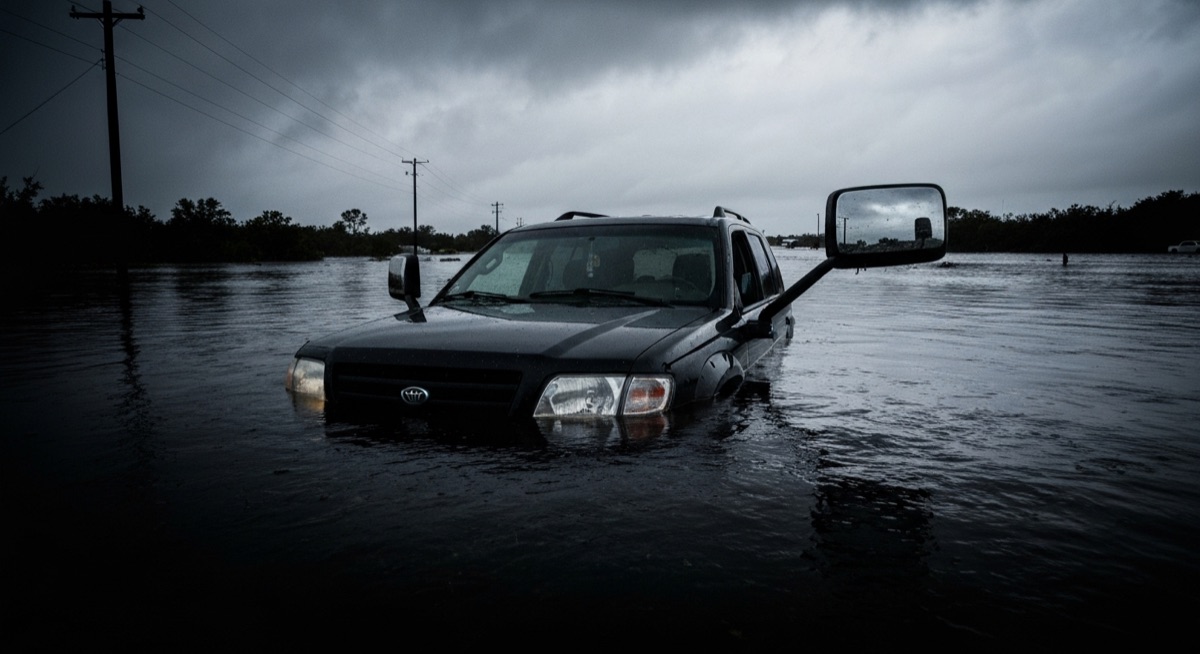
Hurricane Ian made landfall near Fort Myers on September 28, 2022. The storm surge pushed through Lee and Charlotte counties and submerged something in the range of 350,000 to 500,000 vehicles. Some were obvious total losses — floating in parking garages, buried under debris, claimed quickly by insurance adjusters.
A significant share were different. Privately repaired, quietly dried out, detailed, listed for sale. No adjuster, no claim, no paper trail.
The cars that entered the insurance system took time to process. By December 2022, salvage inventory from the Ian flood zone was moving up I-75 and I-4 into Central Florida through dealers, independent wholesalers, and private sellers. Then Hurricane Nicole hit Volusia County — roughly 30 minutes from downtown Orlando — in November 2022. Two major flooding events within six weeks fed inventory into the same regional wholesale auction system.
Here’s the thing about flood cars: they don’t appear on local lots the week after a storm. They show up two to four months later, after insurance processing, salvage auctions, title transfers, and transport. Cars that got wet in October arrive on Orange Blossom Trail lots in January looking freshly detailed, tires still with tread, CARFAX showing one owner. The December-through-February window is the highest-risk period for Orlando-area buyers, which is exactly why most people don’t see it coming.
The financial exposure is real. Undisclosed flood damage can require $3,000 in repairs on the low end — more like $20,000 if water reached the wiring harness, the ECU, the brake system, and the carpet all needed replacing. And if no insurance claim was ever filed, the seller in Florida has no legal obligation to disclose any of that history.
That is the law as written. I find it genuinely hard to believe every time I reread the statute, but there it is.
Florida’s Title Brands: What the Law Actually Says
Florida Statute 319.14 governs how the state brands vehicle titles. Know the four relevant categories before you set foot on a lot. This single piece of knowledge is probably the most useful preparation a used-car buyer in this state can do — and most buyers skip it entirely.
Flood is the brand most buyers assume is self-explanatory. The statute defines it specifically as a vehicle that an insurance company has declared a total loss due to flood damage. That triggering condition is everything. No insurance company involvement means no flood brand, regardless of what the vehicle went through physically.
Salvage applies when an insurer declares a total loss for any reason — collision, theft recovery, flood, hail — typically when repair costs exceed a defined percentage of the vehicle’s value. A salvage-branded car cannot legally be sold as operational in Florida until it’s been repaired and inspected.
Rebuilt/Reconstructed is the brand applied after a salvage-titled vehicle passes a Florida salvage vehicle inspection at a DMV Inspection Station. The car is now legal to operate and sell. The rebuilt brand stays on the title permanently. These vehicles are disclosed. The problem is buyers who don’t know to look for it, or sellers who obscure it.
Certificate of Destruction means the vehicle was declared non-rebuildable. It cannot be titled for road use in Florida. If you see one offered for sale as a driver, walk away.
The critical enforcement gap: Florida doesn’t require a flood brand when the owner pays for repairs privately or settles without filing an insurance claim. A car that sat in Ian’s storm surge for two days, was pumped out by the owner, had its carpets pulled, its ECU dried, and its interior resprayed, can carry a clean Florida title. No insurer touched the paperwork.
Title washing compounds the problem. A Florida salvage-branded car gets registered in Georgia, Alabama, or another state that either doesn’t recognize the Florida brand or lets it be superseded by a new title. The car comes back into Florida retail inventory with an out-of-state title that reads clean. A buyer running a standard title check sees only the most recent state of record — not the Florida salvage brand underneath.
What to do: request the printed title. Not a photocopy, not a dealer-printed summary. Verify the VIN’s brand history directly at HSMV.gov before purchase. If the VIN returns a Florida brand and the title in hand shows a different state’s clean record, that discrepancy alone is reason to walk.
Run the History Reports, Then Understand Their Real Limits
CARFAX and the National Motor Vehicle Title Information System (NMVTIS), accessible through vehiclehistory.gov, pull from overlapping but distinct data sources. CARFAX aggregates from insurance company filings, salvage auction records, state DMV title transfers, and service records from participating dealerships. NMVTIS is a federally mandated database covering all 50 states, plus mandatory reports from insurance carriers and salvage yards.
Between them, these systems catch much of the flood-branded and salvage-titled inventory. Run both on every car you seriously consider. But neither has access to the categories of information that matter most in Florida — and this is where buyers get into real trouble.
Private-party cash repairs leave no record. If the owner of a Cape Coral vehicle paid a shop $8,000 in cash and never filed an insurance claim, CARFAX has nothing to report because there’s nothing to see. NMVTIS has the same problem. Out-of-state insurance claims create a lag and sometimes a permanent gap — if a Florida resident’s car was flooded during a trip to South Carolina and the claim was paid by a regional insurer that isn’t a CARFAX reporting partner, that record may never appear. FEMA flood-zone records and NFIP claims aren’t in either database.
Florida’s insurance market makes these gaps worse than they’d be almost anywhere else. The state consistently ranks among the top five nationally for uninsured and underinsured motorists. A lot of Florida vehicles that were submerged in hurricane flooding have no insurance claim on record and will never show up in any commercial history report.
NICB’s free VINCheck at nicb.org is worth the 30 seconds it takes to run. It cross-references the National Crime Information Center’s stolen vehicle database and some salvage records, and occasionally catches things CARFAX misses. It costs nothing.
One thing worth saying directly: a dealer-provided CARFAX isn’t independent. A salesperson presenting it as a clean bill of health is mischaracterizing what the document says. The CARFAX disclaimer is explicit — the report reflects only what has been reported to the system. A clean report is a necessary first step. It is not a final answer. Those are very different things, and the people selling cars in this market know it.
Geography of Flood-Car Risk in Central Florida
Not all lots carry equal risk. Knowing where to be most careful in this specific market is genuinely useful, so here’s how it actually breaks down.
Independent lots on Orange Blossom Trail — US-441, running south of downtown Orlando through Pine Hills and into Osceola County — are the highest-risk category. OBT has historically been the densest concentration of independent used-car dealers in Central Florida. Many are small operations buying wholesale inventory through auction lanes without a franchise’s compliance infrastructure. Inventory sourcing is opportunistic. Post-hurricane, the wholesale auction system generates large quantities of flood-adjacent inventory at prices that are attractive to thin-margin independent dealers. That’s not a moral judgment about OBT dealers — it’s just how the economics work.
Facebook Marketplace and private-party sales in Osceola and Polk counties rank close behind. Private sellers face no mandatory disclosure requirement for flood damage without an insurance claim on record, and online platforms conduct no verification of vehicle condition. Buy Here Pay Here operations along US-192 in Kissimmee sit in the same risk tier. These dealers work with buyers who have limited credit options and are often under pressure to close quickly. Those conditions reduce the likelihood that anyone requests a pre-purchase inspection — and experienced sellers in that market know it.
Smaller franchise dealers with wholesale-sourced inventory are a step down in risk. They’re subject to franchise oversight and state licensing requirements that create more accountability. They source inventory through the same Manheim and ADESA wholesale auction lanes as everyone else, though, and not all wholesale inventory carries clean histories. CPO programs at major franchise dealers are the lowest-risk category. Not zero — but meaningfully lower, because CPO inspection checklists and warranty obligations give dealers a financial reason to exclude damaged vehicles before they become problems.
The distribution geography matters here. Lakeland sits directly on I-4 between Tampa and Orlando and functions as a dense secondary wholesale market. Flood inventory from Tampa Bay, Lee County, and Charlotte County concentrates there before dispersing east. If you’re buying from Lakeland-based lots or private sellers, you’re geographically close to where post-storm inventory moves first.
For buyers who want to know where dealer inventory originates: Manheim Orlando in Ocoee and ADESA Orlando in Sanford are the two major wholesale auction lanes supplying Central Florida lots. Copart Orlando in Longwood is a salvage auction accessible to the public as well as licensed dealers — a car that passes through Copart carries a salvage brand by definition. The concern is the car purchased from Copart, titled in Alabama, and showing up at an OBT independent lot six months later looking like a one-owner vehicle.
What to Look For Inside the Car
A systematic interior inspection takes about 15 minutes and requires no tools. Do it before any test drive, before the salesperson redirects your attention, and before you’ve convinced yourself you love the car.
Door jambs and sill plates first. Crouch down and look at the painted metal sill at the bottom of the door opening. Flood water leaves a tide line — discoloration, rust streaking, or a visible mineral deposit ring at the high-water mark. Cars from barrier-island floods carry sand and salt in that water, so the line is often distinct. Wipe the sill with a white cloth. Rust-colored or sandy residue coming back on white cotton is not normal interior grime.
Seat track channels are highly diagnostic. Pull the seat forward and look at the floor-mounted rail. Silt settles into seat tracks — fine grayish-brown sediment, slightly gritty — and it’s extraordinarily difficult to remove completely. It survives multiple detail jobs. Granular buildup in the low points of the seat track channels, regardless of what the title says, warrants serious concern.
Under the console trim and carpet edges: lift the floor mat at the corners and look at the carpet underneath. Discoloration, stiffness, or a darker watermark ring is a problem. New carpet or floor mats on a vehicle that otherwise shows age-appropriate wear is a bigger problem. Carpet replacement is the most common cosmetic repair on flood cars. On a car with a worn headliner, sun-faded plastics, and scuffed door panels, brand-new carpet is conspicuously out of place. That mismatch is the tell.
The instrument cluster on many vehicles traps moisture inside the glass after submersion. Look for fogging at the corners, condensation droplets visible inside, or a white haze along the lower edge. This is hard to fake and hard to clean out fully.
Interior fasteners below the seat rail are among the most reliable physical indicators. Look under the front seats at the brackets and bolts securing the seat to the floor. In Central Florida, exterior components on older vehicles carry ambient surface rust from the humidity — that’s normal. Interior fasteners, protected from weather by being inside the cabin, shouldn’t be heavily rusted. Deep orange-brown rust on sub-seat bolt heads and track brackets, on a vehicle where the exterior paint and exterior fasteners look normal, indicates the rust source was interior water. That means water was inside the cabin.
The smell question requires some nuance here. Central Florida’s humidity means mold grows in poorly maintained vehicles that were never flooded — a car left with windows cracked in an outdoor Orlando lot through rainy season will smell musty regardless of its history. Musty alone isn’t conclusive. What’s concerning is a heavy, layered chemical perfume — the kind that results from multiple rounds of odor-eliminating product applied to mask something underneath. If a used car smells more like a detailing shop than a car, that’s not cleanliness. That’s concealment.
The fuse box — typically under the dash on the driver’s side or under the hood near the firewall — is accessible without tools on most vehicles. Open it and look at the fuse terminals and relay contacts. Green corrosion, white powder deposits, or rust staining on electrical contacts are not normal. Corrosion on the ECU connector, which on most vehicles can be spotted visually by tracing the main wiring harness under the dash, is a serious finding that needs a mechanic’s assessment.
Under the Hood and Underneath
Open the hood before you start the car, when the engine is cold. Look at the engine bay walls — the firewall, the inner fender panels, the hood liner if equipped. A waterline ring appears as a sediment-stained or rust-tinged horizontal band. In areas where Ian’s surge exceeded four feet, engine-level submersion was common.
Look inside the oil filler cap opening without unscrewing it. Milky, frothy oil residue visible around the cap threads indicates water intrusion into the oil system — associated with hydrolock damage, which occurs when water enters the cylinders during engine operation and connecting rods bend or snap against it. A mechanic assesses this through a compression test and visual inspection of the cylinder walls. The oil cap is a preliminary indicator any buyer can see without tools.
Check the air filter box. Silt or dried organic material inside the airbox on a recently detailed vehicle is consistent with submersion.
The undercarriage inspection is where self-assessment hits its limit. You need a lift and proper lighting, not a floor jack in a parking lot. Brake line corrosion on a flood vehicle is safety-critical. Severely corroded brake lines can fail. They cannot be detected from the exterior. Wiring harness corrosion is the single costliest and most commonly missed indicator — harnesses run through floor channels, behind interior panels, and through the firewall, corroding from the inside out while the insulation looks intact. A shop with diagnostic equipment can assess harness condition. A parking-lot inspection cannot.
One Florida-specific note: A/C condensation drainage and minor residue under the dash is normal here because the system runs constantly for most of the year. What isn’t normal is rust streaking or white mineral scale at the evaporator drain exit point inside the cabin. That indicates water was standing at that level inside the vehicle, not draining through it.
The Pre-Purchase Inspection: What It Costs and Why It Matters
A full pre-purchase inspection with a written report at an independent Orlando shop runs $100 to $200. The starting cost for undisclosed flood damage repairs — assuming the car still runs — is roughly $3,000. For a vehicle needing harness replacement, ECU replacement, brake system reconstruction, and mold remediation, the bill reaches $20,000 or more.
The PPI is not optional on a used-car purchase in Central Florida right now. I don’t know how else to put that.
The Colonial Drive (SR-50) corridor has historically been the highest-volume area for used-car PPIs in Orlando because it runs adjacent to one of the region’s densest concentrations of used-car lots. Shops along that stretch see enough PPI volume that many have developed systematic inspection protocols including post-hurricane-specific checks. Shops in Maitland and Casselberry serve buyers shopping Seminole County lots and the northern suburbs. Shops in Sanford and Longwood are well-positioned for buyers looking near ADESA Orlando or the US-17-92 corridor.
When you call to schedule, ask three specific questions: Do you inspect for wiring harness corrosion? Do you check ECU connector condition? Do you put the car on a lift and examine brake and fuel line integrity? Those questions separate shops running a basic road-test-and-fluid-check from shops doing the structural inspection this market requires.
The most useful single question for any Central Florida mechanic who’s been doing PPI work since late 2022 is this: “Since Hurricane Ian, what are you finding on PPIs that you didn’t used to flag?” A mechanic who’s been in the market has an answer. They’ve seen the cars. They know what an Ian-era flood vehicle looks like after 18 months of detail work and resale. If the answer is vague or dismissive, that’s information too.
A seller who declines to allow a third-party inspection before purchase is telling you something. Any seller — dealer or private party. There is no legitimate reason to refuse an independent inspection on a vehicle you claim is problem-free. If a dealer says they don’t allow outside inspections, or that their in-house mechanic already checked it, those are not acceptable substitutes. Walk.
Specific Tools You Actually Need
HSMV.gov is the authoritative source for Florida title brand history. Look up the VIN before you visit the lot. It won’t cover damage that occurred without an insurance claim, or title history in other states — but it will tell you if Florida ever branded this vehicle Flood, Salvage, Rebuilt, or Certificate of Destruction. Access through flhsmv.gov and find the motorist services VIN check.
NICB VINCheck at nicb.org is free, requires no account, and takes 30 seconds. It cross-references theft records and some salvage databases and occasionally catches records CARFAX misses because it draws from the NCIC database. It won’t cover private repairs or uninsured vehicles. Run it anyway.
vehiclehistory.gov accesses the federal NMVTIS database — title information from all 50 states plus mandatory reports from insurers and salvage yards. It’s useful specifically for spotting interstate title transfers and title washing. Reports cost a few dollars. Run it in addition to CARFAX, not instead of it. The limitations are the same: no private cash repairs, no uninsured damage, no events the system was never told about.
CARFAX at carfax.com is the most comprehensive commercial vehicle history product. Insurance filings, auction records, state title transfers, service records from participating shops. It won’t cover private cash repairs, uninsured vehicles, FEMA flood records, or claims filed with non-reporting insurers. A clean CARFAX is a starting point. Stop treating it as a finish line.
The Florida AG’s office at myfloridalegal.com accepts consumer complaints against dealers who misrepresent vehicle condition or title history. Following Ian, the AG issued consumer advisories specifically addressing flood car fraud. Private-party sales are harder to pursue through this channel — the focus is licensed dealers. Relevant post-purchase if a dealer made provably false representations about title history. For more on what Florida’s property insurance market looks like for consumers navigating storm-related claims, that coverage runs parallel to the vehicle title issues described here.
HSMV’s public communications office can be reached at (850) 617-2000 if you need to confirm what a specific title brand means for a specific transaction before you sign. They can’t conduct on-the-spot investigations, but they can answer definitional questions. Title fraud goes to HSMV’s inspector general or the AG’s office. Those buying or selling in our automotive coverage will find related guidance on navigating Florida’s dealer landscape throughout the year.
Florida hurricane season runs June 1 through November 30. The two to three months following the end of each season — and following each individual storm event — are the highest-risk windows for flood-car inventory to surface in Central Florida retail markets. If you’re shopping between December and February, you’re buying at exactly the time these checks matter most. None of the steps above are complicated. Most are free. The only one that costs money is the one that can save you $20,000.