How to Prepare Your Car for a Fourth of July Road Trip from Orlando
What to check, when to check it, and where to take your car this week — specific to SR-528, I-4, and Florida's July heat


How to Prepare Your Car for a Fourth of July Road Trip from Orlando
What to check, when to check it, and where to take your car this week — specific to SR-528, I-4, and Florida’s July heat
The car that got you through a January Costco run without a hiccup can fail spectacularly on a two-hour July crawl behind brake lights on SR-528. The physics are different. So are the stakes. The margin for error on a holiday weekend — when tow response times stretch, the Brevard County marshes offer zero roadside shade, and afternoon thunderstorms arrive like a 3 p.m. appointment — is smaller than most drivers account for.
This is a 48-hour countdown checklist built for the Orlando-to-beach run during the July 4th window. Start it today.
Know Your Route Before You Touch the Car
The three realistic departure corridors from Orlando behave differently under holiday volume, and which one you’re taking changes what you should be most worried about mechanically.
SR-528 (the Beachline) to Cocoa Beach is the most popular eastbound run at roughly 60 miles, and it’s the route most likely to strand you somewhere genuinely awful. East of the FL-417 interchange, SR-528 crosses exposed marshland with almost no service infrastructure. Fuel and service options disappear well before the road opens into an empty toll corridor — top off before you leave the metro. A tire failure in the middle marsh section means a narrow shoulder, no shade, and longer FHP response times because there’s almost nothing out there. I’ve driven this stretch on a July afternoon. “Unpleasant” doesn’t cover it.
Tolls run roughly $3.50–$4.50 with a valid E-PASS or SunPass; verify current rates with CFX/OOCEA before you go. Without a transponder, you’re looking at toll-by-plate billing at the higher rate — a billing headache you don’t need on a holiday. This route also carries the most concentrated overheating risk during congestion, which gets its own section below.
FL-417 south to I-95, then south to New Smyrna Beach is the local’s pick at about 65 miles. Less traffic, generally faster moving. The tradeoff is speed itself: higher average speeds on I-95 raise the stakes on any tire or mechanical problem. If you haven’t checked your tires, don’t gamble on this one.
I-4 west to Clearwater Beach is the longest at roughly 100 miles and carries a specific problem. The I-4 Ultimate construction corridor — particularly from SR-408 to US-192 — produces the worst stop-and-go exposure of any Orlando-to-beach route, running straight through the most thermally punishing part of a July morning. That’s where overheating incidents cluster. Budget more time than Google Maps suggests. Seriously, more than that.
Before you leave on July 4th morning, open FL511.com or the FL511 app for real-time incident data on your corridor. It’s more granular for Florida-specific problems than Google Maps. Check construction status on SR-528 near the I-95 interchange and on the FL-417 Osceola segment — work has been active in both spots.
One administrative note: SR-528 and FL-417 are fully electronic toll corridors. No cash lanes. If you’re in a rental, or your SunPass balance is sitting at zero, you’ll get a mailed invoice at the higher rate. Load it now. Thursday at the latest.
The Day-Before Checks (Thursday or Friday)
These are the checks a non-mechanic can actually perform. They’re ranked by consequence — the stuff most likely to leave you on a SR-528 shoulder at noon comes first.
Coolant level and condition. This is first because it’s the failure mode most directly worsened by Florida heat, and the one Orlando drivers most consistently skip. With the engine cold — not warm, cold, meaning it hasn’t run in at least four hours — open the hood and check the overflow reservoir. It should sit between MIN and MAX. If you have any uncertainty about the primary level, pop the radiator cap carefully with a rag. The fluid should be clean and colored — green, orange, or pink depending on type — not rust-brown, not milky, not low. Vehicles past 75,000 miles that have never had a coolant flush, or anything with a history of slow leaks that haven’t caused problems in mild weather, are specifically at risk this weekend. Mild weather forgives a marginal cooling system. Two hours at parking-lot speeds in July does not.
Tire pressure. Check it with a gauge, in the morning before the car moves, in a shaded driveway or garage. Do not trust your TPMS light. Federal law requires TPMS to alert when pressure drops 25% below the manufacturer’s recommended spec — meaning a tire spec’d at 35 PSI won’t trigger a warning until it hits around 26 PSI. That is a dangerously underinflated tire, and you’ll drive most of a beach run on it without a single dashboard warning. The recommended pressure is on a sticker inside your driver’s door jamb. Not on the tire sidewall, which lists maximum pressure. Inflate to the door jamb number.
Tire condition. Tread depth, then sidewalls. Run your eyes and your hand along the sidewall of each tire and look for cracking, bubbling, or any unusual bulge. A sidewall bulge is a structural failure waiting to happen. The SR-528 marsh section is not where you want to find out about it.
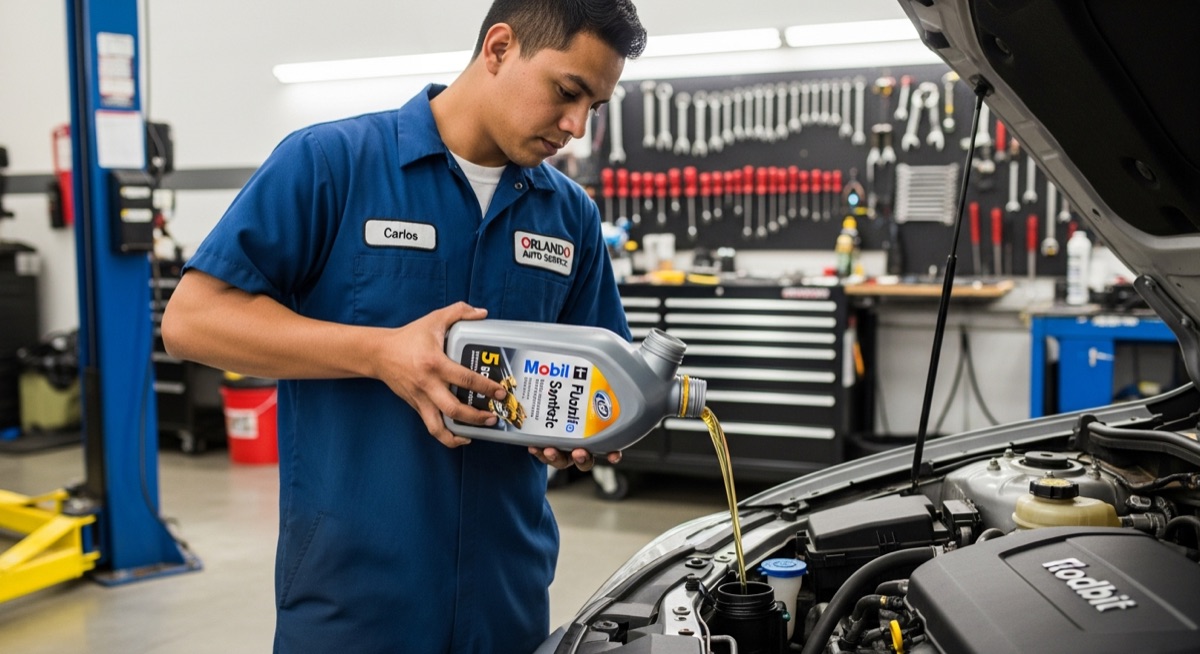
Oil level. Pull the dipstick, wipe it, reinsert, pull again. You’re not doing a full service — you’re confirming the engine isn’t running a quart low going into a high-stress weekend. Oil is both a lubricant and a secondary cooling medium for engine components coolant doesn’t reach. Top it off if needed with the grade listed on your oil cap.
Wiper blades. Turn them on and watch. Streaking or skipping? Replace them before Thursday. Florida’s afternoon thunderstorms in July are not a maybe — they’re a near-daily certainty. The return drive from Cocoa Beach or Clearwater in the 3–7 p.m. window will almost certainly involve rain, sometimes heavy. Blades cost $20 at any AutoZone or Walmart. Skipping this check is a decision to drive through highway spray and July lightning with degraded visibility. Bad trade.
Air conditioning. Run the AC at full cold for five minutes and confirm it’s actually cold. If it’s blowing lukewarm, cycling oddly, or barely keeping up, your compressor or refrigerant level has a problem. A failed AC system in stop-and-go on SR-528 in July isn’t just miserable — for children, elderly passengers, or pets, a cabin climbing into the 90s is a medical situation. Don’t discover a failed compressor at mile 40 in direct sun with no shade and miles to the next interchange.
The Tire Pressure Problem Is Specifically Worse Here
Tire pressure rises approximately 1 PSI for every 10°F increase in temperature — documented in tire manufacturer guidance and NHTSA maintenance recommendations. The practical implication for a Florida holiday run: a tire reading 32 PSI in a 72°F garage can read 36 to 38 PSI after 45 minutes on SR-528 asphalt in July, when surface temperatures can hit 130–150°F.
Two specific reasons this matters. First, overinflation shrinks the contact patch — the footprint of tire that actually touches the road. Smaller contact patch means less wet-weather grip, which matters directly because the return trip from the beach frequently runs through afternoon storms. Less rubber on wet asphalt at highway speeds is a braking problem. A real one.
Second, TPMS can throw a false low-pressure warning when a hot tire cools after you park at the beach. The rapid pressure drop as the tire cools from highway temperature can briefly trigger the warning light even when nothing is wrong. If your TPMS light comes on after parking with no visible tire problem, check pressure manually before doing anything else. A tire that reads 37 PSI hot isn’t necessarily overinflated — it may be exactly right. Deflating it to 32 PSI hot means it’ll be dangerously underinflated once it cools, which is precisely the wrong fix.
Overheating on a Holiday Toll Road
Most cars on a current maintenance schedule will make the Cocoa Beach run without incident. But here’s the specific failure mode worth understanding: stop-and-go traffic eliminates the ram-air cooling effect that manages under-hood temperatures at highway speeds, shifting the full thermal load onto your electric radiator fans. Simultaneously, your AC compressor is running near maximum demand in July ambient heat. That’s the worst combination for any cooling system operating near its margins.
On SR-528, the risk concentrates in the exposed marsh corridor east of the 417 interchange. Overheat there and you’re sitting on a narrow shoulder with no shade, no services, and a tow truck that may take a while. There’s no convenient exit to coast into.
On I-4, the trouble zone is the construction corridor from SR-408 to US-192 — the longest, most intensive stop-and-go segment of any of the three departure routes, with no realistic alternate during holiday volume.
If your temperature gauge climbs above its normal range — and you should be checking it periodically on a hot holiday run, not waiting for the warning light — the moves are straightforward. Turn off the AC to cut the compressor load, then turn the heater on full blast. It’s miserable, yes. But the heater core pulls heat from the engine coolant directly into the cabin. It works. Move right and exit at the next interchange or rest area. Do not wait for the needle to redline. On SR-528, know where your interchanges are before you leave — the gaps in the marsh section mean acting early on a rising temperature gauge is the difference between a minor detour and a full breakdown.
If steam is coming from under the hood: pull over completely, shut off the engine, and call for help. Do not open the radiator cap.
Where to Get a Same-Week Check in Orlando
Firestone Complete Auto Care on Lee Vista Boulevard sits directly in the SR-528 corridor. If you’re heading east on the Beachline, this is a logical morning-of stop. Call ahead to confirm walk-in availability — don’t assume.
Tire Kingdom has locations on Colonial Drive and S. Orange Avenue. Colonial Drive serves the I-4 corridor well; S. Orange Avenue is the better stop for drivers heading south toward FL-417. Of the chain options, Tire Kingdom tends to be straightforward about what actually needs doing versus what they’d like to sell you. That’s worth something before a holiday weekend.
Midas on Semoran Boulevard and E. Colonial covers the central and east Orlando departure zone and is well-positioned for both SR-528 and FL-417 runs.
Walmart Auto Care Centers on S. Orange Blossom Trail and in Kissimmee are the lowest-barrier option if you just need tires inflated and a quick look. Extended hours, typically open seven days. Wait times on holiday weeks can stretch, so plan for that.
Walk-in availability the week of July 4th is not guaranteed at any of these shops. Call Thursday morning. A five-minute call before noon is the difference between getting in and being told they’re booked through the weekend.
AAA members can access pre-trip inspections through approved shops, but it requires an appointment — not walk-in. If you’re a member and haven’t booked, do it today. Standalone inspection pricing, where charged, typically runs $20–$30; most multi-point inspections get bundled with a qualifying service like a tire rotation or oil change. Confirm pricing when you call.
Morning-Of: The 8 A.M. Checklist
Check tire pressure again. Cold, before the car moves, before it’s sat in direct sun. Temperature swings between night and morning can shift readings enough to matter even if you checked Thursday.
Verify coolant and oil are still reading where they were from the day-before check. If either dropped overnight, you have a leak. Don’t leave.
Open FL511 and check your corridor for incidents and construction activity. Five minutes now can reroute you around a problem you’d otherwise sit in for 45.
Confirm your E-PASS or SunPass has a current balance. Both SR-528 and FL-417 have no cash option.
Walk around the car. Look at each tire visually. Look under the car for any fluid that wasn’t there yesterday. Glance at the coolant reservoir with the hood open. This takes four minutes and catches things a checklist misses.
Leave Before the Traffic Math Turns Against You
Eastbound SR-528 to Cocoa Beach sees congestion building between 8 and 10 a.m. on July 4th. Wheels moving before 8 a.m. gives you a reasonable shot at a clear run. By 10 a.m., you’re in it.
I-4 to Clearwater Beach requires the earliest start — leave before 7:30 a.m. to clear the Orlando metro before theme-park traffic and holiday volume compound inside the construction corridor. Return congestion on I-4 eastbound through downtown can run until 10 or 11 p.m. If you’re doing Clearwater, make peace with the fact that this is a full-day commitment before you leave.
FL-417 to New Smyrna Beach is the least congested of the three. A 9 a.m. departure is still workable, though earlier is always better. The higher speeds on I-95 make those day-before tire checks non-optional.
Wait — that would duplicate the NHTSA link. Let me use the category hub link here instead.
FL-417 to New Smyrna Beach is the least congested of the three. A 9 a.m. departure is still workable, though earlier is always better. The higher speeds on I-95 make those day-before tire checks non-optional. As we cover across our automotive coverage, preparation beats roadside improvisation every time.
The return timing matters: the peak westbound window on SR-528 — roughly 6 to 9 p.m. — overlaps directly with Central Florida’s afternoon thunderstorm activity. You will almost certainly drive back from the beach in rain. Your wipers, your headlights, and a 4-second following distance all matter in that window. If you replaced those streaking blades Thursday, you’ll be glad you did.
What to Keep in the Car
Water. More than you think you need. The minimum for the drive — not the beach, the drive — is one substantial bottle per person. A breakdown on SR-528 in July without water moves from inconvenience to medical situation fast, especially for kids or elderly passengers.
A charged external battery pack. If you’re on the SR-528 shoulder with low cell signal and a dying phone, everything gets harder. A pre-charged backup battery is a $20 fix for a problem that can otherwise cascade badly.
A reflective triangle or road flares. The exposed SR-528 marsh section has poor visibility. If you’re stopped, you need to be seen.
A small bottle of pre-mixed coolant — not concentrate — takes up no meaningful trunk space. It covers one of the most common reasons drivers get stranded on a hot highway: a slow leak that finally got ahead of the system. This is not a repair. It’s an “I can reach the next interchange” measure. There’s a real difference between those two things.
Cash. SR-528 and FL-417 have no cash toll lanes, but if you exit at an interchange and need a gas station or a water run, having bills on hand removes friction at an already bad moment.
Sunscreen and a hat in the cabin, not just the beach bag. If you’re waiting roadside in direct July sun, the beach bag is in the trunk. This seems obvious until you’re standing on a highway shoulder at noon figuring out it isn’t.
Most people make this drive without incident because their car is in reasonable shape and they left early enough. But the July 4th corridor is not a normal drive — it’s a long holiday crawl in ambient heat that would stress a new car, on roads where the next exit can be miles away. Two days of prep eliminates most of that risk. Start Thursday.