How to Dispute a Mechanic Bill in Orlando Under Florida Law
A step-by-step guide to disputing a mechanic's bill in Orlando under the Motor Vehicle Repair Act.

How to Dispute a Mechanic Bill in Orlando Under Florida Law
A step-by-step guide to disputing a mechanic’s bill in Orlando under the Motor Vehicle Repair Act.
You brought your car in for a brake job. The shop quoted you $400. You came back to pick it up and the invoice says $780. The service advisor is explaining something about additional labor and a rotor they “had to” replace, and now you’re standing at a counter trying to figure out whether you’re being taken advantage of or whether this is just how car repair works.
It’s a disorienting moment. You’re not a mechanic. They are. And the car is still on their lot.
This guide is for that moment. Florida has a specific consumer protection statute — the Motor Vehicle Repair Act, Chapter 559, Part IX of the Florida Statutes — that governs exactly this situation. It imposes concrete obligations on repair shops, gives you specific legal rights when those obligations aren’t met, and opens multiple complaint and enforcement pathways. Most drivers don’t know the law exists. Most mechanics are counting on that.
Here’s what Florida law actually says, and what you can do about it in Orlando today.
The Moment the Bill Doesn’t Match the Estimate
Before getting into the statute: a difference between an estimate and a final bill is not automatically illegal. Repairs are genuinely unpredictable. A shop that quotes $400 for a brake job and discovers the calipers are seized has a legitimate reason to ask for more money. The law accounts for this.
What the law does not allow is a shop that quietly doubles your bill without telling you, without getting your approval, and without any written authorization — then refuses to release your car until you pay. That’s a potential violation of Florida Statutes §§ 559.905 and 559.904, and it entitles you to specific remedies.
The distinction that matters: did the shop contact you before doing the additional work, explain what it would cost, and get your authorization? Or did they do the work and hand you a bigger number at pickup?
The whole statute is built around that dividing line.
What the Shop Was Legally Required to Do Before Touching Your Car
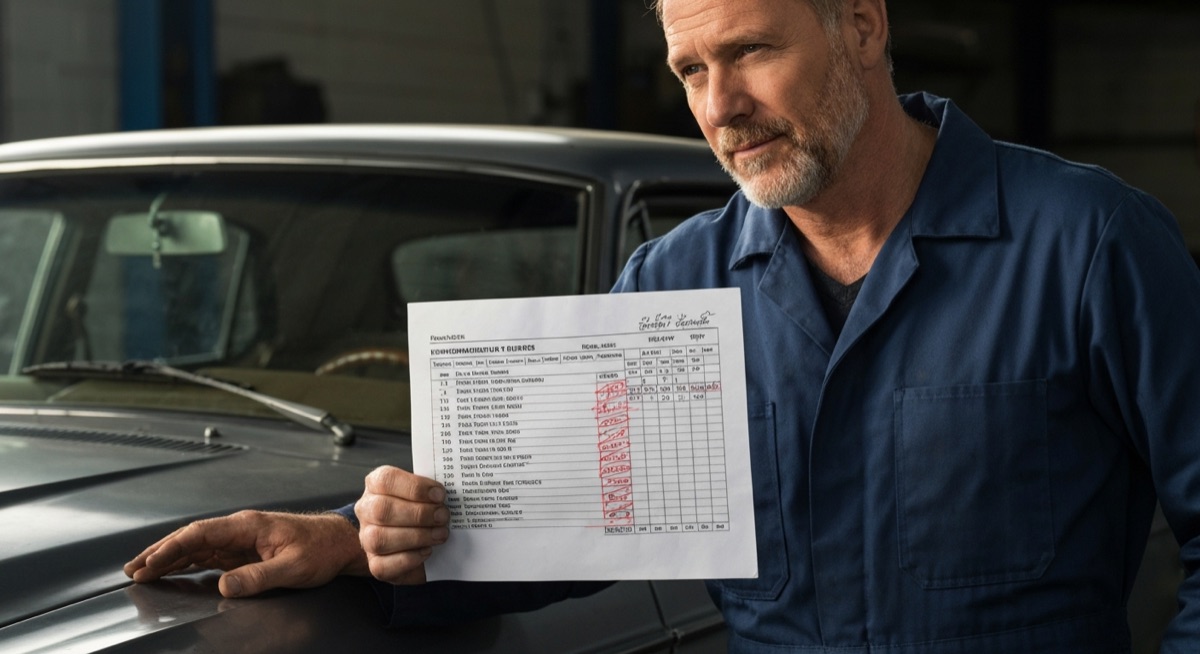
Under Florida Statutes § 559.904, any motor vehicle repair shop in Florida must provide a written estimate before beginning repair work if the cost will exceed $100. That threshold is low. It covers almost every meaningful repair.
The written estimate must include specific elements. Parts must be listed separately, identified as new, used, or rebuilt. Labor must be stated separately from parts. Environmental disposal fees, shop supply charges, and administrative fees must each be broken out. This isn’t a technicality. Bundling everything into a single line or writing “misc. charges” without explanation does not satisfy the statute. I’ve seen invoices that looked thorough and still didn’t meet this standard.
The shop cannot begin work until you’ve authorized the estimate. A verbal authorization is technically sufficient under the statute, but it becomes your problem to prove later. Get written authorization — sign the estimate directly, or send a confirming text. A text takes ten seconds and can save you hundreds of dollars.
Some repairs require partial disassembly before the shop can even produce an estimate. A transmission teardown to assess internal damage is the classic case. The law addresses this. If disassembly is required for diagnosis, the shop must tell you in writing — before disassembly begins — what the diagnostic inspection will approximately cost, and must get your authorization for that work first. Once the diagnosis is done, they provide the full repair estimate. You can authorize or decline. If you decline and want your car back, the shop can charge you the agreed diagnostic cost. Only that.
There’s no loophole for “we thought it would be quick” or “we didn’t know the total until we were done.” No exceptions.
The 10% Rule — Your Clearest Legal Lever
This is the provision most people miss entirely. It’s also the most useful one in a typical dispute.
Florida Statutes § 559.905(1) sets a hard ceiling on how much a shop can charge above the written estimate without your additional authorization. The statute says a shop may not charge more than 10% above the written estimate without first contacting you, explaining the additional cost, and getting your approval before proceeding.
Run the math on the opening scenario. Written estimate: $400. The shop may go up to $440 without calling you. Every dollar above $440 requires your explicit authorization before that work gets done. A final bill of $780 on a $400 estimate, with no documented mid-repair authorization from you, violates Florida law.
Under § 559.905(2), if a shop charges more than the authorized estimate plus the 10% allowance without getting that authorization, the customer is entitled to pay only the estimate amount plus the 10% allowance. Full stop. The shop did work beyond what you authorized. The financial exposure for that decision is theirs. With the written estimate in hand and no documented authorization for the gap, your legal liability is capped at $440, not $780. That’s not a negotiating position. That’s what the statute says.
One thing worth pinning down: the shop’s authorization has to actually reach you and result in your agreement. A voicemail they claim to have left, with no return call and no confirmed approval, does not satisfy the requirement. If they left a voicemail and you never responded, that cuts against you, so document every communication with the shop immediately and keep it.
Can They Legally Hold Your Car?
This is the question that turns a billing dispute into a crisis. The answer is: it’s complicated, and shops frequently get it wrong.
Florida law does give repair shops a lien on vehicles for unpaid repair bills, but that lien comes with procedural requirements. Under Florida Statutes § 713.585, a shop owed money for labor and materials has the right to retain possession of the vehicle until the bill is paid. That’s legitimate — it’s called a mechanic’s lien, and it exists in Florida statute. But the lien process requires the shop to provide the customer with written notice, follow specific procedures if they intend to sell the vehicle to satisfy the lien, and comply with statutory timeframes. A shop that holds your vehicle for a disputed charge while failing to follow these procedures may itself violate the Motor Vehicle Repair Act — as may a shop that holds the car as leverage while refusing to itemize what you owe or why.
When your car is being held, you have options. You can post a bond equal to the disputed lien amount through a surety company to secure release of the vehicle while the dispute continues. That costs money upfront but gets your car back. If the lien is procedurally defective, a court can issue an injunction requiring the shop to release the vehicle — this means filing in circuit court and generally benefits from an attorney. Central Florida Legal Aid handles qualifying cases at no cost.
Do not simply pay the inflated bill under duress and plan to dispute it later unless you’re genuinely out of options. Paying can complicate your case, though a credit card chargeback may still be available. Document every interaction before you pay anything.
Before You File Anything — Two Things to Do Right Now
The most common reason a legitimate auto repair dispute fails is that the customer can’t produce the original written estimate. Everything else in this article depends on that document.
Before you contact any agency, gather everything you have: the original written estimate, signed or with your authorization noted; the final invoice; all texts, emails, and voicemails between you and the shop, especially anything involving authorization for additional work; photographs of your vehicle at drop-off and pickup if you have them; and payment records. Keep the originals. Make copies.
Also worth knowing: Florida Statutes § 559.911 requires the shop to return replaced parts to you on request, unless those parts are going back to the supplier under a warranty or core charge exchange. If you asked for your old parts and didn’t get them, that’s an independent violation. Document it.
Once you’ve assembled that package, write a letter to the shop’s owner or general manager — not the service advisor. The letter should identify the specific dollar difference between the written estimate and the final bill, cite Florida Statutes § 559.905 and the 10% rule by name, and state that you intend to file a complaint with the Florida Department of Agriculture and Consumer Services if the matter isn’t resolved within a specific deadline.
Send it by email and certified mail. Keep copies.
This step does real work. A shop that knows a complaint is coming — and that a substantiated FDACS violation can mean civil penalties and license action — frequently agrees to a partial or full adjustment before anything is formally filed. Many disputes that customers assume will require court end right here.
How to File an FDACS Complaint — and What It Will Actually Do
The Florida Department of Agriculture and Consumer Services is the primary enforcement agency for the Motor Vehicle Repair Act. Its Division of Consumer Services handles complaints against auto repair shops statewide.
You can file by phone at 1-800-HELP-FLA (1-800-435-7352), Monday through Friday, 8 a.m. to 5 p.m. The faster route is the online portal at fdacs.gov. Navigate to Consumer Services, locate the complaint form, and attach everything — written estimate, final invoice, authorization records, photos. Upload it all.
FDACS can investigate, contact the repair shop, and attempt mediation. If mediation produces an agreement, FDACS documents it. If the shop is found to have violated the Motor Vehicle Repair Act, FDACS can pursue enforcement including civil penalties, registration suspension, or revocation. A shop’s registration is its license to operate. That’s real.
Here’s the honest part about what FDACS mediation usually produces: partial adjustments to disputed bills, not full refunds. The agency’s goal in mediation is resolution, not adjudication. If you want a legal determination that the shop violated the statute and that you’re owed a specific amount, that determination happens in court. But the complaint still has value — a shop with a pending FDACS investigation has a strong incentive to settle, because a substantiated finding goes on its agency record and can trigger license consequences.
When filing, specify Orange County as your county of residence and the county where the repair occurred. FDACS routes Orange County complaints through its Central Florida district operations in Orlando.
The Credit Card Chargeback — A Parallel Tool Most People Overlook
If you paid any portion of the disputed charge with a credit card, you have an independent remedy that runs parallel to your FDACS complaint or any court filing: a chargeback dispute with your card issuer.
Under the Fair Credit Billing Act, cardholders can dispute billing errors and, in some circumstances, charges for services not rendered as agreed. A repair charge that substantially exceeded an authorized estimate can qualify. The card issuer investigates, contacts the merchant, and can reverse the charge if the dispute is substantiated.
Contact your card issuer’s dispute department as soon as possible. Chargeback windows are time-limited — check your card’s specific terms for the deadline. Provide the same documentation package you’ve already assembled: written estimate, final invoice, authorization records, a brief explanation of the overrun and why it wasn’t authorized under Florida law. The merchant can respond with their own documentation. The card issuer decides.
If the chargeback is approved, the charge is reversed and the shop must pursue payment through other means — which, in a case where they may have violated § 559.905, they may not be eager to do.
If you’re pursuing a chargeback alongside an FDACS complaint or small claims filing, coordinate carefully. An approved chargeback affects the amount in dispute for other proceedings. Talk to a consumer attorney if you’re running multiple tracks at once.
Small Claims Court in Orange County — When and How
When the demand letter and FDACS complaint don’t resolve things — or when you want an actual judicial determination of what you legally owe — small claims court is the most accessible forum. Florida recently raised its small claims dollar threshold, so confirm the current ceiling with the Orange County Clerk of Courts before filing. The Legislature has adjusted this figure in recent sessions.
Small claims cases are filed at the Orange County Courthouse, 425 N. Orange Avenue, Orlando, FL 32801. Filing fees vary based on the claim amount; check the current schedule at myorangeclerk.com or call the Clerk’s office. The website has a self-help section with forms and instructions. You don’t need an attorney.
The process: file the claim, serve the defendant shop, attend a pretrial hearing where a mediator attempts settlement, and if that fails, a hearing before a judge. For a well-documented auto repair dispute — written estimate in hand, final invoice showing the overrun, nothing from the shop authorizing the difference — the case often settles at pretrial mediation before it ever reaches a judge.
One thing changes the economics of even small disputes: Florida’s Deceptive and Unfair Trade Practices Act, FDUTPA, Chapter 501. FDUTPA prohibits unfair or deceptive trade practices and allows a prevailing consumer to recover attorney’s fees from the defendant business. A shop that violated the Motor Vehicle Repair Act may also have committed a deceptive trade practice. An Orlando consumer attorney who handles FDUTPA cases can take a case on a contingency or fee-shifting basis because the attorney’s fees, if you prevail, are collectible from the shop. A $380 overrun that would otherwise be impractical to litigate becomes viable when the shop is potentially on the hook for legal fees if they lose.
The Orange County Bar Association’s lawyer referral service can connect you with someone who handles consumer protection matters. Central Florida Legal Aid serves income-qualifying residents at no cost. As we cover in our automotive coverage, consumers who know the relevant statutes by name consistently fare better in these disputes than those who don’t.
What to Realistically Expect
I want to be straight about what each of these pathways actually delivers, because “you have legal rights” and “you get your money back” are not the same thing.
A well-drafted demand letter with an FDACS complaint threat, backed by clean documentation, frequently produces an offer — usually not a full adjustment, but a meaningful reduction. The shop’s motivation is simple: they don’t want a formal complaint on their FDACS record. If you have the written estimate and can show there was no authorization for the overrun, the letter has real teeth.
FDACS mediation, when it works, tends to produce partial adjustments. A shop agrees to reduce the bill by some amount, not necessarily down to the estimate plus 10%. FDACS can mediate and pursue enforcement separately; it can’t order a refund. The enforcement track moves slowly. If your goal is money back rather than accountability, treat FDACS as one tool alongside others.
Credit card chargebacks can be effective where payment was made by card and the documentation is clean. The card issuer isn’t applying Florida law — they’re applying the Fair Credit Billing Act and their own dispute procedures. A shop that can’t produce a signed authorization for additional work is in a weak position in that investigation.
Small claims court is genuinely effective for well-documented cases. The pretrial mediation step gives the shop one more opportunity to settle before a judge sees it. If it does reach a judge and you have a written estimate plus nothing from the shop showing authorization for the overrun, you’re in a strong position.
The single factor that determines the outcome in almost every pathway: whether you have the written estimate. Customers who prevail almost always have it. Customers who don’t, almost never do. If you’re reading this before your car is even in the shop — maybe a friend just went through this and sent you the link — get a written estimate and keep a copy before you leave. That one habit is worth more than everything else in this article.
Orlando Resources
Florida Department of Agriculture and Consumer Services — Division of Consumer Services fdacs.gov | 1-800-HELP-FLA (1-800-435-7352) | Monday–Friday, 8 a.m.–5 p.m. The primary state agency for Motor Vehicle Repair Act complaints. File your complaint here first. When filing, specify Orange County as your county to route correctly to the Central Florida district office in Orlando.
Orange County Courthouse — Small Claims Filing 425 N. Orange Avenue, Orlando, FL 32801 myorangeclerk.com Confirm the current small claims dollar ceiling and filing fee schedule at the Clerk’s website or by calling the office. The Clerk’s self-help center assists unrepresented filers with forms and procedural questions.
Orange County Bar Association — Lawyer Referral Service ocbanet.org Connects consumers with attorneys who handle consumer protection, FDUTPA, and Motor Vehicle Repair Act cases.
Central Florida Legal Aid Free civil legal assistance for income-qualifying Orange County residents, including auto repair disputes. Current contact information and income eligibility guidelines at the organization’s website or through the Florida Bar’s referral resources.
Florida Legal Services — Orlando floridalegal.org Statewide civil legal services organization with an Orlando presence. Assists low-income Floridians with consumer matters and maintains consumer rights resources useful regardless of income level.
The Motor Vehicle Repair Act exists because the Florida Legislature recognized an obvious problem: the shop knows what’s under the hood and you don’t. The statute tries to rebalance that by requiring transparency before work begins and authorization before costs escalate. When a shop skips those steps, you have real options — more than most people realize, and more than most shops want you to know. The question is whether you have the paperwork to use them.