What to Do If Your Car Floods in Orlando During a Storm
Florida's hurricane and rainy season opened June 1. A step-by-step guide for Orange County drivers on the coverage gap most people discover too late, what the next 30 minutes cost you, and which ro…

What to Do If Your Car Floods in Orlando During a Storm
Florida’s hurricane and rainy season opened June 1. A step-by-step guide for Orange County drivers on the coverage gap most people discover too late, what the next 30 minutes cost you, and which roads to avoid before the next storm.
If you’re reading this because water is already rising around your car, skip to Section 3 right now: do not turn the key. That single mistake is what separates a $4,000 insurance claim from a $12,000 total loss.
For everyone else — and there will be more of you before September — this is the guide that local news has largely failed to provide. National insurance explainers don’t address Florida’s specific coverage rules. Hurricane content focuses on property, not vehicles. And the afternoon convective storms that dump three inches on Pine Hills in forty minutes don’t wait for a named storm to cause real damage. They just show up on a Tuesday.
Here’s what you actually need to know.
Know Before It Happens: Orlando’s Repeat Flood Roads
Orlando’s flooding problem is baked into its geography. The city sits on flat, sandy substrate with a high water table, and much of Orange County’s western and eastern unincorporated neighborhoods were built with stormwater infrastructure that wasn’t designed for the intensity of modern convective systems. When a fast-moving afternoon storm drops heavy rain over an area that can’t drain it quickly, cars pay the price. This isn’t a once-a-decade problem. It’s a June-through-September problem.
These are the corridors that flood regularly enough that every local driver should know them by name:
John Young Parkway underpasses near Oak Ridge Road. Among the most reliably dangerous spots in the city. The grade dips sharply at several crossing points, and the underpass geometry traps water faster than it can drain. Drivers catch a green light and roll into what looks like a passable puddle. It isn’t. More than one Orlando mechanic has described this stretch as “the car wash that totals your engine,” and they’re not joking.
The I-4 stretch between SR-408 and SR-528. Longtime locals call it “the bowl.” It collects runoff from elevated sections of the interchange and can sheet-flood lanes faster than FDOT’s overhead signs can warn approaching traffic. This is highway-speed territory. Drivers are going 65 when the water appears.
Pine Hills residential streets near Raleigh Street. Low-lying terrain, storm drains that overwhelm during fast afternoon cells, older housing stock, narrow streets, and topography that funnels water toward the same blocks year after year.
Azalea Park near the Chickasaw Trail corridor. Lake-adjacent grades and older drainage infrastructure. Localized flooding can leave cars sitting in a foot or more of water along streets that looked dry an hour earlier — which is what makes it disorienting when it happens.
The Conway and Hoffner Avenue area. Near the chain of lakes south of downtown, low-grade road sections sit close to lake elevation. After sustained rain, the margin between dry road and standing water disappears fast.
None of these locations requires a hurricane. A strong afternoon storm in July — the kind that forms over the Gulf, rolls inland, and drops concentrated rainfall over a single ZIP code — is sufficient. From May through September, treat these corridors with real caution, not just vague awareness.
The Coverage Gap That Wipes Out Orlando Drivers
Before we get to what to do, you need to understand whether your insurance will pay for anything. This is the part most people skip, and it’s the part that costs them the most.
Florida law requires drivers to carry property damage liability and personal injury protection. It does not require comprehensive coverage. That means a driver carrying the state minimum — perfectly legal — has zero flood protection. Not a dollar.
Flood damage to your vehicle is covered only by comprehensive coverage, which appears on your declarations page as “other than collision.” This single component covers weather events, flooding, hurricane wind, falling objects, fire, and theft. If that line doesn’t appear on your dec page, a flooded car is entirely your financial problem.
This gap is not hypothetical. In higher-rate ZIP codes like 32808 (Pine Hills) and 32822 (Azalea Park) — two of the repeat flood corridors named above — comprehensive coverage gets dropped regularly to reduce premiums. The math isn’t irrational: if you’re paying $180 a month for full coverage on a twelve-year-old Camry worth $8,000, dropping comprehensive and collision saves real money. The problem is that the exposure is invisible until the afternoon a storm stalls over Raleigh Street.
The particular irony: lender-required policies mandate comprehensive, which means this gap hits hardest on paid-off older vehicles. If you still owe on your car, your lender already forced the coverage. If you paid it off two years ago and quietly dropped comp to save money, you may not know it’s gone until you’re standing in a parking lot watching the water rise. Call your insurer or an independent broker and find out what adding comprehensive would actually cost — this is one of the recurring themes in our automotive coverage that local drivers consistently underestimate. It’s probably less than you expect.
Step 1: Do Not Start the Engine
If your car has been in standing water, do not attempt to start it.
Modern car engines draw air through an intake that sits low in the engine bay — often near the front bumper or wheel well. In normal operation, fine. When water enters the intake, the engine draws liquid into the cylinders instead of air. Water doesn’t compress. On the compression stroke, the connecting rods — the steel components that transfer force from pistons to the crankshaft — are built for a compressible medium. When they hit water instead, they bend or snap. This is called hydrolocking, and it turns a potentially repairable situation into near-certain total loss. One turn of the key.
The financial stakes are straightforward. A car with water damage limited to the interior — soaked carpet, wet seat padding, damp insulation — typically costs $1,500 to $5,000 to repair with professional drying and remediation. A hydrolocked engine adds $4,000 to $12,000 in engine replacement on top of that. What would have been a repair claim becomes a total-loss declaration.
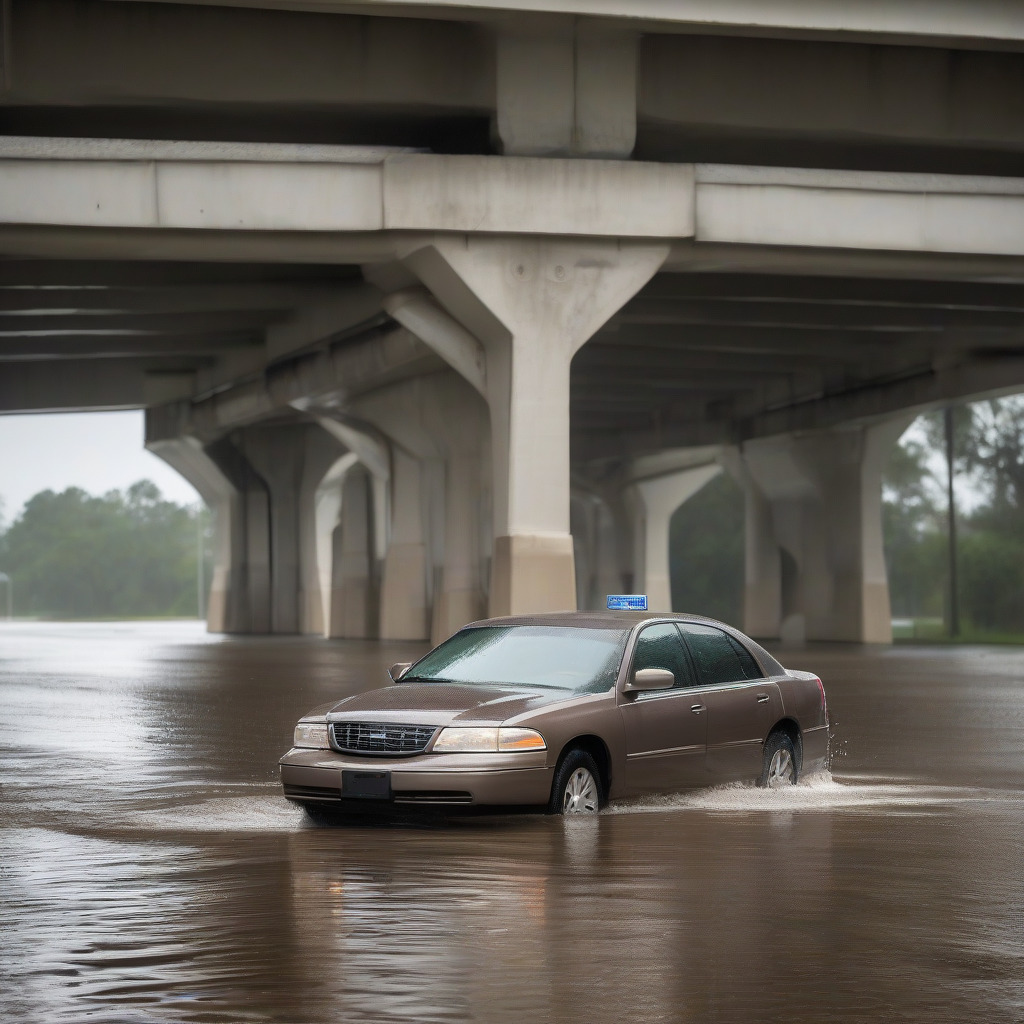
Water level tells you how much risk you’re carrying. Above the door sill but below the dash: tow it immediately, don’t touch the key. Water reached the engine’s air intake: stop moving the car. Above the hood line on a running engine: it’s almost certainly a total loss regardless of what you do next.
The practical rule: if the car sat in standing water at any level while you were away from it, treat it as a hydrolock candidate until a mechanic says otherwise. The cost of caution is a tow truck. The cost of overconfidence is an engine.
Step 2: Document Everything Before the Tow Truck Arrives
The thirty minutes before the tow truck arrives are the most important thirty minutes of your insurance claim. Evidence disappears fast in Central Florida’s humidity, and adjusters work from what you can show them, not what you remember.
Photograph the water-line tide marks on the exterior door panels and lower windows. These marks are left by sediment and debris as water recedes, and they’re the adjuster’s most reliable indicator of how high water reached. They dry and fade within hours in Florida heat. Get them on camera before the car moves.
Photograph the interior before any cleanup. Don’t pull out floor mats or start blotting up water. I know it feels like the right thing to do. Don’t. The interior in its saturated state — visible waterlines on seats, standing water on the floor, marks on door panels — is documentation. A dry, cleaned-out interior is a dispute waiting to happen.
Capture the VIN plate (lower left corner of the windshield) and the odometer reading in the same session. If the car becomes a total-loss claim, these numbers matter for the actual cash value calculation and title transfer. Note the exact time and location. If Florida’s insurance commissioner issues a catastrophe declaration for the weather event, your claim processing changes. Different statutory timelines apply, and your documentation needs to tie your damage to the declared event. A note in your phone is sufficient.
One thing people almost always skip: if the car sits in Central Florida summer air for more than 48 hours before professional drying begins, mold growth is essentially certain. Orlando in July — 85-plus degrees, 80-plus percent humidity — is a perfect mold incubator. Insurers may dispute mold remediation costs if they can show the owner delayed getting the vehicle to a drying facility. Document when you made the tow call. Document when the shop received the car. That timeline matters more than it should.
Step 3: Call Your Insurer, Then Understand What Happens Next in Florida
Once the documentation is done and the tow is arranged, call your insurer. A few specifics apply to the Orlando market.
The major carriers in Orange County — State Farm, Progressive, GEICO, AAA Auto Club South, and Allstate — all handle flood claims through direct repair program (DRP) shops. These are shops with a standing relationship with the insurer, which typically means faster appraiser assignment, quicker parts authorization, and less friction on estimates. When you call to open the claim, ask immediately: “What shops are on your DRP list in the Orlando area?” Getting the car to a DRP shop can cut the assessment timeline, especially after a storm when independent shops are managing a surge of vehicles.
For flood work specifically, ask any shop whether they’ve handled post-storm volume and what their drying equipment consists of. Industrial dehumidifiers and air movers running continuously for 48 to 72 hours are the baseline for serious interior remediation. If a shop can’t describe their process, find one that can.
Know this vocabulary before you call your adjuster: ACV (actual cash value — what the insurer says your car is worth); proof of loss (the formal document that starts the statutory clock); total loss threshold (Florida-specific, explained below); DRP shop (direct repair program). Using these terms correctly changes the tone of the conversation. Adjusters move differently when they realize you’ve done your homework.
For current specifics on insurer response obligations and how Florida’s 2023 insurance reform legislation affects auto comprehensive claims, contact the Florida Office of Insurance Regulation directly at floir.com.
Step 4: Interior Damage vs. Engine Damage and What It Means for Your Claim
Adjusters approach flood claims in tiers based on where water reached. Knowing these tiers before you talk to your adjuster means you can tell whether an estimate is reasonable or whether you need to push back.
Water entering the cabin but stopping at carpet and seat level is recoverable. Professional drying, ozone treatment, carpet padding replacement, and electrical testing typically run $1,500 to $5,000 depending on vehicle size and shop rates. Timing is the critical variable — the sooner drying starts, the better.
Water above the door sill reaching the ECU, fuse boxes, and wiring harnesses is where repair costs climb fast. Modern vehicles carry 50 to 150 electronic control modules covering climate control, stability control, transmission, airbags, and more. Water intrusion at this level means diagnostic scanning of every module, replacement of compromised wiring, and potential ECU replacement. Estimates in this tier typically run $3,000 to $8,000 or more. The hidden problem is that corrosion-related failures show up weeks after the initial event — a car that seems fine on the lot develops issues in August. Shops experienced with flood work will flag this explicitly in their estimate. If yours doesn’t mention it, ask why not.
A hydrolocked or fully submerged engine means engine replacement plus all of the above. On vehicles with an actual cash value under $20,000, this almost always results in a total-loss declaration.
Step 5: How to Read a Total-Loss Declaration and What Comes Next
Florida law sets a total-loss threshold under Fla. Stat. § 319.30: if repair costs reach a defined percentage of the vehicle’s actual cash value, the insurer must declare it a total loss. Verify the current threshold with your insurer or the Florida OIR, as Florida’s 2023 legislative session changed portions of the insurance code. What matters practically: Florida’s threshold has historically been lower than most other states, which means Florida drivers are more likely to find a repairable-seeming vehicle declared a total loss. That’s a gut punch when you were expecting a repair estimate.
When a total-loss declaration comes through, the insurer takes title to the salvage vehicle and initiates transfer through Florida DHSMV. That process typically adds two to four weeks to your settlement timeline on top of the claim resolution period. You’re not driving during this time.
Here’s what catches people off guard: rental car coverage, if you purchased it, typically terminates at the date of the total-loss declaration — not the date of settlement. There’s often a two-to-four week gap between declaration and when you actually have settlement funds to buy another car. Drivers find out about this when the rental company calls to say the insurer stopped paying. If you’re in a total-loss situation, ask your adjuster the day of declaration: “When does my rental coverage end?” Get the answer in writing. Then plan around it.
A salvage title permanently marks a vehicle in Florida’s system. A rebuilt vehicle can be re-titled with a “rebuilt” designation after inspection, but that designation follows it forever, affecting resale value and creating complications with future insurance. Many carriers won’t write comprehensive coverage on a rebuilt-title vehicle. If you’re weighing whether to accept a low settlement and rebuild the car yourself, talk to a mechanic and an independent broker before you decide. The numbers often don’t work the way people expect.
Disputing the ACV is the most common point of friction in total-loss settlements, and it’s where people routinely leave money on the table. Florida drivers have the right to request the comparable vehicle data the insurer used to calculate ACV — the specific comps, their condition ratings, and their market locations. If those comps are for vehicles in poor condition or pulled from markets with lower values than Central Florida, that’s a legitimate basis for dispute. Independent appraisal is available under most policies. Don’t sign off on an ACV figure without reviewing the comps. It takes an hour.
How Long Will This Actually Take in Orlando
Realistic timelines, with the honest caveat that post-storm claims can run long:
A standard comprehensive flood claim typically sees adjuster contact within three to five business days of opening, with resolution within 30 days of proof-of-loss submission. DRP shops generally move faster than independents because the appraiser relationship is already in place.
Post-catastrophe declaration events run on a different calendar entirely. After Hurricane Ian in 2022, total-loss settlements in Orange and Osceola counties stretched to six to twelve weeks from claim opening. Repair claims ran longer due to parts backlogs and shop capacity. Florida’s extended statutory windows for catastrophe events give insurers more time to respond — so the period after a named storm landfall is genuinely the worst time to need a quick resolution. If you’ve been through it, you already know.
If you’re hitting walls with a complex or stalled claim, the Florida Office of Insurance Regulation and the Florida Department of Financial Services Division of Consumer Services both handle insurer complaint escalation. These contacts produce results when claims are genuinely stalled beyond statutory windows. Reach them at floir.com and myfloridacfo.com.
What to Do Right Now If You’re Not Sure You Have the Right Coverage
Pull your declarations page today. Look for “comprehensive” or “other than collision” in the coverage list. If it’s not there, you have no flood protection. Call your insurer or an independent broker this week — not after the next storm system forms in the Gulf.
Check your regular routes against the corridors listed above. If you drive through the John Young/Oak Ridge underpass area, the Conway/Hoffner lake grade zone, or the residential Pine Hills streets near Raleigh Street, you’re in elevated-risk territory during any serious afternoon storm from May through September. That’s not alarmism. That’s just the local geography doing what it does every summer.
Look up your property’s FEMA flood zone designation through the Orange County Property Appraiser site (ocpafl.org) or FEMA’s Flood Map Service Center. Even if your home isn’t in a designated flood zone, the roads you drive through may be. That’s the relevant risk for your car.
If you have comprehensive on a paid-off vehicle, verify the coverage limit reflects what the car is actually worth now. Insurer-assigned ACV in a total-loss situation is based on market value at time of loss, and used car values have moved considerably over the past three years. It’s worth knowing what you’d actually receive before you have to find out.
Set a calendar reminder to revisit this in October. Peak storm season runs through late September. The coverage you need is cheap relative to the loss you’re avoiding. The documentation takes twenty minutes. The roads to avoid are the same ones that flood every summer.
For current Florida insurance questions, contact the Florida Office of Insurance Regulation at floir.com or the Department of Financial Services Division of Consumer Services at myfloridacfo.com. FEMA flood zone maps are available at msc.fema.gov. Orange County property and zone information is available at ocpafl.org.