How to Prepare Your Orlando Small Business for Hurricane Season
Before the season peaks, there's still time to close the gaps that turned survivable storms into business-ending events for owners across Orange County. Here's what to do, in order, before August.

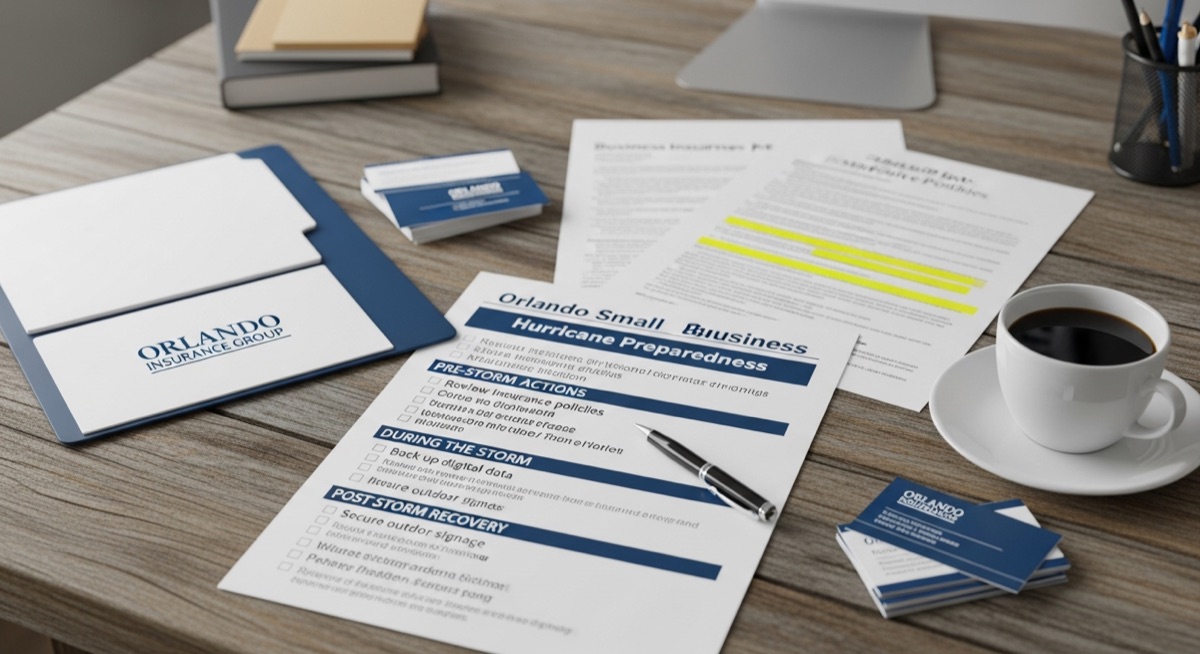
How to Prepare Your Orlando Small Business for Hurricane Season
Before the season peaks, there’s still time to close the gaps that turned survivable storms into business-ending events for owners across Orange County. Here’s what to do, in order, before August.
If you own a small business in Orlando and your hurricane preparedness plan consists of boarding the windows, moving inventory off the floor, and waiting for the lights to come back on, you’re not prepared. You’re betting that your policy covers what you assume it covers. You’re betting that your generator will be permitted and running before the season peaks. You’re betting that you’ll be able to reconstruct your financial records while your neighbors are filing claims with incomplete paperwork and no flood policy.
Those are losing bets.
Hurricane Irma in 2017 and Hurricane Ian in 2022 showed that Orlando’s 60-mile inland cushion isn’t a shield — it’s a false sense of security that has cost Central Florida business owners real money. Uninsured flood losses. Business interruption claims that never paid because the trigger wasn’t met. SBA disaster loan applications that stalled because the owner couldn’t produce three years of tax returns from a flooded office.
This isn’t a FEMA checklist. It’s a step-by-step guide to the specific coverage questions, permit requirements, and document obligations that apply to small businesses operating in Orange County right now. If you’re reading this in June, you still have time to act on most of what follows. By August, several of these windows will have closed.
Stop Assuming Distance Protects You
Orlando sits roughly 60 miles from either coast. That geography breeds complacency — and honestly, it’s understandable. But Central Florida’s topography is the problem, not the solution. The region is almost entirely flat, with aging stormwater infrastructure that can’t handle sustained rainfall from a slow-moving storm.
When Ian made landfall in late September 2022, the storm’s remnants produced significant flooding across parts of Orange County. Businesses in the Dr. Phillips, MetroWest, and Lake Nona corridors experienced flooding, signage destruction, and roof damage. Power outages stretched five to fourteen days in some areas served by OUC and Duke Energy.
Irma, five years earlier, knocked out power across Orange County commercial corridors for a week or more. Roof and signage losses were widespread, including in areas that sustained no structural wind damage — only sustained tropical-force gusts. If you rode that one out thinking you got lucky because you were “inland,” that’s exactly the mindset this article is trying to interrupt.
The primary threat to an Orlando small business isn’t a direct hit. It’s an extended power outage. It’s inland flooding from flat drainage that has nowhere to go. Most consequentially, it’s the insurance gaps that transform a manageable disruption into a closure that never reverses. Peak risk runs mid-August through October. The last viable window to address most of the steps below is June.
Step 1: Pull Your Commercial Policy and Read These Four Lines Before Anything Else
Before you buy anything, install anything, or call anyone, locate your commercial insurance declarations page and your full endorsement schedule. If you can’t find the physical policy, call your broker today and request the complete document. Not a summary. The full policy with all endorsements.
The first provision you need to understand is your named-storm deductible. In Florida, commercial property policies typically carry a hurricane or named-storm deductible calculated as a percentage of the insured building value — commonly 2 to 5 percent — rather than a flat dollar amount. If your building is insured for $500,000, your named-storm deductible may be $10,000 to $25,000. That threshold must be met before coverage activates for any structural or contents claim. Many Orlando business owners don’t know their policy works this way until they file a claim and receive a partial payment — or nothing at all. That’s a bad moment to find out.
Your business interruption coverage almost certainly requires direct physical loss or damage to your insured property as the trigger. No physical damage means no BI claim, regardless of how many days you’re closed. This becomes critical when the power is out but your building is intact.
Some policies include a utility interruption endorsement — off-premises power coverage. This is a separate endorsement that determines whether your coverage extends to losses caused by power outages originating outside your property. If it isn’t listed on your declarations page, you don’t have it.
Every standard commercial property policy in Florida excludes flood. The exclusion isn’t buried in fine print — it’s a foundational exclusion in the policy structure. Storm surge, rising water, inland drainage overflow: no coverage unless you carry a separate flood policy through the National Flood Insurance Program or a private flood insurer, with its own limits and claims process.
This review is pre-storm work. Discovering these provisions during a claims conversation after a storm isn’t a coverage dispute. It’s simply reading the policy you already agreed to.
Step 2: Understand the Business Interruption Coverage Gap That Hit Orlando Hard After Ian
This is the most consequential thing in this article. It’s also the gap that most surprised Orlando small business owners after Ian — and “surprised” is a polite word for what happened to some of them.
Standard business interruption insurance compensates you for lost revenue and continuing fixed expenses — rent, payroll, loan payments — when your business is closed due to a covered loss. The operative phrase is “covered loss.” Because standard BI requires physical damage to your insured property as the trigger, a business that loses ten days of revenue because OUC or Duke Energy hasn’t restored power, but whose building has no structural damage, typically has no BI claim. The lights are off. The refrigerated inventory is gone. The staff has been sent home for two weeks. If the roof is intact and the walls are standing, the standard policy pays nothing for that.
After Ian, this played out across Orange County with particular force in corridors where power outages outlasted any structural repairs. Restaurant strips on Sand Lake Road sat dark for a week or more with no covered loss and no BI payment. Retail operations in MetroWest. Offices throughout commercial Orange County — closed, losing money, and uninsured for that specific loss. I’ve talked to owners who genuinely didn’t believe this was how their policy worked, right up until the adjuster explained it.
Two endorsements address this gap. Get both if you don’t already have them.
The utility interruption endorsement (also called off-premises power interruption coverage) extends BI coverage to losses caused by a power outage from a utility provider outside your property. It typically includes a 72-hour waiting period before coverage activates, so the first three days of a power-related closure aren’t covered. But days four through fourteen are — and given that OUC and Duke Energy outages after Ian lasted five to fourteen days in parts of Orange County, this endorsement is the difference between a partial recovery and none. If your broker tells you it’s not available or not worth it, get a second opinion.
Contingent business interruption coverage addresses a different exposure. If your business depends on a regional distributor, a key supplier, or a facility operated by someone else — a commercial kitchen you rent, a central warehouse, a regional food distributor serving the I-Drive corridor — and that operation is disrupted by the storm, your losses likely aren’t covered under standard BI. A contingent BI endorsement extends coverage to losses caused by damage to those dependent operations. It’s not a standard add-on; you have to ask for it specifically.
The 72-hour waiting period also intersects with mandatory evacuation orders in ways that caught several owners off guard after Ian. If Orange County issues a mandatory evacuation and you close for three days before the storm arrives, those days fall outside the waiting period window. Your BI coverage, if it activates at all, starts counting from when the power outage begins — not from when you made the decision to close.
Before the end of June, sit down with an independent commercial insurance broker who works Central Florida commercial lines. Ask specifically: Do I have a utility interruption endorsement, and what’s the waiting period? What is my named-storm deductible in dollar terms based on my current insured value? Is my building insured to replacement cost or actual cash value, and when was that value last updated? Do I have flood coverage?
The answers determine your actual financial exposure. For a deeper look at how recent Florida insurance legislation affects these calculations, Florida property insurance rate increases and what they mean for you is worth reading before that broker meeting. You don’t want to find out in October.
Step 3: Apply for Your Generator Permit Now, Not in August
Commercial generator installation in Orlando isn’t a purchase decision. It’s a permitting process, and it takes longer than most owners expect.
In areas within incorporated Orlando — downtown, College Park, SoDo, Parramore — commercial electrical permits are processed through the City of Orlando Building Division at (407) 246-2271. In unincorporated Orange County — Dr. Phillips, MetroWest, Pine Hills, parts of Apopka, and most of the tourist corridor — permitting runs through Orange County Development Services at (407) 836-5550.
Plan for a two-to-six week processing window during non-emergency periods. That can extend further for larger generators requiring engineered load calculations — which is exactly what you’ll need if you’re running HVAC, refrigeration, and lighting simultaneously for a restaurant or food service operation. The load calculation must be prepared and stamped by a licensed engineer and submitted with the permit application. That engineering step alone adds two to three weeks.
The permit covers more than the generator itself. Installation requires a licensed electrical contractor. The automatic transfer switch — which disconnects your building from the utility grid before the generator activates, protecting utility workers and your equipment — requires a separate electrical inspection that must pass before the system can be used commercially. If you’re running diesel or large propane, fuel storage above certain volume thresholds triggers an inspection by Orange County Fire Rescue under state fire code. Confirm the threshold with your contractor before you finalize anything.
One thing owners near residential zones consistently underestimate: noise. Ivanhoe Village, the Milk District, College Park, parts of Baldwin Park — 24/7 generator operation during storm recovery can trigger Orlando’s nighttime commercial noise ordinance. Complaints during the recovery period are common. A code enforcement action while you’re trying to reopen is a problem you genuinely don’t need. Ask about decibel-rated enclosures before you buy the equipment.
A business owner reading this in early June who hasn’t started the permit process is looking at a realistic installation date of mid-to-late July — assuming no delays, no contractor scheduling problems, no revision requests. That leaves a month of buffer before peak season. Wait until July and you’ll be joining an August installation queue with contractors already booked. Start the application now.
Step 4: Build a Business Continuity Plan That Reflects Your Orlando Operation
Federal templates for business continuity plans are written for everyone, which means they’re written for no one in particular. An Orlando retail or restaurant operation in a flood-prone corridor needs a plan calibrated to local conditions.
Map your power dependency first and be specific about it. Identify which functions require on-site power and which can operate remotely or be suspended. A restaurant’s core operation is entirely power-dependent — no walk-in coolers, no stove, no POS means no service. A professional services firm can sustain certain client functions on laptops and mobile hotspots from a temporary location. That distinction drives your generator sizing and your continuity options. Get clear on it before you buy hardware.
Establish communication protocols before a named storm is 72 hours out. When a storm enters the Gulf or approaches from the east and Central Florida is within the five-day cone, activate your protocol. Don’t wait until the storm is 24 hours out and your employees are buying water. By then you’ve already lost the window for organized communication. Your protocol should cover how employees receive status updates and return-to-work notices, how customers are notified of closure and reopening, and how you’ll reach key vendors and suppliers. All contact information should be stored off-site and accessible without power or a local internet connection. Phone trees on paper, not just in your phone.
Map your specific flood risk using Orange County’s stormwater management portal and FEMA’s flood mapping resources. Both provide parcel-level flood zone data. Ian showed that even parcels in moderate-risk zones can experience flooding when a slow-moving storm stalls over flat terrain.
Identify backup suppliers now. Businesses on the I-Drive corridor, OBT, and Mills 50 that depend on regional distributors — food, restaurant supply, specialty retail inventory — should identify at least one alternative source before the season. Regional distribution hubs routinely take days to resume normal operations after a storm. That disruption isn’t a covered BI event under most standard policies.
Document your reopening sequence as a checklist. After a storm, the question isn’t just when power returns — it’s when your building is cleared for reentry. Orange County requires post-storm inspection and clearance for commercial properties with structural or flooding damage before employees can reenter. OUC restoration confirmations are available by address on OUC’s outage map. Build these steps into your plan explicitly.
If your business operates under a complex lease in downtown, Midtown, or Lake Nona, read it now. Small business tenants in Orange County frequently haven’t reviewed their storm and force majeure provisions — and some have been genuinely surprised by what they found. Your lease may place repair obligation timelines, rent abatement conditions, and access restrictions entirely in the landlord’s hands. Understanding that before a storm is useful. Understanding it while you’re waiting for your space to be repaired is not. Have a Central Florida business attorney review those provisions before storm season. The Orange County Bar Association at (407) 422-4551 can provide a referral. Those same attorneys are often well-versed in what to know before hiring a licensed contractor in Orlando — relevant if post-storm repairs put you in the position of vetting unfamiliar vendors quickly.
Step 5: Back Up and Store These Specific Documents Off-Site Before June 1
Document preservation isn’t general good practice. It’s a prerequisite for filing insurance claims, applying for SBA disaster loans, and restarting operations. Here’s the actual list.
Your commercial lease — the full document, not just the signature page. You’ll need it for force majeure review, rent abatement claims, and landlord communication.
Your insurance policies — complete, with every endorsement and exclusion. Not the summary. After a storm, when you’re on the phone with your broker, you need to know what you’re covered for without waiting for documents to be overnighted.
Federal and state tax returns for the past three years. The SBA Economic Injury Disaster Loan application requires these to establish pre-disaster revenue. Without them, your application stalls.
Accounts receivable records showing what your baseline revenue actually was. An insurance adjuster asking you to prove lost revenue needs to see what normal looked like. Records preserved before the storm carry more weight than figures reconstructed after one.
Payroll records, required for both BI claims and SBA applications. Vendor contracts relevant to your operation.
Equipment inventory, documented with photos or video. Walk your space with your phone before storm season and record everything — serial numbers, condition, approximate value. This is your contents claim documentation. It takes 30 minutes and is nearly impossible to reconstruct accurately after a storm. Do it this week.
Copies of your Florida DBPR license and all state and local business licenses, articles of incorporation or organization, operating agreement, and EIN confirmation letter. Digital copies are adequate for most of these. Record the license numbers separately from the original documents.
Cloud storage on geographically distributed platforms — Google Workspace or Microsoft OneDrive — works fine for most of this. Confirm it’s accessible from a mobile device on cellular, not just your office network. If you’re in a regulated industry — healthcare, financial services, legal — confirm your storage method complies with applicable data security requirements before moving anything to a consumer platform.
Step 6: Know What Financial Recovery Tools Are Available and How to Access Them Fast
Orange County businesses fell inside declared federal disaster zones for both Irma and Ian. That federal disaster designation is what unlocks SBA Economic Injury Disaster Loans — not grants, but low-interest working capital loans designed to cover fixed expenses when revenue has stopped and your obligations haven’t. Rent, payroll, utilities, operating costs. They’re not for physical repairs; that’s what your commercial property claim is for.
Loan amounts are based on demonstrated economic injury, calculated from your pre-disaster financial records. This is exactly why Section 5 comes before this one. An SBA application without tax returns, financial statements, and accounts receivable documentation moves slowly and may be approved at a lower amount than you need.
The local SBA contact is the Orlando District Office at (407) 420-6360. If a federal disaster declaration is issued — a post-storm determination, not something you can apply for in advance — the SBA will announce a specific disaster loan program number and application deadline. Apply early. Businesses that file in the first two weeks after a declaration typically see approval in weeks four through six. Those filing in week five or six are looking at significantly longer timelines. In a cash-flow crisis, that gap matters.
If you carry a commercial flood policy through the NFIP, understand how the claims process works before you need it. The NFIP process runs separately from your commercial property claim. Physical damage and economic injury are handled through parallel channels that don’t coordinate with each other automatically. Trying to manage both simultaneously while also reopening your business is genuinely chaotic. Knowing the process in advance is the only way to stay ahead of it.
For insurance disputes — a denied claim, an adjuster’s estimate you believe is wrong, a coverage interpretation question — the Florida Department of Financial Services handles commercial insurance complaints at myfloridacfo.com. More broadly, Orlando’s business and professional coverage tracks regulatory and financial developments affecting local operators throughout the year.
Your Pre-Season Deadline Calendar
May / Early June: Pull your full commercial policy and endorsement schedule. Meet with an independent commercial broker to review your named-storm deductible in dollar terms, utility interruption endorsement status, flood coverage status, and whether your insured building value reflects current replacement cost. Begin the generator permit application. Identify your flood zone using Orange County stormwater and FEMA mapping resources.
June: Finalize your business continuity plan — power dependency mapping, supplier backup identification, communication protocols. Complete off-site document backup for everything in the Section 5 list. Have an attorney review your commercial lease’s storm, force majeure, and rent abatement provisions. Confirm flood policy coverage is bound and waiting period requirements are met.
July: Confirm generator installation and electrical inspection are complete. Verify fuel storage has passed Fire Rescue inspection if applicable. Test the automatic transfer switch. Confirm employee and vendor communication lists are current and stored off-site.
August: When a named storm enters the five-day cone for Central Florida, execute your 72-hour communication protocol — notify employees, customers, and vendors. Confirm inventory status and document with photos. Verify your policy documents and contact numbers are accessible from a mobile device. Review your reopening sequence checklist.
October / Post-Season: Meet with your broker to update insured building values if you’ve made improvements or if construction costs have shifted. Review whether your endorsements should be adjusted based on anything that happened during the season.
Hurricane season in Central Florida is a recurring business risk with documented impacts in Orange County as recently as 2022. The owners who came through Ian with manageable losses weren’t lucky — they knew what their policy actually covered, they had flood insurance, and they weren’t learning what “utility interruption endorsement” meant from an adjuster in October.
None of this preparation is complicated. All of it requires starting before you need it.