How Much Does It Cost to Form an LLC in Florida in 2026
The state fee is $100. Add a registered agent, an Orange County business tax receipt, and a city permit if you're inside Orlando limits, and you're looking at $165 to $485 — before you miss the ann…

How Much Does It Cost to Form an LLC in Florida in 2026
The state fee is $100. Add a registered agent, an Orange County business tax receipt, and a city permit if you’re inside Orlando limits, and you’re looking at $165 to $485 — before you miss the annual report deadline.
If you’ve searched “how to form an LLC in Florida,” you’ve already seen the $100 figure. It’s correct and it’s incomplete. The Florida Articles of Organization fee is $100. That payment creates your legal entity. That’s all it does.
It doesn’t license you to operate in Orange County. It doesn’t satisfy the City of Orlando’s permitting requirements. It doesn’t cover the registered agent you’re legally required to designate. It doesn’t cover the annual report you’ll owe starting in 2027. And if you’re running the business from your house in Colonialtown or Baldwin Park, it has nothing to do with the home occupation permit you probably need.
For an LLC physically operating in the Orlando metro — inside city limits or in unincorporated Orange County — real first-year costs run $165 at the low end to $485 at the high end. Four variables drive that spread: where your business address falls geographically, whether you serve as your own registered agent, whether you’re home-based, and whether you need optional state documents that most single-member LLCs don’t.
What follows accounts for every cost layer, in the order you’ll actually encounter it.
The State Filing Fee: What $100 Gets You
Florida LLC formation goes through the Florida Division of Corporations at Sunbiz.org. You file Articles of Organization, pay $100, designate a registered agent, and wait one to three business days for a stamped confirmation that your LLC exists as a legal entity in Florida.
Two optional documents are available at filing or afterward: a certified copy of your Articles ($30) and a Certificate of Status ($5). The certified copy matters if you’re opening a business bank account at an institution that requires it — some do, some don’t. The Certificate of Status confirms the LLC is active, sometimes required for contracts or commercial leases. Neither is mandatory.
What state formation actually does is narrower than most people expect. It doesn’t register your business with Orange County or the City of Orlando. It doesn’t authorize sales tax collection. It has no connection to local zoning. Every layer below the state level is a separate system with separate deadlines and separate fees.
Registered Agent: DIY Is Legal, But There’s a Catch
Florida law requires every LLC to designate a registered agent — an individual or entity with a physical Florida street address (no P.O. boxes) who is available during business hours to receive service of process and official state mail. That name and address go into the public Sunbiz.org record.
You can serve as your own registered agent. It costs nothing. For solo operators running from a legitimate commercial address, it’s perfectly reasonable.
The complication is privacy. If you’re a consultant working from your house in the Milk District or an e-commerce operator in Winter Park running inventory out of your garage, your home address gets published in a searchable state database. That record doesn’t expire, doesn’t go private, and can’t be scrubbed once filed. A lot of home-based operators discover this after the fact. Many skip DIY entirely and pay for a commercial registered agent service instead.
Commercial registered agents generally run $50 to $150 per year for Florida service. Northwest Registered Agent is around $125. Registered Agents Inc. runs $50 to $200 depending on plan. LegalZoom charges roughly $249 per year as a bundle. ZenBusiness includes registered agent in paid plans starting around $199.
One pattern worth flagging: several formation platforms advertise discounted or free first-year registered agent service, then reset to significantly higher rates at Year 2 renewal. If you sign up for a bundled package, confirm the renewal rate before committing. That fine print tends to resurface at an inconvenient time.
The Annual Report Trap: $138.75 or $538.75
This is the cost that catches the most first-year LLC owners off guard in Florida. It’s also the most avoidable expensive mistake in the Orlando small-business world, and one we’ve covered in detail in our business and professional coverage.
Florida requires every active LLC to file an annual report between January 1 and May 1. The fee is $138.75. It’s filed through Sunbiz.org, confirms or updates basic LLC information, and takes about five minutes. Mandatory regardless of whether the LLC earned a dollar or had any activity.
Miss the May 1 deadline and the state tacks on a $400 late penalty — stacked on top of the original fee, not in place of it. Miss it entirely and the state administratively dissolves the LLC. You lose the liability protection the entity was supposed to provide. Your business name becomes available for someone else to register.
For Orlando operators specifically: the annual report window runs January through April, which lines up almost exactly with Central Florida’s peak tourist season. Owners of short-term rental LLCs, hospitality businesses, and food and beverage operations are often at their busiest in March and April — right when the deadline is closing in. Set a calendar reminder in January and file early. The $400 late fee is not negotiable and not reimbursable.
Your first annual report as a 2026 formation is due May 1, 2027. It’s not a first-year cost, but it’s the single largest recurring expense in every year after that.
Orange County Business Tax Receipt: The Layer Most Formation Guides Skip
State LLC formation and local business licensing are entirely separate systems that don’t communicate with each other. The Florida Division of Corporations doesn’t notify Orange County when you form an LLC. Orange County doesn’t notify the state when you skip the business tax receipt. Both run in parallel, and compliance is your problem.
A Business Tax Receipt (BTR) — formerly called an occupational license — is a county-level annual authorization to do business within a jurisdiction. In Orange County, BTRs are administered by the Orange County Tax Collector at octaxcol.com. For a small owner-operated professional services LLC — consultant, freelancer, designer, property manager — annual fees typically run $30–$50.
Orange County BTR renewals are due by September 30. Operating without one is technically a code violation, though enforcement against small home-based businesses is inconsistent. The practical risk is less about fines and more about being caught unprepared if you’re audited, enter a contract that requires proof of local licensure, or open a business bank account at an institution that asks for it.
Before filing, check your specific classification on the Orange County Tax Collector’s fee schedule. Some business types carry higher fees based on the nature of the work, commercial square footage, or headcount. Single-member consulting or professional services LLCs running from home are almost certainly in the lowest tier.
Verify the current fee schedule at octaxcol.com before filing — fees are subject to annual adjustment.
City of Orlando BTR: A Second Permit, Only If You’re Actually Inside City Limits
If your business address sits within the incorporated City of Orlando, you owe both the Orange County BTR and a separate City of Orlando Business Tax Receipt through orlando.gov/business. For a small LLC, the city BTR runs approximately $35–$75 per year depending on business classification.
The critical qualifier is “inside city limits.” The City of Orlando is not the same thing as Orange County, and this trips up a lot of people. Large portions of the metro carry Orlando mailing addresses but fall in unincorporated Orange County — outside the city’s jurisdiction, owing only the county BTR.
Neighborhoods where the city BTR clearly applies: Downtown Orlando, Thornton Park, the Milk District, College Park, Colonialtown, Baldwin Park. Neighborhoods where “Orlando, FL” addresses may fall outside city limits — owing only the county BTR: parts of Metrowest, Pine Hills, areas south of the airport. The line doesn’t follow zip code boundaries.
Use the City of Orlando’s address lookup tool at orlando.gov or call the Business Development Division directly. Don’t assume the BTR applies because your address says “Orlando, FL.” Don’t assume it doesn’t because your neighbors say they’ve never filed one.
Verify the current city BTR fee schedule at orlando.gov/business before filing.
Home-Based LLC? You Likely Need a Home Occupation Permit
Orlando has a large population of home-based LLC owners — freelancers, independent consultants, e-commerce operators, bookkeepers, graphic designers. If your LLC’s principal address is a home inside City of Orlando limits, you almost certainly need a Home Occupation Permit before operating.
The permit isn’t designed to prohibit home-based businesses; it regulates them. It confirms your business activity is consistent with residential zoning: no customer foot traffic, no employees coming to the home, no commercial vehicle storage, no external signage. Most freelancers and consultants qualify easily.
The City of Orlando Home Occupation Permit fee is approximately $75. Confirm the current figure at orlando.gov/business or through the city’s Development Services counter before filing.
If you’re in unincorporated Orange County — even with an Orlando mailing address — city rules don’t apply. Check with Orange County Zoning for applicable home occupation requirements, which run through a separate process.
Skipping this step is one of the more common oversights for home-based LLC owners. The permit isn’t onerous. But operating without it leaves you exposed if a neighbor files a code complaint or a client contract requires proof that your business address is properly permitted.
First-Year Cost Table
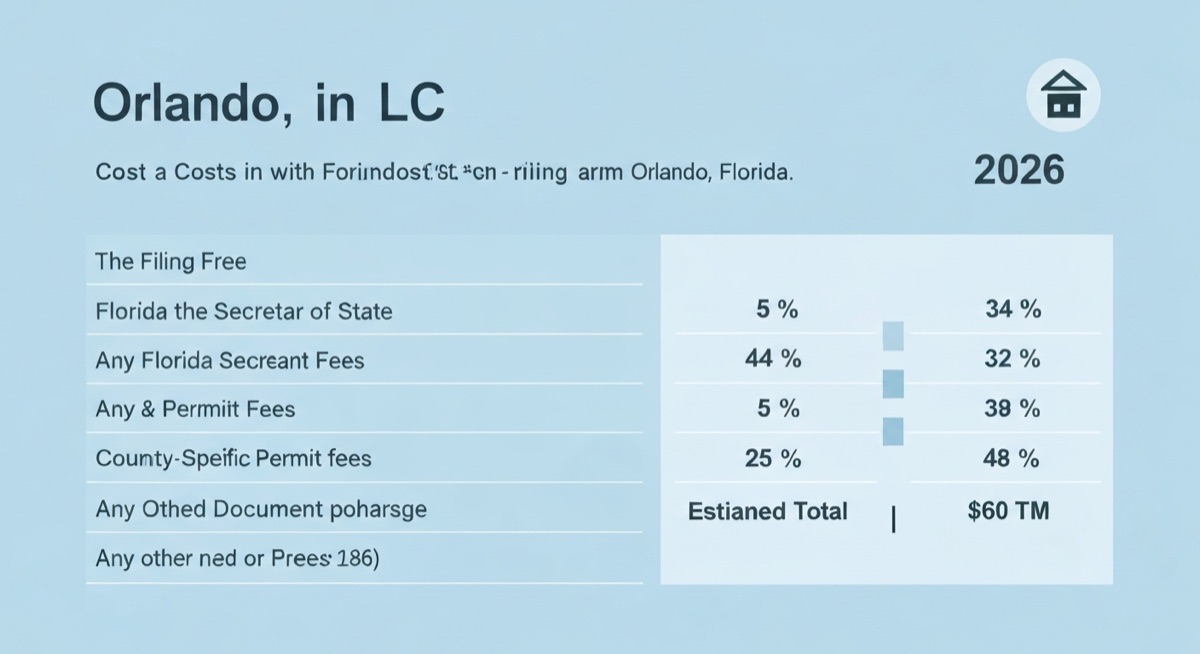
Here’s the full itemized picture for an Orlando-area LLC formed in 2026:
| Cost Item | Low End | High End |
|---|---|---|
| Florida Articles of Organization (Sunbiz.org) | $100 | $100 |
| Registered agent (DIY vs. commercial service) | $0 | $150 |
| Orange County Business Tax Receipt | $30 | $50 |
| City of Orlando BTR (if inside city limits) | $35 | $75 |
| Home Occupation Permit (if home-based, city limits) | $0 | $75 |
| Optional state documents (certified copy, certificate of status) | $0 | $35 |
| First-Year Total | $165 | $485 |
An LLC owner who is home-based in Thornton Park, uses a commercial registered agent for privacy, and picks up the certified copy for their bank is looking at $430–$485. A home-based operator in unincorporated Orange County, serving as their own registered agent, skipping optional documents, comes out closer to $165.
The spread is wide because Orlando’s regulatory geography is genuinely layered — more so than most formation guides let on.
Year 2 and Beyond: Ongoing Annual Costs
| Annual Cost Item | Low End | High End |
|---|---|---|
| Florida annual report (due May 1) | $138.75 | $138.75 |
| Registered agent renewal | $0 | $150 |
| Orange County BTR renewal (due Sept. 30) | $30 | $50 |
| City of Orlando BTR renewal (if applicable) | $35 | $75 |
| Annual Total | ~$169 | ~$414 |
The annual report fee is the same regardless of revenue or activity — $138.75, every year. File late and it becomes $538.75. Set a January calendar reminder and file early. This is not a complicated thing to get right, and the $400 penalty for getting it wrong is entirely avoidable.
Year 2 is also when bundled formation service pricing typically resets. If your first-year package included discounted registered agent service, your renewal notice will reflect the standard rate. Before that hits, compare standalone registered agent services — the credible ones run $50 to $150 per year, often significantly less than what the big platforms charge at renewal.
Orange County’s BTR renewal deadline is September 30. The City of Orlando’s is typically June 30. Late penalties exist for both, though they’re generally less punishing than the state’s.
What This Guide Doesn’t Cover
A few significant cost categories fall outside this article’s scope — not because they’re unimportant, but because they vary too widely by situation to quote general figures.
Operating agreement: A custom operating agreement drafted by a Florida business attorney varies by complexity and firm. Single-member LLCs can work from a simple template. Multi-member LLCs, or anything involving investors, partners, or profit-sharing, should have an attorney review it before signatures go on paper. This is one area where skipping professional help is usually a false economy.
Florida Department of Revenue registration: If your LLC will collect sales tax or have employees, you must register with the Florida Department of Revenue at floridarevenue.com. The registration is free. Operating a sales-tax-collecting business without it creates back-liability exposure that tends to be very expensive to clean up.
DBPR licensing: Contractors, real estate agents, cosmetologists, interior designers, and a number of other licensed professions must hold active Florida Department of Business and Professional Regulation licenses regardless of LLC status. These carry their own fees and renewal timelines entirely separate from business formation.
Orange County Tourist Development Tax: LLCs operating short-term rentals in Orange County must register with the Orange County Tax Collector for Tourist Development Tax collection — a separate registration from the BTR with its own compliance requirements. If you’re running a short-term rental LLC, Orlando’s short-term rental rules add another compliance layer worth understanding before you file.
CPA fees: Tax preparation for an LLC, particularly one that has elected S-corp status, is a real recurring expense. It’s not a government fee, but it’s the cost that tends to surprise people most in year two.
Four sources Orlando LLC owners actually need:
- Florida Division of Corporations — sunbiz.org (state formation, annual reports, registered agent changes)
- Orange County Tax Collector — octaxcol.com (county BTR applications and renewals)
- City of Orlando — orlando.gov/business (city BTR, home occupation permits, address jurisdiction lookup)
- Florida Department of Revenue — floridarevenue.com (sales tax registration, employer registration)
The $100 state filing fee is where the process starts. Properly licensed in Orlando, you’re looking at $165 to $485 in Year 1 and $169 to $414 every year after that — assuming you file the annual report on time.