LLC vs S Corp for Florida Business Owners
No state income tax means the breakeven point is higher than you've read. Here's the Florida-specific math.

LLC vs S Corp for Florida Business Owners
No state income tax means the breakeven point is higher than you’ve read. Here’s the Florida-specific math.
If you’ve been googling “LLC vs. S-corp” lately, you’ve probably landed on some version of the same article: elect S-corp status once your business clears $40,000 or $50,000 in net profit, pay yourself a reasonable salary, take the rest as distributions, and pocket the self-employment tax savings. It’s clean advice. It’s also calibrated for California, New York, and Illinois — states where business owners carry a state income tax burden that Florida owners simply don’t face.
That distinction matters more than most of those articles acknowledge. When you strip out the state income tax variable, the S-corp election produces smaller gross savings, which means compliance costs eat a larger percentage of whatever you save. The breakeven threshold moves materially to the right. And yet the “$40K rule” keeps circulating in Orlando Facebook groups and Reddit threads as though it were universal law.
This piece works through the math specifically for Florida, at three realistic income levels, using Orlando-area cost and wage data. The goal is to give Orange and Seminole County business owners a grounded basis for deciding whether an S-corp election is worth exploring with a CPA — or whether it’s simply not the right tool yet.
The Only Tax the S-Corp Election Actually Saves You in Florida
Start here, because this is the entire mechanism.
When you operate as a sole proprietor or single-member LLC filing Schedule C, the IRS treats your net business profit as self-employment income. You owe self-employment (SE) tax at 15.3% on the first $168,600 of net earnings (the 2024 Social Security wage base — confirm the current year’s number with your CPA) and 2.9% above that threshold. You get to deduct half of SE tax from gross income, which softens the blow modestly, but the obligation is real.
The S-corp election doesn’t eliminate that tax. It relocates it. You pay yourself a W-2 salary, which is subject to payroll taxes — the employer-employee equivalent of SE tax, same 15.3%/2.9% structure. Distributions above that salary pass through to your personal return without SE tax or payroll taxes. That gap — the distribution amount times the applicable SE tax rate — is your gross savings.
Here’s where Florida’s math diverges. In a state with a personal income tax, the picture is richer: an LLC owner in a high-income-tax state avoids state tax on distributions just as much as federal SE tax, so the gross savings include both layers. A Florida LLC owner gets only the federal SE tax savings. No second layer. That’s not a flaw in the S-corp structure — it’s the arithmetic of living in a no-income-tax state, which is otherwise a substantial advantage — but it’s the number that generic advice consistently overstates. When someone in New York runs this math, the election pencils out at $40,000 because they’re stacking federal and state savings. You’re not.
Side-by-Side: LLC vs. S-Corp at Three Income Levels
The three scenarios below cover Central Florida professionals at $60,000, $100,000, and $180,000 in net profit. These are directional illustrations, not tax advice — the specific figures require CPA validation against your actual salary assumption, the current wage base, and your full income picture. Reasonable salary assumptions must be drawn from Orlando-area BLS wage data (addressed below) and confirmed by a qualified CPA. For context on the upfront costs of establishing the entity itself, see our coverage of how much it costs to start an LLC in Orlando in 2026.
Scenario 1: UX Designer, $60,000 Net Profit
At $60,000, a meaningful distribution above a market-rate salary is hard to achieve. The slice of income that escapes SE tax is small, gross savings are narrow, and annual S-corp compliance costs of roughly $2,000–$4,000 (payroll service plus Form 1120-S preparation plus incremental bookkeeping) swamp whatever you save. This is the scenario where the $40K national rule does the most damage — because it sounds like you’re in range, but the Florida-specific math says you’re not.
| Single-Member LLC | S-Corp | |
|---|---|---|
| Net profit | $60,000 | $60,000 |
| W-2 salary | — | CPA-determined from BLS MSA data |
| SE / payroll tax | On full net profit | On salary only |
| SE tax on distribution | — | $0 |
| Gross SE tax savings | — | Narrow at this income level |
| Annual compliance costs | ~$500 (Schedule C prep) | ~$2,000–$4,000 |
| Net annual result | Baseline | Negative — compliance costs exceed savings |
Scenario 2: Dental Associate, $100,000 Net Profit
At $100,000, gross SE tax savings become more meaningful. Whether the election actually produces a positive net result depends heavily on the specific reasonable salary floor — and for a licensed dental professional, that floor isn’t low. This is the income range where the math warrants a serious professional conversation, but walking in expecting a clear win is premature. It might break even. It might be modestly positive. The specifics vary more than the generic advice implies.
| Single-Member LLC | S-Corp | |
|---|---|---|
| Net profit | $100,000 | $100,000 |
| W-2 salary | — | CPA-determined from BLS MSA data |
| SE / payroll tax | On full net profit | On salary only |
| SE tax on distribution | — | $0 |
| Gross SE tax savings | — | Real, but margin above compliance costs is thin |
| Annual compliance costs (incremental) | Baseline | +$2,000–$4,000 |
| Net annual result | Baseline | Near breakeven to modestly positive |
Scenario 3: Lake Nona Specialist / Senior Contractor, $180,000 Net Profit
At $180,000, the distribution above a market-rate salary is substantial. Gross SE tax savings are meaningful, including the 2.9% Medicare-only savings on income above the Social Security wage base. Net annual savings, after compliance costs, are positive and keep growing as income increases. If you’re consistently clearing $180,000 in net profit and still filing Schedule C, have that conversation this month — not next tax season.
| Single-Member LLC | S-Corp | |
|---|---|---|
| Net profit | $180,000 | $180,000 |
| W-2 salary | — | CPA-determined from BLS MSA data |
| SE / payroll tax | 15.3% to $168,600 wage base; 2.9% above | On salary only |
| SE tax on distribution | — | $0 |
| Gross SE tax savings | — | Meaningful; 2.9% Medicare savings applies above wage base |
| Annual compliance costs (incremental) | Baseline | +$2,000–$4,000 |
| Net annual result | Baseline | Positive; grows with income |
The “Reasonable Salary” Requirement — and What It Means in the Orlando Market
The IRS requires S-corp owner-employees to pay themselves a salary that reflects what the business would pay an unrelated employee for the same work. This isn’t a soft guideline. It’s the primary audit trigger when owners push it too low, and it’s the mechanism the IRS uses to prevent reclassifying essentially all income as distributions.
The relevant wage benchmark for Central Florida business owners is the Orlando-Kissimmee-Sanford Metropolitan Statistical Area, not national medians. The BLS Occupational Employment and Wage Statistics program publishes MSA-level data annually, and the Orlando figures differ enough from national numbers to matter. Representative Orlando MSA median annual wages — verify current figures before using them — include software developers at approximately $105,000, registered nurses at roughly $70,000–$75,000, real estate sales agents at approximately $58,000–$65,000 (commission-based and highly variable), and construction managers at roughly $75,000–$95,000 depending on tier.
Why does this matter for the math? A higher required salary floor means a smaller distribution. A smaller distribution means smaller SE tax savings. A software developer in Lake Mary who sets their S-corp salary dramatically below the Orlando MSA median is taking a material audit risk. Set it closer to market and the distribution — and thus the savings — shrinks accordingly. This is precisely why the lower-income scenarios above generate limited gross savings: there’s not much room between “what you’re legally required to pay yourself” and “what you earned.” That gap is where your savings live. In Florida, without state income tax amplifying it, the gap needs to be pretty wide before the numbers make sense.
The IRS also weighs the nature and extent of the owner’s services, whether the business has other employees, comparability data from similar companies, and the relationship between distributions and salary over time. Getting this number defensibly right requires local wage data and professional judgment. Not a rule of thumb.
What an S-Corp Actually Costs to Run in Central Florida
The gross SE tax savings is the revenue side of the analysis. Here’s the cost side, with real Orlando-area numbers.
Payroll administration. Running a single-officer payroll isn’t complicated, but it requires a payroll service or careful manual attention. Payroll services for a single-officer S-corp run approximately $500–$1,500 annually. This cost doesn’t exist for a Schedule C LLC.
Tax preparation. A single-member LLC lands on Schedule C of your personal return; a straightforward Schedule C return might cost $500 in CPA fees. An S-corp requires a separate federal corporate return (Form 1120-S), K-1 schedules, and reconciliation with your personal return. Central Florida CPAs have quoted 1120-S preparation fees in the $1,500–$3,500 range for single-officer S-corps with clean books, with higher fees for multiple income streams, depreciation schedules, or prior-year cleanup. “Clean books” is doing a lot of work in that sentence — if your bookkeeping is a mess, the fee goes up before you’ve saved a dollar.
Bookkeeping. An S-corp demands cleaner account separation, more precise payroll accounting, and documentation of distributions. If you’re already paying for bookkeeping, the incremental cost may be modest. It won’t be zero.
Florida annual report. Both LLCs and corporations registered with the Florida Division of Corporations owe an annual report by May 1. The current fee is $138.75 (verify on sunbiz.org). Miss the deadline and a $400 penalty hits automatically — no grace period, no appeal, just a bill. Set a calendar reminder for April 15.
Florida corporate income tax. Florida’s corporate income tax applies to C-corps. S-corps are generally exempt because income passes through to shareholders. Narrow exceptions exist — built-in gains recognized after an S-election, and certain passive investment income — but for a typical operating small business, the exemption applies cleanly. Confirm with a CPA if you previously operated as a C-corp.
Total annual compliance cost increment for a single-officer S-corp over a simple LLC: conservatively $2,000–$4,000 with clean books. That’s the number your gross SE tax savings has to beat before you come out ahead. In Florida, without the state income tax layer, beating it requires more income than most of what you’ve read online would suggest.
Florida’s Actual Breakeven: Why It’s Higher Than You’ve Read
The “$40,000–$50,000 breakeven” figure in national personal finance content comes from a model that includes state income tax savings. In a high-income-tax state, a business owner at $50,000 in net profit avoids both SE tax on distributions and state income tax on those same distributions — combined gross savings that cover compliance costs.
A Florida business owner at $50,000 saves only the SE tax piece. At that income level, with a reasonable salary that doesn’t leave much room for distributions, gross SE tax savings often won’t cover a $2,000–$4,000 compliance increment. You could do everything right and end the year having paid more in compliance costs than you saved in taxes.
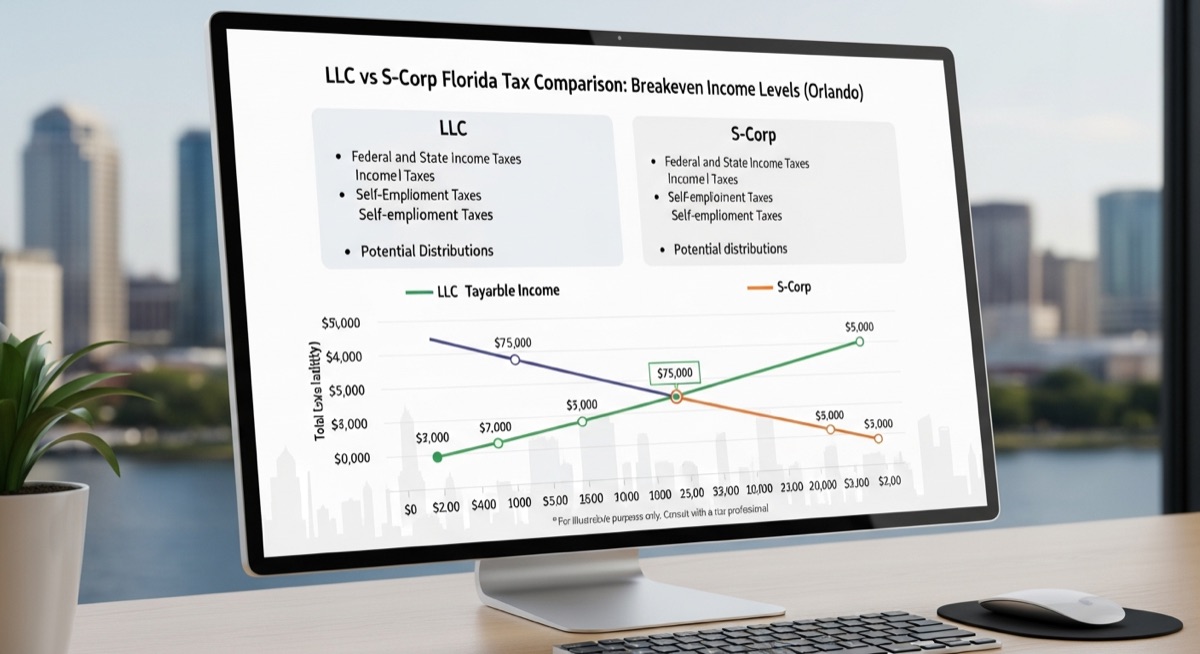
In Florida, the S-corp election doesn’t produce meaningful positive net savings until net profit reaches approximately $70,000–$80,000 — and that assumes a reasonable salary floor that allows a meaningful distribution, stable income, and efficient compliance. For healthcare contractors, licensed professionals, or specialists where the Orlando MSA wage benchmarks are strong, the effective breakeven is often closer to $90,000–$100,000. The logic is simple: without the state income tax amplifier that makes the math work in high-tax states, the threshold where the election becomes worth it sits higher here. Not prohibitively higher. Just higher than the internet says.
Can Your Existing Florida LLC Elect S-Corp Status?
Yes. An existing Florida LLC doesn’t dissolve, reform, or convert when it elects S-corp status. It remains an LLC under Florida law — same liability protection, same SunBiz registration, same operating agreement. What changes is the federal tax classification. The election is made by filing IRS Form 2553 with the Internal Revenue Service. One form.
For new businesses: Form 2553 must be filed within 75 days of formation or the date the LLC began doing business, whichever is earlier, for the election to be effective that tax year from inception.
For existing businesses making a prospective election: file Form 2553 by March 15 of the year you want the election to take effect (for calendar-year filers). Miss that date and you’re waiting until the following year.
If you missed the window, IRS Revenue Procedure 2013-30 provides a late-election relief mechanism. To qualify, you must have acted as though the election were already in effect — treated distributions as S-corp distributions, filed consistent with S-corp status — and the failure to timely file must have been inadvertent. Available, but not automatic.
A common Orlando scenario: You formed your Florida LLC in August 2024 and you’re now planning for 2025. You missed the 75-day window for a 2024 S-corp election. File Form 2553 by March 15, 2025, and the election is effective January 1, 2025. Wanting 2024 taxed as an S-corp retroactively means pursuing late-election relief under Rev. Proc. 2013-30 — which requires demonstrating consistent S-corp treatment since formation, difficult to establish if you’ve been filing Schedule C for six months.
Florida doesn’t require a separate state-level S-corp election. IRS Form 2553 is the only filing needed. Confirm with a CPA if your LLC has multiple members, has previously had a different tax classification, or has any Florida corporate return filing history.
Three Florida-Specific Details Most Articles Skip
The F-1120 Question
Florida’s corporate income tax return (Form F-1120) is required for C-corporations but not for S-corporations — Florida conforms to the federal S-corp pass-through treatment, so income isn’t taxed at the entity level. The narrow exception involves built-in gains accrued while the entity was a C-corp, recognized within a recognition period after the S-election. Converting an existing C-corp to S-corp status makes this a live question. For an LLC that’s always been a disregarded entity, it isn’t. Verify with a CPA familiar with Florida Department of Revenue guidance.
Workers’ Compensation Officer Exemptions
Orlando’s construction and contractor sector is large, and Florida’s workers’ compensation framework interacts directly with the S-corp election. Corporate officers in Florida can apply for a workers’ comp exemption through the Florida Division of Workers’ Compensation — up to three officers per corporation can be exempt in both construction and non-construction businesses. This matters for a sole contractor who doesn’t want to carry coverage on themselves. Once you have W-2 payroll as an S-corp officer, the classification and exemption interact in ways that aren’t always obvious. Sort out your exemption status with the Division of Workers’ Compensation during entity setup, not afterward. This is the kind of problem that surfaces when you’re trying to pull a permit or get added to a job — exactly the wrong moment.
The SunBiz Annual Report Deadline
Both LLCs and corporations owe an annual report to the Florida Division of Corporations by May 1. The fee is $138.75 (sunbiz.org has the current figure). Miss the deadline and a $400 penalty hits automatically. No grace period. The report also reflects the entity’s registered agent, principal address, and officer information — if you’ve made changes after converting to an S-corp, this is where you correct them publicly. Put April 15 on your calendar now. Paying a $400 late penalty because you forgot to file a one-page form is the worst possible use of the money you’re trying to save.
Who Should Have This Conversation — and Who Isn’t Ready
The S-corp election makes sense to explore seriously if your net profit is consistently approaching or above $80,000, your income is stable rather than feast-or-famine, you already have a business bank account and some kind of bookkeeping in place, and you have a tax professional you can work with. Consistency matters more than a single good year — the compliance costs are annual whether or not your income holds up.
Hold off if your net profit is below $60,000, if your client roster could shift significantly in the next twelve months, if you’re in year one and still figuring out your revenue model, or if you’re doing your own bookkeeping with no CPA relationship. An LLC is a legitimate, efficient structure for most small business owners in Orlando. There’s no penalty for staying there until the math actually works.
When you’re ready, look for a CPA who is a member of the Florida Institute of CPAs (FICPA) and has a real small-business entity practice — not just someone who files returns. This is the kind of decision that benefits from the deeper context you’ll find in our business & professional coverage. Strong small-business advisory practices in the Orlando area are concentrated in Maitland Center, downtown Orlando, and Winter Park, though the credential and specialty matter more than the address.
Come to the first appointment with three years of Schedule C returns if you have them, your current monthly net profit average, your SunBiz registration date, and a list of what you currently spend on bookkeeping and tax prep. Those four inputs let a CPA run a real breakeven analysis in the first meeting.
Ask three specific questions: What is the reasonable salary range for my role in the Orlando MSA? What is your fee to prepare a Form 1120-S for an entity like mine? At what net profit level, given my situation, does the election produce positive net savings? A CPA who won’t give you ballpark answers to those questions in a consultation isn’t the right fit. You should walk out of that first meeting knowing whether this is worth pursuing — not scheduling a second meeting to find out.
Tax laws, IRS procedures, and Florida Department of Revenue guidance change. The figures in this article reflect 2024 parameters and are intended to illustrate general principles, not to provide tax advice for any specific individual or business. Consult a licensed CPA or tax attorney before making any entity election.