What to Know About Leasing Warehouse Space in Orlando
Corridor-by-corridor pricing, Orange County zoning explained plainly, and the lease terms that routinely cost tenants money in Florida's climate.

What to Know About Leasing Warehouse Space in Orlando
Corridor-by-corridor pricing, Orange County zoning explained plainly, and the lease terms that routinely cost tenants money in Florida’s climate.
If you’re shopping for warehouse or light industrial space in the Orlando metro right now, you’re entering a market that looks meaningfully different from two years ago. The gap between what tenants assume they’ll pay and what the lease actually costs them remains wide — wider than it should be, given how much information is theoretically out there.
This guide is for the e-commerce fulfillment operation outgrowing a storage unit in Maitland, the HVAC contractor who needs a real shop in Apopka, the regional distributor evaluating options along I-4. For anyone who has opened a LoopNet listing, seen a dollar-per-square-foot figure, and wondered what they’re actually going to pay.
The short answer: identify your submarket based on where your drivers and employees actually live, verify zoning before you tour, confirm the physical specs against what the building can actually deliver, and read the HVAC, roof liability, and CAM escalation clauses before you sign. Everything else here is the longer version.
What You’re Actually Paying
Industrial leases in Orlando are almost universally triple-net. The base rent figure in a listing is not your monthly number. It’s the floor.
On top of base rent, you pay your pro-rata share of property taxes, property insurance, and common area maintenance. Those charges are billed monthly as estimates and reconciled annually, or passed through directly. In 2025, CAM charges alone typically run between $1.50 and $3.50 per square foot annually, depending on the age of the park, paving condition, and how aggressively the landlord maintains things. Property taxes and insurance stack on top.
In post-Ian Florida, commercial property insurance has repriced sharply across the market. The NNN pass-throughs tenants are absorbing today are materially higher than three years ago. That’s not a hypothetical warning — it’s showing up in actual reconciliation statements. For a broader look at how insurance costs are shifting across property types, Florida property insurance rate increases and what they mean for you is worth reading before you model your NNN exposure.
Do the math before you tour. On a 10,000-square-foot lease at $11 per square foot base rent, the spread between a low-cost and high-cost NNN building can run $30,000 to $50,000 more per year. That’s not a rounding error. That’s whether you made money.
Before touring any space, ask the listing broker for a full NNN expense estimate broken out by line item — taxes, insurance, and CAM separately. More importantly, ask for the CAM reconciliation history from the past three years. Those documents will show whether the landlord’s estimates have tracked reality or whether tenants got hit with large true-up payments at year’s end. Both are common. The difference is substantial when you’re budgeting for actual occupancy costs. A landlord who won’t produce reconciliation history is telling you something worth hearing.
Corridor by Corridor
Orlando’s industrial inventory is not evenly distributed. The five major submarkets differ in building age, physical specs, and rent — and right now, they differ in how much negotiating room tenants actually have.
OBT/South Orange
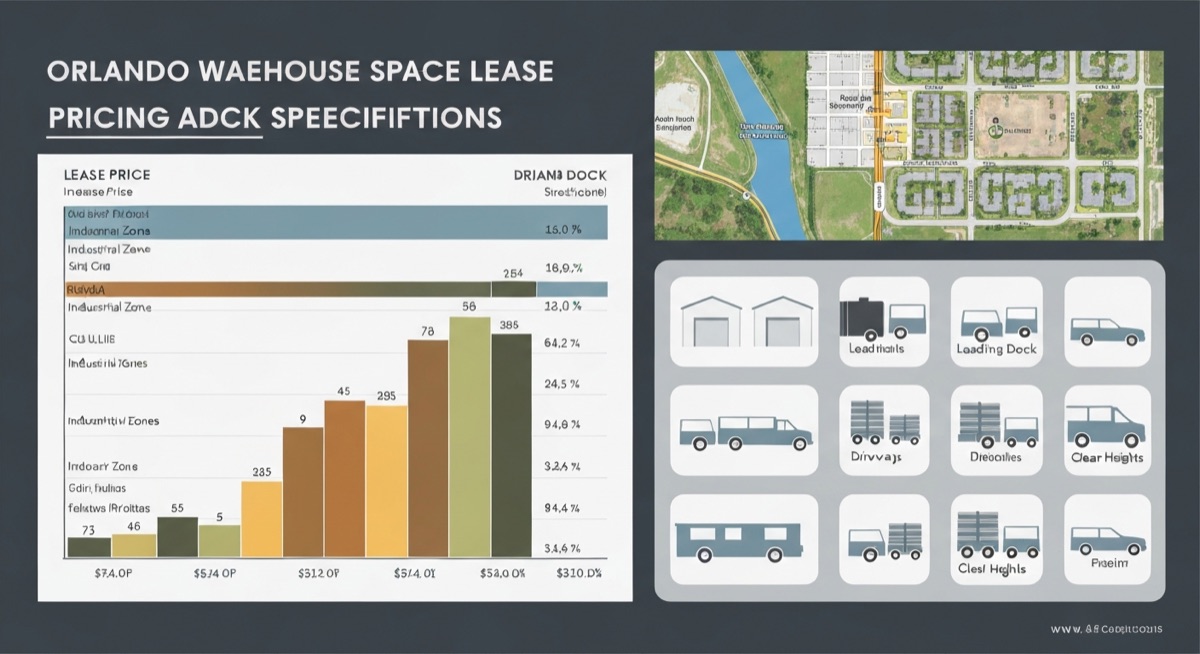
The oldest industrial corridor in the market. Tilt-up concrete buildings from the 1970s through 1990s, mostly 5,000 to 20,000 square feet, with grade-level access rather than true loading docks in much of the inventory. Asking rents run $8 to $11 per square foot NNN — the lowest in the metro. The tradeoff is building quality, and it’s a real one.
Clear heights are often 14 to 18 feet. Electrical service is frequently 200-amp panels. Deferred maintenance is common. Contractors and auto-related businesses find workable space here. E-commerce or distribution operations with rack storage or frequent outbound truck movements will find the physical specs limiting — sometimes deal-breakingly so. Tour with that in mind before you fall in love with the rent number.
John Young Parkway/West Colonial
Mid-tier flex parks built mostly in the late 1980s through early 2000s. A mix of dock-height and grade-level units, generally 4,000 to 15,000 square feet. Proximity to SR-408 and the I-4 interchange makes this useful for businesses serving multiple parts of the metro. Asking rents run $9 to $13 per square foot NNN.
Traffic on West Colonial is a real operational consideration, and aging infrastructure in many parks means due diligence on physical specs matters. Don’t let the central location talk you past a building with a 200-amp panel and a 2003 roof.
Goldenrod/Semoran/Airport
This one gets consistently underrated. The Goldenrod Road and South Semoran corridor, extending south toward the Orlando International Airport cargo area, puts tenants within a short drive of OIA’s cargo ramp and the Turnpike interchange. For any business with air freight needs — or that benefits from same-day metro delivery — this corridor deserves more attention than it typically gets from tenants who default straight to I-4.
Asking rents run $10 to $14 per square foot NNN. Inventory spans both older multi-tenant flex space and newer construction, with a reasonable range of bay sizes. If you’ve been ignoring this corridor, it’s worth a second look.
I-4/Sanford–Lake Mary
The newest and most institutionally owned product in the metro. Spec buildings completed between 2022 and 2024 offer 28- to 36-foot clear heights and multiple dock-high doors, designed for modern distribution operations. Asking rents reflect it: $11 to $16 per square foot NNN for Class A product.
This is also where the 2022–2024 building surge left the most vacancy, which means tenants have genuine negotiating advantage here right now. If you have any location flexibility, this is where to start the conversation — not finish it.
Apopka/Northwest Orange
The market’s emerging growth area. Lower land costs and less traffic congestion than central corridors attracted new development over the past five years. Newer buildings here offer meaningfully better specs than OBT stock at rents closer to OBT pricing: $10 to $13 per square foot NNN.
For contractors, landscaping companies, and light manufacturers based in the northwest suburbs, this corridor eliminates a real commute drag. More available space than the tight 2021–2022 period has made it more competitive on terms. If your employees live in Apopka, Ocoee, or Winter Garden, this is probably where your search should start.
I-1 vs. I-2: What Orange County Zoning Actually Allows
This is the section tenants most often skip and most often regret skipping. Zoning language is tedious. The consequences of getting it wrong are not.
Under Orange County’s Land Development Code, I-1 (Light Industrial) permits warehousing, distribution, light manufacturing, trade services, contractor shops, and most e-commerce fulfillment — provided those operations don’t generate significant outdoor activity, excessive noise, or noxious emissions. I-2 (Heavy Industrial) covers large-scale outdoor equipment storage, heavy manufacturing, auto dismantling, and industrial processes that generate byproducts requiring additional regulatory oversight.
For most small businesses, I-1 covers what you need. An e-commerce operation receiving pallets by truck and shipping parcels via UPS is squarely I-1. A contractor’s shop with interior tool storage and work trucks on a paved lot is I-1. A commercial kitchen that doesn’t involve large-scale processing with discharge is typically permissible in I-1 with appropriate health department approval.
Operating an I-2 use in an I-1 building is where businesses get into trouble. A landscaping company that parks heavy equipment outdoors and runs a mulch operation, a metal fabricator with outdoor staging areas, or an auto shop with inoperable vehicles stored outside may be in technical violation of I-1 zoning. A landlord who discovers this — or who gets a complaint from a neighboring tenant — can treat it as a lease default. Even if the landlord is indifferent, county code enforcement can issue a stop-work order. That’s an ugly situation that’s entirely avoidable.
There’s a jurisdictional issue many tenants never check: not all addresses with “Orlando” in them are governed by Orange County’s Land Development Code. The City of Orlando has its own zoning code with different industrial classifications and different permitted-use tables. A property on North OBT with a City of Orlando address is governed by the City’s code, while a property three blocks away might be unincorporated county. To verify which jurisdiction governs a property you’re considering, use Orange County’s GIS viewer at ocfl.net or the City of Orlando’s zoning map at orlando.gov. Enter the parcel address and confirm both the jurisdiction and the specific zoning designation before any conversation about lease terms. Ten minutes. Has saved more than a few businesses from an expensive mistake.
For borderline uses — a composites manufacturer that wants to run occasional outdoor curing, or a food distributor staging refrigerated trailers overnight — Orange County’s special use permit process exists as a pathway. The realistic timeline from application to Board of Zoning Adjustment approval is two to four months, assuming the use is genuinely compatible with the district. Factor that into any business timeline that depends on it.
If your use is borderline, call Orange County’s Planning Division (407-836-3111) or the City of Orlando’s Planning Bureau (407-246-3382) before committing to a space. Both offices will answer a direct question about use permissibility. It’s a free phone call.
Dock Doors, Clear Heights, and Electrical
These specifications determine whether a space is functional for your operation or useless regardless of rent. They’re also the specs brokers most often list inaccurately.
A “loading dock” in a listing can mean a true dock-high door — where the floor is elevated so a standard trailer backs up flush for level loading — or it can mean a grade-level drive-in door with a portable dock plate. Not interchangeable. If your operation involves receiving truckload freight from commercial carriers, you need dock-high access. Grade-level doors require a forklift with significant reach and are slower for receiving staff. Much of the older OBT and Goldenrod stock is grade-level only. Newer Sanford and Apopka product typically has dock-high access. Confirm which type exists in the building, not in the listing language.
Clear height is the usable vertical clearance from the finished floor to the lowest obstruction — a joist, beam, or sprinkler head — not the roof peak. This matters for racking. At 14 to 18 feet, common in older Orlando buildings, your racking options are significantly constrained. At 28 to 36 feet, standard in current spec product, a well-designed racking layout can let you lease considerably less square footage.
Worth doing the arithmetic: a 10,000-square-foot space with 18-foot clear height versus a 7,500-square-foot space with 30-foot clear height. The smaller space might hold more inventory. That changes the rent conversation.
Electrical service is the specification most tenants fail to check until after they’ve signed a lease and called their electrician. Older Orlando industrial buildings were commonly wired with 200-amp, 3-phase service — sufficient for basic lighting, HVAC, and general shop use, but inadequate for any operation with significant motor loads, serious refrigeration, commercial cooking equipment, or production machinery.
If your operation requires 400 to 800 amps — light manufacturers, food operations, and some tech-hardware assemblers frequently do — an older building will require a service upgrade. That can run $20,000 to $60,000, depending on the utility transformer situation, and the cost typically falls on the tenant unless specifically negotiated as a landlord improvement. Before you tour a building on OBT or Goldenrod priced attractively, ask for the electrical panel documentation. If it’s borderline, bring an electrician to the showing. Not after. To the showing.
Florida-Specific Lease Clauses That Cost Tenants Money
Generic commercial real estate advice applies everywhere. What follows is specific to Orlando, Orange County, and Florida’s insurance and weather environment. It’s the kind of detail covered in our business and professional coverage of the local market that general real estate guides typically gloss over.
HVAC systems in Florida work harder and fail faster than in most of the country. A rooftop unit in Orlando runs significantly more annual hours than the same unit in Atlanta. Standard lease language in many Florida industrial leases assigns HVAC maintenance and replacement responsibility to the tenant. A rooftop unit replacement runs $8,000 to $15,000 per unit. In a building with four or five RTUs, that exposure adds up fast.
Negotiate a landlord-provided HVAC cap — a provision limiting your replacement liability per unit to a dollar threshold, with anything above that cap being the landlord’s problem. In the current market, with vacancy up from post-COVID lows, this is negotiable in many buildings. At minimum, ask for documentation of each unit’s age and last maintenance service before signing. A nine-year-old unit in Orlando heat is not the same as a nine-year-old unit in Oregon.
Florida’s standard commercial lease language can place roof-leak repair responsibility on the tenant for interior damage resulting from roof failure. This becomes most problematic after hurricane-season storms, which run June through November. Half the year. Request a roof inspection report before signing, get the repair history from the past three years, and make sure the lease assigns roof structure maintenance to the landlord. If the roof is more than ten years old, push harder on this clause.
Orange County has significant areas in FEMA-designated special flood hazard zones. Zone AE is high-risk, where federal flood insurance may be required by lenders and commercial flood insurance is expensive. Zone X500 is moderate risk — lower insurance cost, not zero risk. For a NNN tenant, flood insurance cost passes through as part of the property insurance line. Ask the broker for the FEMA flood zone designation and verify it independently at msc.fema.gov. Don’t take the broker’s word for it on this one specifically.
CAM charges in some leases escalate without limit year to year. In others, annual increases are capped at a fixed percentage or tied to CPI. Ask every landlord and every broker what CAM charges have been for the past three years and whether the lease contains an escalation cap. In a market where insurance costs have risen substantially, an uncapped CAM provision is a real cost exposure. Negotiate a cap. If the landlord refuses, ask for three years of actual reconciliation statements so you can model the trajectory yourself. If they refuse that too, you’ve learned something useful about who you’re dealing with.
How the 2022–2024 Supply Surge Changed the Negotiating Table
From roughly 2020 through early 2023, industrial tenants in Orlando had almost no negotiating leverage. Vacancy in the sub-50,000-square-foot range was extremely tight in most corridors. Multiple tenants competed for the same spaces. Landlord concessions had largely disappeared. It was a rough time to be looking for space. The current situation is different.
The spec-building surge added significant new inventory, particularly in the Sanford and Apopka corridors, and lease-up on that new product has taken longer than developers projected. Several large multi-tenant parks along SR-46 and Lake Mary have carried elevated vacancy for the better part of a year. This gives tenants real negotiating room today.
Months of free base rent at lease commencement — unavailable from 2020 through 2022 in most buildings — have returned as a negotiable item in newer Class A product in corridors with higher vacancy. Tenant improvement allowances for buildout costs have reappeared in those same buildings. In older product, TI is harder to get but not impossible, particularly if the landlord has carried a vacancy for more than six months.
Three-year base terms are now achievable in several corridors, particularly for smaller bays. The 2020–2022 market pushed many landlords to demand five-year minimums. That flexibility matters for a business that isn’t certain what its space needs look like in year four.
The corridors with the most current tenant advantage are newer Class A Sanford/I-4 product and some of the older, longer-vacant OBT buildings. Landlords are holding firmer on well-located OIA/Goldenrod product and quality Apopka space, where absorption has been steadier.
When you tour space in a Sanford-area park, ask the broker directly whether free rent or TI has been offered to other tenants currently in the park, or to the most recent tenant who signed. Brokers representing landlords aren’t obligated to volunteer this, but a direct question puts it on the table. A tenant representative broker — one working for you, not the landlord — will pull this information without being asked. If you don’t have a tenant rep, that’s worth reconsidering before you start touring.
The Personal Guarantee and Permitted Use Clause
Most landlords of small to mid-sized industrial space in Orlando require a personal guarantee from any tenant entity without a substantial operating history. For a newer LLC with limited credit history, this is largely unavoidable.
The default ask from many landlords is a full lease-term personal guarantee. Sign a five-year lease, your business fails in year two, you personally owe three years of base rent. On a 5,000-square-foot space at $12 per square foot, that’s $180,000 of personal exposure. Sit with that number. What is actually negotiable in the current market is a guarantee capped at six to twelve months of base rent rather than the full lease term. Push for it from the outset. If a landlord won’t budge from a full-term personal guarantee, that’s information worth weighing — about the building, the landlord’s financial position, or both.
The permitted use clause defines what you’re allowed to do in the space. It sounds administrative because it’s buried in lease boilerplate. It isn’t administrative. A clause written as “warehousing and storage only” technically prohibits light assembly, packaging, or receiving and repackaging of goods — all standard functions of an e-commerce fulfillment operation. A clause that says “retail distribution” may not cover daily staging of commercial vehicles or outbound freight operations.
The gap between what a tenant actually does and what the lease says they can do is a technical lease violation. A landlord who wants to remove a tenant — for any reason — can use that violation as the legal mechanism. This isn’t paranoia; it happens.
Make the permitted use clause broad enough to cover your actual operations, plus reasonable expansions. Your attorney can draft appropriate language quickly. The negotiation is worth having before you sign, not after you’ve received a notice of default.
Before You Tour: A Practical Pre-Lease Checklist
Jurisdiction and Zoning
Confirm whether the property is in the City of Orlando, unincorporated Orange County, or another municipality — the applicable zoning code is different in each. Look up the parcel in the Orange County GIS viewer at ocfl.net or the City of Orlando zoning map at orlando.gov. Confirm the specific I-1 or I-2 designation and verify that your planned use is a confirmed permitted use per the applicable code table, not just a reasonable assumption.
If your use is borderline, call Orange County’s Planning Division (407-836-3111) or the City of Orlando’s Planning Bureau (407-246-3382) before committing to anything.
Physical Specs
Ask explicitly: is the loading access dock-high or grade-level? “Loading dock” is not a sufficient answer. Measure or confirm clear height in feet to the lowest obstruction, not the roof peak. Request electrical panel documentation and confirm amperage and whether it’s 3-phase. If the panel is 200-amp and your operation may need more, get a licensed electrician’s upgrade cost estimate before executing the lease.
Lease Economics and History
Request three years of CAM reconciliation statements. If the landlord refuses, note that. Ask whether the lease includes a CAM escalation cap. Ask for documentation of HVAC unit ages and last service records. Request a roof inspection report or information on the roof’s age and repair history.
Insurance and Risk
Look up the FEMA flood zone designation at msc.fema.gov and verify it yourself. Ask the broker for the current all-in NNN expense estimate broken out by taxes, insurance, and CAM separately. Confirm whether commercial flood insurance is required and what it costs.
Negotiation
Ask the broker directly whether free rent or a TI allowance has been offered to any other tenant in the park in the past twelve months. Counter any full-term personal guarantee with a capped structure from the start. Have an attorney review the permitted use clause before execution and confirm it covers your actual operations.
The Orlando industrial market in 2025 is more tenant-friendly than it was two or three years ago. The lease documents haven’t changed. The clauses that favor landlords are still in the standard forms, written in the same dense language they’ve always used. The buildings with outdated electrical and aging HVAC systems are still being leased to tenants who didn’t ask the right questions in time.
The tenants who come out ahead treat the pre-lease process as actual research. They know what they’re paying before they sign rather than finding out when the first reconciliation statement arrives. That’s the whole game, honestly — the rest is just paperwork.