How to Safely Work Out in Orlando Summer Heat
If you moved to Orlando from anywhere north of Georgia — or from the Southwest, or really anywhere without Central Florida's specific cocktail of tropical humidity and relentless summer sun — you'v…

How to Safely Work Out in Orlando Summer Heat
If you moved to Orlando from anywhere north of Georgia — or from the Southwest, or really anywhere without Central Florida’s specific cocktail of tropical humidity and relentless summer sun — you’ve probably already learned this the hard way: exercising outside here in July is not a matter of being a little uncomfortable. It’s a matter of making decisions that can put you in an emergency room.
This guide is built around Orlando-specific data — NWS forecast zones, named trails with actual amenities, real cooling center contacts — because generic heat advice misses the local variables that matter most. Here’s what you actually need to know before you lace up between June and September.
Why Orlando Summer Heat Is Not What Most People Expect
The number on your weather app is not the relevant number. What matters is the heat index, which combines air temperature and relative humidity to reflect what your body actually experiences. In Orlando, the average July heat index during peak afternoon hours runs between 105°F and 110°F. On days when dew points climb to 76°F — which happens routinely from late June through August — the effective temperature your body has to manage is at the upper end of that range and beyond.
The physics matter. Humans cool themselves primarily through sweat evaporation. Evaporation requires that the air be capable of absorbing moisture. When relative humidity is above 70 percent, as it reliably is during Orlando summer mornings, that evaporation slows dramatically. Your body keeps producing sweat; it just stops doing the cooling work. Core temperature climbs faster than it would in, say, Phoenix at 108°F dry heat, because in Phoenix the sweat is actually working.
The wet-bulb temperature — a measure of the maximum evaporative cooling your body can achieve — at Orlando’s typical summer dew points means that sustained exertion produces heat accumulation faster than most people feel it coming. Heat exhaustion in humid conditions can arrive without the dramatic warning signs people associate with desert heat. You don’t necessarily feel parched or overheated before you start to feel weak and confused. The sweat is there. You just aren’t cooling. That’s the part that catches people off guard.
This matters especially for two groups: people who moved here recently from dry or temperate climates, and longtime Orlando residents whose daily lives are almost entirely air-conditioned. Both groups have lower baseline heat tolerance than their fitness level might suggest. Acclimatization requires 10 to 14 days of progressively longer outdoor exposure at low intensity before attempting anything resembling a hard workout outside in summer. It’s not optional. It’s the difference between an uncomfortable run and a trip to the ER.
The Safe Window: What Time of Day You Can Actually Exercise Outside
The defensible outdoor exercise window in Orlando during summer is before 7:30 a.m. That’s not conservative. It’s what the NWS Orlando data supports.
On a representative July day, the heat index typically crosses 95°F between 8:30 and 9:00 a.m. and reaches 100°F by 10:00 a.m. or earlier. The commonly repeated “get out before 9 a.m.” advice is already operating in marginal territory on most summer mornings — I’d push it earlier. At 6:00 a.m., when the sun is just rising and temperatures are in the low-to-mid 80s, you have a workable window. But humidity is already building at that hour. What makes pre-7:30 a.m. safer isn’t that conditions are comfortable; it’s that core temperature accumulation happens slowly enough that a 45-to-60-minute moderate effort is manageable if you’re hydrated and acclimatized. Past 7:30, the math changes quickly.
The afternoon storm window deserves honest treatment. Most days between late June and September, Central Florida’s sea breeze convergence produces thunderstorms between roughly 2:00 and 4:30 p.m. These storms can produce a brief temperature drop, but the post-storm humidity spike can make conditions feel worse, not better. Lightning lingers well after storms pass. A 4:30 to 6:00 p.m. window can occasionally work after a stronger storm moves through, but this is not reliable — and anyone who’s stood outside in Orlando at 5 p.m. after a rain knows it can feel like a sauna with better lighting.
The practical answer is straightforward: finish before 7:30 a.m., start at 5:30 or 6:00. Anything else requires careful assessment of that day’s specific forecast and assumes you understand the risks.
Trail-by-Trail Breakdown: Lake Eola, Cady Way, and West Orange
Lake Eola Park (Downtown Orlando)
The loop around Lake Eola is 0.9 miles, paved, essentially flat, and well-lit for early morning use. The shade situation is inconsistent, and it matters more than people expect. The eastern lakefront stretch is largely exposed. The north and west sides of the loop have more mature oak canopy.
There’s a water fountain at the pavilion on the south side of the lake, with restrooms at the main pavilion. For a summer workout, Lake Eola works best as a short, early-morning option — two or three loops before 7:15 a.m. The exposed sections become genuinely hazardous by 9:00 a.m. Parking is metered but free after 5:00 p.m. on weekdays.
Cady Way Trail (East Orlando/Winter Park)
Cady Way runs approximately 6 miles from the Fashion Square Mall area (the Maguire Boulevard trailhead) east toward Baldwin Park. Shade is partial and uneven. The residential segments in the middle hold more tree cover; the stretches near Fashion Square are open sun, and on a July morning you’ll feel the difference within half a mile.
The Cady Way Pool at 3401 Maguire Blvd puts a water fountain along the trail at a natural turnaround point for early-morning runs, and the pool itself is an option if you need to get out of the heat fast. Before counting on it as a backup, confirm summer activation status — hours aren’t always predictable.
West Orange Trail (West Orange/Oakland Area)
West Orange Trail is the most serious option for distance-oriented runners and cyclists, and it carries the most significant summer risk if approached carelessly. The trail runs approximately 22 miles between Apopka and Oakland in Orange and Lake counties. The sections through Oakland and downtown Winter Garden are tree-lined. The central segments through Killarney and Ocoee are not, and the exposure is real.
For summer use, start at the Winter Garden trailhead on Plant Street. That section has shade, water access, and the density of downtown Winter Garden nearby if you need to cut a workout short. Water fountains are confirmed at the Killarney Station trailhead, Chapin Station, and Oakland. East of Chapin Station, you can find yourself 4 or more miles from water — in July conditions, that’s not a minor inconvenience, it’s the scenario that ends in a 911 call.
This is a 6:00 a.m. trail with a firm turnaround time. Cyclists can cover more ground before conditions degrade; runners should plan every route around confirmed water stops. Turn around before the heat index climbs, not after.
Reading the NWS Orlando Heat Advisory — and What the Thresholds Actually Mean
The NWS office covering Orange County is the Melbourne forecast office, WFO MLB. Orlando’s zone designation for Orange County is FLZ042. Bookmark weather.gov/mlb or search “NWS Melbourne Florida.”
In Central Florida, the NWS uses locally calibrated thresholds. A Heat Advisory is issued when the heat index is expected to reach 108°F for two or more hours. An Excessive Heat Warning is issued when values are forecast to reach or exceed 113°F. These thresholds reflect the region’s acclimatization baseline — the same conditions would trigger warnings at lower temperatures in northern states. If you’re using a national weather app that doesn’t apply local thresholds, you may not be getting the right picture.
To set up phone alerts, go to weather.gov and add Orange County (FLZ042) as a location. Enable notifications for Hazardous Weather Outlooks and Heat Advisories. Wireless Emergency Alerts are pushed automatically when an Excessive Heat Warning is issued, but they arrive late in the advisory process. For planning purposes, checking the 7-day forecast the night before beats waiting for an emergency alert.
Warning Signs of Heat Exhaustion in Humid Conditions
The symptom progression in high-humidity heat exhaustion differs from what most first aid materials describe, which are largely written around dry-heat scenarios. Early signals in Central Florida’s wet-bulb conditions include pale, clammy skin combined with heavy, continuous sweating — the body working correctly but losing ground. Muscle cramps, particularly in the legs and abdomen, often accompany this phase. Fatigue that arrives sooner than expected for your fitness level is also a signal, and it’s one people tend to rationalize away. (“I just didn’t sleep well.” Sound familiar?)
The critical inflection point comes when sweating suddenly stops. In dry heat, that suggests dehydration. In humid heat, it often means the thermoregulatory system has begun to fail. Stop immediately, get into shade or air conditioning, and begin cooling. Do not try to finish the loop.
Heat stroke indicators — confusion, slurred speech, irrational behavior, hot dry skin after heavy sweating — require a 911 call. Do not drive someone experiencing these symptoms to urgent care. Heat stroke can cause organ failure rapidly; getting professional cooling en route matters.
One thing worth saying plainly: running three miles on a treadmill at 68°F three times a week does not prepare your cardiovascular system for 85°F at 90 percent humidity. Orlando residents who spend most of their time indoors have reduced baseline heat tolerance regardless of fitness level. Acclimatization requires actual outdoor exposure, progressively increased over 10 to 14 days. There’s no shortcut, even if your resting heart rate is excellent. For broader context on staying safe outdoors here, this fits squarely within our health & wellness coverage of how Central Florida’s climate affects residents year-round.
Orange County and City of Orlando Cooling Centers: Who Runs Them, Where, and Who Can Walk In
Two separate systems exist here, and they’re easy to confuse. Orange County Emergency Management activates its network when the heat index is forecast to sustain dangerous levels for a prolonged period — historically at or above approximately 103°F. The county’s primary contact is 407-836-9140. Activated locations have historically included Orange County branch libraries, which stay open to anyone during normal operating hours when the network is active. No registration required.
For current 2026 locations and hours, check ocfl.net/emergency or call the number above. Locations shift seasonally and need to be confirmed before you go.
The City of Orlando activates a separate set of sites through its Emergency Management function, reachable through 311 (407-246-2121). Community centers that have historically served this role include Barnett Park and Engelwood Neighborhood Center. City pools are open during normal operating hours. For current 2026 locations, call 311 or check orlando.gov.
Both systems are open to all residents. These are public emergency resources — not facilities for unhoused residents only, which is apparently what a lot of people assume and why they don’t use them. Seniors, parents with young children, people managing medical conditions, athletes who overdid it: all of them are the intended users. The phone numbers above are your fastest confirmation route on any given day.
Indoor Alternatives by Neighborhood: Priced and Located
When outdoor conditions are genuinely unsafe — which, during a July heat advisory, they are — here are the specific alternatives.
Planet Fitness operates multiple Orlando-area locations at standard memberships around $10 per month and is the lowest-cost entry point citywide for non-members. YMCA of Central Florida has branches in Dr. Phillips, Hunters Creek, and Winter Park, among others; daily rates for non-members run around $20. The YMCA’s advantage is pool access, which on a genuine heat advisory day isn’t just exercise — it’s the most effective cooling you’ll find short of an emergency room.
Crunch Fitness has multiple Orlando-area locations with day passes in the $10–15 range. City of Orlando community pools are the most underused option in this category. The Cady Way Pool at 3401 Maguire Blvd and other neighborhood pools charge $2 to $3 for general admission. For anyone who wants actual water immersion rather than a workout, there’s no cheaper option in the city. Confirm 2026 summer hours with City of Orlando Parks at (407) 246-2283.
UCF Recreation and Wellness Center offers community memberships to non-students. Policies and pricing should be confirmed directly with the facility — they vary and change. For east Orlando and Waterford Lakes residents, it’s worth a phone call. The facility includes multiple courts, a large fitness floor, and an aquatics center.
Before You Head Out: The Pre-Workout Checklist
Run through this before any outdoor summer workout.
-
Check the NWS heat index forecast at weather.gov/mlb or search FLZ042 for Orange County. If a Heat Advisory or Excessive Heat Warning is in effect or forecast for morning hours, move the workout inside.
-
Check your planned trail’s water fountains. On Cady Way, the fountain near the pool at 3401 Maguire Blvd is the most accessible. On West Orange, Killarney Station, Chapin Station, and Oakland are confirmed locations. At Lake Eola, the south pavilion fountain is the standard stop. If you can’t confirm a water source is operational, carry enough to cover the full route without it.
-
Check your own hydration status before you walk out the door. Dark yellow urine is a disqualifying condition.
-
Know the nearest open cooling site before you leave — put it in your maps app. Call (407) 836-9140 (county) or 311 (city) to confirm which locations are active that day. This is the same logic as knowing where the nearest hospital is before a long road trip. You won’t need it until you do.
-
Keep your phone on your person. Not in a bag at the car. If you’re solo on the West Orange Trail at 6:15 a.m. and you start to feel off, you need to reach someone immediately.
-
Set a turnaround time, not a turnaround distance. In Orlando summer, you should be heading back to your car by 7:15 a.m. regardless of where you are on the route.
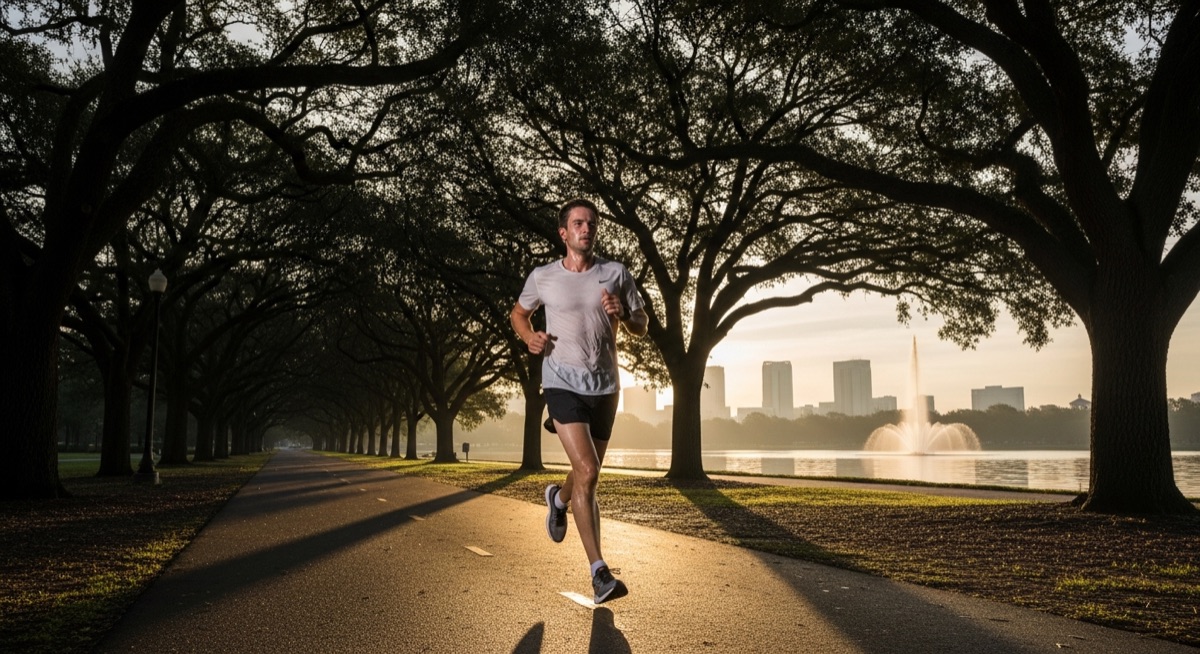
The light off Lake Eola at 6:00 a.m. on a clear July morning is genuinely one of the better things about living here. The trails are worth using. They just require treating the heat as the primary variable — not pace, not distance, not how good you felt last Tuesday on the treadmill. In Central Florida’s summer humidity, it runs the whole workout.