Best Farmers Markets in Orlando for 2026
A reported roundup that checks local vendor ratios, runs a price basket against Whole Foods and Publix, and tells you which markets you can reach without a car.

Best Farmers Markets in Orlando for 2026
A reported roundup that checks local vendor ratios, runs a price basket against Whole Foods and Publix, and tells you which markets you can reach without a car.
How We Reported This — and Why Most Coverage Gets It Wrong
Search for “Orlando farmers markets” and you’ll find the same article recycled across a dozen local lifestyle sites: market names, addresses, hours copy-pasted from event aggregators, stock photos of tomatoes, and a reminder to bring a reusable bag. What you won’t find is how many vendors at any given market are actual Central Florida growers versus wholesale resellers. You won’t find a price comparison that tells you whether you’re paying a premium or getting a deal. You definitely won’t find an honest look at transit access that acknowledges most of these markets are designed, functionally, around people with cars and Saturday mornings free.
This roundup answers those questions. We spent time on the ground counting vendors at four markets, spot-checked prices on five common items, called market managers directly, and checked the USDA FNS database for EBT authorization. The goal is enough verified information to decide whether any of these markets is worth your time and money, and which one fits your particular situation.
Vendor mixes shift week to week, seasonal availability is genuinely variable, and any specific vendor or price mentioned here reflects conditions at time of reporting in early 2026. Call ahead or check each market’s social media before making a special trip.
Central Florida’s Growing Season Changes Everything
Every market evaluation in this piece depends on one foundational fact: Central Florida’s Zone 9b climate produces locally grown food on a schedule that’s almost exactly the inverse of what Midwesterners and Northeasterners expect.
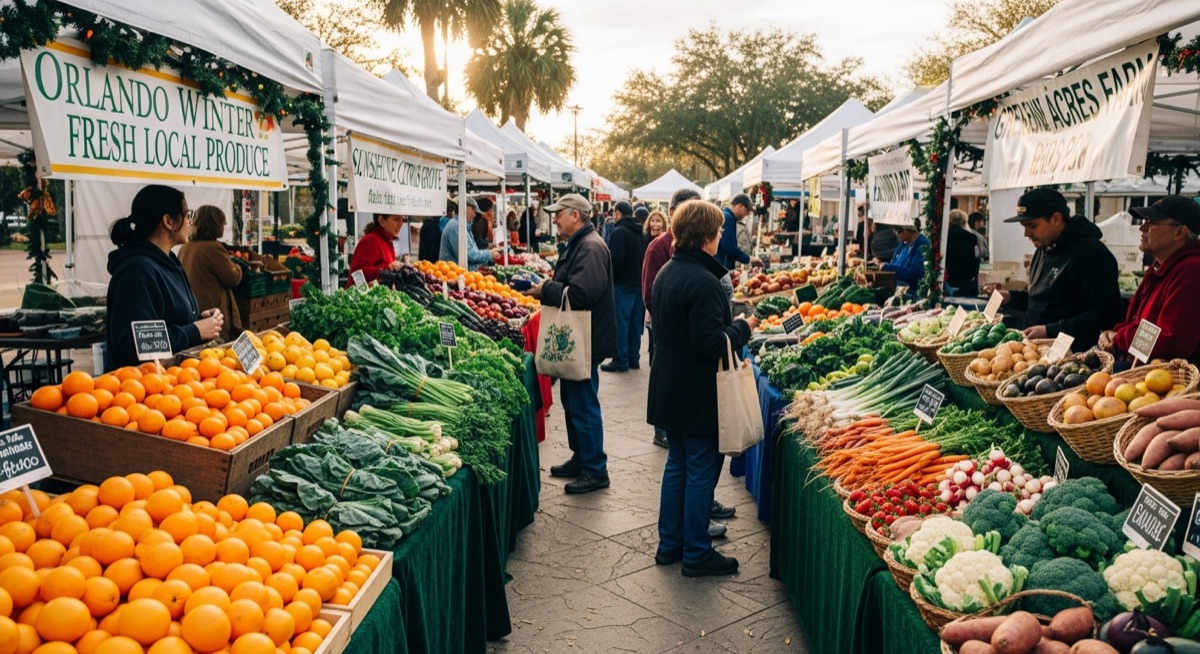
January through April is the real growing season. Locally grown strawberries from Plant City, 60 miles west on I-4. Tomatoes from Hillsborough and Manatee counties. Citrus from Polk County. Leafy greens — kale, collards, arugula, chard — that thrive in Florida’s mild winters. During these months, vendor counts at most markets skew heavily toward actual growers, produce prices are most competitive, and the proposition of getting up on a Saturday morning makes genuine sense.
By June, the calculus shifts. Florida’s summer heat is hostile to most vegetable crops. What doesn’t wilt dies from fungal pressure in the humidity. Vendors who stay through summer are increasingly selling Georgia, Tennessee, or Carolinas produce. Sometimes it’s labeled that way. Often it isn’t. This isn’t a conspiracy — it’s the economics of keeping a booth running year-round when your own fields aren’t producing. But you should know it before you assume the “farm fresh” tomatoes in July came from anywhere near Orange County.
Fall — October through December — is a secondary window. Better than summer, not as productive as winter-spring. Plant City strawberries typically begin arriving at markets in late November. Citrus comes in waves starting in October.
The practical implication: if you visit the Winter Park Farmers Market in February, you’ll have a fundamentally different experience than if you visit in August. This roundup reflects conditions observed in early 2026, near peak season. Your mileage will vary considerably in July.
Winter Park Farmers Market: The Biggest Name, With Caveats
Where: New York Avenue at the New England Avenue rail depot, Winter Park 32789
When: Saturdays, 7 a.m.–1 p.m., year-round. Verify current hours before visiting — construction activity near the depot in 2025 may have affected the schedule.
The Winter Park Farmers Market is the one most Orlandoans have heard of. The reputation is both deserved and slightly inflated, depending on what you’re after.
The location is a genuine asset: a historic train depot in downtown Winter Park, covered vendor space, tree shade, easy access to Park Avenue coffee shops if you want to make a morning of it. The market runs 50 to 60 vendor stalls. The mix skews heavily toward prepared foods, crafts, and baked goods. Local produce vendors are a minority of the total — and that’s the part the lifestyle coverage tends to gloss over. Before visiting with produce-focused expectations, call the market manager and ask about the current grower-to-reseller ratio. It’s the most important number for evaluating the market, and it’s not posted anywhere.
Worth seeking out specifically: raw varietal honeys — orange blossom, wildflower, gallberry — from local honey vendors. Gallberry is a genuinely different product than anything on the Publix shelf and the vendors who carry it know the difference. In strawberry season, Plant City berry vendors set up along the perimeter; look for handwritten signs with farm names rather than generic branding. Microgreens growers operating under small-producer arrangements bring cultivated varieties you won’t find at a supermarket. Ask any produce vendor directly whether they’re USDA-certified organic. Legitimate certified operations can produce the certificate on the spot.
Price spot-check (January 2026):
We priced five items at the Whole Foods on Aloma Avenue in Winter Park and the nearest Publix. The farmers market figures vary by vendor and week, so treat these as reference points rather than guarantees.
Pasture-raised eggs ran $7–$8 at Whole Foods, $5–$6 at Publix. Conventional strawberries (one pint) were $4.99 at Whole Foods and $3.99 at Publix. A bunch of kale was $2.99 and $2.49 respectively. Raw local honey (8 oz.) ran $10–$12 at Whole Foods and $8–$10 at Publix — though what Whole Foods sells as “local honey” is a looser category than what you’ll find at the market from a vendor who can tell you which county the bees worked. Packaged microgreens were $5.99 at Whole Foods; Publix didn’t carry them.
Here’s the bottom line on cost, and it’s not what the farmers market boosters want you to hear: if you’re shopping primarily on price, Publix wins almost every line item. The value at farmers markets is in seasonality, provenance, and variety not available in supermarkets. As part of our local food and nutrition coverage, we’ve found that farmers markets in Orlando in 2026 are not cheaper than grocery stores. Anyone who tells you otherwise hasn’t compared receipts lately.
Parking: The free lot on the Lyman Avenue side fills by 8:30 a.m. in season. Street parking on Morse and New England avenues is your best backup.
Transit: Most transit-accessible major market in the metro. The SunRail Winter Park station is a two-minute walk from the depot. Riding from downtown Orlando, Sand Lake, or points south, this is a genuine car-free option. Lynx Route 102 also serves the corridor.
Audubon Park Community Market: The Weeknight Option Most Shoppers Don’t Know About
Where: 1842 E. Winter Park Rd. at Formosa Ave., in the parking lot of the Audubon Park Garden District retail cluster, Orlando 32803
When: Tuesday evenings, approximately 5–8 p.m., year-round. Hours have shifted seasonally. Confirm before visiting.
This is the best market in Orlando that most shoppers don’t know exists.
It’s smaller than Winter Park — roughly 20 to 30 stalls on a typical evening — but its proportional grower-to-reseller ratio has historically been stronger. The vendors skew toward people selling directly from small farms, which is a meaningful distinction from the prepared-food-heavy Winter Park experience.
The Tuesday evening timing is its biggest structural advantage. For working residents who can’t clear Saturday mornings, it’s a legitimate option, and a Tuesday at 6 p.m. beats fighting the Winter Park depot crowd at 8 a.m. in high season. Arrive closer to opening than to closing if produce is the goal. Several vendors have offered weekly subscription shares collected Tuesday evenings — whether any CSA programs are currently anchored here in 2026 is worth asking directly at the farm produce tables.
Bike access is excellent. The Cady Way Trail runs through this corridor, putting the market within reach from Baldwin Park, Colonialtown, and College Park without touching a road. People visibly arrive by bike on a regular basis. It’s one of those small operational details that tells you something about what a market has gotten right.
EBT/SNAP: Audubon Park has historically held USDA FNS authorization to accept EBT. Confirm current authorization and terminal availability with market management before your visit — authorization statuses change. See the SNAP section below for more detail.
Lynx bus service is possible along this corridor but limited. Verify current routes with Lynx directly.
Lake Eola, Maitland, and the Others
Lake Eola Farmers Market
Where: Lake Eola Park, downtown Orlando
When: Sundays. Verify current hours and operating status directly with market management. This market has experienced real instability in recent years — schedule and management have both fluctuated — and confirming before you go isn’t optional.
When operating, Lake Eola is large and well-attended, set around the park’s lake loop, with strong street food variety and a social atmosphere. By vendor ratio, it skews more toward resellers and crafts than direct-farm vendors — more so than Winter Park or Audubon Park. It makes for a good Sunday outing if that’s what you’re after. If fresh local produce is the primary goal, head to Winter Park or Audubon Park. But confirm the market is running before you make a trip downtown.
Church Street SunRail Station is approximately 0.6 miles from the park entrance — flat, walkable, manageable even in early spring before the heat builds. SunRail runs Sunday service; verify frequency at sunrail.com. Lynx routes serving downtown also put riders within walking distance.
Maitland Farmers Market
Where: Maitland Civic Center. Verify current address before visiting.
When: Saturdays. Verify current hours and operating status with market management.
Maitland is the market that serious produce shoppers sometimes prefer once they’ve outgrown the Winter Park crowds, and there’s something to be said for that logic. Smaller vendor count, but the grower-to-reseller ratio has historically been stronger proportionally, and market management has maintained a stated preference for direct producers. Vegetable growers, citrus vendors, honey producers, and small-batch fermentation and preserved food makers make up a meaningful share of the booths. The atmosphere is quieter — less performative than Winter Park on a high-traffic Saturday.
The SunRail Maitland Station is on the line. Check current walking distance from the station to the Civic Center before planning a car-free trip. SunRail runs Saturday service.
Other Active Markets
Dr. Phillips Farmers Market serves a health-conscious suburban demographic that gets underreported in regional coverage. Transit access is limited; this is a car-dependent destination in any practical sense. Verify operating status and current location before visiting.
Oviedo Regional Farmers Market skews toward artisan and prepared food vendors, with limited direct-farm produce based on recent history. Worth noting for Oviedo residents. Not worth a special trip from Orlando proper if produce is the goal. Verify operating status before visiting.
Lake Mary Farmers Market has seen several iterations open and suspend operations in recent years. Verify current status directly — and maybe don’t make a special trip until you’ve confirmed it’s actually running.
East End Market (3201 Corrine Dr., Orlando 32803) isn’t a traditional farmers market but an indoor food hall housing several local food producers on a permanent basis. Accessible any day of the week, which makes it genuinely useful for shoppers who want small-batch local goods outside of market hours. The tenant roster has seen some turnover since the pandemic. Verify current producers with the venue before visiting.
Certified Organic vs. “We Don’t Spray Much”: What Vendors Are Actually Required to Tell You
Walk through most Orlando-area markets and you’ll hear some version of: “all-natural,” “chemical-free,” “we don’t spray,” “pesticide-free,” “grown without chemicals.” These terms have no legal definition. They require no verification, no inspection, no paperwork. Any vendor can use any of them at any time.
USDA Organic certification is different. It’s a legal designation requiring third-party inspection, a documented management plan, a multi-year transition period, and annual fees. Those costs represent a genuine burden for small diversified vegetable operations. Many farmers who farm in ways that would meet organic standards simply don’t pursue certification — and given what the process involves, that’s understandable. The lack of a certification doesn’t mean a farm is using synthetic chemicals.
But here’s the honest position: without certification, you can’t verify a vendor’s claims at the table. You’re taking their word for it. Some vendors in the uncertified middle ground are farming carefully with minimal synthetic inputs and biological pest management. Others are using conventional inputs and calling it natural because nobody is checking. You cannot tell from a sign which is which.
So ask directly: “Are you USDA certified organic?” If yes, ask to see the certificate — legitimate operations carry it. If no, ask specifically what synthetic pesticides or fertilizers, if any, they use, and how they manage pest pressure. Open-ended specific questions get better answers than a general “are you organic?” Use the USDA Organic Integrity Database to verify current certification status before shopping if this matters to you. It’s publicly accessible and takes about two minutes.
Florida’s direct-farm exemption allows farms meeting certain sales thresholds to sell at markets without a full retail food dealer’s license — a lighter regulatory touch than commercial operations. That’s not inherently a problem; small local farms shouldn’t face the same overhead as industrial ones. But knowing it exists helps you calibrate how much weight to give vendor assurances.
SNAP, EBT, and Whether Any Market Doubles Your Benefits
USDA FNS authorization statuses change. Markets that were authorized in prior years aren’t automatically still authorized in 2026. Florida requires a separate USDA FNS authorization for each market to accept EBT. Confirm EBT acceptance directly with each market before visiting. The USDA FNS authorized retailer search at fns.usda.gov is the most reliable check.
Audubon Park Community Market has historically held FNS authorization. Winter Park Farmers Market has historically held FNS authorization. Lake Eola’s authorization status has fluctuated — confirm directly. Maitland has held authorization in prior years — verify current status.
The larger gap worth naming plainly: I’ve been unable to confirm an active SNAP-match program at any Orlando-area market at time of reporting. Programs that double SNAP purchasing power at farmers markets exist in other Florida cities. SNAP households can use benefits at authorized Orlando markets, which is meaningfully better than nothing — but a match program would make those markets genuinely competitive with grocery-store purchasing power in a way that current authorization alone doesn’t. Contact each market and Florida Fresh Access Bucks directly to confirm whether anything has changed since this was reported.
Getting There Without a Car
Winter Park (Saturday) is car-optional. The SunRail Winter Park station is a two-minute walk from the depot. The train runs Saturday mornings from downtown Orlando (Church Street), Sand Lake Road, and points along the I-4 corridor. Check SunRail’s 2026 weekend schedule at sunrail.com — service frequency has been adjusted in past years and the current timetable is worth verifying before you plan around it. Lynx Route 102 also serves the Winter Park corridor. This is the car-free option in the metro, and it actually works.
Audubon Park (Tuesday evenings) is directly accessible via the Cady Way Trail for cyclists from Baldwin Park, Colonialtown, and College Park. Lynx bus service runs along the corridor — limited, but possible; verify current routes. The Tuesday evening timing works in your favor on transit: you’re traveling against rush-hour traffic flow heading out, which makes the trip noticeably less painful than a peak-hour commute in the same direction.
Lake Eola (Sunday) sits about 0.6 miles from Church Street SunRail Station — flat, walkable, easy in January. SunRail runs Sunday service; verify frequency at sunrail.com. Lynx downtown routes also deposit riders within walking distance. Solid option for downtown and south-downtown residents.
Maitland (Saturday) has SunRail service at the Maitland Station. The market is at the Civic Center. Check current walking distance from station to market before committing to a car-free trip — walkability is the variable here.
Dr. Phillips, Oviedo, and Lake Mary require a car. No qualifications. Lynx coverage is thin in those corridors and walking distances from any transit stop are prohibitive.
Which Market Fits Your Situation
No single market is the right answer for every reader. Here are direct recommendations.
Fresh local produce is your primary goal: Audubon Park Community Market, Tuesday evening, January through April. Historically stronger grower ratio, lighter crowds than Winter Park on Saturday, and you can come away with a week’s worth of seasonal vegetables in one stop. If Saturday is your only option, Winter Park works — but arrive early and head straight to the farm produce tables before you get pulled into the prepared food orbit. It’s easy to spend 45 minutes at Winter Park and leave with three pastries and no vegetables.
You can only go on weekends: Winter Park Saturday is the highest-volume option with the best transit access and most consistent vendor presence. Arrive before 9 a.m. if produce is the point. Maitland is worth considering if you want a quieter, less crowded experience with a comparable grower-to-reseller ratio. Verify hours before going.
You don’t have a car: Winter Park via SunRail on Saturday is the most reliable choice in the metro. Lake Eola on Sunday via Church Street SunRail is a solid second for downtown residents — provided you confirm the market is currently operating before you make the trip. Audubon Park on Tuesday via Cady Way Trail is the best option for cyclists in the Baldwin Park–Colonialtown corridor.
You’re a SNAP/EBT household: Both Winter Park and Audubon Park have historically held EBT authorization; confirm current status with each before visiting. No confirmed SNAP-match program currently exists at Orlando-area markets, though verify with market managers and Florida Fresh Access Bucks directly. Audubon Park’s smaller, more produce-focused vendor mix may stretch EBT dollars further per transaction than a market with a heavier prepared-food orientation.
USDA Organic certification is non-negotiable: Your options narrow significantly. Ask vendors directly for their USDA Organic certificate, and verify in the USDA Organic Integrity Database before shopping. Certified vendors are present at these markets but not dominant. You’ll need to hunt.
You’re shopping primarily on price: Go to Publix. That’s the honest answer. Markets in Orlando in 2026 are not cheaper than grocery stores on most items. The value is in seasonality, provenance, and variety — not in cost savings.
One last thing: the peak window for all of these markets, for all reader types, is January through April. If you’ve only visited a Central Florida farmers market in summer, you haven’t seen what these places can be. Come back in February. The Plant City strawberries are not the same product you find in the Publix clamshell in August, and if you’ve never had one warm from the field, that’s the most useful piece of information in this entire article.
Reporting for this piece was conducted in January and February 2026. Operating hours, vendor rosters, and EBT authorization statuses are subject to change. Verify current conditions with individual markets before visiting. USDA FNS authorization can be confirmed via the authorized retailer search at fns.usda.gov. SunRail weekend schedules should be verified at sunrail.com.