Free Health Clinics in Orlando Where to Get Care in 2026
What Shepherd's Hope, BETA Center, and CommunityHealth Centers of Orange County are actually offering in 2026: hours, eligibility, intake requirements, and what happened to the Orange County reside…
Free Health Clinics in Orlando Where to Get Care in 2026
What Shepherd’s Hope, BETA Center, and CommunityHealth Centers of Orange County are actually offering in 2026: hours, eligibility, intake requirements, and what happened to the Orange County residents who lost Medicaid coverage in 2024.
If you’ve lost health insurance in Orlando and searched online for free or low-cost medical care, you’ve probably found clinic listings that haven’t been updated since 2022. Phone numbers that ring to voicemail. Hours that no longer match what you find when you actually show up.
This guide corrects that. It covers the three providers most likely to help uninsured Orange County residents right now—Shepherd’s Hope, CommunityHealth Centers of Orange County (CHCOC), and BETA Center—with specific attention to what’s changed since Florida’s 2024 Medicaid redetermination eliminated coverage for more than a million and a half state residents. Orange County was among the hardest-hit urban counties in that process, and the resulting demand surge has changed wait times, intake procedures, and capacity at every major safety-net clinic in the region.
What follows is organized by provider, then by practical question. If you need to know which clinic is closest to Pine Hills or South OBT, go to Section 8. If you just lost Medicaid and want the fastest path back to care, start with Section 10.
Section 1: Why This Guide Exists Now
Between mid-2023 and the end of 2024, Florida completed a federally required review of every Medicaid recipient’s eligibility—the first such review since the COVID-19 pandemic began. The results were severe. Statewide, Florida disenrolled more than 1.6 million people, one of the highest totals in the country. A significant share of those disenrollments hit adults in Orange and Osceola counties, a metro area already carrying one of the highest uninsured rates in Florida.
What makes that number harder to absorb: many of those disenrollments were procedural. People lost coverage not because they were ineligible, but because paperwork wasn’t received, addresses had changed, or the state couldn’t verify information on file. A significant share of disenrolled Floridians were still income-eligible. But in a state that hasn’t expanded Medicaid under the Affordable Care Act, adults without dependent children and without a qualifying disability often find they have no re-enrollment path even if they apply again. That’s a structural problem, and it’s worth saying plainly.
On the ground in Orlando, what this looks like is more people arriving at free and sliding-scale clinics with chronic conditions that previously were managed through coordinated care—diabetes, hypertension, thyroid disorders—now showing up at evening volunteer clinics that were already running close to capacity. Intake policies, wait times, and scheduling procedures have shifted in response. The information here reflects reported status as of 2026, and it is part of our health & wellness coverage of Orange County’s safety-net infrastructure.
Section 2: Three Different Models, Three Different Entry Points
Before you call any clinic or show up at a door, knowing what kind of provider you’re dealing with will save you real time.
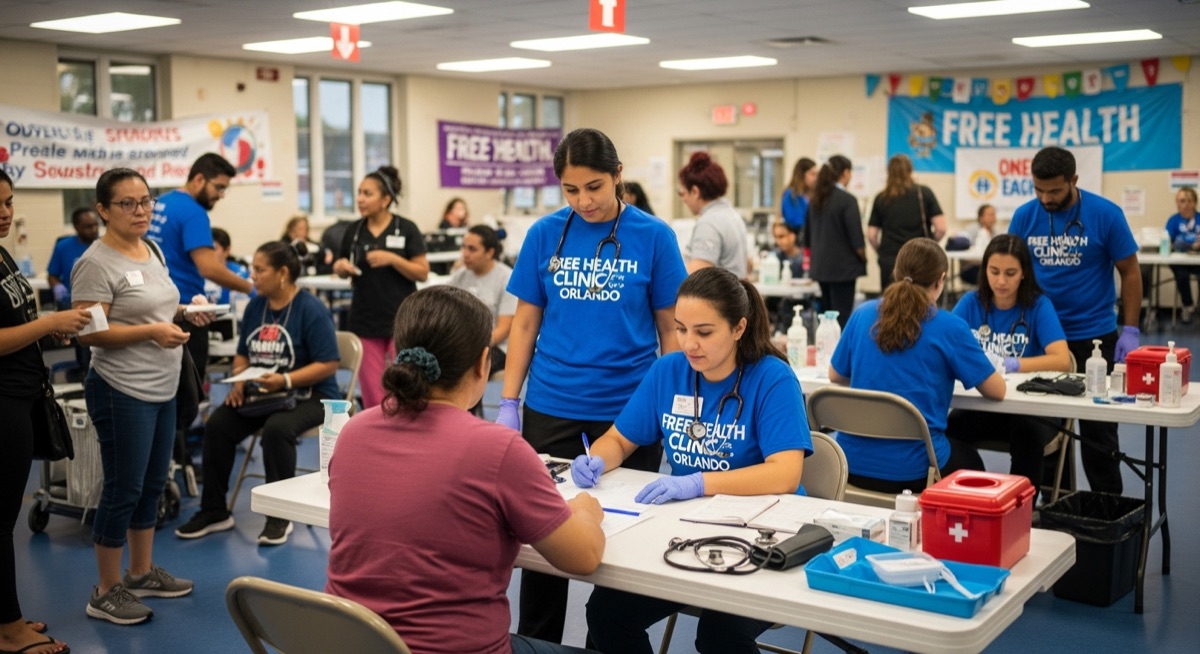
Volunteer-staffed free clinics like Shepherd’s Hope run on donated physician, nursing, and pharmacist time. No fees, no sliding scale, no billing. Because the model depends entirely on donated professional hours, sessions are limited—almost always weekday evenings—and each session has a fixed headcount. You show up, you’re registered in order, and when the clinic fills, it closes.
Federally Qualified Health Centers like CommunityHealth Centers of Orange County operate under a federal mandate requiring them to serve patients regardless of ability to pay, citizenship status, or insurance. They use a sliding-scale fee structure based on income; at the lowest income levels, a visit costs $0 to $20. Unlike free clinics, FQHCs keep patient records across visits, run full business hours, and offer a broader clinical scope—labs, mental health, dental, specialty referrals. They also accept Medicaid and marketplace insurance if you have them.
Then there are targeted nonprofits like BETA Center, which serve a specific population—in BETA’s case, people navigating pregnancy and early parenting—with a defined scope of services that doesn’t include general primary care. Directing someone with diabetes to BETA Center because it appears in a “free clinic” search is a common misdirection that costs people days or weeks of delayed care. It happens more than it should.
Knowing which model fits what you actually need before you walk in is the difference between getting care and getting turned away.
Section 3: Shepherd’s Hope
Shepherd’s Hope is Florida’s largest volunteer medical clinic network. Founded in 1996 by Orlando-area faith communities, it remains faith-affiliated—but patients are not required to participate in or profess any religion to receive care. That’s worth stating clearly, because some people assume otherwise and don’t call.
The network operates four verified clinic sites as of 2026. The Apopka site serves the large agricultural and low-income immigrant communities in northwest Orange County. First Baptist Orlando, in downtown, is one of the network’s most established and highest-volume sites. The Osceola/Kissimmee site serves the significant Puerto Rican and Central American communities in that corridor, with Spanish-language clinical staff routinely present. Shepherd’s Hope also coordinates occasional sessions at other partner locations; calling (407) 876-6699 will get you the current schedule.
Every site operates weekday evenings only. No daytime clinics. Volunteer availability affects capacity on any given night, and sessions close when capacity is reached. Some locations have moved from walk-in to pre-registration systems since 2024—this has shifted at multiple sites, so call before you go even if you’ve been before. At high-volume sites, arriving early is often the difference between being seen and being turned away.
The network serves uninsured adults at or below 200 percent of the federal poverty level. Income documentation is requested but not required for entry; self-attestation is accepted when documentation isn’t available. Shepherd’s Hope explicitly does not require documentation of citizenship or legal residency. You will not be asked for immigration paperwork.
Section 4: CommunityHealth Centers of Orange County
CHCOC is a federally qualified health center, which means it operates under a federal mandate to provide care regardless of a patient’s ability to pay, citizenship status, or insurance. This isn’t discretionary policy—it’s a legal condition of the federal funding the organization receives. That matters especially for anyone who’s been turned away elsewhere.
CHCOC operates multiple clinic sites across Orange County, with particular presence in the corridors carrying the highest uninsured rates: Pine Hills, South Orange Blossom Trail, and East Orlando including Azalea Park and Goldenrod. Most locations run standard clinic hours; some sites offer extended evening or Saturday hours. Same-day appointments are available at most locations, though walk-in policies vary by site and shift with demand. Federally, FQHCs are required to provide same-day access for urgent needs.
The sliding-scale fee is based on household income and family size against federal poverty guidelines. Patients at the lowest income levels typically pay $0 to $20 per visit. If you have Medicaid, Medicare, or a marketplace plan, CHCOC will bill it. If you have no coverage, you’re billed on the sliding scale regardless of documentation status.
What CHCOC provides, depending on the site: adult and pediatric primary care, women’s health and OB/GYN, integrated behavioral health at several locations, dental care at select sites, on-site lab work, pharmacy services, and referral coordination for specialty care. It’s closer to a full-service practice than most people expect from a safety-net clinic. Service availability varies, so when you call, be specific about what you need—it’ll help staff direct you to the right location.
Federal law governing FQHCs prohibits denial of care based on citizenship or immigration status. CHCOC does not require proof of citizenship or legal residency.
Section 5: BETA Center
BETA Center is a nonprofit focused specifically on pregnancy support and early family services. A lot of outdated online listings don’t make this clear enough: BETA Center is not a general primary care clinic.
The center provides pregnancy testing and confirmation, prenatal care coordination and referrals, WIC enrollment assistance, childbirth education, and parenting support. Walk-in access is available for initial pregnancy testing visits.
What BETA does not provide: general primary care, chronic disease management, dental care, mental health services, or care for non-pregnancy-related concerns. If you’re pregnant and also managing diabetes or hypertension, BETA can handle the pregnancy coordination piece—but you’ll need CHCOC or another FQHC for everything else. These are not interchangeable. Getting this wrong costs time people often don’t have.
Section 6: What Services Can You Actually Get?
This is the question that matters most to people managing chronic conditions.
Both Shepherd’s Hope and CHCOC can write prescriptions. Shepherd’s Hope operates a dispensary at its clinic sites where many common medications are provided at no cost during the visit—generics for hypertension, diabetes, cholesterol, and thyroid conditions are typically stocked. CHCOC prescribes through standard pharmacy channels. If you’re managing anything long-term, ask specifically about the 340B drug pricing program when you visit CHCOC; it significantly reduces costs at participating pharmacies, and many patients don’t know to ask.
Labs are drawn on-site at CHCOC locations. Shepherd’s Hope can order basic labs through partner arrangements, but the range is more limited. For comprehensive bloodwork—diabetes management, kidney function, lipid panels—CHCOC is the more reliable option.
For specialists, CHCOC has formal referral relationships across cardiology, endocrinology, nephrology, and other specialty areas. Shepherd’s Hope maintains a volunteer specialist network, but availability is less consistent and coordinating specialty care through the volunteer system takes more patience.
Behavioral health is integrated into several CHCOC primary care sites. Shepherd’s Hope does not offer it as part of its standard clinic model.
Dental care is not available at Shepherd’s Hope. CHCOC offers dental at select locations—not all of them. When you call CHCOC, ask specifically which site has dental and what the current wait is for new patients. It’s one of the tighter bottlenecks in the system right now. Orange County Health Services also operates a separate dental safety-net program; contact them directly to confirm availability.
For mental health crises or psychiatric medication management after losing coverage, 2-1-1 Florida can connect you to crisis resources, and CHCOC provides integrated behavioral health at several sites. If you need immediate crisis support, 988 is available around the clock.
CHCOC provides OB/GYN and prenatal care at some sites. BETA Center handles coordination and referrals but not direct obstetric care. If you’re pregnant and uninsured, both are useful starting points—BETA for initial confirmation and WIC enrollment, CHCOC for ongoing prenatal care.
Section 7: What to Bring
Shepherd’s Hope
Bring a photo ID—government-issued is preferred, but alternatives are considered—and proof of Orange County residence: a utility bill, lease, or any addressed mail. Pay stubs or an employer letter help establish income, but if you don’t have them, you can write a simple income statement at the clinic. A list of current medications is useful if you’re managing a chronic condition; don’t assume anyone has your records, because they won’t.
Immigration status is not asked. Interpreter services are available at most sites, and several have bilingual staff on-site. If language access is a concern, call ahead to confirm.
CommunityHealth Centers of Orange County
Bring a photo ID and proof of income—pay stubs, an employer letter, or a self-attestation form available at the clinic. A utility bill or lease works for proof of address. If you’re housing-insecure, say so at the front desk; staff work through this regularly and won’t make it harder than it needs to be. If you have insurance, bring your card and any existing referrals. Immigration status is not required.
BETA Center
Bring a photo ID. First visits typically involve on-site pregnancy testing. For follow-up or WIC enrollment, bring income documentation if you have it. If you don’t, intake staff can help you work through what’s available. Immigration status is not required.
At all three providers, showing up without documentation does not mean you’ll be turned away. Self-attestation—a signed, written statement of your income and household—is widely accepted. If you don’t have documents, say so at check-in. Staff at all three organizations are used to working with patients in that situation.
Section 8: Which Clinics Serve Which Neighborhoods
Orlando’s highest uninsured neighborhoods are well-documented, and the clinic map tracks them imperfectly but meaningfully.
Pine Hills is one of Orange County’s densest and most underserved communities. CHCOC operates in this corridor. Shepherd’s Hope’s First Baptist Orlando site is reachable by LYNX bus for residents who can make the trip downtown—though that’s not a trivial ask for someone working a split shift, and it’s worth being honest about that.
Parramore is served by the First Baptist Orlando Shepherd’s Hope site and CHCOC locations. BETA Center’s South Orange Avenue location is also close to this corridor.
South OBT has a specific CHCOC presence. This zone has a high concentration of uninsured working adults in service and hospitality—people with jobs that simply don’t come with health benefits.
Azalea Park and Goldenrod are served by CHCOC’s East Orlando locations. This corridor has a significant Central American immigrant population; Spanish-language capacity matters here. Ask about it when you call.
Apopka is served by Shepherd’s Hope’s dedicated Apopka site, which exists specifically because of that community’s need. Apopka has one of the county’s largest populations of agricultural workers and lower-income immigrant families. The Apopka site isn’t a convenience for those residents—for many, it’s the only option that doesn’t require a bus transfer they can’t make.
Buenaventura Lakes in Osceola County is served by the Shepherd’s Hope Osceola/Kissimmee site, which has consistent Spanish-language staff. This community has a large Puerto Rican population, and the clinic’s bilingual operation is a practical asset, not a box-checking exercise.
CHCOC offers interpreter services in Spanish and other languages across its network. If you need interpretation in a language other than Spanish, call the specific site ahead of time to confirm—don’t assume. BETA Center provides Spanish-language services on-site.
Section 9: Practical Logistics
At Shepherd’s Hope’s high-volume sites, particularly First Baptist Orlando, arriving when doors open matters. Patients are registered in arrival order, and sessions close when capacity is reached. On nights with fewer volunteers, capacity can be lower than typical. Confirm the current policy at your specific site before traveling—this has changed at multiple locations since 2024, and a wasted trip is a real cost.
Volunteer availability also drops in summer and around major holidays. Sites have canceled sessions or run at reduced capacity during peak vacation weeks. If you’re planning a visit in June, July, or around Thanksgiving or Christmas, call first to confirm the session is running. The network does its best, but it runs on donated time.
Same-day appointments at CHCOC are available, but the window for same-day scheduling closes early as slots fill. Call when the clinic opens. Walk-in access without a scheduled appointment is more limited and varies by site and day.
Both CHCOC and Shepherd’s Hope can connect patients with enrollment navigators—staff who can help you figure out in real time whether you qualify for Medicaid, a marketplace plan, or another coverage program. For anyone who lost coverage during the 2024 redetermination, this is genuinely useful and underused. Ask specifically when you arrive or call. ACA marketplace open enrollment runs November through January, and some clinics have navigators on-site during that window.
Section 10: If You Lost Medicaid in 2024
If you were disenrolled during the 2024 redetermination and haven’t had coverage since, here’s what you need to know.
A significant share of Floridians removed from Medicaid were dropped for procedural reasons—not because they were actually ineligible. If your income hasn’t changed, it’s worth checking eligibility again. You can reapply through the ACCESS Florida portal or in person at the Orange County Department of Social Services.
Florida hasn’t expanded Medicaid under the Affordable Care Act. Adults without dependent children who earn too little to qualify for marketplace subsidies fall into a coverage gap: they don’t qualify for Medicaid under current Florida rules, and they don’t qualify for marketplace subsidies either. The clinics in this guide exist, in significant part, to serve people stuck in exactly that gap. I don’t want to oversell what any of them can do about the underlying policy—they can’t fix it—but they can provide care while it remains broken.
For someone who recently lost Medicaid and needs care now: CHCOC is your fastest entry point for primary care, medication refills, and chronic condition management. Call your nearest site first thing in the morning. If CHCOC can’t get you in same-day, Shepherd’s Hope can likely see you the same week at an evening session. If you’re pregnant, call BETA Center first for pregnancy coordination and WIC navigation, then CHCOC for ongoing prenatal care.
Verified Contact Information: 2026
| Provider | Phone |
|---|---|
| Shepherd’s Hope | (407) 876-6699 |
| Florida 2-1-1 (referral and navigation) | Dial 211 |
Confirm current contact information for CommunityHealth Centers of Orange County and BETA Center directly via 2-1-1 or a current web search. Phone numbers for both organizations shifted during the 2024–2025 period and could not be independently locked down for this guide.
A Note on What This Guide Can’t Do
Clinic hours, intake requirements, and capacity change. The information here reflects verified current status as of 2026, but any site can modify its schedule, pause walk-in access, or add services without updating its public listings immediately. Before you make the trip, call. Every provider listed here has staff who can confirm hours and tell you what to bring. Five minutes on the phone can save a wasted trip—and in a system where wasted trips have real costs, that’s not a minor thing.
If you’ve used any of these clinics and encountered something different from what’s described here, this guide is updated on a rolling basis as new information comes in.
CityDesk Orlando covers Orange County business and policy. Tips and corrections can be sent to the editorial team.