What to Do When a Mental Health Crisis Hits in Orlando
What actually happens when you call for help in Orange County — and how to choose the right option before you need it.

What to Do When a Mental Health Crisis Hits in Orlando
What actually happens when you call for help in Orange County — and how to choose the right option before you need it.
How to Use This Guide
This is a locally reported resource, not a national hotline list. If you’re searching for mental health crisis help in Orlando right now, start with the triage section immediately below. The fuller sections explain what actually happens in each pathway, who answers the phone, and what you’ll encounter when you arrive. Every resource listed here was directly verified by CityDesk Orlando. The verification date appears at the bottom of the piece.
This guide covers four specific questions: where your 988 call actually goes in Orange County, what Aspire Health Partners’ Crisis Stabilization Unit is and how to use it, how to request a mobile crisis team, and what the Baker Act means for your rights. It’s written for someone who may be searching in or near a crisis moment — their own, or someone else’s. If that’s you right now, skip straight to the triage section.
Start Here: A Crisis Triage Decision Tree
Not sure which option fits? Start here.
Immediate danger to life. Someone has a weapon, is actively attempting suicide, or is physically harming others. Call 911. This is the one scenario where law enforcement and EMS are the right first call. No exceptions.
You need to talk to someone right now and are not in immediate physical danger. Call or text 988. You’ll reach a trained crisis counselor, not an automated menu.
You need someone to come to you. You or someone you’re with is in crisis but the situation isn’t an immediate physical emergency. Request a mobile crisis team. In Orange County, access this through 988 when connected to a counselor.
You can get yourself somewhere and want professional assessment without a hospital ER. Walk in to the Aspire Health Partners Crisis Stabilization Unit, 1800 Mercy Drive, Pine Hills. No appointment needed.
When You Call 988 in Orlando: Where the Call Actually Goes
The 988 number launched nationally in July 2022, but what happens after you dial depends entirely on geography — and that part rarely gets explained. For callers in Orange County, the call routes through the Central Florida Behavioral Health Network (CFBHN), the state-designated managing entity overseeing mental health and substance use services across nine counties: Orange, Osceola, Seminole, Volusia, Lake, Brevard, Flagler, Marion, and Putnam.
CFBHN holds the routing and oversight contract that determines which local provider answers. CityDesk Orlando is confirming the specific call-answering entity for Orange County 988 calls and will update this section upon direct verification.
Here’s what matters regardless: a person answers. The first few minutes involve the counselor checking your immediate safety, hearing your situation, and helping you figure out what kind of help fits the moment. They can stay on the line, dispatch the mobile crisis team, or walk you through whether the Aspire CSU makes sense. If you’re in immediate physical danger, they’ll help coordinate 911.
If you can’t safely speak aloud — you’re somewhere a voice call would make things worse, or you communicate better by text — 988 accepts text and online chat. Text “988” from your phone or use the 988 Suicide and Crisis Lifeline chat at 988lifeline.org. Text and chat responses run slightly slower than voice calls, but both connect to trained counselors.
The Non-ER Option: What Aspire Health Partners’ Crisis Stabilization Unit Actually Is
The emergency room is often the wrong place for a behavioral health emergency. That’s not a controversial claim — it’s just something the system was slow to build around.
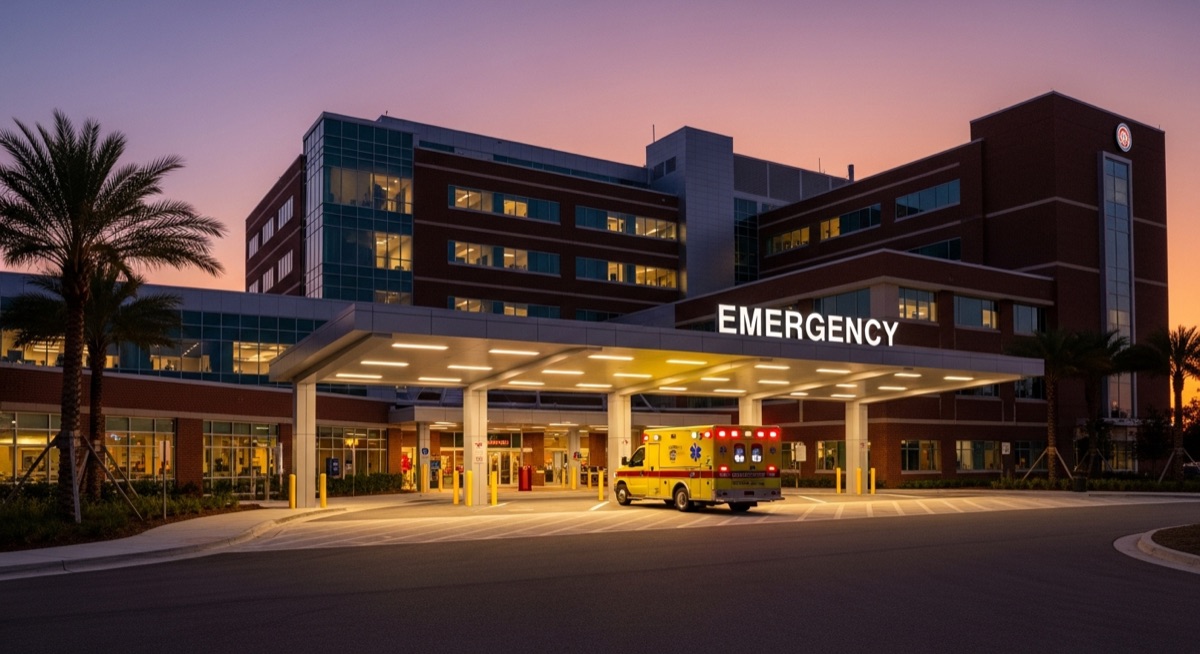
ERs are built for physical medicine. Nationally, psychiatric patients wait significantly longer than the facility average before seeing a specialist — median boarding times exceeding 11 hours in many systems. Neither Orlando Health ORMC on Orange Avenue nor AdventHealth Orlando has a dedicated psychiatric emergency department. Mental health patients enter the same general queue as everyone else. A Crisis Stabilization Unit is a different thing entirely.
Aspire Health Partners operates Orange County’s primary public-sector CSU at 1800 Mercy Drive in Pine Hills, on Orlando’s northwest side. Three things distinguish it from a hospital ER. Clinical staff are trained in psychiatric de-escalation rather than medical triage. Intake happens at a behavioral health window rather than mixed into general ER flow. And the physical space is designed around calming rather than processing volume. If you’ve ever sat in a general ER waiting room during a mental health crisis — the noise, the fluorescent lights, the constant motion — you understand why that last point isn’t decorative.
Bring a photo ID if you have one, though it’s not required. An insurance card and a list of current medications are useful if you can pull them together; their absence won’t stop you from being seen. If you’re coming from southeast Orange County or south toward the airport, the drive to Pine Hills is substantial. Worth factoring in before you’re already in crisis. Kissimmee and south Osceola County residents face an even longer haul — see the geography section below.
Aspire accepts Medicaid, Medicare, and most private insurance. Uninsured patients are seen and stabilized. Under Florida law, crisis stabilization services cannot be denied based on inability to pay, and state DCF crisis funding covers care for people who can’t cover it themselves.
What to Expect at the Aspire CSU: A Step-by-Step Walkthrough
The question that keeps people from using crisis care usually isn’t “where do I go.” It’s “what is going to happen to me when I get there.” The fear of losing control of what happens next stops people from going. So here’s what actually happens.
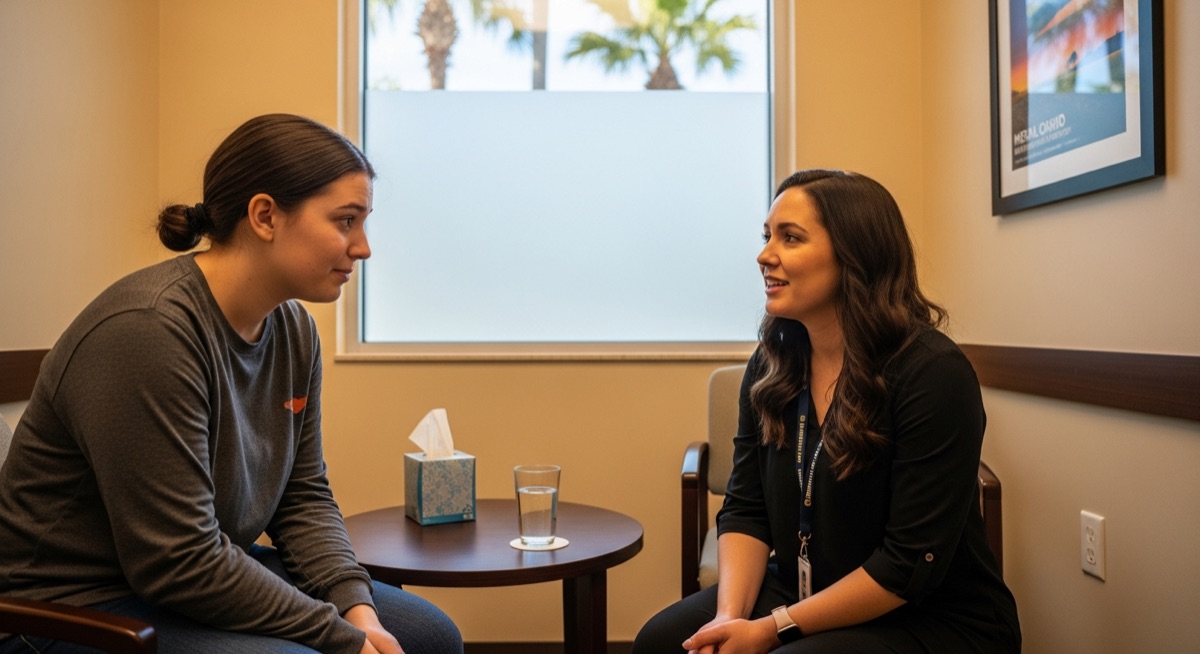
You walk up to the front desk or intake window and say you need crisis services. You don’t need the right words. “I’m not okay” is enough. Staff will ask a few initial questions and have you wait briefly while they prepare intake.
A clinician — typically a licensed mental health counselor or clinical social worker — will meet with you for a brief risk assessment. They’ll ask about your current symptoms, what brought you in, and whether you’re having thoughts of hurting yourself or others. It’s a structured conversation, not an interrogation.
The Aspire Pine Hills facility is not a locked inpatient psychiatric ward. It’s a short-term stabilization environment. The unit runs around the clock with psychiatrists, counselors, peer support specialists (people with lived mental health experience in a formal support role), and case managers. During a stay, you may have a medication evaluation or adjustment — with your consent — along with individual sessions and group programming. Before you leave, staff work with you on a safety plan and a follow-up appointment. That might mean scheduling outpatient therapy, connecting you with a community mental health center, or coordinating with your existing provider. Discharge planning is part of the service, which is one reason this guide belongs in our mental health and wellness coverage rather than a general hospital directory. You’re not just sent back out.
The sharpest difference from the ER: nobody here is primarily oriented toward physical medicine. That’s the whole point of a CSU.
Mobile Crisis Teams in Orange County: How to Request One and What to Expect
A mobile crisis team sends trained behavioral health professionals to you, rather than requiring you to travel somewhere while you’re already struggling. In Orange County, mobile crisis response expanded under Florida’s SB 12 (2023), which directed new funding toward community-based crisis response and was specifically designed to build out alternatives to law enforcement as the default first responder for behavioral health calls.
Call 988 and tell the counselor you need someone to come to your location. Describe the situation — someone is expressing suicidal thoughts, someone is extremely agitated and not responding, you’re in crisis and can’t leave home. Give as much context as you can. The more the dispatcher knows, the better they can prepare the team. CityDesk Orlando is confirming the direct dispatch number for Orange County mobile crisis and will update this section upon verification.
One thing worth knowing if you’re hesitant to call: mobile crisis teams responding to non-violent behavioral health calls in Orange County don’t include law enforcement as a default. The SB 12 model sends clinicians without automatic police co-dispatch for calls that don’t involve weapons or physical danger. If you’re worried a police response will make things worse, that distinction matters.
This is also not a lights-and-sirens situation. Response time reflects the clinical rather than emergency nature of the call. If things are deteriorating rapidly toward physical danger, 911 is still the right call. No insurance is required to request mobile crisis response.
The Baker Act: What Triggers It, What Happens, and What Your Rights Are
The Baker Act — formally Florida Statute 394.463, the Florida Mental Health Act — is the legal mechanism for involuntary psychiatric examination in Florida. Confusion about it causes real harm. People avoid seeking help because they’re afraid of being Baker Acted. Family members sometimes believe they have more power to initiate one than they do.
Only a law enforcement officer, a licensed physician, or a licensed mental health professional can initiate a Baker Act. A family member cannot. A friend cannot. A concerned neighbor cannot. A family member can call 911 and describe what they’re seeing — and law enforcement may initiate a Baker Act if their own criteria are met when they arrive — but the family member is not the initiating party. That distinction matters and it rarely gets explained clearly.
The legal threshold is specific: the person must have a mental illness, and because of that illness, either refuse voluntary examination while posing a likelihood of serious bodily harm to themselves or others — or be so neglectful of their own basic care as to constitute a danger. Both elements must be present. Someone in mental health distress who isn’t meeting that specific threshold cannot be lawfully Baker Acted. The bar is higher than most people think.
When a Baker Act is initiated, the person goes to a receiving facility: a hospital psychiatric unit, a CSU, or a crisis receiving center. The examination window is 72 hours from arrival. During those 72 hours, a licensed professional must evaluate the person and make a clinical determination.
Your rights during a Baker Act are legally enforceable, not just policy suggestions. You have the right to contact your family, unless a specific clinical determination is documented that this would be harmful. You have the right to an attorney. You have the right to refuse non-emergency treatments. Medication without consent is only lawful in genuine emergencies — the Baker Act authorizes examination, not unlimited treatment. You have the right to be held in the least restrictive appropriate setting, and you cannot be held indefinitely under a Baker Act alone.
At the end of 72 hours, one of three things must happen: you’re released, you agree to voluntary admission, or the facility petitions a court for involuntary inpatient placement. That last option requires a separate, higher legal standard and a judge. The 72-hour window is not a blank check.
One more thing: “voluntary Baker Act” is a phrase I’d quietly retire, because it’s a contradiction in terms. You cannot Baker Act yourself. If you recognize that you need inpatient psychiatric care and are willing to seek it, that’s voluntary admission — a different legal pathway, without the same restrictions. Any hospital psychiatric unit or CSU can walk you through voluntary admission options. It’s a legitimate path and it doesn’t carry the same legal weight as an involuntary hold.
For parents specifically: school personnel can call 911 if they believe a student meets Baker Act criteria. Law enforcement makes the determination when they arrive. Schools cannot initiate a Baker Act themselves. If your child has been Baker Acted from school, you have the right to know which facility they’ve been transported to and to be in contact with them, within the clinical parameters noted above.
If You’re Uninsured or Can’t Pay: What Florida Law Requires
“Mental health crisis Orlando no insurance” is one of the most common searches that leads people to guides like this. It’s also the question that gets the least direct answer from official-looking sources.
Under Florida law, crisis stabilization services cannot be denied based on inability to pay. This is not a courtesy policy. The state’s Department of Children and Families allocates crisis funding specifically so that people in psychiatric crisis can access stabilization regardless of insurance status. Aspire Health Partners at 1800 Mercy Drive operates under this framework. If you arrive uninsured, you will be assessed and stabilized. You may receive paperwork about billing, Medicaid enrollment assistance, or sliding-scale options afterward. But care comes first.
Don’t let cost be the reason you don’t go to the Aspire CSU or don’t call 988. The system is funded to serve you.
A Note on Geography: If You’re in South Orange County, Osceola, or Passing Through
The Aspire CSU at 1800 Mercy Drive is on Orlando’s northwest side. If you’re in south Orange County or Osceola County, that’s a real drive when you’re already in crisis — long enough to matter.
For Osceola County residents, a CSU serves your area separately from the Pine Hills location. If you’re in Kissimmee, St. Cloud, or Celebration, call 988 and specifically ask the counselor to identify the nearest crisis receiving facility in Osceola County. CFBHN covers the Osceola service area and counselors can direct you to the local option. CityDesk Orlando is confirming the specific operator, address, and hours for the Osceola County CSU and will update this section upon direct verification.
Visitors and out-of-state residents can call 988 — tell the counselor your physical location immediately. Mobile crisis response is available, or you can present at the nearest CSU. If you end up in a hospital ER, both AdventHealth and Orlando Health facilities have psychiatric consult services, but ER waits for mental health evaluation can run very long. That’s a structural problem with general emergency medicine, not a knock on those hospitals. The CSU walk-in is still the faster, purpose-built option if you can get there.
Resource Summary
All information below was directly verified by CityDesk Orlando. Verification date: July 2025. Crisis resource details — hours, phone numbers, intake status — change. If you find information here that’s outdated, contact CityDesk Orlando so we can update the record.
988 Suicide and Crisis Lifeline
- Call or text: 988
- Online chat: 988lifeline.org
- Routing in Orange County: Central Florida Behavioral Health Network (CFBHN) managing entity; specific call-answering entity under direct verification
- Available 24/7; no cost; no insurance required
Aspire Health Partners Crisis Stabilization Unit
- Address: 1800 Mercy Drive, Pine Hills, Orlando, FL 32808
- Hours: Under direct verification — contact Aspire Health Partners before traveling to confirm current hours
- Walk-in intake: Under direct verification — contact Aspire Health Partners to confirm current status
- ID helpful but not required; insurance card and medication list useful if available
- Accepts Medicaid, Medicare, private insurance; uninsured patients accepted on sliding-scale/charity care basis
Mobile Crisis Team — Orange County
- Access through: 988 (request mobile response when connected to counselor)
- Direct dispatch number: Under direct verification — will be updated upon confirmation
- No insurance requirement
- Responds without automatic law enforcement co-dispatch for non-violent behavioral health calls
Regional Managing Entity
- Central Florida Behavioral Health Network (CFBHN)
- Oversees 988 routing, behavioral health services, and crisis response contracts for Orange, Osceola, Seminole, Volusia, Lake, Brevard, Flagler, Marion, and Putnam counties
Osceola County CSU
- CityDesk Orlando is confirming operator, address, and hours. This section will be updated upon direct verification.
If you’re in immediate physical danger, call 911. If you’re in crisis and reading this, you can walk into the Aspire CSU tonight — no appointment, no insurance required.