Finding Urgent Care in Orlando When You Need It Fast
Cash-pay pricing, corridor-by-corridor wait time patterns, and when you actually need the ER — reported for the people who live here

Finding Urgent Care in Orlando When You Need It Fast
Cash-pay pricing, corridor-by-corridor wait time patterns, and when you actually need the ER — reported for the people who live here
Orlando has more urgent care clinics per square mile along certain corridors than almost any mid-sized American city, and it still manages to produce wait times that drive residents to the emergency room out of sheer frustration. The reason isn’t mysterious: the same clinics that treat locals also absorb foot traffic from millions of annual theme park visitors, a significant percentage of whom have never used health insurance in the United States, don’t carry any, or don’t understand how American walk-in care works. In July, that collision is visible from the parking lot.
This guide is written for people who live here. Its goal is specific: help you make a faster, cheaper, better-informed decision at the moment you or a family member gets sick or injured — without sorting through national aggregator listings that don’t know the difference between a Kissimmee zip code and a tourist zone.
Section 1 — The Local Problem This Guide Is Solving
Orlando’s urgent care market serves two almost completely different populations simultaneously. Most of the time, those populations don’t know they’re sharing space until one of them is sitting in front of the other in a waiting room.
Residents — particularly those in south Orange County and Osceola County — face one of Florida’s highest concentrations of uninsured and underinsured hospitality workers. The service industry that staffs Universal, Disney, the hotels, and the restaurants along I-Drive employs hundreds of thousands of people, a large portion of whom cycle through part-time or seasonal work without employer-sponsored insurance. For those workers, a $2,500 emergency room bill for a strep throat diagnosis isn’t an inconvenience. It’s a financial emergency. Collections, wage garnishment, a month of groceries gone.
That population is largely invisible in how Orlando’s urgent care market gets covered nationally. Aggregator sites optimize for convenience features and star ratings. Local TV health segments focus on new facility openings. Nobody is writing the piece that actually helps an uninsured kitchen worker in Hunters Creek or an hourly hotel employee in Kissimmee understand what a visit will cost before they walk in the door. That’s what this is.
This guide covers cash-pay pricing across the major chains, the corridors where tourist volume makes wait times punishing, the suburban locations where locals can get in and out faster, the federally qualified health centers that most guides skip entirely, and the basic triage framework that keeps you from paying $1,500 for a UTI diagnosis at an emergency room.
Section 2 — The Triage Question: Urgent Care, ER, or Primary Care?
Get this decision right first. Getting it wrong is the most expensive mistake you can make in Orlando’s healthcare system.
Urgent care handles urinary tract infections, ear and sinus infections, strep throat and upper respiratory illness, minor lacerations needing stitches (typically under 2–3 inches, no tendon or nerve involvement), sprains and strains, simple fractures of fingers and toes, mild allergic reactions (hives, localized swelling — not anaphylaxis), sports and school physicals, COVID and flu testing, STI screening, skin rashes, foreign objects in eyes and ears, and workers’ comp initial evaluations. Straightforward wound care. That’s the list.
The emergency room is for chest pain or pressure, stroke symptoms (face drooping, arm weakness, slurred speech, sudden severe headache), difficulty breathing, compound fractures where bone is visible, deep lacerations with arterial bleeding, severe allergic reaction or anaphylaxis, loss of consciousness, fever in infants under three months, seizures, serious head trauma, suspected heart attack, and poisoning or overdose. Skip urgent care. Go directly.
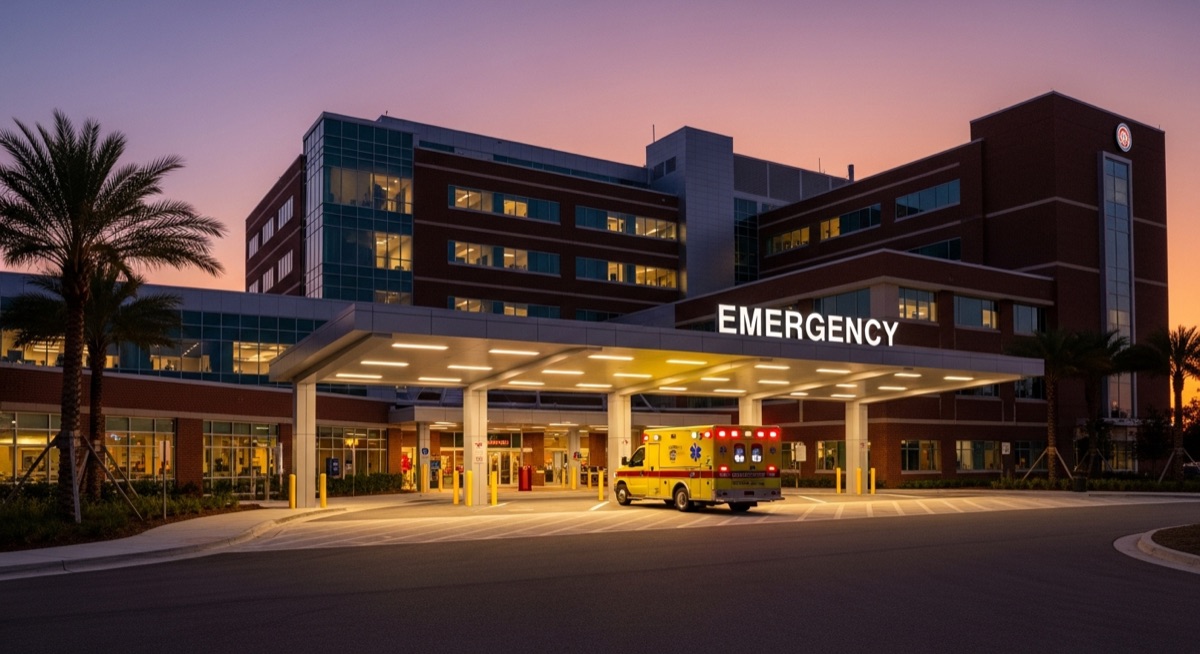
Orlando’s geography makes the wrong choice particularly costly. Orlando Health ORMC downtown is the region’s Level 1 Trauma Center — helicopter landings, gunshot wounds, severe strokes. A UTI there on a Monday in August means waits exceeding four hours for non-critical cases and bills that open at $800 before any diagnostics run. Orlando Health Dr. P. Phillips on I-Drive runs a full emergency room and absorbs tourist overflow all summer; a UTI in July means a likely three-to-five-hour wait and a minimum $1,500 bill. AdventHealth Orlando is a large teaching hospital with similar volume. These are genuinely critical facilities that are being crowded by patients who would be better served somewhere else — and that crowding has real consequences for people who actually need them.
Chronic disease management — adjusting diabetes medications, blood pressure control — requires a primary care physician. Controlled substance refills, specialist referrals, and preventive care belong there too. If you don’t have a primary care doctor and you have insurance, start with your insurer or HR department. If you don’t have insurance, the Federally Qualified Health Centers in Section 7 can serve that role. They function as ongoing medical homes, not one-off visit venues. And anything that’s been building slowly over several weeks isn’t urgent care territory.
Section 3 — The Tourist-Zone Map: Corridors Locals Should Avoid in Peak Season
Three corridors in metro Orlando see heavy tourist-driven urgent care volume during specific periods. Locals who live near these corridors aren’t always aware they can dodge the crunch by driving ten minutes in a different direction.
The I-Drive Corridor from Sand Lake Road north to Universal Boulevard absorbs constant walk-in traffic from hotel guests, convention attendees, and theme park visitors year-round. It gets worse June through August, during spring break (primarily mid-March), Thanksgiving week, and the Christmas–New Year’s window. The Orange County Convention Center adds its own cycle — large conventions bring thousands of out-of-towners who get sick or twist an ankle and default to the nearest clinic. Midday waits at I-Drive-area clinics during high season routinely hit one and a half to three hours. Before 9 a.m. or after 7 p.m., that same clinic is manageable.
The US-192/Kissimmee/Disney Corridor in Osceola County tracks Disney attendance and the vacation home rental market that fills Kissimmee and Davenport with international tourists. CareNow’s Kissimmee locations and various independents along Irlo Bronson Memorial Highway see volume spikes that follow park attendance calendars directly. This corridor also has the highest concentration of uninsured international visitors, which slows intake — staff are working through insurance verification or explaining, sometimes across a language barrier, that the clinic is cash-pay to patients who’ve never encountered the American system.
Lake Buena Vista and the Disney Springs area catches Disney Resort guests referred by their hotel front desks. Volume tracks Disney park reservations closely.
The runDisney calendar matters more than you’d expect. Race weekends fall in January (Walt Disney World Marathon), February (Princess Half Marathon), April (Springtime Surprise), and November (Wine & Dine Half). Each one generates a predictable orthopedic spike at nearby clinics: knee pain, IT band issues, blisters needing wound care, stress fracture concerns. In the 48 hours surrounding those weekends, urgent cares near the Disney complex are essentially a sports medicine clinic. If you have something unrelated and live nearby, go somewhere else or go earlier in the week.
Monday mornings and Friday afternoons after 4 p.m. are high-volume system-wide, every week, year-round. Monday brings the weekend’s accumulated illness — people who spent two days insisting their sinus infection would clear up on its own. Friday afternoons bring people trying to get seen before the weekend. Both patterns are as reliable as the weather.
Section 4 — Where Locals Get Shorter Waits
There are suburban urgent care locations in Orlando’s residential ring that serve almost exclusively local demand and see almost no walk-in tourist traffic. They’re not lesser clinics. They just don’t absorb the volume that punishes the I-Drive and Kissimmee corridors.
Oviedo and Winter Springs in Seminole County host clinics like AdventHealth Centra Care serving a dense residential population of families and young professionals. No Disney hotel nearby. Waits are more predictable and shorter during the summer windows that punish tourist-zone clinics.
Waterford Lakes and the UCF East Corridor along Alafaya Trail serve a large residential and student population. UCF’s student health infrastructure creates some volume, but there are no tourist-driven spikes. Generally manageable.
Apopka and Winter Garden are geographically removed from every tourist corridor. Winter Garden has grown substantially as a residential market over the past few years. Waits run short and predictable. If you’re in west Orange County and not already using these, worth knowing.
Hunters Creek and Meadow Woods in south Orange County is where a significant portion of Orlando’s hospitality workforce actually lives — families in working-class subdivisions, far enough south to be outside the tourist zone. The clinics here are directly relevant for the cost discussion in Section 6.
Lake Nona’s Medical City corridor has newer facilities including UCF Health and AdventHealth options that haven’t yet absorbed heavy residential demand. Waits have been reasonable as the area builds out, though that’ll change as population catches up with development.
Section 5 — How to Check Wait Times Before You Go
The tools exist. Most people don’t use them — which is understandable at 9 p.m. when you’re sick and want to leave the house. Five minutes of checking can save you ninety minutes of waiting.
Solv Health (solvhealth.com or the Solv app) shows real-time or estimated wait times for participating clinics and allows online check-in at many locations. Coverage is solid for some AdventHealth Centra Care locations and a handful of independents, but uneven across other chains. If the clinic you’re considering isn’t on Solv, the listing is absent or shows static information that won’t help you.
The AdventHealth app and Clockwise.md form a genuinely useful combination. AdventHealth Centra Care — the dominant network in metro Orlando, with more than 20 metro locations — uses Clockwise.md for online check-in at participating sites. You hold a place in line remotely and wait at home rather than in a waiting room. Download the AdventHealth app, select your Centra Care location, and check in before you leave. Verify that your specific location uses the online queue; not all sites are configured identically.
Google Maps “Popular Times” is underused. Open any urgent care’s Google Maps listing, scroll to Popular Times, and you get hour-by-hour traffic patterns based on aggregated visit data. It won’t tell you today’s 2 p.m. wait, but it will show you that the clinic is historically packed on Saturday afternoons and quiet on Tuesday mornings. For planning a non-emergency visit, that’s real information.
The phone call remains the fastest and most reliable method. Call the front desk and ask: “How backed up are you right now, and roughly how long is the wait for a walk-in?” Most front desks will give you a straight answer. This takes 45 seconds and beats every app for any clinic that doesn’t use online tools — and honestly often beats them for ones that do.
One flag: listings on Solv, Google, and Zocdoc can be outdated. Hours change. Clinics close or relocate. Services listed may not reflect what’s currently available. I’ve heard from enough people who drove 20 minutes for an X-ray a clinic no longer does to say plainly: call before you drive anywhere specifically for a service you’re not certain they offer.
Section 6 — Cash-Pay Pricing: What a Visit Actually Costs Without Insurance
This is the most-searched question in the category and the most underreported in our health & wellness coverage. Cash-pay pricing at urgent care is more transparent than at hospitals but less transparent than the chains’ websites suggest.
The baseline visit fee — what you pay to be seen, before any diagnostics — varies considerably by operator.
AdventHealth Centra Care charges $150–$300 for a standard adult visit at cash-pay rates. Centra Care publishes a price estimator online. The organization has made a real effort at pricing transparency that’s genuinely better than most hospital-affiliated systems. Use the estimator before your visit and confirm with the front desk when you arrive.
CareNow, the HCA Healthcare subsidiary concentrated around the tourist corridor and in Kissimmee, quotes base visits in the $125–$200 range before add-ons.
AFC Urgent Care operates as a franchise model; the Altamonte Springs location and others quote base visit fees around $100–$175 for cash-pay patients. AFC has been more upfront about cash pricing than some competitors.
MD Now, the South Florida chain now in Orlando, runs $100–$175 for base visits.
Concentra, primarily occupational health-oriented, charges $100–$150 at base for walk-in cash visits.
Independent clinics scattered through residential neighborhoods — Milk District, Mills 50, older commercial corridors in north Orange County — often run $75–$150 for a basic visit. They’re not carrying chain or hospital-system overhead, and it shows in the price.
What gets added to that base fee is where “starting at” stops being useful. Most clinics bill separately for X-rays, lab work, injections, dispensed medications, and wound care. Ask the front desk specifically what diagnostics will be billed separately before any tests are ordered. Reputable clinics will tell you. If a staff member is evasive about this, pay attention to that.
The ER comparison that matters: the same UTI diagnosis that costs $100–$200 at urgent care will generate a hospital ER bill that opens at $800 and commonly runs $1,500–$3,000 after facility fees, physician fees, and lab fees are billed separately. That gap isn’t a rounding error. For an uninsured hospitality worker, it’s a debt collection event.
International tourists should request an itemized receipt at checkout. Travel insurance requires it for reimbursement — “we saw you and charged $200” is not sufficient documentation for a European or Latin American travel insurer. Every line item, with procedure codes, on a printed receipt. Ask at checkout, not after you’ve left.
Before walking in anywhere: call and ask what the cash-pay rate is for a basic visit and how X-rays and labs are billed. Any clinic worth going to will answer that directly. All figures above reflect reported and publicly listed ranges. Verify before your visit.
Section 7 — The Uninsured Option Most Guides Don’t Mention: FQHCs and County Clinics
Every “best urgent care in Orlando” roundup covers AdventHealth and CareNow. Almost none mention the option that is often meaningfully cheaper for uninsured and low-income patients — and that treats the same conditions.
Federally Qualified Health Centers are community health clinics that receive federal funding and are required by law to see patients regardless of ability to pay, charging on a sliding-fee scale based on household income. For patients at or below the federal poverty level, visit fees can be as low as zero. For patients between 100–200% of the poverty level, fees are scaled but remain far below private urgent care rates. The overall range runs from $0 to roughly $150 depending on income and services.
Signature Healthcare operates an FQHC-designated network across Orange County, with multiple sites including locations in the Pine Hills area. Their facilities provide primary care, urgent sick visits, dental, and behavioral health on a sliding-fee basis. Walk-in sick visits are available at some locations; others require same-day scheduling by phone. Call ahead to confirm current hours and availability.
Orange County Health Services operates several health clinics providing sliding-scale care through the county government. These aren’t urgent care centers in the commercial sense, but they handle the same acute conditions and charge on an income-based scale.
Osceola County operates community health options in Kissimmee serving the large hospitality worker and uninsured population in that region.
FQHC intake is straightforward. You’ll be asked for proof of income — a pay stub, tax return, or self-attestation if you have no documentation. The clinic assigns you a sliding-fee discount tier. The process adds about 10–15 minutes on your first visit. You don’t need insurance. You don’t need to be a citizen; FQHCs serve patients regardless of immigration status.
These clinics treat the same conditions urgent care handles — UTIs, respiratory infections, ear infections, skin conditions, minor wound care, blood pressure checks, STI screening. They also provide continuity that a commercial urgent care can’t. If you come in for a UTI and it turns out you have uncontrolled hypertension, they can manage both. That’s a real difference.
Florida raised the income eligibility threshold for certain adult Medicaid populations in July 2023. Hospitality workers, retail workers, and gig workers who have never qualified for Florida Medicaid should check current eligibility — the threshold changes opened coverage for some adults who were previously in the gap. The Florida DCF ACCESS portal is the enrollment point, and enrollment is open year-round for Medicaid, unlike ACA marketplace plans. An uninsured worker who qualifies and enrolls converts future cash-pay urgent care visits into low-copay or zero-copay visits. That’s worth an hour of paperwork.
Section 8 — The Main Urgent Care Chains, Compared on What Matters Locally
AdventHealth Centra Care operates more than 20 metro-area locations: Altamonte Springs, Winter Park, Waterford Lakes, Oviedo, Lake Nona, East Colonial, and multiple sites south toward Kissimmee. The network also operates pediatric-specific Centra Care for Kids locations — these are staffed and equipped differently from adult urgent cares and are a meaningfully better choice for pediatric visits than a general urgent care. Don’t bring a sick kid to a general urgent care if there’s a pediatric Centra Care within reasonable distance.
Centra Care accepts most major commercial insurance plans, Florida Medicaid (participation varies by location — verify), and Medicare. Cash-pay rates run $150–$300 at base. Online check-in through the AdventHealth app and Clockwise.md works well at participating locations. X-ray is available at many sites; confirm before driving if imaging is why you’re going. Spanish-language clinical staff are available at several locations, particularly in south Orange County and Kissimmee. The AdventHealth affiliation means the system can facilitate referrals and follow-up within the hospital network.
CareNow (HCA Healthcare’s urgent care subsidiary) clusters around the tourist corridor — near Universal, in Kissimmee, in south Orange County. It accepts commercial insurance and some Medicaid plans; call ahead to verify. Cash-pay visits run $125–$200 before diagnostics. Online check-in is available through the CareNow web portal. The tourist-corridor locations experience exactly the seasonal volume described in Section 3, and there’s no workaround if you’re going to those sites in summer.
AFC Urgent Care is a franchise model, so quality and pricing can vary between owners. The Altamonte Springs location has a solid reputation among north Orange County and south Seminole County residents — shorter waits, competent care, serves a largely residential population that doesn’t include anybody staying at a Disney hotel. AFC accepts most commercial plans; Medicaid acceptance varies by franchisee. Verify directly. Cash-pay base visits run $100–$175.
MD Now expanded from South Florida into Orlando and has locations across a mix of residential and commercial corridors. Base visits run $100–$175. Call ahead to confirm current pricing and hours.
Concentra’s primary focus is occupational health: drug testing, workers’ compensation initial evaluations, return-to-work physicals, DOT physicals. If you’re a worker with a job-related injury or need an occupational health evaluation, Concentra is the right call. For general walk-in illness, it functions but isn’t the first choice. Cash-pay walk-in visits run $100–$150 at base.
Independent clinics in residential neighborhoods — Milk District, Mills 50, parts of north Orange County — often charge less than any of the chains above and aren’t prominently indexed on national aggregator sites. Search “[neighborhood name] urgent care” rather than “urgent care near me” and you’re more likely to surface them. Call ahead to verify hours and services.
The Florida Agency for Health Care Administration licenses urgent care clinics. If you want to confirm a clinic holds a current license before visiting, the AHCA online provider lookup can do that. Worth knowing, particularly for any clinic outside a recognized chain.
Section 9 — Seasonal Health Patterns Orlando Residents Should Know
Orlando’s climate and geography produce specific health patterns that drive urgent care visits on predictable cycles.
Heat-related illness peaks June through September. Heat exhaustion — dizziness, heavy sweating, nausea, weakness, elevated heart rate — is a legitimate urgent care visit. Central Florida’s combination of heat and humidity is more dangerous than visitors expect, and it catches longtime residents off guard too, particularly during the first brutal weeks of July. Outdoor workers in landscaping, construction, and theme park operations absorb genuine heat stress in July and August. Heat exhaustion is urgent care territory. Heat stroke — confusion, loss of consciousness, hot dry skin — is an ER emergency. Do not drive yourself to urgent care if you’re confused or can’t stand. Get someone else to drive or call 911.
Respiratory illness runs October through March, overlapping with cold, flu, RSV, and COVID. Volume at urgent cares spikes starting in October. If you’re going in for something non-respiratory during these months, avoid Monday mornings and Friday afternoons.
Allergy season splits into two windows: oak pollen peaks February through April, and late-summer humidity drives mold spore counts up July through September. Allergy-driven visits are common and frequently don’t require urgent care if you have an established treatment plan. First severe allergic reaction or a regimen that’s stopped working — urgent care is the right call. Seasonal allergies you’ve managed for five years suddenly needing adjustment — that conversation belongs with a primary care doctor or allergist.
Hurricane season runs June through November. Post-storm lacerations from debris cleanup are exactly what urgent care handles well. Generator-related carbon monoxide poisoning, which is a recurring post-storm event in Florida every time a significant storm comes through, requires an emergency room. If anyone in a home with a running generator reports headache, dizziness, nausea, or confusion, get out of the structure and call 911. Don’t drive to urgent care.
Section 10 — Quick-Reference: The Decisions You’ll Actually Need to Make
Bookmark this for the moment it’s 8 p.m. on a Sunday and you’re making a decision fast.
Urgent care is right for: UTI with burning, frequency, and urgency but no back pain suggesting kidney involvement and no high fever. Ear infection or strep throat in adults or children. Sprain or suspected minor fracture where you can still bear weight, no visible bone, swelling isn’t severe. Laceration needing stitches if bleeding is controlled, the wound is clean, no tendon involvement. Upper respiratory infection with low-grade fever, no shortness of breath, no chest pain.
Go straight to the ER for: Chest pain, pressure, or left arm pain. Stroke symptoms — facial drooping, arm weakness, slurred speech, sudden severe headache. Difficulty breathing or throat closing. Anaphylaxis. Serious head trauma or loss of consciousness. Any fever in an infant under three months. That last one is absolute — infants that age have immature immune systems and any fever is treated as a potential serious bacterial infection. Go directly to a pediatric ER. No detours.
The three corridors to avoid June through August: I-Drive from Sand Lake Road to Universal Boulevard — go before 9 a.m. or after 7 p.m.; midday waits hit one and a half to three hours in peak season. US-192/Kissimmee corridor, where volume tracks park attendance. Lake Buena Vista/Disney Springs area. Check wait times before driving to any of these in summer.
Best wait-check options: AdventHealth app with Clockwise.md for participating Centra Care locations. Solv Health app — verify your clinic is listed first. Google Maps Popular Times histogram for hour-by-hour patterns. Phone call to the front desk — still the most reliable option, digital tools or not.
Cash-pay price ladder: FQHC clinics run $0–$150 on sliding scale for eligible patients. Independent clinics start at $75–$150 for a base visit. Major urgent care chains run $100–$300 depending on operator — AFC, MD Now, and Concentra on the lower end, Centra Care on the higher. Hospital ERs start at $800 and commonly reach $1,500–$3,000 for conditions urgent care can treat.
If you’re not sure: Call the urgent care and describe your symptoms. Most clinics will tell you honestly if you need the ER instead. For poisoning or suspected ingestion, call Poison Control directly.
Pricing ranges in this guide reflect reported and publicly listed figures and should be verified directly with each clinic before your visit. FQHC income eligibility thresholds are based on federal poverty guidelines and may be adjusted annually. Florida Medicaid expansion eligibility should be confirmed through the DCF ACCESS portal.