Why Orlando Air Quality Declines from Wildfire Smoke
Florida's own fire season runs February through May, but summer smoke from Georgia and the Carolinas is increasingly reaching Central Florida. Here's what the generic weather apps won't tell you.

Why Orlando Air Quality Declines from Wildfire Smoke
Florida’s own fire season runs February through May, but summer smoke from Georgia and the Carolinas is increasingly reaching Central Florida. Here’s what the generic weather apps won’t tell you.
If you opened a weather app on a hazy morning in Orlando and found the air quality listed as “Moderate,” you probably scrolled past it. What the app almost certainly didn’t tell you is whether that haziness came from a prescribed burn in Osceola County, smoke drifting south from a wildfire burning in coastal Georgia, or the ordinary mix of highway and aviation particulate that hangs over the SR-528 corridor on still mornings. Those distinctions matter. They shape both how seriously to take the reading and what to actually do about it.
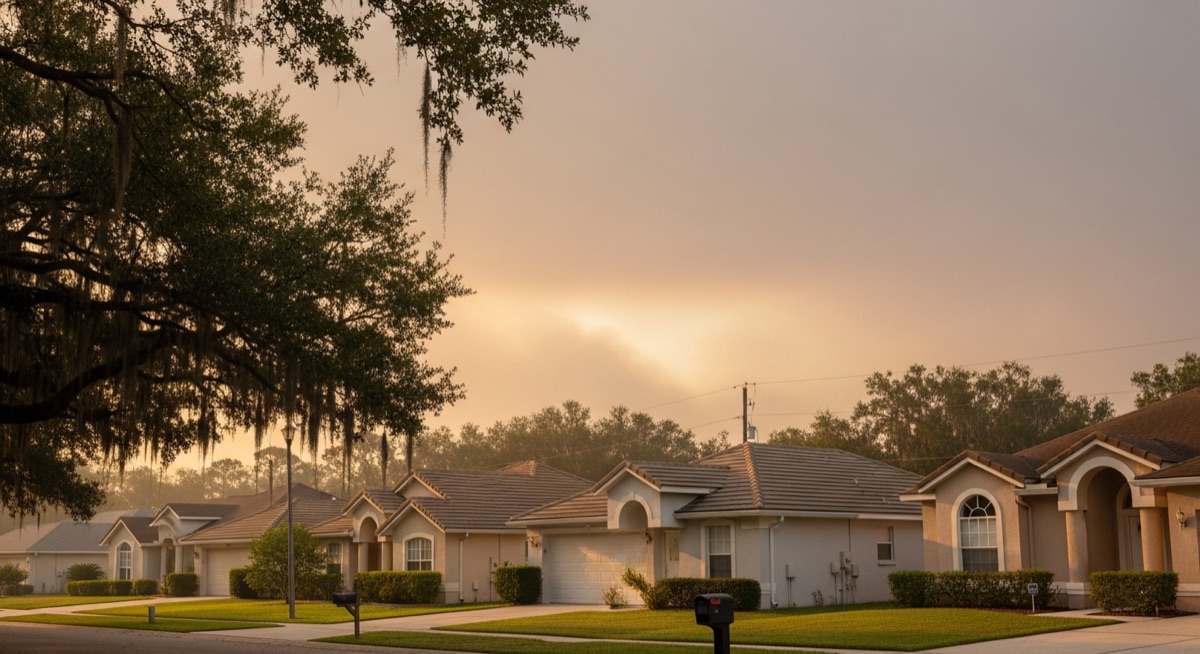
Central Florida has a wildfire smoke problem that most residents don’t know they have, partly because the problem doesn’t announce itself the way it would in, say, the Sacramento Valley, where orange skies are unmistakable. Here, smoke blends into ambient haze. The air looks a little thick. Throats feel slightly scratchy. Parents wonder whether soccer practice should stay on the schedule. Usually no official advisory has been issued, and often the nearest EPA monitoring station is miles away. The whole thing is easy to dismiss—which is exactly the problem.
Orlando’s Two Smoke Windows—and Why Most Residents Only Know About One
Ask most Central Florida residents when they should worry about wildfire smoke, and they’ll either say they never really think about it—this isn’t California—or they’ll mention a vague memory of the smoke that drifted down from Canada in the summer of 2023. Both answers miss the more immediate and recurring pattern.
Florida has its own documented wildfire season running roughly February through May, when the dry season creates conditions for fast-moving fires in scrubland, pine flatwoods, and palmetto prairie. The Florida Forest Service tracks wildfire activity across the state, and Central Florida’s surrounding counties—Lake, Polk, Osceola, and Volusia—regularly contribute to that total. In a dry spring, fires in those counties produce smoke that drifts directly into metropolitan Orlando. A fire burning in the Green Swamp or Polk County’s scrub forests during a westerly-wind morning sends smoke over residential areas within hours. That’s not a remote possibility. It happens most years.
The second window is less intuitive. Starting in June, as Florida transitions into its wet season, the local fire risk diminishes—but prevailing wind patterns shift in a way that channels smoke from wildfire activity in Georgia, the Carolinas, and sometimes further north directly toward Central Florida. This caught many residents off guard during the 2023 Canadian smoke event, when air that had traveled extraordinary distances registered on Orange County monitors and produced genuinely unhealthy conditions for several days. The event was unusual in scale, but the meteorological pathway it used is not. South-moving air ahead of high-pressure systems happens in lesser degrees most summers, and most years it doesn’t make the news, which is its own kind of problem.
How Smoke Actually Reaches Orlando: Wind, Sea Breeze, and the Morning Trap
Central Florida’s geography shapes how wildfire smoke behaves here in ways that differ from the Western states where most public health guidance was developed.
During Florida’s dry season, prevailing winds come predominantly from the southwest—the same direction as many of Florida’s burnable public lands. What makes Orlando specifically tricky is the sea breeze. The city sits between the Atlantic to the east and the Gulf to the west. On most warm afternoons, onshore breezes develop from both directions and converge somewhere over the metro area, mixing and dispersing ground-level particulate. Good news for afternoon runners. Bad news is that this means the worst air quality window is almost always morning, before the sea breeze develops. Smoke that settled overnight sits at ground level with limited dispersal in the early hours.
This is exactly when outdoor workers begin their shifts. It’s when morning runners are out. Youth athletic programs schedule early practices specifically to beat the afternoon heat. The window with the highest exposure risk is the window when people are most active outdoors. The National Weather Service office in Melbourne covers Central Florida and incorporates sea breeze timing into its forecasting, but its public AQI guidance doesn’t typically make this morning-versus-afternoon distinction explicit. For a parent deciding whether to send a child to a 7 a.m. soccer practice, that gap matters.
The Monitoring Gap: Where Orange County’s Air Sensors Are—and Where They Aren’t
Orange County has approximately 1.4 million residents and two to four regulatory-grade air quality monitoring stations operated by the Florida Department of Environmental Protection—the kind of EPA-certified sensors whose data feeds into official AirNow readings and state compliance reports. These stations are concentrated in the western and central portions of the county, generally in the downtown-to-Holden Avenue corridor. You can explore FDEP’s monitoring network through floridadep.gov’s air monitoring pages; station assignments shift over time, so confirming current locations directly is worthwhile.
Here’s the practical consequence of that geography. A resident in Bithlo, in eastern Orange County near the Brevard County line, draws their official AQI reading from a monitor separated by meaningfully different land cover, smoke plume patterns, and local emission sources. Same problem in Christmas, in the far eastern 32709 zip code. These are neighborhoods surrounded by burnable scrub and forest—the areas with the most direct wildfire smoke exposure—and they have the least ground-truth monitoring data. A fire in that scrubland puts smoke overhead while the resident checking AirNow sees numbers from a monitor on the opposite side of the county. That’s the system failing the people most at risk.
PurpleAir, the crowdsourced low-cost sensor network, partially fills this gap. Coverage is denser in wealthier western communities—Dr. Phillips, Windermere, Lake Nona, College Park—where residents are more likely to have purchased sensors. East Orange County has notably thinner coverage. This isn’t a criticism of the technology. It’s a description of the access and awareness gap that exists. Residents in under-covered neighborhoods should understand that even the PurpleAir map may show them nothing useful during a smoke event, leaving them dependent on what they can see and smell.
Which Neighborhoods Face the Most Exposure—and Why
East Orange County — ZIP codes 32826, 32820, 32833, the Bithlo and Christmas corridor — sits at the intersection of two compounding problems: proximity to burnable land and near-total absence of monitoring infrastructure. The scrub and pine flatwoods of eastern Orange County are exactly the fuel type that produces rapid-spreading wildfires during Florida’s dry season. A fire burning in that zone during a westerly-wind morning puts smoke directly over residential areas. Residents there have no PurpleAir sensor nearby, no regulatory monitoring within meaningful distance, and likely no push alert from any air quality service. The smell is often the only warning.
Pine Hills, ZIP codes 32808 and 32818, faces a different compounding problem. The neighborhood’s housing stock skews older — generally less-tight building envelopes, meaning outdoor air infiltrates more readily than in newer construction. Pine Hills also sits close to I-4 and the SR-408 interchange, so baseline PM2.5 on ordinary days is already elevated by traffic particulate. When wildfire smoke adds to that baseline, residents near those corridors are starting from a higher exposure floor. They’re not dealing just with the smoke. They’re dealing with the smoke on top of everything else.
The SR-528/OIA corridor, ZIP codes 32812 and 32822, combines aviation-related particulate — jet exhaust and ground support equipment emissions from Orlando International — with heavy highway traffic on the Beachline Expressway. PM2.5 readings near OIA run higher than in less industrially influenced parts of the county on an ordinary clear day. Smoke layers on top of that.
Horizon West and Windermere, ZIP codes 34786 and 34787, are more exposed than their suburb aesthetics suggest. Rapid growth has pushed residential development close to scrubland interfaces, and prevailing dry-season wind patterns increase smoke drift from fires burning in the Green Swamp and western Orange and Lake County wildlands. PurpleAir coverage here is relatively good — residents are more likely to get neighborhood-level real-time data than their counterparts in east Orange County. Given the fire exposure, that’s at least something.
Where to Actually Check AQI for Your Block—Five Tools, Ranked for Usefulness
“Check AirNow” is the standard advice. It’s also incomplete. Here are the tools that actually give Orlando residents useful information during a smoke event, in order of practical value.
fire.airnow.gov — the Fire and Smoke Map is the most underused resource on this list. It’s a joint product of EPA, USDA Forest Service, and NWS that overlays active fire locations, smoke plume trajectories, and air quality sensor readings on a single map. During a smoke event — Florida dry season fire or summer drift from the Carolinas — this map tells you whether the smoke overhead has an identified source, where it’s moving, and what nearby monitors are reading. It also shows you where the monitoring gaps are, which is itself useful information. Bookmark this one before you need it. Seriously, do it now on a clear day so you know how to read it when it isn’t.
PurpleAir’s live map (map.purpleair.com) is more geographically useful than AirNow for the parts of Orange County that have sensor coverage. Zoom into your specific neighborhood and look at sensors within a mile or two. During a smoke event you’ll often see meaningful variation across just a few miles. Important caveat: PurpleAir sensors aren’t regulatory-grade, and their raw readings tend to run high relative to EPA measurements. Use the “EPA” correction option in the display settings for a more calibrated number.
IQAir.com aggregates both regulatory-grade and crowdsourced sensor data with relatively clean historical context. If you want to understand whether today’s reading is out of the ordinary for your area — and whether the trend is worsening or dissipating — IQAir’s neighborhood pages are easier to navigate than most government alternatives. Useful when you’re trying to decide whether to reschedule something.
The FDEP Air Monitoring site (floridadep.gov) is where Florida’s official, regulatory-grade monitoring data lives. It’s not designed for consumer usability and it shows, but it’s the authoritative record. Useful for cross-referencing crowdsourced readings against the regulatory baseline and confirming whether a formal advisory has been issued.
EnviroFlash (enviroflash.info) sends email or text alerts when AQI in a subscribed area crosses thresholds you set. It runs off the same regulatory monitoring network, so its usefulness depends on how close you are to a monitoring station. For residents in better-monitored parts of Orange County, it’s the most passive way to stay informed. Set it up once; it does the rest.
One thing worth understanding: regulatory stations measure PM2.5 with higher accuracy and are legally certified for compliance purposes. PurpleAir sensors measure the same pollutant with lower-precision instruments. On a calm smoke day with consistent plume behavior, both are telling you something real. On a windy, spatially variable day — the kind where readings shift block to block — proximity to the sensor beats certification. The crowdsourced sensor two blocks from your house will often tell you more than the certified station four miles away.
Who Is Most at Risk in Central Florida—and Why the Standard Advice Understates It
Federal wildfire health guidance is largely calibrated for populations studied in the Western wildfire context: elderly residents, children, and people with diagnosed respiratory conditions. Those categories are valid here. They’re also incomplete.
Outdoor workers are probably the largest underserved group in Central Florida’s smoke exposure problem. The metro area has one of Florida’s largest concentrations of landscaping workers, construction laborers, and theme park grounds staff — people who work full shifts outdoors by definition and have essentially no mechanism to reduce exposure when air quality degrades, short of refusing to work. No national wildfire health communication framework addresses this group seriously. When Orange County issues an air quality advisory, it almost never includes guidance about landscaping crews or theme park staff. A landscaper working an eight-hour shift at AQI 120 absorbs significantly more exposure than an office worker who stays indoors all day. That’s not a subtle distinction. It’s the entire ballgame, and it goes largely unacknowledged.
Children in organized youth sports face a concentrated exposure problem with a specific timing pattern. Youth soccer leagues and baseball programs schedule morning practices to avoid afternoon heat — which, as discussed above, is precisely when ground-level smoke is most concentrated. Most coaches and league administrators have no protocol for smoke events. The same heat-illness policy that moves practice indoors at 95 degrees has no equivalent for AQI 125. If your child plays in an organized league, this is worth raising directly with whoever sets the schedule.
Older adults in active adult communities, particularly in Horizon West and Lake Nona, represent a concentrated medical risk. Reduced cardiac and pulmonary reserve means PM2.5 exposure that causes mild symptoms in a healthy adult can trigger meaningful physiological stress in an older resident. Many newer active adult communities have solid air filtration; others don’t.
Asthma and COPD patients in Central Florida face a variable that most Western-state health guidance ignores: humidity. Central Florida’s year-round high relative humidity affects how PM2.5 particles behave in the respiratory tract. Generic national AQI thresholds weren’t developed with Florida’s humidity profile in mind. Patients managing asthma or COPD should discuss smoke event thresholds directly with their pulmonologist rather than relying on guidance calibrated for Phoenix or Los Angeles. For more on protecting your home environment during smoke season, our coverage of home hardening strategies for hurricane and high-risk weather events addresses building envelope improvements that also reduce outdoor air infiltration.
The Prescribed Burn Factor: When the Smoke You Smell Is Legal but Still Harmful
A significant proportion of the smoke Orlando residents smell is neither wildfire nor distant drift. It’s prescribed burn smoke from managed burns conducted by FDEP and the Florida Forest Service in surrounding counties. Osceola, Polk, Lake, and Volusia counties all have extensive prescribed burn programs, with heavy activity in winter and early spring.
When you smell smoke on a clear Orlando morning with no news reports of a wildfire, a managed burn is a reasonable first suspect. Here’s the health point residents often miss: prescribed burn smoke carries the same PM2.5 risks as wildfire smoke, volume for volume. The fact that a burn is legal, managed, and ecologically beneficial does not filter out the fine particulate. Sensitive individuals — children, people with respiratory conditions, outdoor workers — should treat prescribed burn smoke with the same precaution as any other smoke event. “It’s just a controlled burn” is not a reason to keep your asthmatic kid at soccer practice.
The Florida Forest Service maintains daily burn activity by county on its website. FDEP also operates inquiry lines through its district offices. When you smell smoke and aren’t sure what it is, those are the first places to check. Knowing the source helps you estimate both duration and intensity.
Indoor Alternatives on High-AQI Days: Named Venues, Filtration Specs, and What to Ask
On a smoke day when outdoor exercise is genuinely risky — AQI above 100 for sensitive groups, above 150 for everyone else — the practical question is where to go. Not all climate-controlled facilities are equal. The right question to ask any gym is specific: do they run MERV-13 or higher filtration, or do they have dedicated HEPA air scrubbers in the workout space? MERV-13 filters capture a significant fraction of PM2.5-sized particles. The MERV-8 filters common in basic commercial HVAC do not. A facility with standard commercial AC and MERV-8 filters recirculates outdoor air through inadequate filtration — marginally better than being outside, not meaningfully protective during a smoke event. This is also worth considering as part of your home health and wellness coverage priorities: the same filtration standards that matter in a gym apply to what’s running in your own HVAC system.
Life Time Fitness at 7800 Turkey Lake Road in Dr. Phillips markets its air quality infrastructure as a differentiator and has invested in HEPA filtration. Call ahead to confirm the current filtration specs for that specific building; day passes run around $30. Orange County Parks & Recreation community centers — including Barnett Park at 4801 W. Colonial Drive and the Marks Street Senior Recreation Complex in Downtown Orlando — offer free or low-cost indoor recreational space. These are publicly funded facilities maintained to commercial standards, and the specific filtration ratings are worth confirming with facility management before smoke season. Calling on a clear-air day to ask about filter ratings is a completely reasonable thing to do. Do it before you need the answer.
YMCA of Central Florida operates multiple locations including Downtown Orlando and Hunters Creek; day passes run around $15. UCF Recreation and Wellness Center on the main campus offers day passes and memberships to the public — it’s large, modern, and has substantial indoor cardio and weight training space. For residents in the 32826 zip code, a high-exposure area with limited monitoring, this is the geographically logical indoor alternative. LA Fitness has multiple Orlando locations and day passes in a similar range.
When you call any of these facilities, the specific question is: “What MERV rating are your HVAC filters, or do you run dedicated HEPA air scrubbers in the workout areas?” If the answer is “I’m not sure” or “we have great AC,” ask for a facilities manager. A well-run facility will be able to answer this. If they can’t, treat it like any other vague commitment — as insufficient information for a health decision.
Fast-Action Checklist: What to Have Before the Next Smoke Event
Smoke events don’t give advance notice calibrated to Amazon shipping times. Set these up on a clear-air day, before you need them.
Air quality alerts:
- EnviroFlash (enviroflash.info): email or text when AQI crosses your chosen threshold for your Orange County zip code
- PurpleAir app: configure notifications for the nearest sensor to your home; a threshold around AQI 100 is appropriate for households with children or respiratory conditions
- NWS Melbourne (weather.gov/mlb): follow directly or on social media for air quality statements issued alongside weather advisories
- Florida Dept. of Health–Orange County: bookmark the advisory page for official county-level guidance
Equipment to have on hand:
N95 or KN95 masks — roughly $2 apiece at ACE Hardware locations throughout Orange County, Home Depot, CVS, and Walgreens — are effective for PM2.5 during brief necessary outdoor exposure. Running an errand, getting from the car to a building. They reduce exposure; they don’t make extended outdoor exercise safe on a high-AQI day.
A portable HEPA air purifier for a bedroom or living room — adequate units start around $80 to $100 from Levoit, Coway, or Winix — is worth buying before a smoke event, not during one. Costco at Millenia Mall and the Target on Colonial Drive carry rotating stock, and local inventory depletes fast once a regional smoke event makes the news. A purifier running in the room where children sleep during a smoke event produces measurable reduction in indoor PM2.5 exposure.
The morning before outdoor exercise:
Start with fire.airnow.gov, then check your nearest PurpleAir sensor. AQI below 50: proceed normally. AQI 51–100: sensitive group members — asthma, COPD, heart disease, pregnancy, children under 12 — should consider moving exercise indoors or shortening it significantly. AQI 101–150: outdoor exercise should be brief and low-intensity for everyone; sensitive groups should stay in. AQI above 150: outdoor exercise isn’t recommended for anyone. These thresholds come from EPA’s own guidance. They’re worth having stated clearly against the backdrop of a region where the air frequently looks fine while the particulate count is not.
Central Florida isn’t the Western United States. The fires here are smaller, the smoke events shorter, and the dramatic visual cues largely absent. It’s easy to look out at a slightly hazy morning and decide everything’s probably fine. But the particulate is real, the monitoring gaps are real, and the populations absorbing the highest exposure — outdoor workers with nowhere to go, children at 7 a.m. practices, east county residents surrounded by burnable scrubland with no nearby sensor — aren’t well served by generic advice that assumes you live near an EPA monitoring station and can simply stay indoors.
Check the fire map before outdoor exercise on hazy mornings. Know where your nearest PurpleAir sensor is. Find out now, before smoke season, whether the gym you’d use on a bad-air day is actually filtering for PM2.5. And if you live in Bithlo or Christmas, understand that the official AQI reading you see is not from your neighborhood. The number is real. The location it’s measuring is not yours.