What DACA Holders in Orlando Need to Do Now
As USCIS Orlando processes another naturalization season, Dreamers in the region face processing delays, a swamped immigration court, and a narrow window to protect their work authorization

What DACA Holders in Orlando Need to Do Now
As USCIS Orlando processes another naturalization season, Dreamers in the region face processing delays, a swamped immigration court, and a narrow window to protect their work authorization
On a weekday morning at the USCIS Orlando Field Office, something unusual happens. Newly sworn American citizens walk out of naturalization ceremonies — dressed up, small flags in hand, families waiting. For some of them, it’s the end of a process that took a decade or more.
A few floors away, the contrast is sharp. Central Florida’s DACA recipient population — roughly estimated in the tens of thousands across the broader metro — manages renewals, watches litigation move through federal courts in Texas, and in some cases juggles a concurrent removal proceeding at the Orlando Immigration Court on Lawton Road. Two entirely different speeds. For people with an expiration date printed on their employment authorization card, the slower speed is the one that matters most right now.
This piece reports the facts on the ground as of mid-2026: what USCIS actually takes to process renewals, what the Orlando immigration court docket looks like, when to file, and where to find legal help that’s real and affordable in Central Florida.
How Long Is USCIS Taking? Processing Times for DACA Renewals in 2026
The USCIS Orlando Field Office does not process DACA renewal applications. It hosts naturalization ceremonies. It handles biometrics for select cases. Form I-821D — the DACA renewal application — gets adjudicated elsewhere. Paper filings go to the USCIS Chicago Lockbox facility. Online submissions go through myUSCIS at uscis.gov. Calling the Orlando field office to ask about your renewal timeline won’t move your case forward. It will eat up your afternoon.
The USCIS processing time tool at uscis.gov/forms/filing-guidance/check-case-processing-times is authoritative. Check it directly on the day you plan to file. USCIS updates posted ranges roughly monthly, and any figure printed here reflects the date it was written, not the date you read it. Screenshot the tool result with the date visible — that’s your contemporaneous record.
There’s no separately reported processing time for Orlando-area applicants. Because renewals are adjudicated at national service centers rather than field offices, your ZIP code doesn’t determine how fast your case moves. What determines it: when your application was received and whether USCIS asked for additional evidence. The Chicago Lockbox date-stamps paper filings on receipt; myUSCIS records the submission timestamp electronically. Online filing avoids the brief postal delay and gets you a receipt notice faster. For straightforward cases in mid-2026, online is the better choice — though complex situations or those requiring attorney review may still warrant paper.
The Employment Authorization Clock: When to File and What Happens If You Miss the Window
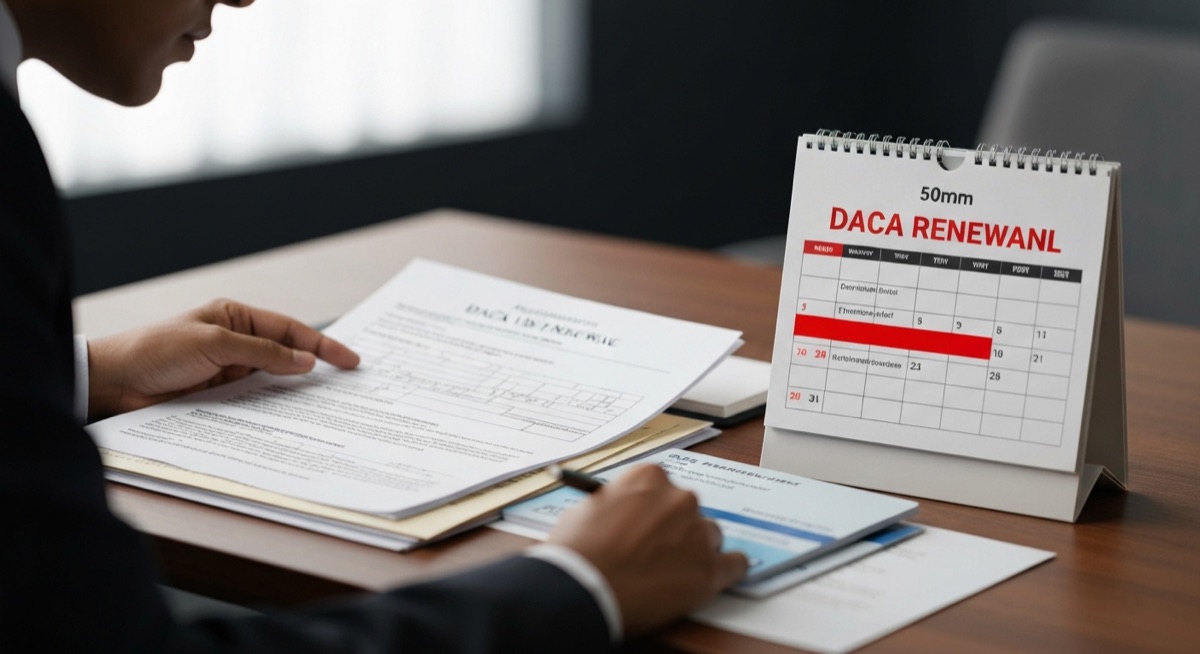
Here’s the most consequential fact in this article: USCIS recommends filing your renewal 150 to 180 days — roughly five to six months — before your current Employment Authorization Document expires. That window exists because of how long processing takes.
A renewal filed that far in advance, if the posted processing range holds, has a reasonable chance of returning before your old EAD expires. Filing within that window also triggers a specific protection. A timely, properly submitted renewal application gives your current EAD an automatic 180-day extension, effective from the expiration date printed on the card. Even if your renewal hasn’t been adjudicated by the time your card expires, you can continue working lawfully for up to 180 additional days — as long as you filed on time.
This automatic extension policy remains in place for timely-filed DACA renewals. Verify it. Because DACA has been subject to court orders that affected what USCIS can and cannot do, confirm this protection is still operative at the time you file. Check uscis.gov/DACA or consult an immigration attorney before relying on it.
What happens if your EAD lapses? The consequences are immediate, and Central Florida’s job market makes them worse. Walt Disney World, Universal Orlando, and the hotel and restaurant groups along International Drive are federally regulated employers subject to I-9 compliance. When an EAD expires without a documented extension, employers must re-verify work authorization. If an employee can’t produce a valid document or a receipt notice showing a timely renewal was filed, HR faces an uncomfortable compliance call. Large hospitality employers with formal HR departments enforce I-9 re-verification strictly. Federal audits happen. Fines for knowingly employing unauthorized workers are real.
A DACA holder whose EAD lapses during Orlando’s peak tourism season — November through January, when the workforce swells — faces not just a paperwork problem but a genuine risk of losing their job at the worst possible moment in the employment calendar. Immigration attorneys in this market describe that scenario as their recurring nightmare for clients.
Beyond work authorization, a lapsed EAD affects your Florida REAL ID driver’s license. The Florida Highway Safety and Motor Vehicles department ties driver’s license eligibility for DACA holders to valid employment authorization. A lapsed EAD means your license may not be renewable until new work authorization is documented. In a metro where public transit coverage is thin outside downtown and the tourist corridor, losing the ability to drive legally creates grinding, practical hardship. It’s not abstract.
This is why immigration professionals say the same thing without variation: file within the 150-to-180-day window. Don’t wait.
Orlando’s Immigration Court Backlog: The Concurrent Proceedings Problem
Not every Central Florida DACA holder is managing only a renewal. Some have open removal proceedings at the Orlando Immigration Court on Lawton Road. Verify the current address at justice.gov/eoir before traveling there.
For those individuals, the renewal and the court case run simultaneously on two entirely separate bureaucratic tracks. DACA renewals are processed by USCIS, an executive agency within the Department of Homeland Security. Immigration court proceedings are handled by the Executive Office for Immigration Review (EOIR), a separate entity within the Department of Justice. The two systems don’t automatically communicate with each other. A valid, current EAD and an active removal case on the docket can coexist. That’s not a paradox — it’s just how the two bureaucracies are built.
According to TRAC Immigration data — the most reliable public source for immigration court caseload statistics, updated monthly — the Orlando Immigration Court has one of the more congested dockets in the Southeast. Current figures show the Orlando court’s pending caseload running into the tens of thousands of cases, with median wait times for initial hearing dates extending to several years for newly filed matters.
The court’s jurisdiction covers Orange, Osceola, Seminole, Lake, and Brevard counties — a catchment of roughly 2.5 million people that includes large immigrant workforces in hospitality, construction, and agriculture.
The practical implication: if you have an open removal case and your DACA expires while you’re waiting on a court date, you don’t get the benefit of DACA protections during that gap simply because the court hasn’t gotten to you yet. Your USCIS renewal track and your EOIR track need coordination, ideally by attorneys who are in communication with each other. If a single attorney handles both, confirm they understand both systems. If your court-appointed representative is separate from your renewal preparer, make sure both know the other exists and understand the timeline. This coordination failure is, from what immigration attorneys in this area describe, more common than it should be.
Check your Orlando court case status through the EOIR automated case information line (1-800-898-7180) or at acis.eoir.justice.gov.
Policy Uncertainty in 2026: What the Litigation Means for Filers Right Now
DACA’s legal footing in mid-2026 remains contested, and the uncertainty has direct practical implications for what recipients can count on.
The litigation history: In Texas v. United States, a long-running challenge brought by Texas and other states, a federal district court in Texas has ruled DACA unlawful. The Fifth Circuit upheld portions of that ruling. The Supreme Court declined to fully resolve the underlying question on the merits. The Biden administration codified DACA into federal regulation in 2022, and litigation over that regulatory rule continued. USCIS accepts renewal applications from current DACA recipients but remains barred by court order from processing new initial applications for individuals who’ve never held DACA status.
If you’re renewing an existing grant, USCIS takes your application. If you’re applying for the first time, USCIS is blocked from processing it.
What does filing a renewal accomplish? A timely renewal application preserves your place in the queue and triggers the automatic EAD extension described above — assuming that extension policy hasn’t been curtailed by a new court order. What it doesn’t do: resolve anything. Recipients aren’t holding a permanent status. They’re holding a renewable grant of deferred action, the continuation of which depends on USCIS processing and on the federal courts not issuing a new injunction that halts renewals entirely. Calling that position merely “uncertain” undersells it. It’s a genuinely precarious place to be, and people making major life decisions — housing, jobs, school — deserve to hear that plainly rather than have it softened.
This is why immigration attorneys say, consistently and without exception: file as early as you’re eligible, don’t wait for the courts to resolve anything, and consult an attorney before making any decision based on assumptions about policy stability.
Affordable Legal Help in Central Florida: What’s Open, What’s Waitlisted
Most coverage of DACA names organizations without telling you whether they’re actually taking cases. Here’s the current picture as of mid-2026. Intake status changes — call before going.
Community Legal Services of Mid-Florida (CLSMF) is the largest legal aid organization in the region and the primary resource for DACA holders across Orange, Osceola, Seminole, Lake, Brevard, Volusia, and surrounding counties. CLSMF provides free civil legal services to income-qualifying clients, and their immigration services have included DACA renewal assistance. Contact them directly via clsmf.org before assuming they have capacity — intake for immigration matters has been waitlisted due to demand. Their website has current intake information, but a direct call gets you real-time status.
Catholic Charities of Central Florida operates low-fee immigration services from offices in the Orlando area. Not free, but below market rate, and they handle DACA renewals with historically shorter waitlists than the fully free providers. Contact them through cflcc.org to confirm current capacity and fees.
The Farmworker Association of Florida, headquartered in Apopka, is an underutilized resource for DACA holders in Lake County’s agricultural corridor and Orange County’s rural areas. FWAF isn’t a law firm, but it connects community members with legal resources and can help navigate intake for organizations like CLSMF. For DACA holders working in nurseries, citrus operations, or poultry processing in the region’s agricultural belt, FWAF is often the most practical first point of contact — and more people in that community should know it exists.
The Hispanic Bar Association of Greater Orlando (HBAGO) hosts pro bono legal clinics. Check their current 2026 clinic schedule by contacting them directly. Clinic availability is periodic, not ongoing, and slots fill quickly.
UCF Student Legal Services provides free legal assistance to enrolled University of Central Florida students. Confirm with them whether they can assist with an I-821D renewal before making an appointment.
Florida Legal Services can help identify regional capacity if local providers are full. Find current contact information at floridalegal.org.
Private Attorneys: What Representation Costs and What to Watch Out For
If you’re hiring a private attorney, current Orlando-area market rates for DACA renewal preparation run roughly $500 to $1,500 in attorney fees, depending on case complexity and the firm. Solo practitioners and smaller practices cost less; established immigration firms near downtown Orlando tend to price toward the higher end. These fees are separate from the USCIS filing fee. The current fee for a DACA renewal (Form I-821D plus Form I-765) was set under the 2024 fee rule at $550. Confirm the current fee at uscis.gov/forms before filing.
The most important warning in this piece: notario fraud is a documented, persistent problem in Central Florida, and our immigration and consumer fraud coverage tracks the issue closely. The title “notario” carries legal weight in many Latin American countries — it denotes a licensed legal professional. In the United States, it means nothing. Non-attorney immigration consultants operating as notarios have been documented taking fees for DACA filings, submitting incomplete or incorrect paperwork, and in some cases pocketing money without filing anything at all. They can’t legally practice immigration law. They can’t speed up USCIS processing. They can make your situation significantly worse while charging you for the privilege.
The Florida Bar and USCIS have both issued warnings about this type of fraud targeting the Spanish-speaking immigrant community. For a detailed account of how these schemes operate and how to report them locally, see our guide to notario fraud in Orlando. To verify someone is a licensed Florida attorney: go to floridabar.org and use the attorney search tool. Enter the person’s name. If they’re a licensed Florida Bar member in good standing, they appear. If they don’t, they’re not licensed to practice law in Florida. No exceptions. The Florida Bar’s lawyer referral service at floridabar.org connects you with immigration attorneys who’ve agreed to a reduced-fee initial consultation.
The Osceola County and Institutional Employer Angles
Two dimensions of Central Florida’s DACA situation are consistently underreported.
Osceola County and Kissimmee have among the highest concentrations of DACA-eligible residents in the region. The county’s large Central American immigrant workforce creates significant renewal demand in a county where nonprofit legal capacity is thin. Most serious immigration legal services require a trip to Orlando — an added barrier for residents of Kissimmee or St. Cloud working multiple jobs along US 192 or at resort properties near the county line. If you’re in Osceola and expecting a short drive to resolve your legal situation, plan for the reality that the provider you need may be in Orlando, with a waitlist when you get there.
Orange County Public Schools is a less obvious but significant angle. OCPS employs a measurable number of DACA holders in paraprofessional roles — teachers’ aides, classroom support staff, bus aides, cafeteria workers. These are W-2 employees subject to I-9 requirements. When an EAD expires without a documented timely renewal and auto-extension, OCPS HR is legally required to re-verify work authorization, same as any large federally regulated employer. DACA holders employed by OCPS should understand that their employer’s compliance obligations run on a tighter clock than they might assume. Communicating proactively with HR about a pending renewal — including providing the receipt notice showing a timely filing — is both legally appropriate and practically wise. Don’t wait for HR to come to you.
What to Do Now: A Verified Action Checklist
-
Find your EAD expiration date today. Look at the physical card. Count back 150 days from that date. If that date is already past or coming up fast, you’re behind the ideal filing window.
-
Check current USCIS processing times. Go to uscis.gov/forms/filing-guidance/check-case-processing-times, select Form I-821D, note the posted range, and screenshot it with the date visible. Processing times change monthly.
-
Gather your documents. You’ll need your current EAD, two passport-style photographs meeting USCIS specifications, the filing fee (verify the current amount at uscis.gov), and Forms I-821D and I-765. Online filers: use myUSCIS. Paper filers: send to the USCIS Chicago Lockbox — not to the Orlando field office.
-
If you need legal help, contact Community Legal Services of Mid-Florida first through clsmf.org. Ask specifically about DACA renewal intake and current capacity. If waitlisted, contact Catholic Charities of Central Florida through cflcc.org. In Lake County’s agricultural corridor, contact the Farmworker Association of Florida in Apopka for a referral.
-
If you have open immigration court proceedings, your renewal is happening on a completely separate track. Make sure whoever handles your renewal knows about the court case, and make sure your court representative knows your DACA status. They need to coordinate. Check your court case status at acis.eoir.justice.gov or call (800) 898-7180.
-
Verify any attorney through the Florida Bar at floridabar.org. Pay the USCIS filing fee directly to USCIS. Do not pay a notario to file for you.
-
Track the policy. DACA’s legal status has changed before and may change again. Check uscis.gov/DACA for current official status before and after you file. TRAC Immigration data on the Orlando court docket is at trac.syr.edu.
The naturalization ceremonies at the USCIS Orlando Field Office will continue this summer. The people walking out earned something that DACA holders — through no fault of their own — still can’t access: permanence. There’s something genuinely painful about that contrast, and I don’t think we should report around it. What Central Florida’s DACA community can do right now is buy time, protect their employment authorization, and work the system as it actually exists rather than as they might wish it to be. File early. Use vetted legal help. Understand that USCIS and EOIR are two separate clocks running simultaneously, and that waiting for the courts to resolve a question that’s been unresolved for years is not a strategy.
The clock on your EAD is the one variable you can actually control. Start there.
CityDesk Orlando is a local business publication covering Orlando, Orange County, Osceola County, Seminole County, and the broader Central Florida metro. This article is reported information and does not constitute legal advice. Readers with active cases should consult a licensed Florida immigration attorney.