What Florida Law Requires for Rent Increases in Orlando
No cap exists. But notice requirements are real, and violating them has consequences.

What Florida Law Requires for Rent Increases in Orlando
No cap exists. But notice requirements are real, and violating them has consequences.
Picture this: You come home to a letter slipped under your apartment door in Colonialtown. Your landlord is raising your rent by $275 a month, effective in 35 days. You have 10 days to sign and return an amended lease or vacate. No phone call. No warning. Just a form letter with a number you weren’t expecting and a deadline that feels impossible.
Two-bedroom apartments in Orange County have been running around $1,800 in recent cycles. When a $275 bump lands on top of that, the math gets brutal fast for hospitality workers and service employees whose wages haven’t moved — as The Costs That Don’t Show Up in the Calculator lays out, housing costs in this market reach further than the monthly rent figure alone. The question those renters are asking — often at 11 p.m. on a weekday — is a legal one: Can my landlord actually do this?
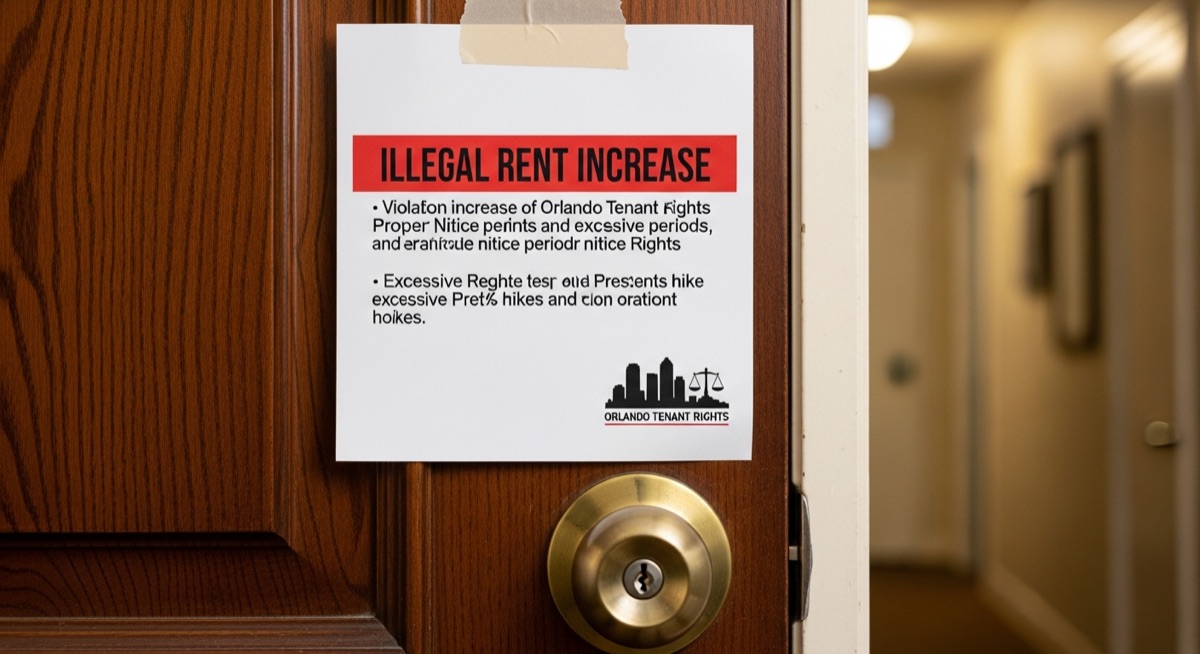
Short answer: Yes. An Orlando landlord can raise your rent by any amount, with no statewide cap. But only at the legally correct moment, with legally valid written notice, delivered the legally required way. Miss any one of those conditions and the increase may be unenforceable. Most renters — and most online explainers — get these specifics wrong.
Can a Florida Landlord Raise Rent During an Active Lease?
No. Not without your written permission.
If you’re in the middle of a fixed-term lease — say, a 12-month lease running January 1 through December 31 — your landlord cannot legally raise your rent during that period unless the lease itself explicitly grants that right. Florida’s Residential Landlord and Tenant Act, codified in Chapter 83 of the Florida Statutes, treats a fixed-term lease as a binding contract. The rent is a term of that contract. Changing it mid-term without authorization in the written agreement is a breach by the landlord.
That protection matters concretely here. Orlando’s economy runs heavily on tourism — theme park workers, hotel staff, restaurant employees — people who sign standard 12-month leases and don’t think about the fine print again until something goes wrong. The mid-lease protection is real and it’s theirs.
One caveat: read your lease. Some form leases used by large property management companies include clauses permitting “adjustments” tied to inflation indexes or market rates. If that language is in yours, the landlord may have contractual cover. If it isn’t, a mid-term increase notice is flatly improper.
Renewal is a different animal entirely.
How Much Notice Is a Florida Landlord Required to Give Before Raising Rent?
This is where two very different groups of renters live under two very different rules.
Month-to-month tenants
Florida Statute §83.57 requires your landlord to give you at least 15 days’ written notice before the end of the monthly rental period. That phrase — “before the end of the monthly rental period” — is the element most commonly misunderstood, and misunderstanding it almost always works against the tenant.
The 15-day clock does not start from the date you receive the letter. It runs backward from the end of your current rental period. If your rent period ends on the 31st, the landlord’s written notice must be in your hands no later than the 16th for the increase to take effect at the start of the following period. A notice slipped under your door on the 22nd — for a period ending on the 31st — doesn’t satisfy the statute. It’s too late. The increase cannot legally take effect until the rental period after the one for which proper notice was given.
Month-to-month arrangements are common among hourly workers in Orlando’s tourism and service industries. Seasonal employment, variable schedules, the preference for flexibility over a locked 12-month commitment — these produce a large population of renters who have the 15-day protection but may not know to count from the right starting point. If a rent increase notice arrives that feels too close to the end of your period, count backward from the last day of your rental cycle. If the notice came in after the 15-day mark had passed, it’s defective.
Fixed-term and annual lease tenants
Here’s the part that surprised me when I first looked it up: Florida law doesn’t prescribe a mandatory advance notice period for rent increases at fixed-term lease renewal. The governing timeframe is whatever your lease specifies. Many well-drafted leases — including standard forms used by larger Orlando property managers — require 60 days’ notice before a renewal rate change. Where that language exists, 60 days is binding. But if your lease is silent on the question, you have less protection than you think.
That gap is not a technicality. It’s a genuine hole in Florida tenant protection law. The quality of your individual lease matters enormously, which means a tenant whose landlord used a careful attorney is better protected than one whose landlord printed a form off the internet.
Before you need this information, find the sections of your lease labeled something like “renewal,” “rent adjustment,” or “notice.” Know what it says. Your Lease, Your Rights walks through the standard clauses Orlando renters most commonly misread — including the renewal and notice provisions that determine whether a rate change is legally binding.
Is There a Limit on How Much Rent Can Be Increased in Florida?
No. A landlord who gives proper notice can raise your rent by $50 or by $500. The law doesn’t touch the amount.
Orange County and the City of Orlando can’t fill that gap. Florida law explicitly prohibits local governments from enacting rent stabilization or rent control ordinances. The prohibition on municipalities sits at §166.043; the prohibition on counties at §125.0103. These are explicit legislative preemptions — the state has told local governments they have no authority here, regardless of local housing conditions or what city council members might prefer.
There is no rent stabilization ordinance in Orange County. There is no rent control ordinance in the City of Orlando.
The legislature’s position on this has been consistent for decades: supply-side solutions, not price controls. I think that judgment has failed Orlando renters badly — the supply hasn’t materialized fast enough, wages in the hospitality sector haven’t kept pace, and the people absorbing the cost are exactly the workers the regional economy depends on. But the policy isn’t ambiguous and it isn’t changing anytime soon. Florida renters have no protection against the size of an increase. Only against an increase that skips required notice or arrives at the wrong time.
What Counts as Proper Written Notice for a Rent Increase in Florida?
This is where most online guides go vague exactly when they should get specific.
Under §83.56 of the Florida Statutes, notice from a landlord is legally valid when delivered by hand directly to the tenant or to an adult household member, or when sent by certified mail. Posted notice on the door works in specific circumstances — when the tenant is absent and can’t be reached by the above methods, combined with mailing.
A text message is not recognized as valid notice under §83.56 unless the lease explicitly pre-authorizes electronic communications. Neither is a verbal conversation, even face-to-face. Email falls into the same category. Unless your lease contains explicit language pre-authorizing electronic notice and you’ve agreed to it in writing, email alone doesn’t satisfy the statute.
This is one of the most common failures in the Orlando rental market. Individual landlords managing one or two units routinely send rent increase notices by text because it’s fast. Tenants receive those messages, believe they’ve been properly notified, and act accordingly. Legally, they haven’t been. The notice is defective.
When a notice arrives, ask yourself: Was it in writing — not just a text? How was it delivered? What date did you actually receive it, and does that leave enough time before the end of your rental period? If the delivery method was wrong or the timing insufficient, you’re holding a legally defective notice.
What Happens If I Pay the Higher Rent — Do I Lose My Right to Challenge It?
Yes. A tenant who pays the increased rent without written objection may be treated — by a court, by a mediator, by the landlord — as having accepted the new terms. Payment is conduct. Conduct can be interpreted as consent. A cleared check at the new rate is powerful evidence for the landlord.
If you intend to contest a notice but can’t withhold payment, pay under written protest. Before the payment clears, send a written communication to your landlord — by a method you can document — stating clearly: you’re paying this month’s rent but you are not accepting the proposed increase as valid. You dispute the notice because [specify: improper delivery, insufficient timing, mid-lease increase] and you’re preserving all rights to challenge it.
You don’t need an attorney to write that letter. You do need to send it before the check clears.
For month-to-month tenants especially, this is urgent. The legal situation can shift within a single 30-day cycle. Don’t let a paid check serve as your answer.
Can a Landlord Retaliate Against Me for Questioning a Rent Increase?
Florida Statute §83.64 prohibits landlord retaliation against tenants who exercise their legal rights — and a rent increase can, in the right circumstances, constitute exactly that retaliation. The statute’s protection applies when a tenant has engaged in protected activity: filing a complaint with a housing code enforcement agency, contacting a building inspector, organizing with other tenants, or asserting rights under the Residential Landlord and Tenant Act. If a landlord responds to that protected activity with a rent increase or an eviction notice, the law creates a presumption of retaliation if the adverse action follows the protected activity within a specified timeframe. The landlord then bears the burden of demonstrating a legitimate, non-retaliatory reason.
This matters particularly in neighborhoods like Parramore and Pine Hills, where aging rental housing stock generates higher rates of habitability complaints — plumbing failures, broken air conditioning in August, pest problems. Some tenants have historically swallowed those conditions rather than file code complaints, afraid of exactly this kind of landlord response. The anti-retaliation statute is supposed to break that dynamic. It doesn’t always work. But it gives tenants something real to stand on, especially with documentation.
Keep a timeline: dates of any complaints or reports, copies of written communications, the date the rent increase notice arrived, the gap between them. If other tenants in the building received similar treatment around the same time, their experience matters too. If you believe your increase was retaliatory, get to Legal Aid or a tenant’s rights attorney. This isn’t a situation to navigate alone.
What Can I Do If My Landlord Raised Rent Without Proper Notice in Orlando?
Document the notice immediately. Photograph it where you found it. Note the date, the delivery method, exactly where it appeared. Under the door? Certified mail? Taped to the door? Handed to you by the manager? These details determine whether the notice was legally valid, and they disappear if you don’t capture them now.
Read your lease. Find the sections covering notice, renewal terms, and rent adjustments. Determine whether you’re month-to-month or on a fixed term. Locate any language specifying required notice for renewal changes. Know what your lease actually says before you respond to anything.
Respond in writing before you pay. Be specific: not “I don’t like this increase” but “This notice does not comply with Florida Statute §83.57 because [reason].” Send it by certified mail or, if your lease pre-authorizes electronic notice, by email with delivery confirmation. Keep a copy.
Contact the Legal Aid Society of the Orange County Bar Association at 100 E. Robinson St., Suite 500, Orlando. Free civil legal assistance for income-qualifying tenants. This is exactly the kind of situation covered in our legal & finance coverage of tenant rights, landlord disputes, and the local organizations that handle them. A landlord-tenant attorney can evaluate your specific lease and notice, tell you whether it’s defective, and advise on next steps. They handle exactly these cases, in Orange County, at no cost to qualifying clients.
If you don’t income-qualify for Legal Aid, contact the Florida Bar Lawyer Referral Service at 1-800-342-8011. Many attorneys who handle landlord-tenant matters offer a reduced-fee initial consultation.
Is Anything Changing in 2026?
Probably not in tenants’ favor. The Florida Legislature completed its 2025 regular session in early May 2025. Any statutory changes affecting 2026 landlord-tenant law must be confirmed through enrolled bill records at myfloridahouse.gov and flsenate.gov. If no legislation was enacted — which has been the consistent pattern — then §83.57, §83.575, §83.56, and §83.64 remain in their current form.
The legislature’s recent direction has run consistently toward landlord-favorable preemption. That hasn’t reversed, and I see no sign it’s about to.
One thing worth knowing heading into hurricane season: Florida’s anti-price-gouging statute applies during a state of emergency declared by the governor. In a hurricane emergency declaration covering Orlando or Orange County, landlords are legally prohibited from imposing unconscionable price increases on housing. This is not a general rent cap — it kicks in only during declared emergencies and the period immediately following. It rarely comes up. When it does, it comes up fast, and renters who know about it are in a better position than those who don’t.
Quick-Reference Card for Orlando Renters
Month-to-month tenants: §83.57 requires at least 15 days’ written notice before the end of the rental period — not 15 days from when you receive the letter. Count backward from the last day of your cycle.
Fixed-term/annual lease tenants: No mandatory statewide notice period for rent increases at renewal. The timeframe is whatever your lease specifies — often 60 days in well-drafted leases, sometimes nothing. Read your lease.
Mid-lease increases: Illegal without explicit written authorization in the lease.
Rent caps: None under Florida law. Orange County and the City of Orlando are preempted by state statute (§166.043 and §125.0103) from enacting any local rent stabilization or rent control ordinance.
Valid notice delivery: Hand delivery, certified mail, or posted notice in specified circumstances. Text message, verbal statement, or email (unless your lease explicitly pre-authorizes it) doesn’t satisfy §83.56.
Waiver warning: Paying the increased amount without written objection may be treated as acceptance. If you’re disputing, pay under written protest before the check clears.
Retaliation protection: §83.64 protects tenants who’ve filed code complaints or exercised legal rights. A rent increase following protected activity may be presumed retaliatory.
Free legal help: Legal Aid Society of the Orange County Bar Association — 100 E. Robinson St., Suite 500, Orlando.
Florida Bar referrals: 1-800-342-8011.
Key statutes: §83.56 (notice delivery), §83.57 (month-to-month notice), §83.575 (fixed-term termination), §83.64 (anti-retaliation), §125.0103 (county preemption), §166.043 (municipal preemption).
Reporter’s note: Before publication, verify independently and on the record: current Legal Aid Society phone number and address; current two-bedroom median rent figures for Orange County with source and date (CoStar, ApartmentList, or Zillow Research); whether any 2025 Florida legislation affecting Chapter 83 was enacted and signed; current availability of Orange County dispute resolution or mediation for landlord-tenant matters; the Florida statute citation for the anti-price-gouging provision; and the statute governing electronic notice validity in landlord-tenant contexts. All statutory citations should be confirmed against the current Florida Statutes at leg.state.fl.us.