What to Know About Florida Intestate Succession in Orange County
Orange County families face a specific set of rules, and a specific courthouse. Here's what the law actually says and what the local process costs.

What to Know About Florida Intestate Succession in Orange County
Orange County families face a specific set of rules, and a specific courthouse. Here’s what the law actually says and what the local process costs.
If you own a home in Orlando and die without a will, your family won’t simply divide your property the way they assume they will. Florida has its own inheritance rules, and they apply automatically, regardless of what anyone believed you wanted. In Orange County, those rules play out inside a courthouse through a process that can take six weeks or eighteen months, depending on what you owned and how it was titled.
This piece explains Florida’s intestate succession law in plain English, covers the homestead rules that most coverage gets wrong, and walks through what Orange County Probate Court actually costs and requires. It’s explanatory journalism, not legal advice. If you’re dealing with an estate right now, the final section tells you exactly where to start.
The Assumption That Gets Families Into Trouble
A College Park homeowner dies unexpectedly. The house is worth roughly $380,000 — a common figure for that neighborhood right now. He’s married. He also has two adult children from a prior relationship. His wife assumes she inherits everything. His adult children, whom he remained close with, assume their stepmother will take care of it.
Florida law says both assumptions are wrong.
Under Florida’s intestate succession statute, when a decedent leaves a surviving spouse and descendants who are not also the spouse’s descendants, the estate doesn’t pass entirely to either party. The spouse gets half. The children from the prior relationship split the other half. On a $380,000 estate, that division has real consequences. And on the house specifically — as the homestead section below explains — the rules are even more complicated than the money split.
Florida’s Inheritance Ladder: Who Gets What, and in What Order
Florida Statutes §§ 732.102 and 732.103 establish the succession order for a decedent who dies without a will. The differences matter in ways that show up years later in Orange County probate dockets.
If you leave a surviving spouse and no descendants, your spouse inherits everything. Clean.
If you leave a surviving spouse and descendants who are also the spouse’s descendants — children of both of you — your spouse still inherits everything. Florida treats this as a second tier of simplicity.
Here’s where it gets thorny. If you leave a surviving spouse and descendants who are not the spouse’s descendants, your estate splits down the middle. Half to the spouse, half divided among your descendants. This is the blended-family outcome. It generates most of the phone calls to estate planning attorneys in Central Florida.
When there’s no surviving spouse, the entire estate passes to your descendants, divided per stirpes. That term means the share of any deceased child flows down to that child’s own children rather than being redistributed among surviving siblings.
No spouse and no descendants? The estate moves up the family tree. First to your parents, then to your siblings and their descendants, then to your grandparents and their line. By the time the law reaches third cousins and distant aunts, the pool of potential claimants becomes genuinely difficult to locate. If no heirs are found — no spouse, no children, no siblings, no parents, no one — the estate escheats to the State of Florida. The funds go into the general treasury. It happens more than people expect.
The Homestead Exception: Why Your House Plays by Completely Different Rules
This is the section most coverage either skips or handles carelessly, and it’s the single biggest source of avoidable family conflict in Orange County estates.
Florida’s homestead law, codified at F.S. 732.401, treats the primary residence differently from every other asset. If you die without a will, leaving a surviving spouse and lineal descendants, your spouse does not automatically inherit the home outright. What actually happens: the spouse receives a life estate, with the decedent’s lineal descendants holding a vested remainder. The spouse has the right to live in the home for the rest of her life. She cannot sell it, refinance it, or will it to anyone without the cooperation of the remainder holders — the descendants.
On a $400,000 Colonialtown bungalow, that plays out in concrete ways. Say the surviving spouse wants to sell and move somewhere smaller, or she needs to tap the equity for medical expenses or assisted living as she ages. She can’t do any of that unilaterally. The adult children from the prior relationship hold a legal interest. If any of them are uncooperative — or if one is still a minor, which layers a guardianship proceeding on top of everything — the home becomes effectively frozen. Title companies won’t insure a sale without all parties signing. Banks won’t refinance. A house owned free and clear becomes entangled in ways that are expensive and slow to undo.
Florida does give the surviving spouse a choice. Rather than accepting the life estate, she can elect to take an undivided one-half interest as a tenant in common. She’d own half the home outright; the descendants collectively own the other half. That’s still co-ownership with its own complications, but it gives her a transferable interest rather than one that expires at death. Which option is actually better depends on the specific family and what’s likely to happen next — this is precisely the question where even one conversation with an attorney pays for itself.
The picture shifts when there are no lineal descendants. If the decedent leaves a surviving spouse and no descendants, the spouse inherits the homestead outright. No life estate. Full ownership. And when there’s no surviving spouse, the home passes to the descendants per stirpes as fee simple. Multiple adult children become co-owners, which creates its own set of friction for a property only one of them may want to keep.
There’s also an interaction with Florida’s constitutional homestead protection — a separate, layered body of law that limits what even a valid will can do with the primary residence if the decedent leaves a spouse or minor child. Families write wills in Florida that would be unenforceable because the documents don’t account for the constitutional protection. They find out during probate, when a transaction can’t close and they’re already paying attorney fees to fix it.
What Skips Probate Entirely — and Why Your Beneficiary Designations Matter More Than You Think
Not everything you own passes through the probate process. Several categories of assets transfer directly to a named individual at death, bypassing the court entirely. Florida’s intestate succession rules don’t touch them.
Life insurance policies with a named beneficiary transfer directly to that person. Real property titled with right of survivorship transfers to the surviving co-owner. Bank accounts designated payable-on-death (POD) pass to the named recipient. Investment and brokerage accounts with a transfer-on-death (TOD) designation do the same. Retirement accounts — IRAs, 401(k)s, 403(b)s — with a designated beneficiary skip probate entirely and go to whoever is named on the form on file with the institution.
If you hold a checking account at Fairwinds Credit Union or a savings account at CFE Federal Credit Union, that account transfers according to the beneficiary designation on file with the institution, not according to anything a Florida court decides. The actual probate estate — the pool of assets subject to the court process — is frequently much smaller than the full estate once non-probate assets are factored out. An estate that looks substantial on paper, but consists mostly of a life insurance policy and a 401(k) with named beneficiaries, can move through probate quickly.
Two risks follow from this. First, outdated designations can route assets to an ex-spouse, a deceased person, or simply no one. That last scenario is the dangerous one: if a beneficiary designation is blank, the asset defaults into the probate estate and becomes subject to the intestate rules. Second, people over-rely on the existence of a retirement account or life insurance policy to protect someone they love, not realizing the beneficiary form they completed years ago still names a first wife or a college roommate they’ve lost touch with.
Fixing a beneficiary designation costs nothing and requires no attorney. Call the institutions where you hold accounts. Ask for a copy of what’s currently on file. Update it if it’s wrong. That one step prevents some of the worst outcomes these families face — and it’s genuinely that simple before someone dies.
Three Tiers of Probate: Matching the Process to the Size of the Estate
Florida law provides three administrative pathways. Which one applies depends on the size and nature of the estate.
Disposition Without Administration (F.S. 735.301) is technically not a probate proceeding. It’s a clerk-level process requiring no judge, available only when the estate’s sole assets are amounts needed to reimburse people who paid the decedent’s final illness and funeral costs — nothing left to distribute beyond those costs. For most families, it’s too narrow to be useful.
Summary Administration (F.S. 735.201) applies when the estate subject to administration doesn’t exceed $75,000, or when the decedent has been dead more than two years regardless of estate size. No personal representative is appointed. You file a petition and a proposed order; if uncontested, the judge enters an order directing distribution and the parties use it to retitle assets. Typical timeline: four to twelve weeks. Significantly less expensive than formal administration.
Formal Administration is required when the probate estate exceeds $75,000 and the decedent has been dead less than two years. A personal representative is appointed. A three-month creditor notice period runs — that clock cannot be shortened by statute, and no one can work around it. Assets are inventoried, debts are paid, and the court eventually approves a final accounting and distribution. For most Orange County estates that include a home, formal administration is the required pathway.
One nuance worth flagging: because homestead property is excluded from the $75,000 calculation, an estate consisting primarily of a protected homestead and modest other assets may still qualify for summary administration. That determination requires careful analysis — the calculation should be done with a practitioner, not estimated on a napkin.
Rising home values are also quietly pushing estates that used to qualify for summary administration into formal administration. Families expecting a quick, inexpensive process sometimes get an unwelcome surprise.
What Orange County Probate Actually Costs and How Long It Takes
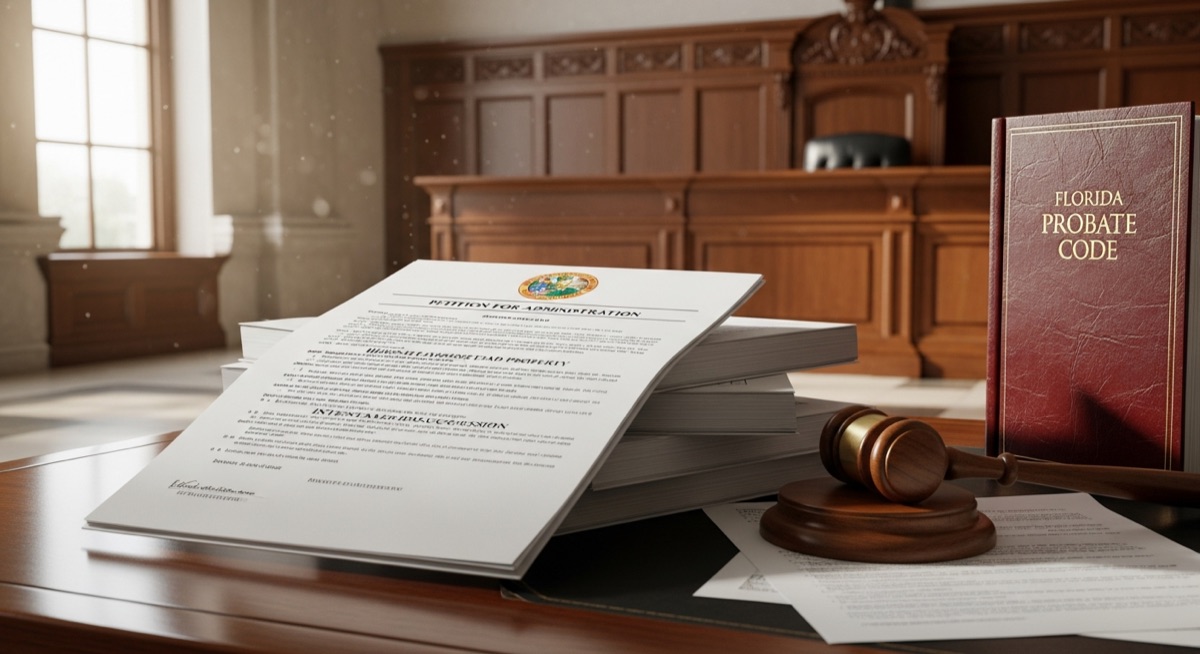
The Orange County Probate Division operates under the Ninth Judicial Circuit Court of Florida. Probate filings go to the Orange County Courthouse at 425 N. Orange Avenue, Orlando, FL 32801 — but confirm the current intake location directly with the clerk’s office before filing, as some divisions route through separate facilities. The clerk’s office number is 407-836-2060. Current fee schedules are at myorangeclerk.com. Verify everything before you act on any figures here; court fees and procedures change.
Filing fees for formal administration have run in the $400–$465 range based on recent schedules. Summary administration fees have been lower, generally $235–$285. Those figures cover only the court’s filing cost. They don’t include attorney fees, publication costs for the creditor notice, certified mail, or recording fees for deed transfers.
Florida Statute 733.6171 governs attorney fees through a statutory sliding scale. The presumptively reasonable fee is 3 percent of the first $1 million of estate value, declining above that threshold. On an estate where a $400,000 home is the primary asset, that calculus produces roughly $12,000 in attorney compensation. Contested matters, real property sales, and complex asset structures push fees considerably higher. An estate involving multiple properties, out-of-state assets, or a business interest can run well past that baseline.
Summary administration, when uncontested, typically resolves within a few months of filing. Formal administration carries the mandatory three-month creditor window and then whatever time the inventory, accounting, and any property transactions require — routine Orange County estates generally take nine months to a year and a half from filing to final discharge. Disputed matters extend that significantly. Check current docket conditions with a local practitioner; post-pandemic backlogs have hit the state’s probate divisions unevenly.
What Orlando Probate Attorneys See Families Get Wrong
These aren’t hypothetical scenarios. They’re patterns that appear in actual estate files in Orange County, regularly.
Retirement accounts and bank accounts with outdated or missing beneficiary designations are among the most common problems. An account left blank defaults into the probate estate. An account still naming a first spouse routes assets to someone the decedent spent years building a new life away from. The fix takes a phone call before death. After death, nothing can be done.
The homestead life-estate outcome surprises nearly everyone. Families assume the house goes to the spouse — full stop. They’ve never heard of a life estate and vested remainder, and they find out what those terms mean when a real estate transaction can’t close and they’re already three months into an estate administration. At that point, resolving the conflict may require a separate attorney for each party, and what might have been a clean sale becomes a negotiated settlement with legal fees on both sides.
Families also wait too long to open probate after a death. Florida imposes no strict filing deadline, which creates a false sense that waiting is safe. Property taxes, HOA fees, insurance, and maintenance on the decedent’s home accumulate and must be paid by someone. If no one has legal authority to act, those bills can go unpaid while the estate sits in limbo.
A few complications are specific to Orange County’s market. The county has a substantial population of seasonal residents whose Florida domicile status can be contested if they split time between Florida and a northern state — and establishing Florida domicile as of the date of death determines which state’s probate laws govern, which state can tax the estate, and which court has jurisdiction. Condo units in Orlando’s many HOA communities carry notification requirements and association lien rights that intersect with estate administration in ways that require local knowledge — a subject covered more fully in our legal and finance coverage of Florida homeowner rights. And families who relocated to Central Florida from other states — a significant share of the county’s growth — often apply inheritance assumptions that are accurate where they came from and wrong here. Florida’s homestead protections are unlike what most other states provide. That gap tends to become expensive.
Where to Start If You’re Dealing With This Now
The Orange County Courthouse Probate Division is at 425 N. Orange Avenue, Orlando, FL 32801. Confirm the current probate intake location with the clerk before visiting — procedures can shift. The clerk’s office number is 407-836-2060. Fee schedules and procedural information are at myorangeclerk.com. The clerk’s office can explain what forms are required for a summary or formal administration opening. They can’t give legal advice, but they can walk you through the mechanical steps.
For attorney referrals: the Orange County Bar Association Lawyer Referral Service is at 407-422-4537. The Florida Bar Lawyer Referral Service is 1-800-342-8011, or at floridabar.org/public/lrs — referrals statewide, modest set fee for the initial consultation.
Several Orlando-area firms handle estate planning and probate regularly. Dean Mead is at 420 S. Orange Ave., downtown and close to the courthouse. Winderweedle, Haines, Ward & Woodman, P.A. is in Winter Park. GrayRobinson P.A. has multiple Central Florida offices. When you call for a consultation, be prepared to describe the approximate estate value, how assets are titled, whether there’s a surviving spouse or minor children, and whether descendants from prior relationships are involved. That framing helps an attorney give you a realistic sense of complexity and cost upfront.
If no one has died yet and you’re reading this because the College Park scenario sounds familiar — you own a home, you have a blended family, you don’t have a will — understand that doing nothing costs your family far more in attorney fees and court time than basic estate planning documents would have. The fee for a straightforward will and a few beneficiary updates is a rounding error compared to the cost of a contested formal administration. Make the call.
Sidebar: 5 Assets That Skip Probate Entirely
The intestate succession rules explained in this article govern none of the following. These assets transfer directly to the named beneficiary or co-owner at death, outside the court process:
- Life insurance with a named beneficiary
- Jointly titled real property (joint tenancy with right of survivorship, or JTWROS)
- Payable-on-death bank accounts (POD)
- Transfer-on-death investment accounts (TOD)
- Retirement accounts — IRAs, 401(k)s, 403(b)s — with designated beneficiaries
The caveat: if a beneficiary designation is missing, outdated, or names a deceased person, the asset may default into the probate estate and fall under the intestate rules after all. Check yours.
This article is explanatory journalism. It is not legal advice and does not create an attorney-client relationship. Florida law is subject to change; readers should verify all statutory references and consult a licensed Florida attorney for guidance specific to their situation. Filing fees, court addresses, and procedures referenced in this article should be confirmed at myorangeclerk.com or by contacting the Orange County Clerk of Courts directly at 407-836-2060.