How to Set Up an IRS Installment Agreement in Florida
From basic agreements to currently-not-collectible status, here's how to read your options and when to stop DIYing it.

How to Set Up an IRS Installment Agreement in Florida
From basic agreements to currently-not-collectible status, here’s how to read your options and when to stop DIYing it.
If you filed your federal return this spring and found a balance due — or if a CP503 or CP504 notice recently showed up in your mailbox — you have more options than you probably think. A tax bill that can’t be paid in a lump sum is an annual reality for a lot of Central Florida workers: the Disney contractor with irregular withholding across three 1099s, the tipped server on Sand Lake Road whose employer’s withholding never quite kept pace, the gig driver who skipped quarterly estimated payments, the small business owner sorting out the downstream mess from an Employee Retention Tax Credit claim. This piece is written for those people.
The short answer to “I owe money I can’t pay all at once — what do I do?” is this: the IRS has a structured set of resolution options, and the right one depends almost entirely on how much you owe. Whether you’re under $10,000, under $50,000, or over $50,000 controls every path that follows. The rest of this guide walks you through the decision in sequence.
Step One: Assess Where You Stand Before You Call Anyone
First thing to understand about an IRS balance-due notice: it’s not a levy. It’s not a seizure. It’s a billing statement with a specific procedural meaning, and the type of notice tells you where in the IRS collection sequence you currently sit.
CP2000 is not a bill at all. It’s a proposed change to your return based on a discrepancy between what you reported and what a third party reported to the IRS. A lot of people end up in this situation because they got a CP2000 and ignored it — and then the actual bill followed. CP503 is the second notice in the standard collection sequence, meaning the IRS has already sent an initial balance-due notice and hasn’t received payment. Informational pressure, not enforcement. CP504 is the one that signals the IRS is preparing to move toward enforced collection. That’s the notice that should prompt immediate action. Not panic — action. There’s a difference.
Before you call the IRS or anyone else, pull your current balance from the IRS Online Account portal. You’ll need to create or log into an ID.me-verified account. Once inside, you can see your exact balance broken down by tax year, the composition of that balance (tax, penalties, and interest separately), any notices issued, and your payment history. The dollar figure in that account governs everything that follows. Write it down.
Step Two: Know Your Three Resolution Paths
Most coverage of IRS debt resolution talks about “getting on a payment plan” as though it’s a single product. It isn’t. There are three meaningfully different paths, each with different qualifying conditions and different outcomes.
Installment Agreement (IA). A formal agreement to pay your balance in monthly installments over a defined period. An installment agreement halts enforced collection while it remains in effect, but it does not stop interest and penalties from accruing — and it does not prevent the IRS from filing a federal tax lien, a public record that can affect your credit and complicate real estate transactions. More on that in Step Five.
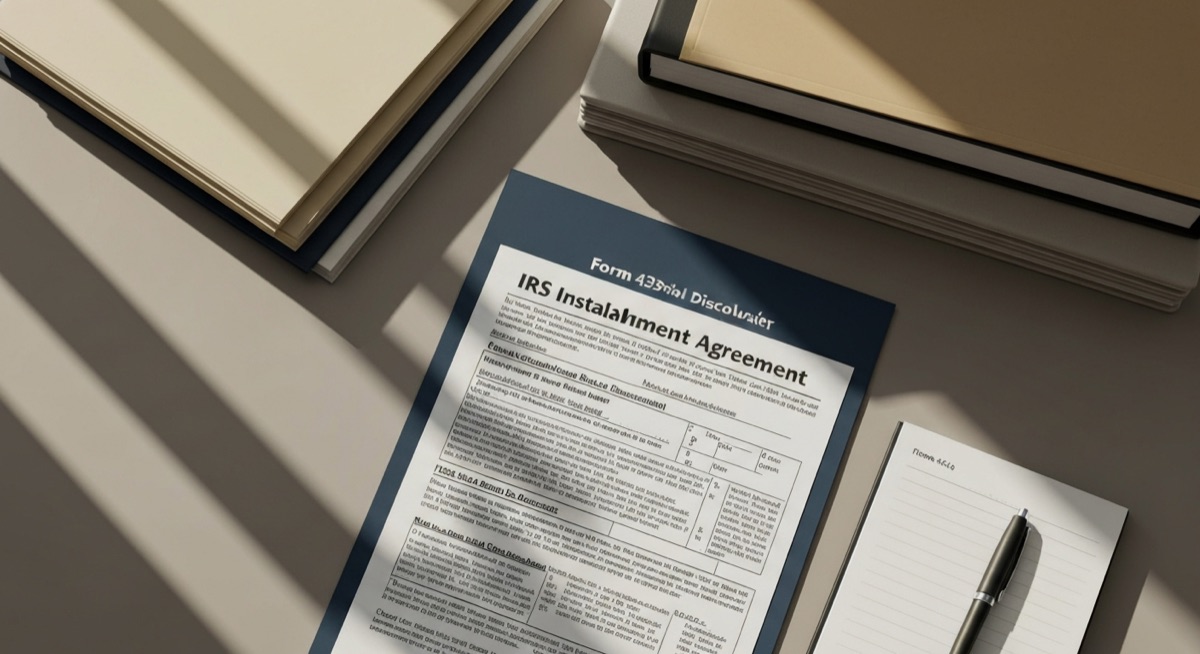
Partial Payment Installment Agreement (PPIA). This one flies under the radar and it shouldn’t. It exists for taxpayers who genuinely cannot pay their full balance within the 72-month window even at maximum monthly payments. Under a PPIA, the IRS accepts payments based on what you can actually afford, with the understanding that the remaining balance may expire uncollected when the IRS’s 10-year collection statute runs out. PPIAs require full financial disclosure via Form 433-A, periodic IRS review of your finances, and documentation that your assets and income truly can’t cover the balance. This is a legitimate tool, not a loophole — but it requires professional guidance to present correctly. I’ve seen taxpayers attempt the 433-A on their own and argue themselves into higher payments than necessary because they didn’t know which allowable expenses to document. That’s a predictable, avoidable mistake.
Currently Not Collectible (CNC) Status. The IRS determines that your current income and assets are insufficient to make any payment without causing genuine financial hardship. CNC halts all collection activity, including levies, without requiring a payment commitment. It does not forgive the debt; interest keeps accruing. The IRS will periodically review your finances and can reinstate collection if your circumstances improve. Getting to CNC requires the same Form 433-A disclosure as a PPIA and a clear demonstration of hardship.
One practical note for Central Florida readers: Florida has no state income tax. You’re dealing with one agency, one balance, one process — a genuine administrative advantage compared to taxpayers in California or New York facing concurrent state collection actions on top of everything else.
Step Three: Find Out if You Qualify for the Standard Agreement
The standard installment agreement is the IRS’s no-financial-disclosure track. It works well for most local taxpayers carrying a modest balance from a single tax year — most gig workers, tipped hospitality employees, W-2 workers with underwithholding.
The qualifying conditions are simple: your combined balance (tax, penalties, and interest) must be $50,000 or less, and you must be able to pay the full balance within 72 months. No Form 433-A. No IRS review of your bank accounts, investment balances, or home equity. The IRS sets a minimum monthly payment by dividing your balance by 72, you accept the terms, and the agreement goes into effect.
Before committing to a 72-month plan, check whether you qualify for the short-term payment plan instead. If your balance is $100,000 or less and you can pay in full within 180 days, there’s no setup fee, and you stop interest and penalty accrual faster. If you can put together a partial payment now and clear the rest within six months through a refund, a bonus, or a loan, the math usually favors finishing quickly. Six years of compounding interest looks very different from six months. Run the numbers.
For an Uber driver who owes $4,800 in self-employment tax, a server at a Lake Buena Vista resort who underwitheld by $3,200, or a freelance contractor who got a 1099-NEC from an Orlando production company and forgot to set aside estimated payments — the standard agreement is the right tool. It’s available entirely online, it processes immediately, and it genuinely doesn’t require professional help to execute.
Step Four: Understand What This Actually Costs You
“Getting on a payment plan” is not free. The total cost is substantially more than the monthly payment number suggests, and the IRS’s online application doesn’t always make that visible upfront.
Setup fees (verify current amounts at IRS.gov before applying):
| Application method | Fee |
|---|---|
| Online, with direct debit (DDIA) | $31 |
| Online, without direct debit | $130 |
| Phone, mail, or in-person | $225 |
Low-income applicants at or below 250% of the federal poverty level may qualify for a fee waiver or reimbursement — apply using the checkbox on Form 9465 or note it during the online application. The arithmetic here is obvious: apply online and enroll in direct debit. The $99 difference between online direct debit and a phone application goes into your pocket for no reason otherwise. Direct debit also reduces your default risk, which matters because a missed payment triggers the termination notice sequence described in Step Seven.
Interest. The IRS charges interest on unpaid balances at the federal short-term rate plus three percentage points, adjusted quarterly. As of early 2025, that rate was running around 8% annually. Verify the current rate at IRS.gov before you act.
Failure-to-pay penalty. This accrues at 0.5% of the unpaid balance per month from the original due date. Once a valid installment agreement is in place, the rate drops to 0.25% per month. It does not stop. It runs for the full life of the plan.
A taxpayer entering a 72-month agreement will pay substantially more than the original balance once accrued interest and the ongoing penalty are included. An installment agreement is still far preferable to levy action — but knowing the actual cost helps you decide whether paying faster saves money. In most scenarios, it does.
Step Five: Apply Through the IRS Online Portal
The IRS Online Payment Agreement application is at https://www.irs.gov/payments/online-payment-agreement-application (verify this URL is active before applying). You’ll need an IRS Online Account with ID.me verification. If you haven’t created one, do that first — the verification process takes longer than you’d expect, so don’t start this at 4:55 p.m. on a Friday.
Once inside, the application walks you through your current balance, proposes a minimum monthly payment, and lets you select a higher amount and a draft date. For direct debit, you’ll enter your bank routing and account numbers. The system generates immediate confirmation. Print or save it.
Here’s the distinction most coverage blurs: levy suspension and lien filing are not the same thing. Once a valid installment agreement is in effect, the IRS generally suspends enforced collection — no levies on wages, bank accounts, or property while the agreement is current. That’s real and protective. But a federal tax lien — a public notice of the IRS’s legal claim against your assets — can still be filed, and routinely is filed on balances over $10,000, regardless of whether an installment agreement is in place. A lien shows up in public records, can complicate mortgage refinancing, and can disrupt a real estate closing. It doesn’t disappear when you enter an agreement. It’s released when the balance is paid in full, or in some cases can be subordinated or withdrawn under specific conditions.
If you’re carrying an IRS balance and planning any real estate transaction in the near term, talk to your title company or mortgage lender about how a federal tax lien will affect your specific closing before you sign the agreement. The lien doesn’t block you from the agreement — but it creates complications worth understanding before you’re staring at a closing table. For broader context on how financial obligations intersect with homeownership in Central Florida, our legal & finance coverage addresses related topics for local residents.
One more nuance worth flagging: the IRS has a 10-year collection statute of limitations from the date of assessment (IRC §6502). That clock is paused while an installment agreement application is pending and while the agreement is in force. Entering a long-term agreement extends the window during which the IRS can collect. For most taxpayers paying off the balance, this is irrelevant. For taxpayers weighing a PPIA or CNC strategy, the statute math matters — another reason to involve a professional before committing to a path.
Step Six: Know When to Stop DIYing It
The standard online agreement works well for straightforward situations. But there are circumstances where trying to navigate this alone produces a worse outcome than hiring someone who does this for a living.
Balance over $50,000. At this threshold, you exit the standard track and must submit Form 433-A — a detailed disclosure of your income, expenses, assets, and liabilities. The IRS uses this form to calculate what it believes you can pay, and that number is almost always higher than what taxpayers expect. How the 433-A is completed, and which allowable expenses are properly documented, directly determines your monthly payment. A professional who knows the form isn’t a luxury at this point.
Missing returns. Filing compliance is a condition of any installment agreement — you must be current before the IRS will approve one. Getting multiple years of returns prepared accurately and in the right sequence, while managing the collection clock, is coordination most taxpayers can’t handle alone under pressure.
Active levy notice. Get a professional on the phone the same day. A levy stops when a valid resolution is in place, but the response window is measured in days, not weeks.
PPIA or CNC might be the right call. These strategies require a financial presentation, not just an application. If your circumstances involve genuine hardship — seasonal income, medical bills, a job loss — a professional can present that case in a way that gets heard. Without one, you’ll likely be placed on a standard agreement that fails the next time income drops. That outcome is foreseeable, and it’s worth money to avoid it.
Complex concurrent issues. ERTC claims under review, trust fund recovery penalty exposure, an IRS examination running alongside a collection action — these compound quickly without professional coordination.
On which professional to hire: a CPA with IRS representation experience can handle most installment agreement negotiations and 433-A submissions and will know your financials well. An enrolled agent (EA) is specifically licensed by the IRS for all representation matters — collections, audits, appeals — and many EAs specialize exclusively in resolution work. For a straightforward installment agreement negotiation involving a 433-A, an EA is usually the most efficient and cost-effective choice. A tax attorney adds attorney-client privilege, which matters if there’s any possibility of fraud exposure or if the matter might eventually involve litigation. For anything touching criminal exposure or civil fraud penalties, you want an attorney, not an EA, regardless of cost.
Several IRS resolution practitioners operate in the Orlando market, with a notable concentration along the Sand Lake Road corridor and in the Dr. Phillips area. When shopping for representation, ask specifically about experience with Form 433-A submissions and installment agreement appeals. That question alone separates practitioners who do this regularly from those who do it occasionally. A useful comparison point when evaluating financial service providers locally: Orlando’s best credit unions, compared on rates and local access covers how to assess local financial institutions by similar criteria. (CityDesk is pursuing direct quotes from local enrolled agents and tax attorneys; this section will be updated with attributed comment upon confirmation.)
Step Seven: Understand What Happens if You Miss a Payment
An installment agreement is a contract, and the IRS treats a missed payment as a default. This section is especially important for Orlando workers with irregular income — seasonal hospitality employees, touring entertainment contractors, tipped workers whose income swings with convention-season volume. If you work the hospitality calendar, read this carefully before you sign anything.
The CP523 notice (IRS Notice of Intent to Terminate Installment Agreement) is issued when you miss a payment, fail to file a return while the agreement is in effect, or fail to pay a new tax liability that comes due during the agreement period. From the date of the CP523, you have 30 days to cure the default before the agreement terminates and enforced collection resumes.
Within that 30-day window: pay the missed amount plus any accrued balance to bring the account current; request a Collection Due Process (CDP) hearing with the IRS Office of Appeals, which suspends termination while the appeal is pending; or submit a new installment agreement application. The IRS will not reinstate an agreement more than twice for the same tax period without requiring a full financial review. A second default on the same liability will likely trigger a 433-A process even if you were originally on the standard track.
The single most useful piece of advice in this entire guide: call the IRS before you miss a payment. The IRS has a process for proactively requesting a temporary suspension or revision of agreement terms based on a change in financial circumstances. It requires documentation and isn’t guaranteed — but a taxpayer who calls proactively before a default is in a categorically better position than one responding to a CP523. A few minutes on the phone when income drops can prevent the entire default-notice sequence. Don’t wait for the notice to arrive.
Step Eight: Know Your Local Resources if Things Get Complicated
Taxpayer Advocate Service (TAS)
The TAS is an independent organization within the IRS for taxpayers experiencing hardship as a result of IRS action. It’s not a free negotiation service and doesn’t replace professional representation, but it can step in when IRS collection machinery is moving faster than a taxpayer can respond — an imminent levy on wages or a bank account, a lien preventing a home sale that would itself resolve the debt, or a situation where the IRS has simply failed to respond to a legitimate application.
Orlando-area taxpayers in Orange County are served by the Jacksonville TAS office at 400 W. Bay Street, Suite 35045, Jacksonville, FL 32202. Verify the current address at taxpayeradvocate.irs.gov before making the drive. The national intake number is 1-877-777-4778. You can also initiate a request by filing Form 911 (Request for Taxpayer Advocate Service Assistance) directly.
TAS assistance isn’t available for routine installment agreement applications. It’s specifically for hardship situations where normal IRS processes have failed or where irreparable harm is imminent.
Orlando IRS Taxpayer Assistance Center (TAC)
Verify the current address through the IRS TAC locator at IRS.gov before you travel — the location has changed, and the address currently listed by some sources hasn’t been independently confirmed by CityDesk. Appointments are required; walk-ins aren’t accepted.
TAC staff can confirm your account status, help you understand a notice, accept a payment, and assist with identity verification. They cannot negotiate installment agreement terms, make hardship determinations, or override collection actions. If you have a straightforward question about your account and want to confirm what you’re seeing online, a TAC appointment is useful. If you need to negotiate, it isn’t — and that distinction trips up more people than it should.
Quick-Reference Box: Key Numbers and Links
Verify fees, interest rates, and addresses before acting. IRS rates adjust quarterly and office locations change.
| Resource | Detail |
|---|---|
| IRS Online Payment Agreement portal | https://www.irs.gov/payments/online-payment-agreement-application (verify active) |
| IRS Online Account (balance lookup) | IRS.gov (search “IRS Online Account”) |
| Setup fee — online, direct debit | $31 |
| Setup fee — online, no direct debit | $130 |
| Setup fee — phone/mail/in-person | $225 |
| Current IRS underpayment interest rate | ~8% as of early 2025; verify current quarterly rate at IRS.gov |
| Failure-to-pay penalty (active agreement) | 0.25% per month |
| Standard agreement balance limit | $50,000 (tax + penalty + interest) |
| Short-term plan limit/window | $100,000 / 180 days / no setup fee |
| TAS national intake number | 1-877-777-4778 |
| Jacksonville TAS office | 400 W. Bay St., Suite 35045, Jacksonville, FL 32202 (verify at taxpayeradvocate.irs.gov) |
| Orlando IRS TAC address | Confirm current location at IRS.gov TAC locator before visiting |
| Form 911 (TAS hardship request) | Available at IRS.gov/forms |
What Happens Next
If you owe the IRS money you can’t pay in a single check, the worst thing you can do is nothing. The IRS’s collection sequence runs on a schedule regardless of whether you engage with it, and the cost of inaction — additional penalties, a lien on record, levy action — is always higher than the cost of the payment plan itself.
For most Central Florida workers carrying a four- or five-figure balance from a single tax year, the standard installment agreement is accessible and manageable. Apply online, enroll in direct debit, make every payment on time. When the balance tops $50,000, when returns are missing, when there’s an active levy or a lien complicating a property transaction, or when a PPIA or CNC argument might be in play — that’s when a local enrolled agent or tax attorney earns their fee. The IRS negotiates every day with practitioners who know the 433-A process. A taxpayer calling in cold does not enter that conversation on equal footing.
Start with your IRS Online Account. Know your number. Work through this sequence.
CityDesk Orlando covers local business, finance, and the Central Florida economy. This article is informational and does not constitute legal or tax advice. Consult a licensed tax professional for guidance specific to your situation.