Living Trust vs Will in Florida What You Actually Need
A trust avoids probate only for assets you remember to put in it. Before you pay $3,000 for a document, here's what the math and the law actually say.

Living Trust vs Will in Florida What You Actually Need
A trust avoids probate only for assets you remember to put in it. Before you pay $3,000 for a document, here’s what the math and the law actually say.
Every few months, a wave of attorney marketing rolls through Central Florida. Social media ads. Seminars in hotel conference rooms off International Drive. Mailers landing in Parramore and Windermere alike. The message never really changes: you need a revocable living trust, and you need one now. The pitch isn’t dishonest, exactly — a trust is a legitimate planning tool, and sometimes the right one. But the marketing rarely tells you what a trust cannot do, which assets already skip probate without one, or what Florida’s own probate shortcuts might mean for your household. That omission isn’t accidental.
What follows is the framework that attorney consultations sometimes skip — or rush past on the way to the retainer agreement.
What a Trust Does and Doesn’t Do in Florida
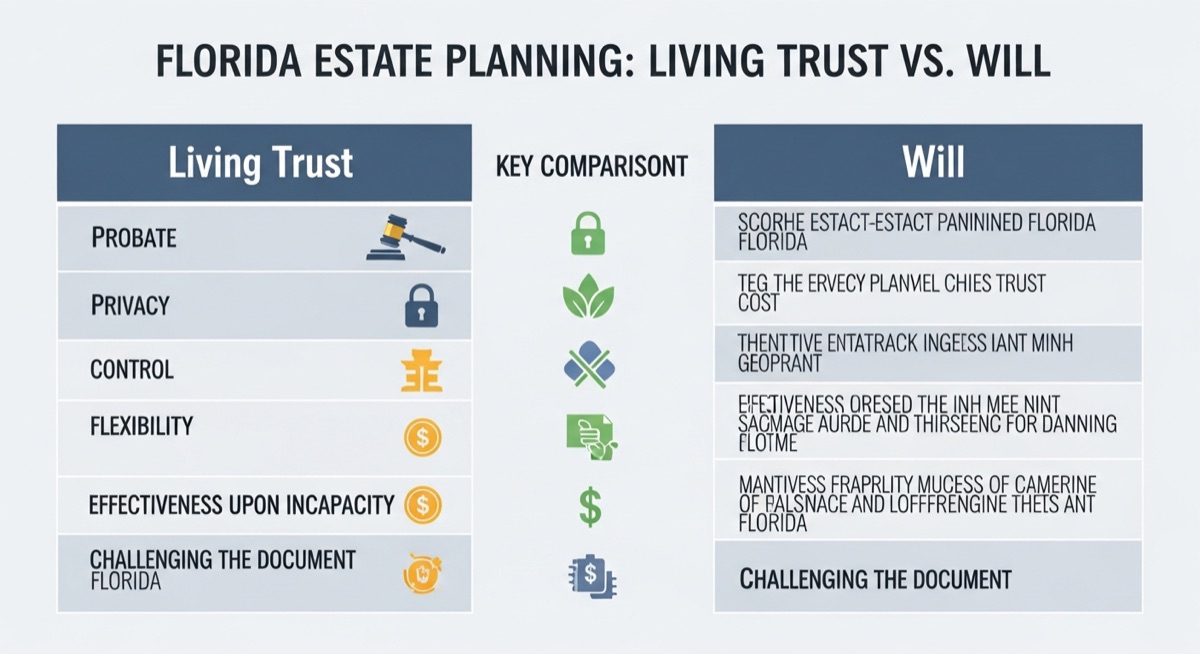
A revocable living trust is a legal arrangement in which you transfer ownership of assets to a trust during your lifetime, name yourself as trustee, retain full control while you’re alive, and designate a successor trustee to distribute those assets after you die. The selling point is that last part: avoiding probate court.
Here’s what the brochure buries: a revocable living trust avoids probate only for assets that have actually been transferred into it. Sign a trust document, put it in a drawer, and never retitle your house or brokerage accounts into the trust’s name — you’ve bought an expensive piece of paper. The assets still go through probate. I keep returning to this point because it’s the one that catches people off guard years later, when it’s too late to fix cheaply.
For many Orlando families, the case for a trust shifts once you learn what Florida already provides. Summary administration, under F.S. 735.201, applies when the probate estate — not the gross estate, but assets that would actually require probate — is $75,000 or less, or when the decedent has been dead more than two years. The Orange County Probate Division at 425 N. Orange Ave. handles these petitions. Filing fees currently run around $280–$310 (verify current figures at myorangeclerk.com before relying on them). Disposition without administration, for even smaller estates, requires no court proceeding at all. These aren’t obscure loopholes. They’re mainstream options for middle-class households, and they’re worth understanding as part of our legal & finance coverage of estate planning decisions affecting Central Florida residents.
The trust-versus-will decision is really a question about how much of your estate is actually exposed to formal probate — and for a lot of Orlando families, that number is smaller than they think.
The Assets That Skip Probate Before You Do Anything
Before you can answer whether you need a trust, you need to know what a will actually governs. A will controls only probate assets: property held in your name alone, without a beneficiary designation or joint title arrangement. A surprising number of common assets skip probate entirely by operation of law, and if you’ve never mapped this out, the exercise is worth an hour of your time.
Retirement accounts — IRAs, 401(k)s, 403(b)s — pass directly to named beneficiaries outside of probate. Your will has no authority over a 401(k) with a named beneficiary, and neither does your trust, unless the trust itself is named as beneficiary. That choice carries its own complications for required minimum distributions, which is a separate conversation worth having with your attorney.
Life insurance with a named beneficiary pays directly to that beneficiary regardless of what your will says.
Jointly held property with right of survivorship passes automatically to the surviving owner. Real estate titled as JTWROS, or personal property held jointly, requires no probate and no trust.
POD and TOD accounts — payable-on-death bank accounts and transfer-on-death brokerage accounts — pass directly to named beneficiaries. Most Florida banks will add a POD designation to an existing account with a one-page form. Free, twenty minutes, probate-proof.
Florida homestead passing to a spouse or minor child operates under different rules, addressed below.
If your primary assets are a home you own jointly with your spouse, a 401(k) with your spouse as beneficiary, a life insurance policy with named beneficiaries, and a savings account set up as POD — you may have already solved most of your probate exposure without a trust. The trust calculation really comes down to whatever’s left over after you work through this list. For a lot of people, that remainder is modest enough to change the whole decision.
Florida Homestead: Where Most People Get Into Trouble
Homestead is the most distinctly Florida element of any estate plan, and it generates more confusion than anything else. This is the area where I’ve seen the most well-intentioned people make expensive mistakes.
Florida homestead does not automatically avoid probate. If a homeowner dies with property titled solely in their name and leaves a spouse or minor child, the property is subject to constitutional restrictions under Article X, Section 4 of the Florida Constitution — and depending on the circumstances, a court may still be involved in the transfer.
A homestead can go into a revocable trust without losing the property tax exemption, but only if specific conditions are met. Under F.S. 196.031 and 196.041, the owner must occupy the property as their primary residence and must be the beneficiary of the trust during their lifetime. When a homestead is held in trust, the Orange County Property Appraiser (200 S. Orange Ave., or ocpafl.org) requires a trust certification affidavit to keep the exemption. Fail to file it and you can lose the exemption without knowing it — sometimes for years.
For homeowners with simpler situations, the Lady Bird Deed is worth serious attention. Formally called an enhanced life estate deed, it lets a homeowner convey the property to named beneficiaries effective at death while retaining full control during life — including the right to sell or mortgage the property without the beneficiaries’ consent. No Florida statute specifically authorizes Lady Bird Deeds, but they’re widely used and accepted by Florida title companies. The deed avoids probate for the home, keeps the homestead exemption intact, and costs a fraction of establishing a full trust. Recording fees with the Orange County Comptroller run approximately $10 plus $0.70 per page; attorney fees for preparing the deed typically run a few hundred dollars. If the house is your only real probate concern, that comparison alone is worth a direct conversation with an estate planning attorney before you commit to a full trust package.
One practical note: the Lady Bird Deed handles only the property it covers. It doesn’t replace a will, and it doesn’t touch your financial accounts.
Do You Still Need a Will?
Yes, almost certainly — even if your home passes via a Lady Bird Deed, your retirement accounts have named beneficiaries, and your bank accounts are set up as POD.
A will names a personal representative to handle final bills, tax filings, and any assets that slip through the cracks. It names a guardian for minor children if both parents die. It addresses personal property — vehicles, jewelry, furniture, the boat in the driveway — that rarely has a beneficiary designation. And it provides a backstop for any asset you acquire after your last round of beneficiary updates. Most people have at least a few of those, usually without realizing it.
Whether you need a trust on top of a will is where the math comes in.
What Probate Actually Costs in Orange County
The argument for a trust rests on what you’re avoiding — so you need to know what you’d actually be avoiding.
Orange County Probate Division filing fees for formal administration run around $400–$435 to open. Summary administration petitions run around $280–$310. The court costs aren’t really the problem.
Attorney fees are. Florida Statute 733.6171 sets out a sliding-scale guideline for attorney compensation in formal probate proceedings. On a $400,000 estate, guideline fees run approximately $15,000–$17,500. On a $750,000 estate, the number climbs. These fees are published in the statute — not hidden — but a lot of families don’t encounter them until a parent has died and the estate is already open. That’s exactly the wrong time to be surprised by a five-figure legal bill.
There’s also a privacy argument worth taking seriously. Florida probate is public record. When an estate goes through the Orange County Probate Division, the inventory, the creditors’ claims, and the distribution records are accessible to anyone who walks in and asks. A trust is administered privately. For business owners or people with complicated family situations, that matters more than the filing fees.
What a Will and a Trust Actually Cost in Orlando
Local pricing varies. Contact attorneys directly and verify specifics — the ranges below reflect the Orlando market, and practitioners including Gierach and Gierach in Winter Park are worth calling alongside two or three other local estate planning attorneys before you rely on any number.
Basic will, single individual: approximately $300–$600
Married couple package with durable power of attorney and healthcare surrogate: approximately $800–$1,500
Revocable living trust, single individual: approximately $1,500–$3,000
Married couple with pour-over wills, durable POA, and healthcare surrogate: approximately $2,500–$5,000 and up, depending on complexity
Orlando-area practitioners generally price somewhat below Miami and Tampa rates, though that gap narrows for complicated matters. One thing to pin down before you sign: whether the quoted price covers document drafting only, or document drafting plus initial funding assistance — deed preparation, account retitling coordination. Some attorneys include both. Others quote documents only and itemize the rest separately. That distinction matters more than most clients realize, and attorneys don’t always volunteer it.
For a professional first opinion without committing to a full engagement, the Florida Bar Lawyer Referral Service (800-342-8011) offers an initial 30-minute consultation with a participating attorney for $35. Verify the current fee before you call, but it’s a reasonable way to spend an afternoon before writing a much larger check.
The Funding Gap: The Risk Trust Marketing Doesn’t Mention
A revocable living trust that hasn’t been funded is, functionally, a filing cabinet with a legal fee attached.
Funding a trust means different things for different asset types. Real property requires a new deed — transferring title from your name to your name as trustee — recorded with the Orange County Comptroller. If you buy another property after the trust is established, you need to go through this again. Many people don’t. Nobody reminds them.
Vehicles are a specific Florida problem. The Florida Department of Highway Safety and Motor Vehicles doesn’t readily accommodate trust titling of automobiles, and most Orlando estate planning attorneys leave vehicles out of the trust entirely. The car may need to go through a simplified probate process. This is a known limitation, not a scandal, but it should be disclosed upfront — if your attorney glosses over it, ask directly.
Bank and brokerage accounts need to be retitled in the trust’s name or set up with POD or TOD designations naming the trust as beneficiary. Account retitling means presenting trust documentation to each financial institution, which takes time and occasionally generates friction. In practice, this step gets skipped or forgotten more often than attorneys would prefer to admit.
The pour-over will catches everything that wasn’t properly transferred into the trust. When you die, assets outside the trust flow through your estate via the will and are distributed according to the trust’s terms. But those outside assets still go through probate — summary administration if they’re under $75,000, formal probate if they’re not. A trust with significant funding gaps means you’ve paid for the document and still ended up in probate for a chunk of your estate. That outcome is more common than the seminar slides suggest.
Florida’s Tax Picture
Many Floridians ask about trusts because they’re worried about estate taxes. For most of them, that worry is misplaced — and I’d rather say that plainly. Florida has no state estate tax and no inheritance tax.
The federal estate tax exemption was approximately $13.61 million per individual in 2024. Verify the current figure with an attorney or at irs.gov, since it adjusts annually. For the overwhelming majority of Orlando households — including many who are doing quite well financially — the federal estate tax simply isn’t a factor in the trust decision.
One exception: under current federal law, the estate tax exemption is scheduled to drop substantially after 2025 when the Tax Cuts and Jobs Act provisions expire. It could return to roughly half the current figure, adjusted for inflation. If your estate approaches that threshold, the time to act is now, not later.
Which Document Package Fits Which Situation
Renter or owner with a modest estate and no minor children. If your estate is primarily a 401(k) with named beneficiaries, a life insurance policy, and a bank account you can set up as POD, a will paired with current beneficiary designations likely covers your actual exposure. Your probate estate may be small enough to qualify for summary administration — $280–$310 in filing fees rather than $15,000-plus in attorney fees for formal probate. This profile describes more Orlando households than trust marketing would have you believe.
Homeowner whose primary asset is the house, without a complicated family situation. Compare the cost of a Lady Bird Deed — deed preparation plus Orange County recording fees — against the cost of a full trust. The Lady Bird Deed removes the home from probate, keeps the homestead exemption intact, and leaves the rest of your estate to be handled by a will plus beneficiary designations. Ask the attorney to run both scenarios side by side before you decide.
Married homeowner with minor children or a blended family. A trust adds real value here. It provides continuity of management if both spouses die simultaneously or become incapacitated in sequence, and it can structure distributions to minor children without court-supervised guardianship of property. Blended families in particular get real flexibility that a will handles awkwardly — wills are public record and can be contested; trusts are harder to attack. The cost of a married couple trust package compares more favorably against formal probate fees on a combined estate.
Business owner or holder of multiple properties. Multiple properties can mean separate probate proceedings in separate counties — an administrative and financial headache worth avoiding. A trust consolidates that exposure. The question here isn’t really whether to proceed; it’s drafting and funding. If you’re also navigating disputes over an HOA-held property or deed restriction in connection with that real estate, the trust’s successor trustee structure can help avoid ownership gaps during administration.
What to Ask Before You Sign
A first attorney meeting is not the place to be passive.
“Which assets in my specific situation would actually go through probate without a trust, and which skip it regardless?” Any competent estate planning attorney should walk through your asset list and answer this concretely. Vague answers are a signal.
“What is the total cost — including deed preparation, recording fees, and account retitling — not just document drafting?” The quoted price for a trust package often covers documents only. Get the full number before you compare.
“If I buy another property after the trust is established, what do I need to do, and what will it cost?” Ongoing maintenance has a price. Know it upfront.
“What does the pour-over will cover if I forget to transfer something into the trust?” A good attorney will explain this clearly and acknowledge that it triggers probate for forgotten assets. Ask if it isn’t mentioned voluntarily.
“Would a Lady Bird Deed plus beneficiary designations and a basic will accomplish what I actually need?” This question doesn’t mean you won’t end up with a trust. It forces a comparison rather than a default — and an attorney who bristles at it is telling you something useful.
The Bottom Line
A revocable living trust makes sense for specific Orlando households: multiple properties, blended families, significant assets that can’t be handled through beneficiary designations, or privacy concerns that make private administration worth the cost. For those households, the math against formal probate attorney fees on a larger estate works out. That’s real.
For a household whose main assets are a jointly-owned home, a 401(k) with named beneficiaries, and a life insurance policy, the calculation looks completely different. The assets that would actually flow through Orange County Probate Division may be small enough to qualify for summary administration. A Lady Bird Deed for the house and a will for everything else can accomplish the same result at a fraction of the price.
Florida law has more built-in probate shortcuts than most residents know — that’s genuinely good news, and it never comes up at the hotel seminar. The right question isn’t “should I have a trust?” It’s “which of my assets are actually exposed to formal probate, and what’s the cheapest way to address that?” The answer depends on your specific asset list, your family structure, and what Orlando-area estate planning counsel is actually charging this year. Not on which mailer landed in your mailbox last month.
CityDesk Orlando covers legal and financial topics affecting Central Florida residents. This article is informational; it does not constitute legal advice and does not create an attorney-client relationship. Consult a licensed Florida attorney for advice specific to your situation. Filing fees, statutory figures, and tax exemption amounts should be verified before you rely on them — these numbers change.