How Florida's Save Our Homes Cap Limits Your Property Taxes
What the Save Our Homes cap actually does to your tax bill, how portability works across county lines, and how not to blow the deadline

How Florida’s Save Our Homes Cap Limits Your Property Taxes
What the Save Our Homes cap actually does to your tax bill, how portability works across county lines, and how not to blow the deadline
Imagine you bought a house in Baldwin Park in 2012 for around $350,000. Today, the Orange County Property Appraiser’s just value on that same property sits somewhere north of $650,000. On paper, you’ve built extraordinary equity. But your property tax bill has almost certainly not kept pace with that appreciation. Not even close. The gap between what your home is worth and what you’re actually taxed on is one of the most valuable financial assets you hold as a Florida homeowner — and it’s almost completely invisible until the moment you think about selling.
That gap is your Save Our Homes differential. It can be worth thousands of dollars a year. It can move with you when you sell. And most homeowners either don’t know it exists or assume someone else will handle it for them. Nobody handles it for you.
This piece explains how the cap works, what the savings actually look like in Orange County’s tax environment, how portability functions when you move — including across county lines to Seminole, Osceola, and Lake — and what you have to file, with which office, by when.
How the Cap Works
Florida established Save Our Homes as a constitutional amendment, effective January 1, 1995. The mechanic is simple: once a property receives a homestead exemption, its assessed value — the figure the county uses to calculate your tax bill — can only increase by a maximum of 3% per year, or the rate of inflation as measured by the Consumer Price Index, whichever is lower.
In a market like Orlando, that ceiling adds up into something genuinely significant. When CPI runs at 2.1%, your assessed value can climb no more than 2.1%, regardless of what the real estate market does. In years when appreciation runs 8% or 12%, the gap widens fast. Do the math on a decade of that divergence and you start to see why longtime Orlando homeowners sometimes look at their tax bills with genuine disbelief.
Two numbers matter here, and they’re different:
Just value (sometimes called market value) is what the Orange County Property Appraiser determines your property would fetch on the open market. Recalculated annually. Reflects reality.
Assessed value is what your taxes are actually calculated on. For a homesteaded property, this is capped by Save Our Homes and will typically be much lower than just value after a few years of solid appreciation.
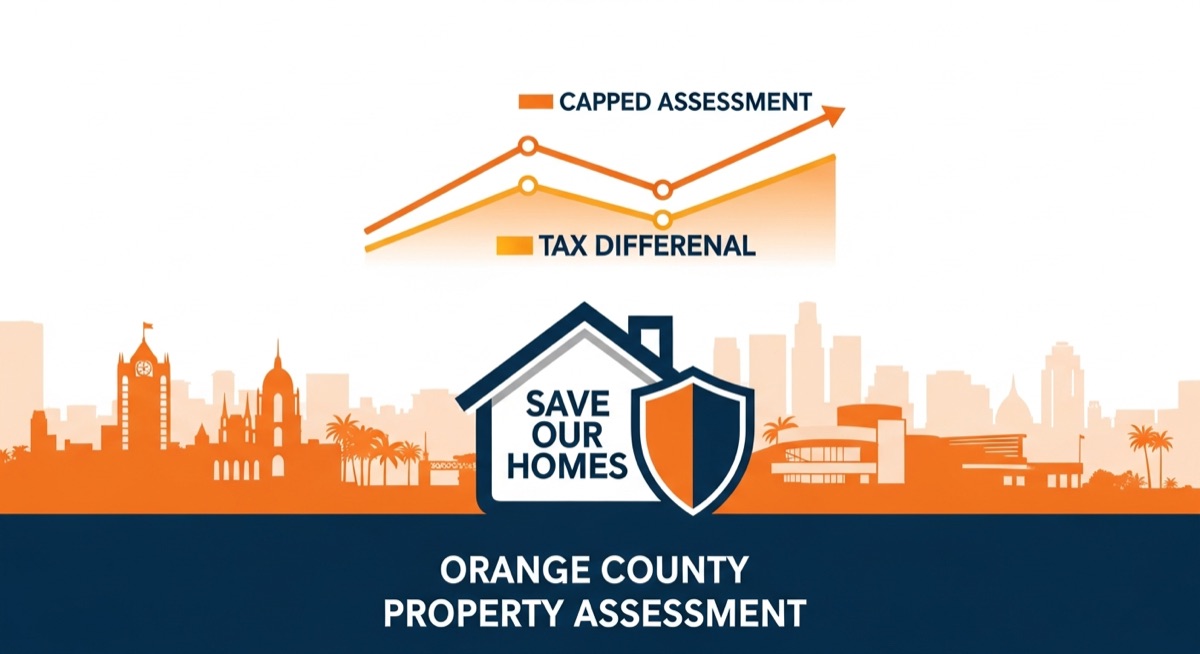
The difference between those two numbers is your SOH differential — formally called the “assessment difference.” Back to Baldwin Park: a homeowner sitting on a $650,000 just value but taxed on an assessed value of $450,000 has a $200,000 SOH differential. That’s not a rounding error. That’s a real number that affects your real life every November when the tax bill arrives.
One condition is non-negotiable: the cap only applies to homesteaded property. This is also why a property’s assessed value resets toward just value when it sells — the new owner must establish their own homestead, and the clock starts fresh. The governing statute is Florida Statute 193.155.
Orange County millage rates vary by district. Unincorporated Orange County, the City of Orlando, Apopka, Winter Garden, and Ocoee all carry different combined rates, and that variation directly affects how much a given differential is worth annually. The Orange County Property Appraiser’s website at ocpafl.org publishes current millage information, and OCPA staff can walk through specific scenarios for your address.
What the Cap Actually Saves You: A Dollar Example
A homeowner has a property with a just value of $300,000. After several years of strong appreciation with homestead in place, their assessed value has only risen to $200,000. The SOH differential is $100,000. They sell and purchase a new home with a just value of $400,000.
Without portability, the new home gets assessed at full just value: $400,000. The standard Florida homestead exemption of $50,000 applies (the first $25,000 covers all taxing authorities; the second $25,000 applies to non-school levies), bringing the taxable value to $350,000.
With portability, the homeowner transfers their $100,000 SOH differential to the new property. The assessed value of the $400,000 home drops to $300,000. Apply the $50,000 homestead exemption, and the taxable value lands at $250,000. That $100,000 reduction in taxable value works out to roughly $2,000 per year in savings compared to being assessed at full just value — though the exact figure depends on your district’s millage rate, which varies across Orange County jurisdictions and shifts annually. For a broader picture of what these costs mean in practice, this topic fits squarely within our legal & finance coverage.
Over ten years, that’s around $20,000. And because the cap continues applying to the new assessed value (not the just value), the differential starts growing again at the new property as appreciation continues. It’s a genuinely good deal — one of the better ones available to Florida homeowners, which is a sentence I don’t write lightly given how often the state’s tax treatment gets oversold.
Portability: Taking Your Differential With You
Amendment 1, effective January 1, 2008, added portability to the Save Our Homes framework. The formal name is “Assessment Difference Transfer.” It allows you to carry your accumulated SOH differential to a new homesteaded property anywhere in Florida when you sell your current one.
I’ll say plainly: this benefit is dramatically underused. Homeowners sell, move across town or across county lines, and leave years of accumulated savings behind because nobody mentioned there was a form to file. The benefit doesn’t survive passivity.
A few rules govern how the transfer works.
The maximum transferable differential is $500,000. For most Orange County homeowners that ceiling isn’t relevant — but for longtime owners in Winter Park, Delaney Park, or College Park who purchased in the early 2000s, it’s worth calculating before you decide to sell. If your differential exceeds $500,000, you transfer exactly $500,000. The rest is forfeited. There’s no mechanism to carry the excess to a future purchase. It disappears.
You must establish homestead at your new property within two years of January 1 of the year following the year you sold (or abandoned homestead at) your previous home. Sell in 2024, and the clock starts January 1, 2025. You have until January 1, 2027, to purchase and apply for homestead at the new property. Miss that window and the differential that took years to build is gone entirely.
When you’re upsizing: If the new home’s just value is greater than or equal to the old home’s just value, the full differential transfers.
When you’re downsizing: You get a prorated share. The formula:
Portable differential = (New home’s just value ÷ Old home’s just value) × Old SOH differential
Example: $100,000 differential on a home with a just value of $300,000. You buy a new home worth $225,000. Portable differential: ($225,000 ÷ $300,000) × $100,000 = $75,000. The new assessed value is $225,000 minus $75,000 = $150,000. Apply the $50,000 homestead exemption and taxable value is $100,000. You don’t transfer the full $100,000 — but $75,000 is still $75,000, and in a county where millage rates aren’t trending down, that proportional benefit is worth calculating before you assume downsizing isn’t worth the paperwork.
Filing in Orange County: The Form and the Deadline
Portability does not happen automatically. You apply for it. This is where most of the money gets left on the table.
The form is DR-501T, “Transfer of Homestead Assessment Difference.” It is a separate document from the standard homestead exemption application (Form DR-501). Filing one does not file the other — a fact that surprises homeowners who assume closing handles everything. It does not. Two forms, both due by the same date, both your responsibility.
Your deadline is March 1 of the year following your purchase. Close on a new Orange County home in October 2024, and your portability application is due March 1, 2025. This catches fall buyers repeatedly. The closing happened this year; the deadline is early next year; then January arrives, things are busy, and suddenly it’s March 2. Put it on your calendar before you lose the closing paperwork in a box somewhere.
File with the Orange County Property Appraiser — 200 S. Orange Ave., Suite 1700, Orlando FL 32801 — in person, by mail, or through the portal at ocpafl.org. Confirm current digital filing options directly with OCPA, as the office’s online capabilities have expanded in recent years and what was mailed last cycle may now submit online.
Portability Works Across County Lines
The most common misconception about portability: that it only works within the same county. It doesn’t. Portability is a statewide benefit with no county restriction.
For Orlando-area residents, the practical corridors are exactly what growth patterns suggest — Orange to Seminole (Oviedo, Lake Mary, Winter Springs, Sanford), Orange to Osceola (Kissimmee, Celebration, St. Cloud), and Orange to Lake (Clermont, Groveland, Minneola). All fully permitted under Florida law. If you’ve been putting off a move to Seminole County because you assumed you’d lose your accumulated savings, that assumption has been costing you.
One procedural detail matters here, and people get it wrong: when moving across county lines, the DR-501T is filed with the destination county’s property appraiser, not the county you’re leaving. Orange County homeowners moving to Seminole County file with the Seminole County Property Appraiser. Moving to Osceola, file with Osceola. The receiving county contacts your previous county to certify the differential — you don’t manage that communication yourself.
If you’re leaving Orange County for another Florida county, do not file your DR-501T with OCPA. File it with your new county’s appraiser by March 1, same deadline, different office. Moving into Orange County from elsewhere in Florida, file with OCPA at 200 S. Orange Ave., and they’ll handle the certification request from your previous county’s appraiser.
The governing statute for inter-county portability is F.S. 193.1551.
If You Missed the March 1 Deadline
Don’t write off the benefit before making a phone call.
Florida law (F.S. 196.011) provides a late-filing window under extenuating circumstances, with a cutoff of September 18 of the applicable year. This is not an automatic extension — it typically requires showing that the failure to meet March 1 wasn’t simple inaction — but it exists, and it’s worth a direct conversation with OCPA before you assume the year is lost. County property appraiser offices vary in how they handle late filings. Some are more accommodating than others when a homeowner can demonstrate genuine confusion about the process rather than just forgetting. Call and ask. The worst outcome is they say no.
Miss September 18 entirely and portability for that specific tax year is forfeited. You cannot go back. But the two-year window to establish homestead at your new property and receive portability on a going-forward basis remains intact. You lose one year of accumulated savings; you don’t lose the ongoing benefit.
The Mistakes That Actually Cost People Money
The single most consequential filing error: Orange County homeowners moving to Seminole or Osceola instinctively file their DR-501T with OCPA — the office they’ve dealt with for years. That’s the wrong office. The form goes to your new county’s property appraiser, and filing it in the wrong place means it doesn’t get processed. This isn’t a technicality that gets sorted out later; it’s a missed deadline.
The two-year clock also trips people up. It doesn’t start on the date you sold your home. It starts January 1 of the year following the year of sale. Sell in December 2024 and you have until January 1, 2027 — not two years from the closing date. That distinction gives buyers slightly more runway than they realize, but it also means the window closes without obvious warning if you’re counting from the wrong date.
Homestead and portability are not one application. The homestead exemption (DR-501) establishes your cap going forward. The portability application (DR-501T) transfers what you’ve already built up. Both are due by March 1. File one without the other and you’ve either established homestead without your differential, or applied for portability on a property that isn’t yet homesteaded.
For longtime homeowners in Winter Park, the Delaney Park corridor, or College Park — properties that have more than doubled since the early 2000s — the differential can exceed $500,000. If it does, you transfer $500,000 and lose the rest. This is worth knowing before you decide to sell, particularly if you’re thinking about whether timing a move by a year or two affects your net position. There’s no mechanism to carry over anything above $500,000, which occasionally surprises people in the middle of what they assumed was a straightforward transaction. Understanding how property taxes interact with your overall buy-or-rent calculation can clarify whether the timing of a sale genuinely moves the needle on your finances.
Before You List
If you’ve held a homestead in Orange County for more than a few years — especially if you bought before or during the post-pandemic run-up — look up your current just value and assessed value at ocpafl.org before you make any decision about selling. The gap between those two numbers is your differential. It’s worth knowing before you talk to a real estate agent, not after.
If you sell and buy elsewhere in Florida, you can take it with you. File DR-501T with your new county’s property appraiser by March 1 of the year following your purchase. Your accumulated differential — up to $500,000 — reduces the assessed value at your new home. The benefit is real, it’s portable, and it doesn’t happen unless you claim it.
For Orange County homeowners: ocpafl.org, or in person at 200 S. Orange Ave., Suite 1700, Orlando FL 32801. OCPA staff are experienced at running portability calculations and will tell you exactly what your number is. Have that conversation before you list, not after you close on the next place.
Quick Reference
Orange County Property Appraiser 200 S. Orange Ave., Suite 1700, Orlando FL 32801 ocpafl.org (Verify current phone number and online filing options directly at ocpafl.org)
Forms
- DR-501 — Homestead Exemption Application
- DR-501T — Transfer of Homestead Assessment Difference (portability)
Key Dates
- March 1 — Deadline to file DR-501T. Closed October 2024 → deadline March 1, 2025.
- September 18 — Late-filing window under extenuating circumstances (F.S. 196.011). Not automatic; call OCPA directly.
- Two-year window — Homestead must be established at the new property within two years of January 1 of the year following the year you sold your previous homestead.
Statutes
- F.S. 193.155 — Save Our Homes assessment limitation
- F.S. 193.1551 — Portability / inter-county Assessment Difference Transfer
- F.S. 196.011 — Late-filing provisions
CityDesk Orlando covers local business, finance, and development in Orange County and surrounding communities. This article is informational. For questions specific to your property or tax situation, contact the Orange County Property Appraiser’s office or a licensed Florida tax professional.