Orlando Apartment Rent Prices by Neighborhood in 2026
Verified prices from downtown to Lake Nona. Plus the fees that can add $400 a month to whatever the listing says.

Orlando Apartment Rent Prices by Neighborhood in 2026
Verified prices from downtown to Lake Nona. Plus the fees that can add $400 a month to whatever the listing says.
If you search “average rent in Orlando,” you’ll get a figure somewhere between $1,500 and $1,700 for a one-bedroom. That number is technically defensible and practically useless. It blends Lake Nona luxury stock with OBT walk-ups, UCF student complexes with Dr. Phillips townhomes, and produces a metro-wide median that doesn’t describe any apartment you’ll actually consider signing.
This guide works differently. The price ranges below were pulled from active listings on Zillow and Apartments.com during the first weeks of 2026 and cross-checked with property managers at ZRS Management, Greystar, and Lincoln Property—three of the larger operators in the market. Where on-record comment was available from managers familiar with specific corridors, it’s attributed. Where it wasn’t, that’s noted. These are not CoStar aggregates, not months-old metro medians, and not promotional figures supplied by leasing offices.
Six primary submarkets are covered in detail: Downtown Orlando/Thornton Park/SoDo, Winter Park/College Park, UCF/Alafaya/East Orlando, Millenia/Sand Lake/Dr. Phillips, Lake Nona/Medical City, and OBT/South Orlando. Three additional corridors—Mills 50, Hunters Creek, and the Valencia campus areas—get their own section because aggregators routinely fold them into broader buckets where their distinct pricing disappears. A breakdown of mandatory fees, utilities, lease timing, and your rights under Florida law follows.
All figures should be verified against live listings before you sign anything. Rents in this market move.
The Neighborhood Breakdown: Six Submarkets, Current 1BR and 2BR Ranges
Quick Reference Table
| Submarket | 1BR Range | 2BR Range |
|---|---|---|
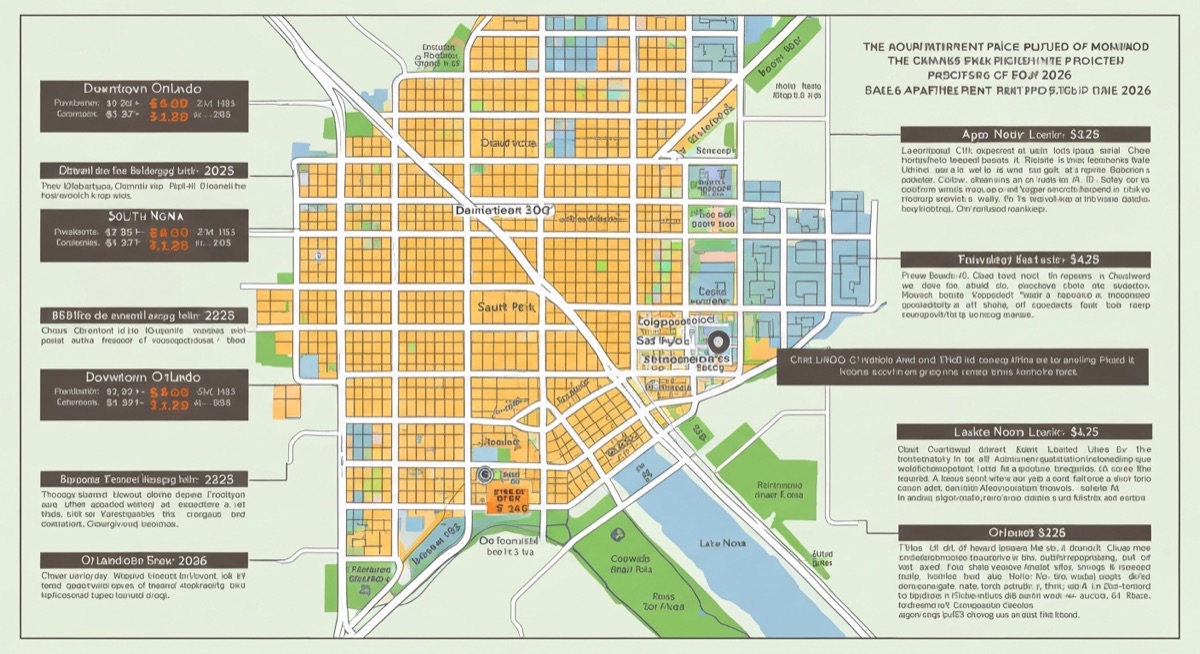
| Downtown Orlando / Thornton Park / SoDo | $1,700–$2,100 | $2,200–$2,900 |
| Winter Park / College Park | $1,600–$2,000 | $2,100–$2,700 |
| UCF / Alafaya / East Orlando | $1,350–$1,650 | $1,700–$2,100 |
| Millenia / Sand Lake / Dr. Phillips | $1,600–$1,950 | $2,100–$2,600 |
| Lake Nona / Medical City | $1,650–$2,050 | $2,150–$2,700 |
| OBT / South Orlando | $1,100–$1,400 | $1,350–$1,750 |
Ranges reflect asking rents on current Zillow and Apartments.com listings. Verify against live listings before any leasing decision.
Downtown Orlando / Thornton Park / SoDo. The downtown core runs $1,700 to $2,100 for a one-bedroom and $2,200 to $2,900 for a two-bedroom. The upper end of both ranges clusters in the Class A high-rises along South Orange Avenue and around Lake Eola. SoDo skews slightly lower than Thornton Park on comparable square footage, but not dramatically. Walkability carries a real price premium here, and the market knows it. Garden-apartment inventory is almost nonexistent downtown, so if that’s what you’re picturing, look elsewhere.
Between 2023 and 2025, the submarket absorbed four new Class A deliveries totaling roughly 850 units. That new construction created competitive pressure on high-rise buildings that once dominated without much friction—which is part of why the concession environment was more generous in 2024 than landlords would prefer to admit. Most of those concessions have since pulled back.
Winter Park / College Park. One-bedrooms run $1,600 to $2,000; two-bedrooms $2,100 to $2,700. Rollins College proximity keeps rental demand in Winter Park steadier than you’d expect for a submarket this size. The older garden complexes from the 1980s and early 1990s often land $200 to $300 below comparable new construction. That’s real money across a 12-month lease.
Winter Park has a low vacancy rate relative to the rest of the metro, and it shows. Inventory turns fast. A unit at the lower end of that range is probably an interior hallway building or a property that hasn’t been renovated since the early 2010s—not necessarily a problem, but it shapes what the lease will and won’t offer.
UCF / Alafaya / East Orlando. One-bedrooms range from $1,350 to $1,650; two-bedrooms from $1,700 to $2,100. This is one of the only submarkets where a renter can still find a maintained one-bedroom below $1,400 without driving into Osceola County. The lower end reflects older garden stock along Alafaya Trail and University Boulevard. Purpose-built student housing like Integra 360 and the Waterford Lakes–area communities push toward the upper end.
Two-bedrooms in the $1,700 to $1,800 range remain common here, particularly in unrenovated complexes—which makes this submarket the most accessible for dual-income households watching monthly costs closely. If you’re negotiating a lease in August or September, you’re timing it well. The submarket has absorbed enough new supply that discounts are still findable even as rents have stabilized from the 2024 dip.
Millenia / Sand Lake / Dr. Phillips. One-bedrooms cluster between $1,600 and $1,950; two-bedrooms between $2,100 and $2,600. This corridor draws a mix of professionals and workers commuting to the tourism corridor who want a quick drive to International Drive without paying short-term-market premiums. Something worth knowing before you tour: Dr. Phillips addresses carry a visible premium in asking prices even when the unit quality matches similarly aged stock in Millenia. A one-bedroom in a 2005-era Millenia complex might lease for $1,630; an identical footprint in a Dr. Phillips property from the same era might ask $1,850. You’re paying for the zip code as much as the apartment.
Lake Nona / Medical City. One-bedrooms run $1,650 to $2,050; two-bedrooms $2,150 to $2,700. Lake Nona is almost entirely new or recent construction—there’s no older apartment stock here in any meaningful volume. The range reflects different amenity tiers and unit sizes within essentially similar-vintage buildings, not quality variance. Properties near the VA Medical Center, Nemours, and UCF Health cater to healthcare workers and graduate students, and that demand base kept vacancy historically low.
That’s shifting. Three major communities delivered lease-up inventory in 2024 and 2025, bringing supply pressure to a market that genuinely hadn’t seen it before. The effect shows up in the current concession environment—more on that in the best-value section below.
OBT / South Orlando. The most affordable submarket in the analysis: one-bedrooms from $1,100 to $1,400, two-bedrooms from $1,350 to $1,750. The lower end of these ranges is real and findable, not theoretical. The stock is older, and the trade-offs are substantial at the low end. Some complexes have deferred maintenance. Pedestrian infrastructure is poor across most of the corridor. Car dependency is near-total. A renter selecting a property here needs to do building-level due diligence rather than assuming price reflects condition—because in this submarket, it often doesn’t.
Mills 50, Hunters Creek, and the Valencia Corridors: Filling the Gap
Aggregators fold Mills 50 into either downtown or “East Orlando” depending on whose algorithm you’re consulting, but the pricing assumptions fit neither bucket. Mills 50 is an arts-district rental market with a distinct inventory profile: older bungalow conversions, small-footprint apartments in mid-century walk-ups, and almost no large apartment complex presence. Direct Zillow listings show one-bedrooms in converted bungalows and smaller buildings at $1,300 to $1,700—often with more square footage than a Class A studio downtown at the same price.
The catch is real. These units vary enormously in condition, frequently lack in-unit laundry, and come with no amenities to speak of. Demand from the restaurant and arts community has outpaced supply of updated small-unit inventory, and rents here have climbed measurably over the past two years even as larger-complex submarkets softened. There’s no large operator with public pricing data to cite. The Mills 50 rental market runs largely through individual landlords and small local property management firms—which means more negotiating room sometimes, and less recourse against deferred maintenance other times.
Hunters Creek sits southeast of downtown off the Florida Turnpike. Aggregators typically slot it into “South Orlando,” which distorts what it actually delivers. Active listings show one-bedrooms at $1,350 to $1,650 and two-bedrooms at $1,700 to $2,050—above OBT/South Orlando pricing but well below comparable amenity-level complexes in Dr. Phillips or Lake Nona. The community was master-planned, has a network of parks and trails, and scores consistently better on standard safety metrics than the corridors it gets lumped with statistically. For renters with children or those prioritizing neighborhood infrastructure without paying the full Lake Nona premium, Hunters Creek is one of the more underexamined options in the metro. I’d put it on the shortlist before accepting the aggregator’s lazy categorization of it as “South Orlando.”
The Valencia campus corridors generate a student-renter market distinct from the UCF corridor but ignored in most rental analyses. Valencia’s East Campus, near Econlockhatchee Trail, draws student renters into the broader East Orlando corridor with one-bedroom pricing at $1,300 to $1,600. The Osceola/West Campus area bleeds into Kissimmee and Celebration pricing territory and tends to run somewhat lower. The lease-cycle pattern mirrors UCF: heavy May–August turnover, then a soft window in late summer. Short-term lease availability near Valencia campuses is more common than in most of the metro, but you’ll pay for it—expect to add $150 to $250 monthly to your quoted rate for anything under 12 months.
How Much Have Rents Actually Changed: Supply, UCF, and Downtown
Orlando’s rental market in 2026 is a direct consequence of a construction cycle that peaked between 2022 and 2024. The metro permitted an unusually high volume of multifamily units in that window—a response to the pandemic-era demand surge that pushed Orlando rents up 15 to 20 percent cumulatively across many submarkets between 2021 and 2023. Those units are now delivered and being absorbed, which explains why the market’s trajectory looks different depending on which zip code you’re asking about.
Rents in most submarkets are flat to down modestly year-over-year as of early 2026. Actual rents—asking price minus concessions—are lower than that where new supply has been most concentrated. Flat still means high in absolute terms. A landlord presenting a flat renewal as good news is technically correct and also leaving something important unsaid.
The luxury high-rise corridor downtown took the most visible pressure. New deliveries increased competition among Class A buildings chasing the same renter pool. Some of those buildings offered free months and waived fees through much of 2024 and into early 2025. As of current listings, the concession environment has moderated. A renter who negotiated well in mid-2024 likely locked in better net terms than what’s available today—that window has mostly closed.
The structural demand argument for the UCF corridor is straightforward: roughly 70,000 enrolled students, a significant share living off-campus, provides a rental demand floor that insulates the area from the softening visible elsewhere. Concessions in the Alafaya corridor were notably aggressive in the second half of 2024—free first months and waived fees documented at multiple complexes as new supply arrived alongside a brief enrollment dip. As of early 2026, the most aggressive offers have pulled back. Waived admin fees (typically $150 to $400) remain a common negotiating tool. A renter targeting this corridor in August or September is still in the best position to push.
What Advertised Rent Actually Costs You: The Fee Breakdown
This is where the $1,500 apartment becomes the $1,900 apartment. Most renters don’t discover it until they’re reading the lease—ideally before they’ve fallen in love with the unit.
At mid-to-large Class A complexes built after 2015—which describes most of Orlando’s purpose-built apartment inventory—the following charges are either mandatory or effectively mandatory:
Parking: $50–$150/month. Surface lot parking is typically included at older complexes. Structured or covered parking at Class A buildings is almost universally a separate line item. Two cars means double that.
Amenity or resort fee: $75–$150/month. Covers pool, gym, dog park, clubhouse. Not optional. Some leases allow the landlord to increase this fee during the lease term or at renewal without renegotiating base rent—read that clause.
Trash valet: $25–$40/month. Doorstep pickup. Mandatory at most Class A properties whether you use it or not.
Pest control: $5–$15/month. Billed as a service charge. Essentially universal.
Renters insurance: $15–$30/month if you buy through the complex’s preferred carrier. Don’t. You can substitute your own policy at the same or lower cost if you shop for it. The lease will specify a minimum coverage level and require proof, but the landlord-partnership option almost always costs more than just buying your own.
Package locker fee: $10–$20/month. A billable amenity at newer complexes as package management systems became standard.
Move-in admin fee: $150–$400 one-time, due at signing, distinct from a security deposit, and not refundable.
To make this concrete: a one-bedroom on South Orange Avenue advertised at $1,850/month. Add covered parking at $125, amenity fee $125, trash valet $35, pest control $10, renters insurance through the complex carrier $20, package locker $15. That’s $330 in monthly add-ons—actual monthly cost $2,180 before utilities. One-time move-in admin: $300.
Compare that to a complex near Alafaya advertising a one-bedroom at $1,450/month with surface parking included: amenity fee $85, trash valet $30, pest control $8, renters insurance $18, package locker $12. Total monthly add-ons: $153, actual monthly cost $1,603 before utilities. Move-in admin fee: $175.
The gap at a typical Class A property runs $200 to $500 per month above the advertised price, driven primarily by structured parking and how the amenity fee is structured. Ask every leasing office for the full monthly fee schedule in writing before you make an appointment—not after you’ve toured and decided you want the unit.
The Utilities Reality: A/C, Electric, and What Total Housing Cost Looks Like
Florida’s summer electricity bills are a climate variable, not a lifestyle variable. Out-of-state relocators underestimate this cost consistently, and they tend to discover the problem in their first August.
In Central Florida’s summer months, electric bills for a one-bedroom typically run $150 to $250 per month—sometimes higher in August if the building has poor insulation or your unit faces afternoon sun. A south-facing third-floor corner unit in an older complex is a genuinely different situation than a first-floor north-facing unit in the same building. When evaluating units, ask specifically whether electricity is separately metered and what the landlord’s estimate of average monthly utility cost is. Then ask whether that estimate reflects the specific unit or a complex-wide average. Complex-wide averages smooth out a lot of variance that matters to your actual bill.
Utility-included units typically build a consumption cap into the lease. Running over that cap—which happens easily in August—triggers per-kilowatt surcharges that can double your actual utility cost. Read that clause before you sign.
Florida’s property insurance costs for landlords increased sharply between 2022 and 2025. Those increased operating costs have found their way into renter-facing pricing: rent increases at renewal, new fee line items, or reduced maintenance investment. This isn’t resolved, and it will keep appearing in renter-facing pricing through 2026 and beyond.
Florida has no state income tax, which is worth factoring into total cost-of-living comparisons for renters relocating from northeastern markets. It doesn’t offset everything, but it’s real.
Best Value Right Now: Specific Areas and Why
OBT / South Orlando: lowest price-per-square-foot in the metro. One-bedrooms at $1,100 to $1,400 represent the lowest asking rents in the metro. The trade-offs are real and should be named plainly. The OBT corridor has documented public safety concerns that show up in crime statistics. The built environment is hostile to pedestrians. Building quality varies significantly from complex to complex—price does not reliably indicate condition here.
A renter who is car-dependent, prioritizes interior space over the surrounding environment, and does thorough building-level due diligence will find genuine value. A renter with children or a partner working late hours will find the trade-offs harder to absorb. Neither reaction is wrong—they just describe different situations.
Hunters Creek: underpriced for what it delivers. For households prioritizing park infrastructure and documented safety metrics without paying Lake Nona prices, Hunters Creek offers a real advantage that doesn’t get discussed much. Two-bedrooms in the $1,700 to $2,000 range here are priced meaningfully below comparable units in Lake Nona. The master-planned trail network, lower traffic density, and park access are measurable features—not marketing language.
East Orlando / Waterford Lakes: timing your concession window. The Waterford Lakes corridor has accumulated enough new and recently renovated inventory that the August–October vacancy peak creates real negotiating leverage. In the 2024 cycle, managers at complexes here waived admin and application fees to lease vacant units. A renter who can target an August–October move-in and act quickly when inventory appears is positioned to negotiate meaningful discounts off the advertised rate.
Lake Nona: negotiate now or pay later. Several large communities delivered lease-up inventory in Lake Nona between 2023 and 2025 and are still working through initial absorption. They’re competing for a renter pool that, while growing as Medical City employment expands, hasn’t grown as fast as developers projected. Right now, a renter willing to sign a standard 12-month lease promptly can negotiate parking included, a waived admin fee, or a partial free-rent month. Once the current lease-up cohort stabilizes, Lake Nona will return to its historically low vacancy profile and landlords will stop negotiating. That transition is coming. If you’re considering this submarket, move on it.
Timing Your Lease: Orlando’s Rental Calendar
Most metros have a basic seasonal rental pattern. Orlando has that, plus a layer most metros don’t.
The standard pattern: March through July is peak leasing season. Listings are plentiful, but so is competition. Landlords price to the peak and negotiate rarely. August through October is the annual soft window. Vacancy climbs as the summer surge ends, the UCF semester has seated, and the next move cycle hasn’t started. Discounts appear, and asking prices are most negotiable.
The additional layer comes from Orlando’s hospitality and tourism sector, which generates rental turnover that doesn’t follow the academic calendar. Theme park, hotel, and restaurant workers move frequently, often on shorter notice than the standard lease-termination requirement. The net effect is that OBT/South Orlando, Millenia, and International Drive–adjacent submarkets see higher-than-average mid-cycle turnover. That creates sporadic availability outside the March–October window—but it also means these complexes price month-to-month premiums aggressively. If you need a short-term lease near the tourism corridor, budget for it explicitly and call the leasing office directly rather than relying on online availability calendars. Those are not updated in real time.
If you have any flexibility on move-in date, target August through October. Even if it requires a bridge arrangement in your current housing, you’ll access below-asking pricing that simply isn’t available during a March lease-up surge, when leasing offices have waitlists and no particular reason to negotiate.
Your Rights as a Florida Renter: Deposits, No Rent Control, and What to Watch in Your Lease
Florida law provides specific protections on security deposits and almost nothing that limits what landlords can charge or raise rents to. That’s the structure of the statute.
Under Florida Statute §83.49, landlords must return your security deposit—or provide written notice of their intent to claim part or all of it—within 15 days if they make no claim. If they intend to withhold any portion, they have 30 days to provide written itemization. Miss that timeline, and they generally forfeit the right to claim anything. Document your move-in condition from day one. Dated photos shared with the landlord through something that creates a timestamp are best. This protects you if a dispute arises at move-out, and disputes arise more often than landlords will volunteer.
Florida has no rent control. In 2023, the state legislature preempted local rent stabilization ordinances statewide. Orange County and the City of Orlando cannot cap rent increases, impose just-cause eviction requirements beyond state minimums, or limit the fees landlords charge—regardless of local political pressure or intent. A ballot measure, a city council vote, a county ordinance: none of it can change this under current state law. Rents in Orlando can be raised to whatever the market will bear at lease renewal, with the notice requirements Florida law specifies. Know this going in.
Read the amenity fee language carefully. At larger corporate-managed complexes, some leases allow the amenity fee to increase during the lease term with 30 days’ notice, or reset to the then-current rate at renewal, separate from the base rent negotiation. At $75 to $150 a month, this is material. Ask whether the amenity fee is fixed for the lease term and get that in writing.
If your lease requires you to purchase renters insurance through the complex’s carrier rather than your own, you’re paying a markup. Most leases that mandate insurance will accept an equivalent third-party policy. Get the minimum coverage requirement in writing, buy your own policy, and provide proof at signing.
Month-to-month premium clauses are standard. If you hold over beyond your lease term without signing a renewal, the monthly rate converts to a month-to-month rate above the annual figure. Some leases specify this clearly; others bury it in the renewal addendum. Know what it is before your renewal window opens.
Move-in admin fees—typically $150 to $400—are not security deposits under Florida law. They’re not subject to the 15/30-day return requirement. They’re non-refundable. They’re also negotiable more often than leasing offices will tell you, particularly in the August–October soft window. Ask.
If you face a dispute, Central Florida Legal Services provides free civil legal assistance to income-qualifying residents in the metro. For renters dealing with wrongful deposit withholding, lease enforcement disputes, or habitability issues, CFLS is the primary free resource in the area. Contact them through the Florida Bar Referral Service or search Central Florida Legal Services directly for current contact information.
Listings and pricing verified against Zillow and Apartments.com active listings, with cross-reference to ZRS Management, Greystar, and Lincoln Property–managed inventory, during the first weeks of 2026. All ranges should be confirmed against current live listings before any leasing decision. CityDesk Orlando updates this guide on a rolling basis as market conditions change.