How Much Does It Cost to Move to Orlando in 2026
If you've searched "how much does it cost to move to Orlando," you've already encountered the problem: estimates that run from $2,000 to $10,000 with no explanation of how anyone lands anywhere in …

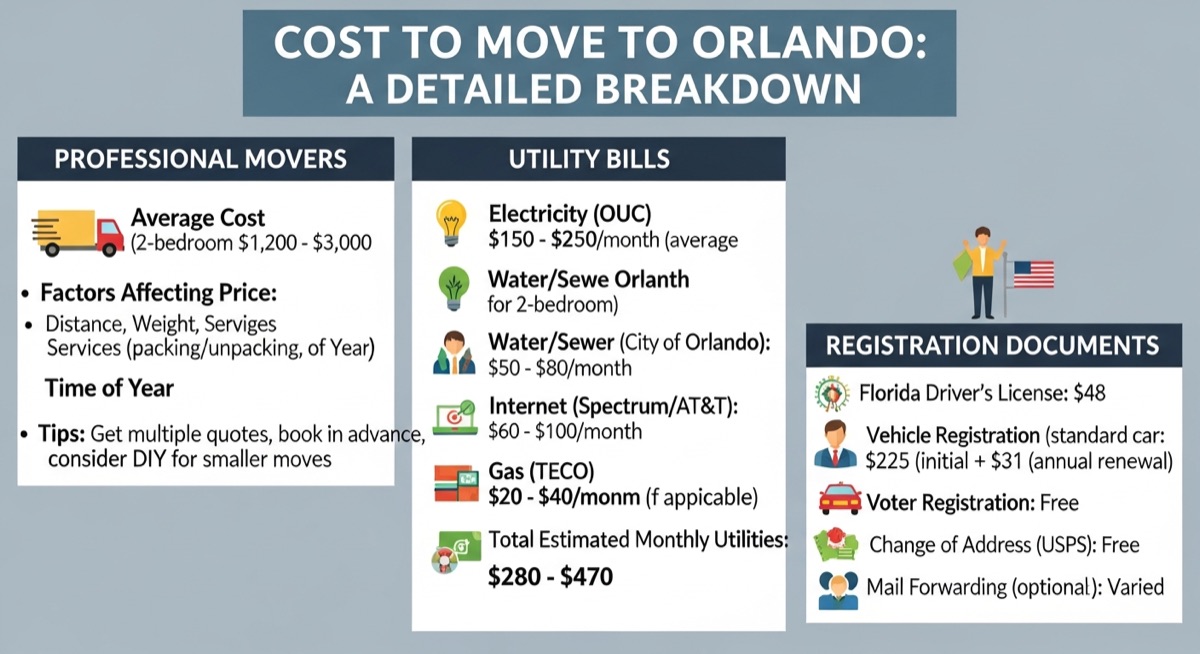
How Much Does It Cost to Move to Orlando in 2026
If you’ve searched “how much does it cost to move to Orlando,” you’ve already encountered the problem: estimates that run from $2,000 to $10,000 with no explanation of how anyone lands anywhere in that range. Those national calculators don’t know whether your apartment is in OUC territory or Duke Energy territory. They don’t know that a Lake Nona complex will charge you a non-refundable HOA move-in fee on top of your deposit. They’ve never heard of Toll-by-Plate surcharges. This guide exists because those gaps are where people get hurt — usually in week two, when the second round of charges shows up.
The honest all-in answer for most out-of-state renters in 2026: somewhere between $8,000 and $22,000. Buyers closing into an HOA community should budget $15,000 to $35,000 before furniture, before groceries, before the first paycheck clears. Every section below explains what pushes you toward one end or the other.
Getting Here: Cross-Country Moving Costs by Origin City
The first line item is getting yourself, your household goods, and at least one vehicle to Central Florida. The mode you choose matters more than the distance.
Full-service movers pack, load, transport, and unload. They’re the most expensive and the least logistically brutal. In 2026, expect $6,000–$12,000 for a one- to two-bedroom from the Northeast — New York, Boston, Philadelphia, D.C. Weight and access issues at your origin matter. From the Midwest (Chicago, Columbus, Indianapolis), budget $5,000–$10,000. The West Coast runs $8,000–$15,000; cross-country weight minimums and fuel surcharges push this up fast. Texas and the Southeast (Dallas, Atlanta, Charlotte) are more manageable at $3,500–$7,000.
Container and PODS-style shipping costs roughly 30–40 percent less because you’re doing the packing and loading. New York metro to Orlando: $3,500–$6,500. Chicago: $2,800–$5,500. Los Angeles: $4,500–$8,000. The tradeoff is real physical labor in the Florida summer if you’re arriving June through August. That’s not nothing.
Self-drive rental trucks are the cheapest option if you have the stamina for two or three days on the highway. Northeast to Orlando: $2,200–$3,800. Midwest: $1,800–$3,200. West Coast: $2,800–$4,500. Texas or the Southeast: $1,200–$2,500.
Flying in and shipping your vehicle separately costs $900–$1,400 from the Northeast, $750–$1,100 from the Southeast, $1,100–$1,700 from the West Coast.
The May–August surge is consistent and predictable. UCF’s fall move-in combines with Florida’s general summer migration, and moving company rates jump 15–25 percent. Availability shrinks. If you can move October through February, do it. If you must move in summer, book six to eight weeks out minimum — waiting until May or June means taking whatever’s left, usually at peak rates. For a deeper breakdown of what local movers charge by job size, see our coverage of how much it costs to hire movers in Orlando.
Your Apartment’s Real Move-In Price Tag: First-Month Costs by Neighborhood
Monthly rent is the number on the listing. Move-in cost is what you actually write a check for on signing day. These figures diverge sharply depending on which Orlando submarket you’re in.
Lake Nona. Mid-range one-bedrooms run $1,700–$1,950 per month. Large complexes here routinely charge first month’s rent, a security deposit equal to one month’s rent, and a non-refundable administrative fee of $200–$350. They also pass through an HOA move-in fee of $200–$500. Realistic Day-1 cost for a one-bedroom: $3,800–$5,200. Some complexes have started charging separate “amenity activation” fees — it sounds invented, because it essentially is, but it’s real money on your move-in invoice. Read every line of the lease before you wire anything.
Dr. Phillips. This southwest Orange County corridor attracts a professional, family-oriented renter base. One-bedrooms at newer complexes run $1,600–$1,900. HOA move-in fees appear at some properties, particularly in planned communities adjacent to single-family HOA neighborhoods. Move-in specials during March through May can trim total out-of-pocket by $300–$500 — worth asking about explicitly. Without a promotion, budget $3,400–$4,800 on signing day.
Baldwin Park. A tight rental market in an infill neighborhood near downtown. One-bedrooms run $1,700–$2,100, and the neighborhood’s master HOA means some rentals carry move-in fees or restrictions on move-in days and elevator usage that require deposits. Budget $4,200–$5,800. New complexes that opened in 2025–2026 have occasionally waived move-in fees to build occupancy, so check for current promotions before assuming the full fee applies.
Milk District and Audubon Park. Older buildings, smaller landlords, fewer corporate fees. One-bedrooms at $1,350–$1,650, typically at smaller complexes without the HOA fee layer. Move-in costs are more predictable: first month, one month’s deposit, maybe a small admin fee. Budget $3,000–$4,500. The tradeoff is that older units in this corridor run warm in summer — your first electric bill will be higher than you expect, and some landlords are slower to respond to maintenance. If the building’s central AC underperforms, you may end up renting a window unit.
Kissimmee (Osceola County). Overlooked by out-of-state movers who anchor their search inside Orange County, and that’s a mistake. One-bedrooms run $1,300–$1,550 along US-192 and near the Turnpike. Realistic Day-1 cost: $2,800–$4,000. Confirm whether you’re in Kissimmee Utility Authority territory before assuming the OUC deposit process below applies — KUA operates independently with a similar but separate structure.
Setting Up Utilities: What OUC and Duke Energy Will Charge Before Your First Bill
Orlando is split between two primary electric providers, and the distinction matters for your move-in budget.
OUC (Orlando Utilities Commission) serves the city of Orlando proper: Downtown, College Park, Baldwin Park, the Milk District, Audubon Park, and most of Dr. Phillips. OUC also provides water in many of these areas, so you may be opening two accounts at once. For new customers with no prior OUC history, the electric deposit runs $130–$200. Customers with a good-standing letter from a prior utility can often have this waived entirely. Call OUC’s residential line before assuming you owe it — plenty of people pay this deposit when they didn’t have to. If you’re also setting up OUC water, add another $50–$100. Water setup takes three to five business days after you apply.
Duke Energy serves Windermere, Ocoee, Winter Garden, Horizon West, and much of southwest Orange County outside Dr. Phillips. Duke’s deposit is credit-tiered. New customers without Florida service history should budget $150–$300. Duke accepts a letter of credit from a prior out-of-state utility to reduce or waive the requirement, but processing takes two weeks — don’t wait until you’re already in the truck.
Between electric, water, internet, and gas where applicable, your first week of utility setup will cost $300–$600 in deposits and connection fees. Spectrum and Brightspeed both serve Orlando; installation and equipment fees run $50–$100 unless you qualify for a promotional waiver.
The 30-Day Clock: Florida License and Vehicle Registration Fees
Florida gives you 30 days from establishing residency to transfer your driver’s license and register your vehicle. This is a hard deadline. The Orange County Tax Collector enforces vehicle registration. Budget for this before you arrive, not after your first paycheck.
The fee schedule in 2026:
- Initial vehicle registration (new to Florida): $225 one-time. This is the number that shocks people most — it feels like a penalty for showing up, and in some sense it is. It doesn’t include your annual renewal.
- Out-of-state title transfer: $75.25
- License plates: $28–$46 depending on plate type
- Annual registration renewal: $14.50–$32.50 for most passenger vehicles under 2,500 lbs, scaling up with weight
- Driver’s license (Class E): $48. Florida issues REAL ID by default. Bring your out-of-state license, proof of Social Security number, two proofs of Florida residential address, and your original birth certificate or passport.
One thing most moving guides skip entirely: use tax. If you bought your vehicle in a state with low or no sales tax, Florida will assess use tax on the vehicle’s value if you paid less than Florida’s rate of 6% state sales tax plus Orange County’s 0.5% surtax. A vehicle purchased in New Hampshire or Oregon could trigger a bill of $500–$2,000 depending on the vehicle’s value. Check with a Florida CPA if your purchase situation is complicated.
The Orange County Tax Collector has offices at Millenia, Pine Hills, South Orange, and Winter Park. Walk-in waits run one to three hours during peak periods, particularly after UCF’s semester starts. Online appointments typically book two to four weeks out. If you’re arriving in September, schedule your Tax Collector appointment before you leave home.
Ten Costs That Blindside Out-of-State Movers
These aren’t hypothetical — they’re expenses that land in your first 90 days and that no moving calculator accounts for.
Summer electric bills. A standard one-bedroom in Orlando runs $150–$250 per month for cooling June through August, depending on the unit’s age, insulation, and your thermostat habits. Older Milk District buildings run toward the high end. Your AC habits from up north don’t translate, and the first bill will make that clear.
The SunPass gap. Orlando’s toll network — SR-417, SR-408, SR-528, SR-429, the I-4 Express — is unavoidable if you live or commute almost anywhere in the metro. Without a SunPass transponder, you’re billed through Toll-by-Plate, which adds a 25% surcharge and mails invoices that escalate if unpaid. A SunPass mini-transponder costs $4.99. Buy it your first week and load it with $100. This is the easiest money you’ll save in this city.
Florida auto insurance. Full coverage runs approximately $3,000–$3,500 annually as of 2024–2025, versus a national average around $2,100. Rates often jump when you switch to a Florida license and registration. A couple with two vehicles could be looking at $500 per month in combined premiums. Shop multiple carriers before you move, not after.
Mandatory renters insurance. Most large complexes in Lake Nona, Dr. Phillips, and Baldwin Park require it. Aimco, Greystar, and MAA properties typically mandate this. Budget $15–$22 per month. If you don’t bring your own policy, they’ll add theirs at $25–$35 per month — more expensive and less coverage. Get your own.
Hurricane season prep. June through November. You need a real kit: water (one gallon per person per day, minimum three days), a battery-powered weather radio, batteries, a first aid kit, any medications you take regularly, and plywood or shutters if applicable. A real kit costs $200–$600. Buy it in April. Once a storm enters the Gulf, stores in the Orlando metro sell out of water, batteries, and generators within hours. Buying in a panic is more expensive than buying in the off-season, and occasionally the supplies just aren’t there.
Quarterly pest control. Florida has cockroaches that fly, subterranean termites, fire ants, and various wildlife that considers your home fair game. If your complex doesn’t include pest service — many don’t — a quarterly contract from Massey Services, Truly Nolen, or Orkin runs $40–$80 per quarter for an apartment. Skip this once and you’ll understand why people don’t skip it twice.
Climate-controlled storage. If there’s any gap between your arrival and your permanent unit being ready, standard storage units are often inadequate for particleboard furniture or anything heat-sensitive. A climate-controlled 10x10 unit runs $130–$220 per month. If you’re looking at more than a month in storage, run the math on whether shipping your belongings later by container would be cheaper than monthly rent.
Homestead exemption deadline (buyers only). Florida’s homestead exemption caps your assessed value increase and reduces taxable value by up to $50,000. It must be filed with the Orange County Property Appraiser by March 1 to take effect for the current tax year. Miss the deadline and you wait another full year. File at ocpafl.org. On a property assessed at $400,000, the difference between homesteaded and non-homesteaded tax treatment can run $500–$1,500 annually. Put this on your calendar the day you close. For buyers thinking through the broader financial picture, our moving and real estate coverage tracks the full range of Orlando-specific costs new residents encounter.
Furniture delivery fees. Ordering from IKEA, Ashley, or Rooms To Go? Delivery and assembly fees add $200–$500 per large item. Coordinate deliveries to land right at move-in when the unit is empty. Scheduling them weeks later means moving furniture twice.
The first grocery run. After an interstate move, your pantry is empty and you’ve eaten highway food for three days. Rebuilding a functional kitchen from scratch — staples, spices, basics — runs $400–$600 for a couple. Have the cash ready. Month-one grocery spending is not the same as month-six grocery spending.
When to Move: Season Affects Both Cost and Comfort
October through February is the best window. Moving company demand drops, carrier availability improves, and apartment communities with vacant units are more motivated to negotiate on fees. The weather is the other thing — lows in the 50s and 60s, humidity manageable, nothing like what you’ll face if you move in July. Late October through November consistently sees the lowest moving rates of the year, sometimes 10–20% below peak season. If you have any flexibility on timing, this window isn’t a close call.
March through May is the shoulder period. Demand builds but hasn’t peaked. April is often the practical sweet spot: decent weather, reasonable mover availability, and enough lease inventory opening that you have negotiating room. Landlords prepare units during the slower winter months and tend to have April openings ready.
June through August is expensive and uncomfortable. UCF — one of the largest universities in the country, with a significant off-campus population concentrated in east Orlando — drives real demand on moving trucks, storage units, and apartment availability. Rates from major carriers run 15–25% higher. You’ll be moving furniture in 92-degree heat at 80% humidity. People do it every year, and every one of them will tell you they’d choose October if they had it to do over.
The hurricane season overlay runs June through November. If you’re using a container service, review their weather policy: some providers won’t place containers during active weather watches, which can delay your delivery. Full-service movers often include weather delay language in their contracts. Read those sections before you sign.
Your Pre-Move Budget Worksheet
Here’s how the math looks for three realistic mover profiles. Confirm specific figures with OUC, the Orange County Tax Collector, and your apartment community before committing — these estimates will get you in the right range, not to the dollar.
Profile 1: Single renter, New York metro to Milk District or Audubon Park, one-bedroom
| Line Item | Estimated Cost |
|---|---|
| Full-service mover (1BR, Northeast) | $6,000–$12,000 |
| First month’s rent ($1,500 avg) | $1,500 |
| Security deposit (one month) | $1,500 |
| Admin fee | $250 |
| OUC electric deposit | $150 |
| OUC water deposit | $75 |
| Internet setup | $75 |
| FL driver’s license + initial registration + title transfer | $350 |
| SunPass + initial toll load | $50 |
| Hurricane kit, pest control, renters insurance (first month) | $225 |
| First grocery run + setup essentials | $500 |
| Total estimated first-month all-in | $10,675–$16,675 |
Profile 2: Couple, Chicago to Dr. Phillips, two-bedroom
| Line Item | Estimated Cost |
|---|---|
| Full-service mover (2BR, Midwest) | $5,000–$10,000 |
| First month’s rent ($2,200 avg) | $2,200 |
| Security deposit | $2,200 |
| Admin fee | $300 |
| HOA move-in fee (if applicable) | $400 |
| Duke Energy deposit | $250 |
| Water + internet setup | $175 |
| FL licenses (2) + 2 vehicle registrations | $700 |
| Auto insurance increase (2 vehicles, first month) | $300 |
| SunPass x2, hurricane kit, renters insurance | $350 |
| First grocery run + household setup | $750 |
| Total estimated first-month all-in | $12,625–$17,625 |
Profile 3: Family buying in Lake Nona or Horizon West HOA community
This profile carries the most variables. Use-tax exposure on vehicles, HOA transfer fees, and whether closing costs are rolled into financing all shift the picture enough that I’d recommend sitting down with a Florida real estate attorney before finalizing numbers. But the out-of-pocket cash side of the move itself looks like this:
| Line Item | Estimated Cost |
|---|---|
| Full-service mover (3BR+, Southeast or Midwest) | $7,500–$12,000 |
| HOA move-in/transfer fee | $200–$500 |
| Utility deposits (larger home) | $150–$350 |
| FL licenses (2 adults) + 2 vehicle registrations | $700 |
| Use-tax exposure on vehicles (if applicable) | $0–$2,500 |
| Auto insurance adjustment | $400 |
| Hurricane shutters, kit, pest control setup | $600 |
| Initial landscaping/HOA compliance | $300 |
| First grocery run + household essentials | $1,000 |
| Total estimated first-month all-in (excluding closing costs) | $10,850–$18,350 |
Confirm These Numbers Before You Finalize Your Budget
Moving cost estimates age fast. Before you set your final budget, verify the following directly.
OUC — deposit requirements and the good-standing letter process: ouc.com or (407) 423-9018. Ask explicitly whether an out-of-state letter of credit waives the deposit. Many people pay it when they didn’t need to.
Duke Energy — deposits are credit-tiered and require a formal account application for a specific figure. Call their Florida residential service line and ask about the good-standing letter process.
Orange County Tax Collector — fee schedule and appointment booking at octaxcol.com. Book your appointment before you leave your home state if you’re arriving in summer or fall. Walk-in waits during peak season are real.
Florida HSMV — current license transfer requirements and fee schedule at flhsmv.gov. Requirements and documentation rules change periodically.
Orange County Property Appraiser — homestead exemption (buyers only) filed at ocpafl.org by March 1 of the year following your purchase. Miss it and you lose a full year of benefits.
Your apartment community — get every move-in fee in writing before you sign. Ask explicitly: “Is there an HOA move-in fee separate from the admin fee? Are there any other mandatory fees before move-in?” The answer will sometimes surprise you — and occasionally save you a few hundred dollars if you catch a waiver they hadn’t mentioned.
Moving to Orlando costs more upfront than most national guides suggest. Nearly all of the gap comes from Orlando-specific line items that generic calculators don’t know exist. Budget more than you think you need, move in fall or winter if you have any flexibility, buy a SunPass the first week, and read your lease before you wire your deposit.