How to Choose a Home Inspector in Orlando
From DBPR license checks to polybutylene pipes, here's what the national checklists don't tell you about buying a home in Central Florida.

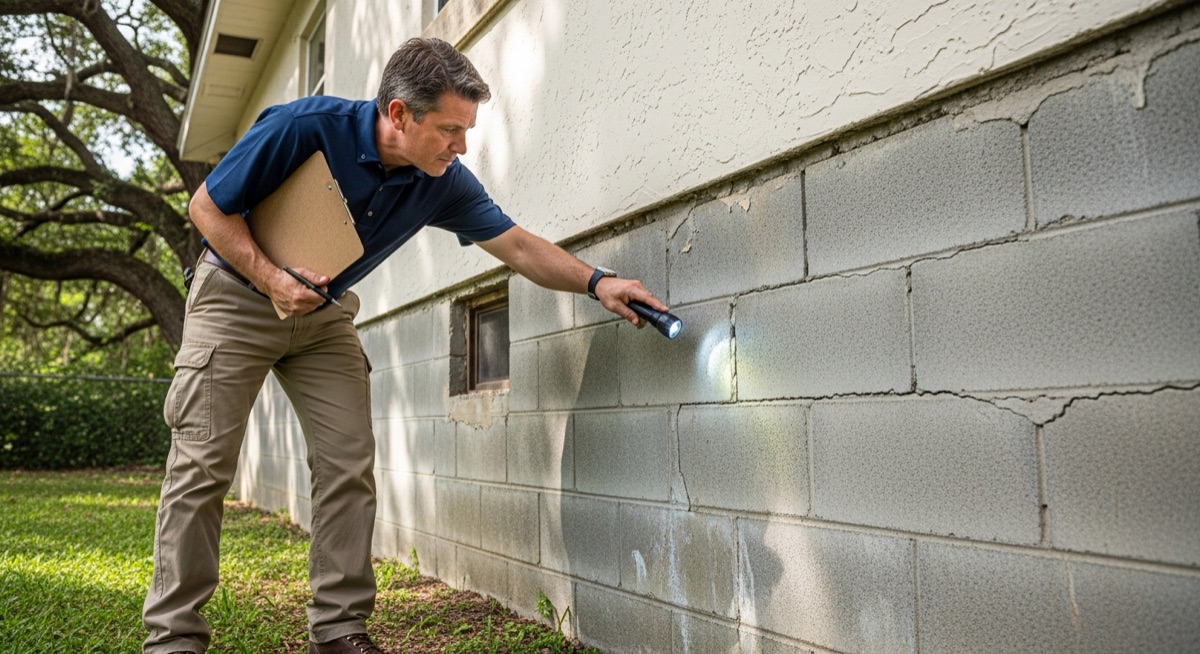
How to Choose a Home Inspector in Orlando
From DBPR license checks to polybutylene pipes, here’s what the national checklists don’t tell you about buying a home in Central Florida.
Finding a home inspector is easy. Finding a good one — someone who will actually protect you in a market where a missed defect can mean a full repipe, a roof replacement, or a six-figure sinkhole remediation — requires different homework entirely.
Most of the guidance available online is written for a generic American homebuyer. Check credentials. Read reviews. That’s not wrong, but it’s not enough when you’re buying in Orlando. The housing stock here spans 1960s concrete block to 2000s-era new construction with its own contamination problems. The ground beneath some neighborhoods is literally dissolving. Florida’s regulatory framework creates specific protections — and specific gaps — that no national checklist accounts for. If you’ve been Googling “how to hire a home inspector” and landing on articles that could apply equally to Boise or Baltimore, that’s the problem.
This guide covers what Florida law requires inspectors to do, what it doesn’t, and what additional inspections your specific property and neighborhood may actually need. It’s written for buyers purchasing in Orange, Seminole, Osceola, and Lake counties.
Step One: Verify the License Before You Do Anything Else
Florida is one of a minority of states that licenses home inspectors at the state level. That’s a meaningful protection — but only if you actually use it.
Under Florida Statutes Chapter 468, Part XV, anyone performing home inspections for compensation in Florida must hold a valid state license issued by the Department of Business and Professional Regulation. The license type is “Home Inspector” (HI). There are no grandfather clauses for experience, no reciprocity arrangements that bypass this requirement. If someone is doing paid inspections in Florida without this license, they’re operating illegally, and you have no regulatory recourse if they miss something.
Verification takes under two minutes. Go to myfloridalicense.com, click “Verify a License,” select “Home Inspector” from the profession dropdown, and enter the inspector’s name or license number. The status should read “Current, Active” — not “Delinquent,” “Null and Void,” or “Suspended.” Note the expiration date. Click through to the full record and look for any formal disciplinary actions.
That last step matters more than most buyers realize. The DBPR’s public database reflects formal enforcement actions: citations, fines, suspensions, revocations. It doesn’t capture informal complaints closed without action, and it doesn’t show civil suits. It’s a floor, not a ceiling. But it surfaces the serious stuff. Buyers who skip this step sometimes discover after closing that their inspector had a documented history of missed defects or prior disciplinary action. That’s a preventable situation.
Do this yourself. Don’t accept a license number from an agent and call it done. The search is free and gives you something no referral can: independent verification.
Step Two: Understand What Florida Law Actually Requires Inspectors to Do — and What It Doesn’t
Once you’ve confirmed a license, understand what that license actually obligates an inspector to do. This is where buyers frequently misread the transaction — and where sellers’ disclosure language can mislead without technically lying.
Florida’s Standards of Practice for licensed home inspectors are codified in Florida Administrative Code Rule 61-30. The standard inspection is visual and non-invasive. An inspector must examine structural components — foundation, framing, floors, walls, ceilings, roof structure — plus roofing, electrical systems, HVAC, plumbing, insulation, ventilation, doors, windows, and fireplaces.
The key phrase is “visual and non-invasive.” The inspector isn’t required to move furniture, cut into walls, excavate, or operate systems outside normal conditions. Reasonable limitation. Real consequences.
Florida’s Standards of Practice explicitly exclude several categories: Chinese drywall identification. Mold sampling or air quality testing. Sinkhole assessment. Septic systems and drain fields. Swimming pools and spas unless separately contracted. Environmental hazards — asbestos, lead paint, radon. Irrigation systems. Detached structures beyond a general visual.
Here’s why that list matters: when a seller’s disclosure says “passed inspection,” what that means legally is quite narrow. A licensed inspector completed a visual review of the listed items. It doesn’t mean the home is free of Chinese drywall. It doesn’t mean there’s no active sinkhole subsidence. It doesn’t mean the septic system functions. Buyers who don’t understand these exclusions walk into closings with a false sense of security — and sometimes into very expensive surprises six months later.
Step Three: Know the Difference Between a Full Inspection and a 4-Point
This confusion is pervasive in the Orlando resale market, particularly with homes built in the 1980s and 1990s in neighborhoods like Altamonte Springs, Winter Park, Casselberry, Pine Hills, and the Goldenrod corridor.
A 4-point inspection examines four systems only: roof, HVAC, electrical, and plumbing. It’s not a buyer’s inspection. It’s an insurance underwriting document — a form your homeowner’s insurance carrier uses to assess risk and decide whether to insure the home. Most carriers, including Citizens Insurance, require a 4-point for homes 30 years and older. For more on what this document covers and when insurers require it, our 4-point inspection overview for Florida homeowners breaks down exactly what the form captures and what it doesn’t.
A 4-point does not examine the foundation, structural framing, insulation, windows and doors, or dozens of other components a full buyer’s inspection covers. It uses a standardized form, not a detailed narrative. That form answers an insurer’s question: Is this home insurable? It doesn’t answer yours: What’s wrong with this house and what will it cost me?
Some sellers of 1980s and 1990s Orlando homes present a recent 4-point as a stand-in for a full inspection. Don’t accept it. Get both. They’re answering completely different questions.
The third product in this family is the wind mitigation inspection, which documents construction features that may qualify you for insurance premium discounts — roof shape, roof-to-wall connections, opening protections. The relevant form is OIR-B1-1802, required by Florida statute. In Orlando, where homeowners insurance has become genuinely punishing, the discounts can be substantial. This one usually pays for itself.
If you’re buying a home that needs all three — full inspection, 4-point, and wind mitigation — most inspectors offer bundled pricing. An inspector already on-site can complete the 4-point and wind mitigation in the same visit as the full inspection for less than three separate trip charges. Ask for the bundle.
Step Four: Order the Add-On Inspections That Orlando’s Older Housing Stock Actually Needs
Central Florida’s housing inventory has specific vulnerabilities that warrant additional investigation. Which ones apply depends on your home’s vintage and location.
WDO/Termite Inspection
Near-universal for Orange, Seminole, Osceola, and Lake counties. A Wood-Destroying Organism inspection is conducted by a licensed pest control operator — not a home inspector, as a separate license is required — and covers subterranean termites, drywood termites, wood-decaying fungi, and related organisms. Central Florida is home to the Formosan subterranean termite, an especially destructive species that’s widespread across the metro. Formosan colonies are larger and more aggressive than native subterranean species and can damage structural members fast. Consider this mandatory for virtually any Central Florida purchase. This is not the place to save $100.
Polybutylene Pipe Check
Homes built between roughly 1978 and 1995 may contain polybutylene supply piping — gray plastic pipe marked “PB2110” — that was widely used as a cheaper alternative to copper before its failure rate became undeniable. PB pipe degrades from chlorine in municipal water supplies, and it fails suddenly rather than slowly. Homes in Altamonte Springs, Casselberry, Goldenrod, Pine Hills, and other Seminole and eastern Orange County suburbs built during this window are prime candidates.
A standard inspection will note polybutylene if it’s visible at supply connections, but much of the piping runs through walls and slabs. Ask the inspector directly whether they suspect or identified polybutylene. If the home has it, some insurance carriers now limit or exclude coverage. Budget for a full repipe and get current quotes from licensed Central Florida plumbing contractors — costs vary significantly by home size.
Chinese Drywall Testing
Homes built or substantially renovated between roughly 2001 and 2008 — particularly in Horizon West, Kissimmee, St. Cloud, Poinciana, and areas that saw heavy construction following the 2004–2005 hurricane seasons — may contain defective drywall imported from China. It off-gasses sulfur compounds that corrode copper wiring and HVAC components and creates a persistent rotten-egg smell.
The standard inspection won’t test for this. Visual clues include corroded copper in outlets and the air handler. Definitive identification requires laboratory testing of a drywall sample. Remediation costs run into the six figures for a full-home treatment. Find it before you close.
Sinkhole/Geotechnical Assessment
Sinkhole activity concentrates in the karst geology of the I-4 corridor, southwestern Orange County near the Polk County line, and throughout Lake County. The risk is lower in the Orange and Seminole county core, but isolated incidents are documented across the metro.
Visual flags include stair-step cracks in block construction exterior walls, diagonal cracks at window and door corners, and doors or windows that no longer close properly. Worth noting: all of these can also have benign causes — Florida’s expansive clay soils stress structures even without active dissolution. A standard home inspection doesn’t assess sinkhole risk. A geotechnical inspection — typically involving ground-penetrating radar or standard penetration testing — is the only way to get meaningful subsurface data.
If you’re buying in southwestern Orange, Lake County, or the Kissimmee-area portions of Osceola, this deserves serious consideration. The Florida Geological Survey maintains a searchable sinkhole incident database at floridadep.gov/fgs. Use it before you make an offer.
Mold/Air Quality Sampling
Mold follows humidity, water intrusion, and construction type. Orlando has all three in abundance. Lake-adjacent homes, homes with older HVAC systems, and older concrete block construction in neighborhoods like College Park, Colonialtown, and Parramore are particularly worth assessing.
A standard inspection may note visible mold staining but won’t capture airborne spore counts or identify hidden colonies behind walls. Air sampling by a mold assessment specialist gives you a baseline. If the home has any history of flooding or HVAC failure, this isn’t optional.
Roof Contractor Review
Citizens Insurance and most private carriers in the Orlando market are under significant underwriting pressure on roofs. A roof that passes a standard inspection may still trigger coverage denial or non-renewal based on age alone. If the inspector flags the roof as aging or approaching end of service life, a separate evaluation by a licensed roofing contractor — not just the inspector’s visual assessment — gives you documentation useful for the insurance underwriting conversation and a real cost estimate. Knowing you’re looking at a $20,000 re-roof in two years is information you need before you sign, not after. Our coverage of roof replacement costs in Orlando can help you calibrate what that estimate should look like before you negotiate.
Septic Inspection
Not all of Orlando runs on municipal sewer. Significant portions of Seminole County, Lake County, and rural-to-suburban Osceola County are on septic, and some in-fill lots in established Orange County neighborhoods are too. A standard home inspection does not evaluate a septic system. A licensed plumber or septic specialist can camera the lines and inspect the drain field.
Septic failures and drain field replacements can run $5,000–$20,000 or more. Before you buy, confirm whether the property is on septic. If it is, order the inspection. That’s not optional information.
Step Five: Vet the Inspector for Independence, Not Just Credentials
Florida law doesn’t prohibit referral relationships between real estate agents and home inspectors. In practice, high-volume markets — Horizon West new construction, the Dr. Phillips and Windermere corridor, the International Drive investment condo market — have established inspector-agent networks where the same inspectors rotate through the same offices.
A repeat referral relationship isn’t automatically corrupt. It often means an inspector who is reliable and communicates professionally. But the structural incentive is real: inspectors who kill deals don’t get repeat referrals. That’s just how the math works, and pretending otherwise doesn’t protect you.
Ask directly what percentage of business comes from agent referrals. An inspector who gets most of their work from a single brokerage has a fundamentally different incentive structure than one who draws from a broad client base or from InterNACHI and ASHI platforms where buyers contact them directly. Ask the inspector to describe a finding that killed a deal. A good inspector has stories — usually more than one. An inspector who struggles to answer this question, or who frames every significant finding as “negotiable,” is telling you something important about how they operate.
Request a sample report before you hire. A useful report includes specific defect descriptions, photographs, recommended remediation or further evaluation, and cost-magnitude language where appropriate. A report full of “recommend monitoring” entries with no guidance on what monitoring means, what triggers action, or what the fix costs protects the inspector’s liability, not your investment.
Cross-check Google and Yelp reviews, but look specifically for post-closing miss complaints. “Inspector was professional and on time” tells you nothing useful. “He missed the polybutylene pipes and we found out three months later when one burst” — that’s the review that matters. One of those is worth more than a dozen five-star check-ins.
Use independent inspector finders. InterNACHI (nachi.org/find-inspector) and ASHI (homeinspector.org) both maintain searchable databases of member inspectors who have met training and examination requirements beyond the state minimum. Accessing inspectors through these platforms rather than agent referrals breaks the referral loop. That’s the whole point.
Step Six: Read the Report Like a Buyer, Not Like Someone Who Wants to Close
Show up for the inspection in person. Walk through the house with the inspector, ask questions at every system, and pay attention to how they explain findings. An inspector who gives monosyllabic answers or seems to resent your presence is not doing their best work. Take that as a signal.
The verbal walkthrough at the end is often more valuable than the written report because you can ask follow-up questions in real time. How urgent is this? What does remediation cost? Is this a safety issue or a maintenance issue? Get those answers before you leave the property.
When the written report arrives, read it in full before talking to your agent about next steps. Your agent has an interest in the transaction closing. You have an interest in knowing what you’re buying. Those interests sometimes align, but they’re not identical.
A useful report contains specific defect descriptions. Not “some roof issues noted” but “three missing shingles at the ridge cap on the north slope, flashing separation at the chimney base.” Photos keyed to defect descriptions matter. Clear categorization of safety hazards versus material defects versus maintenance items matters. Recommended next steps matter — professional contractor evaluation, immediate repair, or specialist inspection. Cost-magnitude language where appropriate.
Watch for this red flag: a report where nearly every significant finding is logged as “recommend monitoring.” Monitoring is appropriate for minor cosmetic wear. It is not an appropriate response to active moisture intrusion, evidence of prior unpermitted work, or components at end of service life. If the report consistently defers rather than recommends, call the inspector and ask what monitoring means and what would trigger the next step. If they can’t answer that clearly, you have a problem.
Items in the report become your negotiating position with the seller. Some warrant a repair credit or seller fix. Some are deal-breakers. Some are yours to manage after closing regardless. Sort those three categories clearly, without wishful thinking. That’s harder than it sounds when you’re emotionally attached to a house.
What to Expect on Cost and Timing in the Current Orlando Market
Full home inspections for a typical 1,500–2,500 sq. ft. single-family home currently run $350–$500. Larger or older properties run higher. A 4-point inspection standalone costs roughly $75–$150. Wind mitigation runs similarly. WDO/termite inspection typically comes in at $75–$125.
Geotechnical or sinkhole assessment is a different scale: expect $1,500–$3,000 depending on scope and methodology. That number gives some buyers sticker shock. In sinkhole-active territory, it’s cheap insurance.
Full inspection bundles including the 4-point and wind mitigation typically run $450–$600 for a mid-size single-family home. Mold sampling and geotechnical work are additional costs that require a judgment call based on property vintage and location.
Build adequate time into your contract inspection period when coordinating multiple vendors. Compressing the inspection period because the seller wants a faster timeline leaves you without enough information to negotiate intelligently. That’s worth holding the line on.
Confirm all pricing directly with licensed inspectors in the Central Florida market before budgeting — fees vary by inspector, by location within the metro, and by how many services you’re stacking. For broader context on what the purchase process looks like right now, our moving & real estate coverage tracks Orlando market conditions, neighborhood comparisons, and buyer guidance across the metro.
Resources and Next Steps
DBPR License Lookup: Go to myfloridalicense.com, select “Verify a License,” choose “Home Inspector,” and search by name or license number. Run this check yourself.
Florida Geological Survey Sinkhole Database: floridadep.gov/fgs maintains a searchable database of reported sinkhole incidents by county and location. Use it before you make an offer.
InterNACHI Inspector Finder: Search nachi.org/find-inspector by ZIP code for certified inspectors outside agent referral networks.
ASHI Inspector Finder: Member search at homeinspector.org with similar functionality.
Wind Mitigation Form: OIR-B1-1802 is the Florida Office of Insurance Regulation’s standardized wind mitigation inspection form. Confirm your inspector uses this form — carriers require it and won’t accept substitutes.
Florida Statutes and Administrative Code Reference: Chapter 468, Part XV governs home inspector licensing. Florida Administrative Code Rule 61-30 governs Standards of Practice.
If an Inspector Misses Something After Closing: File a complaint with DBPR at myfloridalicense.com. For significant financial harm resulting from a missed defect, consult a Florida real estate attorney about your options under contract law or professional liability.
The inspection is not a formality. In a market where a 1990s Casselberry home might have polybutylene supply lines behind every wall, where a 2005 Poinciana build might have Chinese drywall throughout, and where parts of southwestern Orange County are actively subsiding, it’s the only moment between contract and closing when you have the information and the time to make a clear-eyed decision.
Spend the money. Hire independently. Read the report before your agent does.