Best Neighborhoods in Orlando What You Should Know
We pulled the school grades, the HOA fine print, and the commute math. Here's what the agent-written lists leave out.

Best Neighborhoods in Orlando What You Should Know
We pulled the school grades, the HOA fine print, and the commute math. Here’s what the agent-written lists leave out.
How We Reported This — and Why It Matters
Most neighborhood guides for Orlando are written by developers, aggregated from algorithms that weight Yelp-style reviews, or assembled from Niche.com composite rankings that blend census data, test scores, and “feel” into a single letter grade that tells you almost nothing actionable. You’ve probably used one. Most of us have.
This guide is different. We pulled current Florida Department of Education letter grades for the primary feeder schools in each neighborhood — not Niche rankings, not GreatSchools scores, not reputation. We used Orange County Sheriff’s Office district-level crime designations rather than ZIP-code crime indexes that blend wildly different geographies. We relied on price-per-square-foot figures from MLS records rather than median sale prices, because median prices mask whether you’re comparing a 1,200-square-foot bungalow to a 2,800-square-foot new build. We verified flood zone designations through FEMA’s National Flood Hazard Layer for specific streets, not neighborhood-wide generalizations.
None of that makes this guide definitive, and I want to be honest about that. Markets move. School grades are recertified annually. New development changes commute math. What this gives you is a reporting framework specific enough to catch the details that competing guides uniformly miss.
The Grid — 10 Neighborhoods at a Glance
The table below is a starting point, not a verdict. Read the narrative sections before drawing conclusions from any single column.
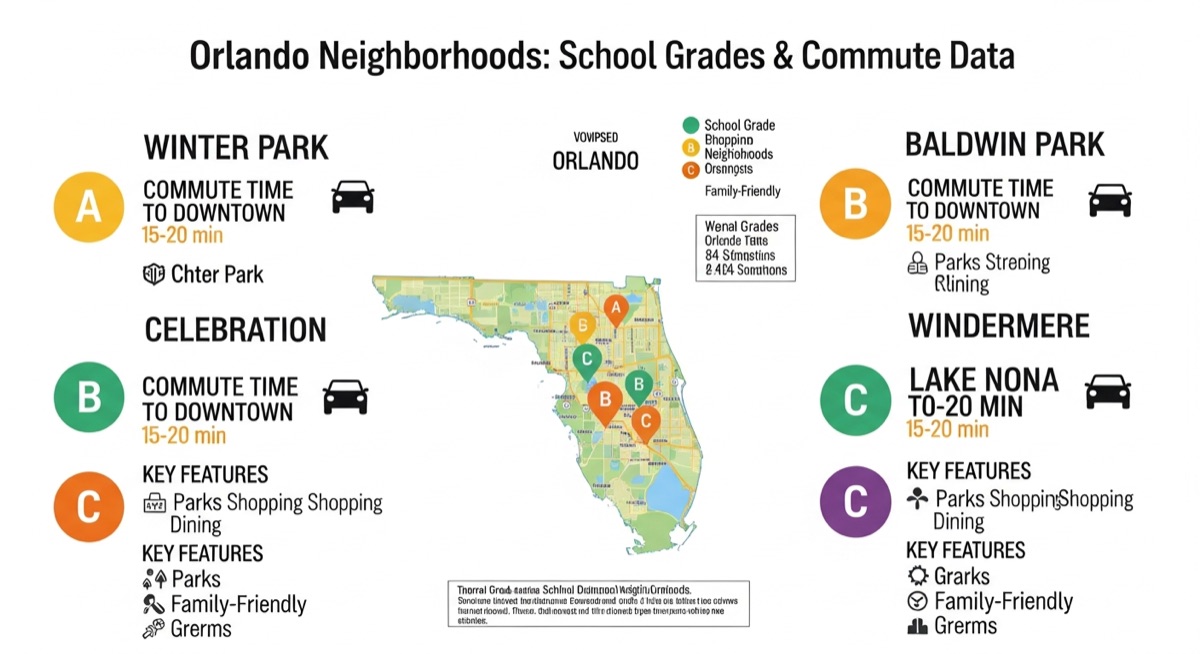
| Neighborhood | Primary Feeder School (FLDOE Grade) | Est. Price/Sq. Ft. | Mandatory HOA | Peak Commute to Downtown | OCSO Crime District | Flood Zone Exposure |
|---|---|---|---|---|---|---|
| Baldwin Park | Baldwin Park Elementary (A) | $280–$340 | Yes ($200–$400/mo.) | 15–20 min | District 2 | Zone AE (lakefront parcels) |
| Winter Park | Winter Park High School (A) | $280–$500+ | No (most streets) | 20–30 min | District 2 | Zone AE (lakefront streets) |
| Lake Nona | Lake Nona High School (A) | $230–$310 | Yes ($200–$600/mo.) | 25–35 min | District 6 | Zone X (mostly) |
| Audubon Park | Audubon Park K–8 (A) | $260–$320 | No | 10–15 min | District 2 | Zone X (mostly) |
| College Park | Princeton Elementary (A) | $260–$320 | No (most streets) | 10–15 min | District 1 | Zone AE (Ivanhoe adjacency) |
| Ivanhoe Village / Mills 50 | Howard Middle / Edgewater High | $250–$340 | No | 8–15 min | District 1 | Zone X (mostly) |
| Parramore | Jones High School (D/C historically) | $150–$220 | No | 8–12 min | District 1 | Zone AE (Lake Dot area) |
| Conway / Belle Isle | Boone High School (B/A historically) | $195–$260 | No (most areas) | 15–25 min | District 3 | Zone X (mostly) |
| Hunters Creek | Hunters Creek Elementary (A) | $185–$245 | Yes ($100–$200/mo.) | 30–40 min | District 5 | Zone X |
| Dr. Phillips | Palm Lake Elementary (typically strong) | $220–$290 | Yes ($150–$400/mo.) | 25–40 min | District 4 | Zone X (mostly) |
Price-per-square-foot figures reflect MLS closed sales in the most recent available quarter and vary by street and housing vintage. School grades reflect the most recently published FLDOE accountability cycle; verify current-cycle grades at fldoe.org for the specific feeder school at a specific address. Crime districts reflect OCSO patrol division assignments. Flood zones require parcel-level verification at msc.fema.gov.
If Schools Are Your First Filter — Baldwin Park, Winter Park, Lake Nona, and Audubon Park
For families relocating from out of state, the first question is almost always about schools. Four neighborhoods in this guide feed into schools currently carrying FLDOE A grades. They look identical in the table. They don’t feel identical when you’re living in them.
Baldwin Park Elementary holds an A grade. The neighborhood was built on the former Naval Training Center site off Lake Baldwin Lane and carries mandatory HOA fees of $200 to $400 monthly depending on sub-community. The Architectural Review Board governs paint colors, landscaping, holiday lighting timelines, and whether a basketball hoop is visible from the street. Price-per-square-foot runs $280 to $340 on the resale market. You’re buying into a restriction framework alongside school access. If you’re the kind of person who wants to leave holiday lights up through January, read the fine print before you fall in love with a house.
Winter Park High School rates among the strongest public high schools in OCPS. The municipality of Winter Park is separate from Orlando, with its own zoning and code enforcement, so buyers shopping “Winter Park schools” need to confirm they’re actually zoned to WPHS — within the city of Winter Park or close enough that feeder assignment holds. Prices run $280 to $380 per square foot on non-lakefront streets and climb above $350 near the water. Most established residential streets have no mandatory HOA. The constraint is price ceiling, and it’s a genuine one.
Lake Nona High School is the school story most out-of-state buyers haven’t heard yet. A large, well-resourced OCPS campus in southeast Orlando, A-rated, feeding a master-planned community where you’ll get more square footage per dollar than anywhere in-town — $230 to $310 per square foot. HOA fees are mandatory across most of the Tavistock Development at $200 to $600 monthly. The trade-off that actually shapes daily life is the commute. Downtown Orlando is 25 to 35 peak-hour minutes away via the 417. If your job is at Medical City rather than downtown, Lake Nona is logical. If it isn’t, that distinction follows you every morning.
Audubon Park K–8 is the value entry point for in-town buyers. FLDOE A-rated, no mandatory HOA, price-per-square-foot in the $260–$320 range, on Florida bungalows and ranch-style homes from the 1950s and 1960s. It’s also actively gentrifying, and that’s worth naming plainly rather than dressing up as “evolving character.”
One warning for every family in this section: verify the FLDOE grade for the specific school in the current accountability cycle, and map the full middle-and-high-school pipeline from that elementary. Audubon Park K–8 feeds into Edgewater High. School grades change — sometimes a full letter grade in a single cycle — and neighborhood price premiums often lag the recertification by a year or more. You’re making a bet on a snapshot.
The Commute Math — Drive Times to the Places Orlando People Actually Work
Orlando’s traffic confuses people who haven’t driven it. The city’s major employment clusters are geographically scattered in ways that make “central location” a nearly meaningless claim. If you’ve sat on the Beachline interchange on a Monday morning, you know.
Downtown Orlando (Orange Avenue / Church Street core). Parramore is 8–12 minutes on surface streets. Ivanhoe Village and Mills 50 are 8–15 minutes via Colonial or Robinson. College Park is 10–15 minutes via Edgewater Drive. Baldwin Park adds 15–20 minutes on a good day via SR 50 or the Bumby corridor. Winter Park runs 20–30 minutes south via I-4 or 17-92, though Fairbanks Avenue backs up heavily between 7 and 9 a.m. Lake Nona is 25–35 minutes north and west, almost entirely dependent on the 417 and the I-4 interchange at the Beachline.
Disney / Convention Center corridor (I-4 exits 64–68). Dr. Phillips is the only neighborhood in this guide with a genuinely short drive here — roughly 15 minutes off-peak, 35–45 in peak traffic via Apopka-Vineland or Sand Lake Road. Hunters Creek runs 20–25 minutes via the 417 north. Anyone selling you on a Baldwin Park or Audubon Park home by noting proximity to I-4 is describing an on-ramp, not a realistic commute.
Medical City / Lake Nona (SR 417 / Narcoossee Road). Lake Nona residents can work at Medical City without touching a highway. Everyone else in this guide can’t. No real way around that.
SunRail. Winter Park is the only neighborhood here where commuter rail is a realistic daily option. The Winter Park SunRail station gets you to the downtown core in roughly 12 minutes and gives you a genuine alternative on the days I-4 turns into a parking lot. For every other neighborhood in this guide, SunRail is mostly theoretical.
The road that shapes more Orlando commutes than any other is I-4 between the 408 and the 417/528 interchange. Which side of it you live on — and whether you’re moving with or against the bulk of traffic — often determines whether your commute is 25 minutes or 55. That’s not a small detail. That’s years of your life.
HOA Reality — What You’re Paying and What You’re Agreeing To
Baldwin Park’s Architectural Review Board runs one of Orange County’s most active HOA governance structures. The ARB controls exterior paint colors (from an approved palette), holiday lighting removal deadlines, visible porch or driveway storage, landscaping changes, fence materials, and the placement of sports equipment including basketball hoops. Violation letters are issued; uncured violations result in fines that attach to the property. Monthly fees of $200 to $400 cover pools, the Village Center, trail upkeep, and common area maintenance — not your individual lot.
Lake Nona’s Tavistock Development-controlled areas operate under similarly layered controls, extending into land use, commercial tenant selection, and signage in ways that affect long-term commercial character, not just whether your fence posts meet spec. HOA fees run $200 to $600 monthly across Lake Nona’s sub-communities. Some gated sections carry additional amenity fees on top of the base.
Hunters Creek uses a master association structure with multiple sub-community HOAs underneath, so buyers may pay both simultaneously — total monthly obligation typically $100 to $200. The sub-community structure also means that restrictions and amenity access vary by section. Occasionally a buyer discovers that the pool they toured belongs to a different sub-community than their home. It happens more than you’d expect.
Dr. Phillips has significant HOA variation by subdivision. Some sections carry extensive ARB oversight; others are lightly governed. Verify at the specific subdivision level.
The HOA-free neighborhoods — College Park, Audubon Park, Mills 50, and most of the older Ivanhoe Village street grid — let you paint your house whatever color you want, park a boat in the driveway, run a short-term rental, or operate a home-based business without asking anyone’s permission. That’s worth something real, depending on how you actually live. If you want to understand your rights when those rules are disputed, how HOA disputes work under Florida law is worth reading before you sign.
One resale detail that rarely makes it into buyer guides: ARB violations that an owner never fully cured surface in a title search and become the seller’s problem at closing. Compounded fines complicate and add cost to a future sale. Don’t assume the previous owner kept up with the paperwork.
The Gentrification Map — Parramore, Ivanhoe Village, College Park, and Audubon Park
Four neighborhoods in this guide are experiencing active investment pressure that is reshaping their demographics, their housing prices, and sometimes their basic character. “Gentrification” here is not a lifestyle adjective. It describes a specific economic process that produces specific winners and losers — and any guide that mentions only one side is filtering the news for you.
Parramore is the sharpest case. A historically Black neighborhood immediately west of downtown, it is surrounded by development pressure its longtime residents did not choose and in many cases cannot afford to benefit from. The Creative Village development on the former Amway Arena site has brought new construction and new residents to the neighborhood’s eastern edge. A two-tier market is forming: older housing stock on the residential grid at $150–$220 per square foot, and new construction townhomes coming in above $250. For buyers, Parramore is a genuine entry point for downtown adjacency. It is also a neighborhood where displacement of existing residents is real and ongoing. Neither fact cancels the other. But a guide that leads with the investment opportunity and buries the context isn’t being straight with you.
Ivanhoe Village and Mills 50 have progressed further along this shift. Both corridors built their identities on independent businesses — galleries, coffee shops, vintage retailers, chef-owned restaurants — that attracted residents who valued walkability and local ownership. Those same qualities attracted capital. Commercial rents on Virginia Drive and Mills Avenue have climbed substantially. Several of the independent businesses that defined these blocks in the 2010s have closed or moved on. What you’re buying into now is partly the residue of a scene that already happened. Our Mills 50 dining guide maps what’s currently operating on those corridors.
Audubon Park is the most livable version of this tension. The Garden District along Corrine Drive has held onto meaningful independent business presence, with locally owned restaurants anchoring the corridor. But rents in the surrounding blocks have risen significantly, and the bungalows and small ranches that once made Audubon Park an entry-level option have appreciated sharply. It’s still a reasonable bet relative to in-town alternatives. The neighborhood character you’re paying for is partly a product of displacement you are participating in. I think that’s worth sitting with honestly rather than skipping over.
College Park is experiencing teardown economics along and near Edgewater Drive. Original 1940s and 1950s bungalows are being purchased, demolished, and replaced with new construction at prices well above the existing stock. The neighborhood’s internal price range is widening, and its architectural character is gradually changing.
The Value Tier — Conway / Belle Isle and Hunters Creek
Both neighborhoods are underreported in buyer guides, and both deserve serious attention from anyone being priced out of the in-town core.
Conway and Belle Isle sit south of downtown, roughly bounded by Conway Road, Hoffner Avenue, Michigan Street, and the lake chain that defines the area’s geography. Price-per-square-foot runs $195–$260 — meaningfully lower than Baldwin Park, Winter Park, or Audubon Park — for housing that’s frequently larger and on bigger lots. The lake geography creates genuinely attractive residential blocks. That said: verify flood zone designation at the address level. This isn’t a throwaway caveat in lake-dense terrain.
The commercial corridors serving this area — Semoran Boulevard, Michigan Street, Conway Road — are strip-mall dominant and car-dependent. School quality varies by exact address. The broader Conway area feeds into multiple schools, and secondary assignment requires address-level verification. Boone High School serves parts of this area and has historically rated B to A, but check current FLDOE grades and confirm your specific address’s feeder before counting on it.
One detail other guides miss entirely: Belle Isle is a separate incorporated municipality, not a City of Orlando neighborhood. Belle Isle residents have their own city commission and their own code enforcement. Some Orlando homebuyer assistance programs, permitting pathways, and development regulations don’t apply. The municipal boundary runs through what looks like a continuous neighborhood — you can drive across it without noticing. Clarify which side you’re on before assuming the same rules apply.
Hunters Creek offers among the best square footage per dollar of any organized community in the metro area. Well-maintained common areas, solid HOA infrastructure at $100–$200 monthly, and easy 417 access. Hunters Creek Elementary currently holds an A rating from FLDOE.
Here’s the complication no other guide names: the southern sections of Hunters Creek cross into Osceola County. Buyers in those sections are zoned to Osceola County schools — a different district from OCPS, with different ratings, different policies, and different feeder patterns. A buyer expecting access to Hunters Creek Elementary may find, depending on the specific parcel, that they’re in Osceola County School District territory instead. Verify district assignment at the specific address. People are genuinely surprised by this.
Flood Zones, Insurance Costs, and the Question Most Guides Skip
Orlando sits in one of Florida’s lake-densest geographies. That’s part of what makes it attractive and part of what makes it financially complicated — sometimes on the same block.
FEMA flood zone designations are not neighborhood-level. They’re parcel-by-parcel, and they can flip from Zone X (minimal flood hazard, no mandatory insurance) to Zone AE (100-year floodplain, mandatory flood insurance for federally backed mortgages) within a single residential street.
The financial difference is substantial. Flood insurance in Zone AE can add $2,000 to $5,000 annually to a home’s carrying cost, depending on the property’s elevation certificate and coverage level. That cost doesn’t appear in a mortgage payment estimate. It doesn’t show up in a price-per-square-foot calculation. It shows up in year one when the insurance bill arrives.
A few specific places where this matters:
Winter Park lakefront streets carry significant Zone AE exposure. Treat flood insurance as a required line item on any street immediately adjacent to the city’s lakes — not optional research.
College Park near Lake Ivanhoe includes Zone AE parcels on blocks adjacent to the lake’s south end. The effect can extend further north than buyers expect, particularly in heavy rain years.
Parramore near Lake Dot includes Zone AE designations around some of the neighborhood’s most transitional blocks, east toward downtown.
Baldwin Park along Lake Baldwin has Zone AE exposure on lakefront and near-lakefront parcels. Since some of the neighborhood’s most desirable homes sit closest to the water, this catches buyers off guard more often than it should.
Go to msc.fema.gov and enter the specific property address before making an offer. Don’t rely on the seller’s disclosure alone. Ask your lender directly whether flood insurance is required and what the estimated annual premium will be. If an elevation certificate exists for the property, request it — it can shift pricing by hundreds of dollars a year.
The Comparison Buyers Actually Need — Baldwin Park vs. Audubon Park vs. College Park
These three neighborhoods generate more buyer confusion than any other combination in Orlando. They’re geographically close — all within a few miles of each other, north and east of downtown — all considered “in-town,” and competing guides describe them in nearly identical terms: walkable, charming, community-oriented. That’s not wrong. It just doesn’t help you decide.
Here’s where they actually diverge.
HOA structure. Baldwin Park has mandatory HOA with ARB oversight and fees of $200–$400 monthly. Audubon Park has no HOA. College Park has no mandatory HOA on most residential streets. If you want to paint your house an unconventional color, operate a short-term rental, park an RV, or run a visible home-based business, Baldwin Park is categorically different from the other two. No exceptions.
School pipeline. Baldwin Park Elementary is A-rated. Audubon Park K–8 is A-rated. For a kindergartner, they look equivalent. For a child approaching middle school, the full pipeline matters more. Audubon Park K–8 feeds into Edgewater High. College Park’s primary feeder is Princeton Elementary — currently A-rated — with Edgewater High as secondary. Zone boundaries don’t always follow the lines you’d draw on a map, so verify feeder assignment at the specific address.
Price-per-square-foot. Baldwin Park runs $280–$340. Audubon Park and College Park both run $260–$320, though the figure shifts quarterly depending on whether new-build replacements are included in the comparable set.
Lot size and housing vintage. College Park lots are generally larger than Audubon Park’s, with original stock from the 1940s–1950s. Audubon Park skews 1950s–1960s. Baldwin Park housing is uniformly newer — most built from 2000 onward — with smaller individual lots but consistent interior finishes. That consistency cuts both ways: newer mechanicals, but less of the character that draws people to in-town neighborhoods in the first place.
Daily commercial life. Baldwin Park’s axis is New Broad Street, with coffee, restaurants, and retail that feel intentionally curated — because they are, through ARB governance. Audubon Park runs along Corrine Drive, where East End Market, independent restaurants, and a farmers’ market have evolved more organically. College Park’s spine is longer and more mixed: excellent local restaurants alongside dated commercial buildings and active teardown-and-rebuild blocks.
For a relocating family with a $550,000 budget and a school-age child, the choice sharpens quickly. Audubon Park offers A-rated elementary access, no HOA restrictions, and lower price-per-square-foot than Baldwin Park — but demands honest engagement with the secondary school pipeline. Baldwin Park offers a predictable environment and strong elementary access, at the cost of HOA fees and governance. College Park offers comparable pricing to Audubon Park, an A-rated elementary feeder, and generally larger lots with no HOA, but with older housing stock that may carry renovation costs.
The right answer depends on the child’s age, your tolerance for HOA governance, and whether you’re planning to stay through secondary school years. There is no universally correct pick — which is exactly why these three neighborhoods keep confusing buyers who walk in expecting one.
Five Questions to Ask Before You Commit to Any Neighborhood
1. Pull the specific parcel’s flood zone. Go to msc.fema.gov and enter the full street address of any property you’re seriously considering. X means minimal hazard; AE means you’re in the 100-year floodplain and will likely need flood insurance. Do this before you make an offer. Ask your insurance agent for a flood insurance quote at that specific address, with the elevation certificate if one exists.
2. Read the current FLDOE school grade and understand what it doesn’t measure. Florida school grades are published annually at fldoe.org. Look up the specific feeder school for a specific address — not the neighborhood’s reputation or any aggregator’s composite score. The FLDOE grade reflects state assessment performance and year-over-year learning gains. It doesn’t measure class sizes, teacher retention, extracurriculars, or magnet program competitiveness. It also doesn’t guarantee enrollment — address verification is required.
3. Request HOA documents before making an offer. Florida law (Chapter 720, Florida Statutes) gives buyers the right to cancel a contract within three business days of receiving HOA documents, including the Declaration of Covenants, Rules and Regulations, and current financial statements. Read them. Look specifically at the ARB process, the fine structure, the current reserve fund balance, and any pending special assessments. An underfunded reserve means the HOA may levy a special assessment on homeowners for major repairs — an expense that won’t appear in your monthly fee quote.
4. Find crime data by OCSO district, not by ZIP code. The Orange County Sheriff’s Office publishes crime statistics by patrol district at ocso.com. ZIP codes routinely blend very different neighborhoods into one figure. OCSO patrol districts more accurately reflect where patrol resources concentrate and where incident rates elevate. Ask specifically about burglary, vehicle theft, and residential property crime rather than aggregate totals.
5. Ask your agent for price-per-square-foot, not median sale price. Median sale prices shift when the composition of homes sold in a quarter shifts. A run of large new builds inflates it; a run of small infills deflates it. That tells you about market composition, not what you’re actually paying for space. Price-per-square-foot normalizes for size and gives you a meaningful comparison across neighborhoods and housing vintages. If your agent won’t pull this from MLS records, find one who will. For more context on how these numbers play out across the metro area, see our moving & real estate coverage.
The agent, the lender, and the developer all have financial reasons to lead with the good news. That’s their job. This guide exists to make sure you know the rest before you sign anything.
CityDesk Orlando’s real estate coverage is editorially independent. No neighborhood, developer, or real estate brokerage paid for inclusion in or influence over this guide. School grade data reflects the most recently published FLDOE accountability cycle; verify current grades at fldoe.org for the specific feeder school at any address you are considering. MLS price-per-square-foot figures reflect closed sales in the most recent available quarter at time of publication. Crime district data reflects current OCSO patrol division designations. Flood zone designations must be verified at msc.fema.gov for any specific property.