What the Numbers Say About I Drive Condo Investment in 2026
Before you make an offer on a tourist-corridor condo, here's what the pro forma actually looks like — by building type, by zip code, by fee structure.

What the Numbers Say About I Drive Condo Investment in 2026
Before you make an offer on a tourist-corridor condo, here’s what the pro forma actually looks like — by building type, by zip code, by fee structure.
The pitch is easy to understand. Epic Universe opened in May 2025, the largest single theme park addition Orlando has seen in a generation, sitting roughly 1.5 miles from mid-International Drive. The Orange County Convention Center has worked its conference calendar back to pre-pandemic volume. Passenger counts at Orlando International are near record levels. If you own a short-term rental unit on the tourist corridor, the demand story is genuinely better than it’s been in years.
But demand and yield are different conversations. On I-Drive in 2026, the gap between them is wide enough to sink a pro forma that looked fine on a napkin. The corridor isn’t a single market. HOA and resort fees swing by hundreds of dollars per month depending on the building. Short-term rental permissions vary by condo declaration, not county ordinance. The difference between a building that permits nightly rentals and one that requires a 30-day minimum can erase four to six points of cap rate before you’ve signed anything. Occupancy has recovered, but not uniformly, and the seasonal floor is real.
This piece tries to give investors the honest version: specific numbers, specific documents, specific buildings, and the compliance issues that determine whether an I-Drive condo actually pencils out.
The Corridor’s Three Sub-Markets Are Not Competing for the Same Guest
International Drive runs roughly 11 miles from Sand Lake Road south to Universal Boulevard north. Treating it as a single market is one of the most reliable ways to misread an investment here, and it happens constantly.
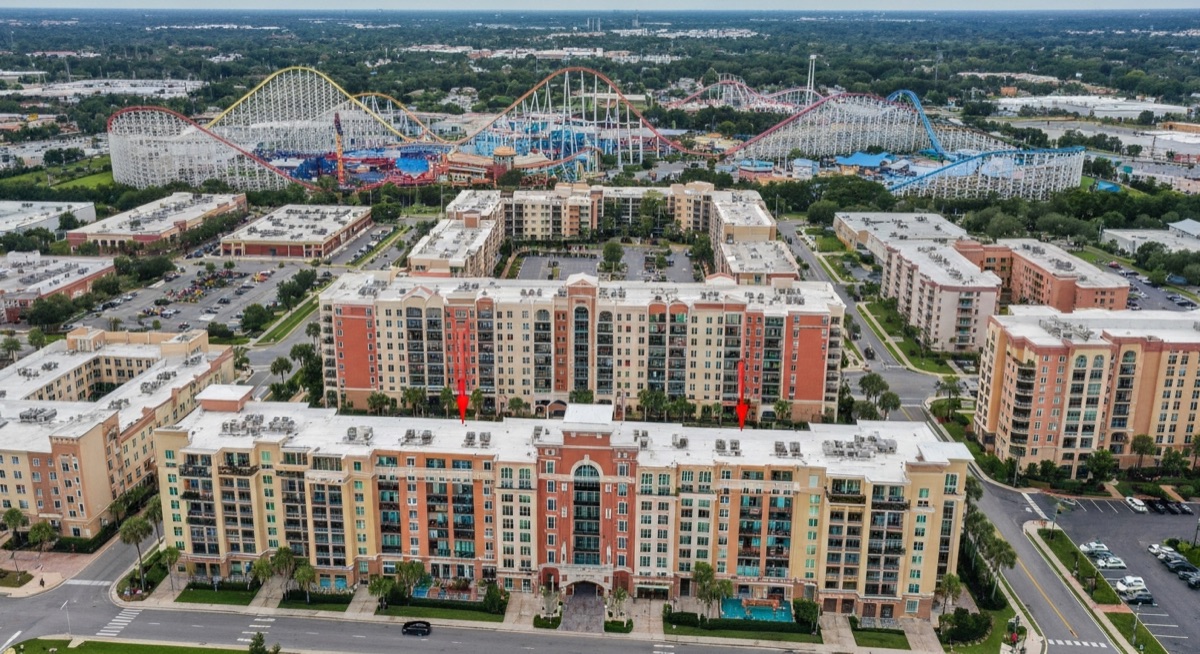
South I-Drive (ZIP 32819, Sand Lake Road to Carrier Drive) is leisure-first. ICON Park anchors foot traffic. Restaurants and attractions cluster here. Nightly rates are achievable because the guest profile is families and couples on vacation — the demographic that books short stays and turns the unit over quickly. These units face the most direct competition from the hotel strip, which keeps pricing pressure real. Demand is also the most consistent year-round, which matters when you’re modeling February occupancy.
Mid-I-Drive (ZIP 32821, Convention Center corridor) draws a more layered demand profile. The Orange County Convention Center generates measurable weeknight occupancy that leisure properties in 32819 don’t see. Convention guests are different buyers: price-sensitive, less interested in the amenity stack, often booking close to arrival. This sub-market favors condo-hotel and extended-stay structures. The OCCC’s calendar is fully recovered as of 2024–2025, which provides a demand floor that softens the slow season. It doesn’t eliminate slow season — nothing does — but it helps.
North I-Drive and the Universal area (ZIP 32836) is where the 2025–2026 investment narrative is loudest. Epic Universe has pulled investor attention north, and the proximity play is real: guests visiting the new park want nearby accommodation. The complication is that supply in 32836 also expanded materially in anticipation of the opening. Investors who bought into the Epic premium two years ago are now pricing against a deeper inventory pool. The lift is genuine. It’s just not unlimited, and any listing describing it as a sure thing is being generous.
STR Permission Is a Building-by-Building Question, Not a County Question
This is the piece of I-Drive due diligence that produces the most costly surprises. Worth being direct about.
Florida’s SB 714 preemption framework limits local governments from banning short-term rentals outright. Orange County can’t categorically prohibit STR activity. What that framework does not do is override a private condo association’s declaration of condominium. A declaration that restricts rentals to a minimum of 30 days is a contract among unit owners — not a zoning ordinance subject to state preemption. The county STR permit and the state framework are irrelevant to your right to rent nightly if the declaration forbids it. This is the most common investor trap on this corridor, and it isn’t close. For a broader look at how municipal STR rules interact with investor decisions across Orange County, our coverage of Orlando short-term rental rules addresses the county-level framework in detail.
Here’s how several named buildings currently sit. Declaration language can be amended by board vote, so investors must request current governing documents before closing. Don’t rely on secondhand characterizations, including this one.
Westgate Lakes Resort & Spa operates under a timeshare-adjacent structure. Owners in traditional interval ownership tiers are bound by the resort’s use and rental program. Independent nightly rental outside the Westgate system is generally not permitted. Anyone considering this property needs to distinguish carefully between interval ownership and any fee-simple condominium components. The documents are not interchangeable, and the distinction matters more than most listing agents will let on.
The Point Orlando Residences near ICON Park runs as a condo-hotel: units placed in a managed rental pool. Owners who opt out of the pool face restrictions on independent STR activity under building rules. The management agreement, not just the declaration, controls the rental posture here.
Blue Heron Beach Resort on Turkey Lake Road is a condo-hotel where nightly rentals have historically been permitted within the building’s managed program. Units are furnished to resort specification. Independent platform listings have existed in this building, but whether they’re actually permissible is a question the declaration and management agreement answer — not the listing agent.
Enclave Suites/Club Exploria operates as an all-suites resort with a structured rental program. Owners are typically required to participate in the on-site rental pool rather than list independently. That clause has a direct effect on net returns because the management split is fixed. You don’t negotiate it.
Star Island Resort in Kissimmee, frequently marketed alongside I-Drive inventory, runs a rental pool structure with on-site management. STR activity is permitted. Request the current 2026 fee schedule and confirm rental program terms before relying on anything stated prior to this year.
CityPlace at Harmony Square and Palms Hotel & Residences represent a newer generation of mixed-use condo developments in the corridor. These are where you’re most likely to find residential-style structures with STR permissions that allow independent platform listings. The range of restriction language is still wide, and minimum rental periods of 7 or 30 days appear in some declarations. Newer building does not mean fewer restrictions.
The document hierarchy an investor needs to understand: condo declaration controls over county permit; county permit controls over state preemption law. A title attorney with recent I-Drive transaction experience reviewing the declaration is looking for the minimum rental period clause, any exclusivity language requiring participation in an on-site program, occupancy caps, and board-enacted rules that supplement the declaration. Board rules can be changed more easily than the declaration itself — request the last 24 months of board meeting minutes to see whether STR enforcement has been an active topic.
If the minutes show fines or cease-and-desist letters sent to STR operators, that’s not a yellow flag. The association actively polices the restriction and it will find you.
The HOA and Resort-Fee Stack Is the Line Item That Kills Pro Formas
Monthly carrying costs in I-Drive condos don’t follow residential norms. Investors accustomed to conventional multifamily are routinely surprised, and “surprised” is a polite way to put it.
Condo-hotel structures — buildings designed and operated as hotels with individual unit ownership — carry the heaviest fee loads. HOA fees plus resort fees on a one-bedroom unit in this category commonly run $800 to $1,400 per month. These fees cover resort-grade common amenities: pools, lobbies, fitness centers, on-site staff. Those amenities are necessary to attract the guest. They also create a fixed cost regardless of occupancy. The pool doesn’t cost less to heat in February because you have fewer bookings. A $1,100 monthly fee on a unit generating $40,000 in annual rental revenue is 33% of gross income before you’ve touched platform fees, property management, utilities, insurance, or property tax.
Residential-style condos with STR permissions — typically newer mixed-use buildings or older residential condominiums that permit short-term rentals by declaration — run lighter, usually $400 to $700 per month for a one-bedroom. These buildings often command lower nightly rates than true condo-hotels because the product is less hotel-like. But the fee load is meaningfully lower, and that difference compounds.
Timeshare-adjacent and branded resort condos are the most expensive category. When resort assessments stack alongside base HOA fees, total monthly carrying costs can reach $1,500 to $2,000 per month on a one-bedroom. The gross rental income that looks attractive in the listing package can be consumed before debt service enters the picture.
One exposure that does not appear in marketing materials — but should appear in every due diligence file — is post-Hurricane Ian special assessment activity. Several I-Drive and near-corridor buildings underwent reserve studies and structural reviews following Ian’s 2022 impact and subsequent legislative pressure on condo reserve funding. Special assessments for insurance premium increases, roof repairs, and reserve replenishment have appeared across multiple buildings since then. Request a 12-month HOA assessment ledger, not just the current monthly fee schedule. A special assessment spread across 18 months becomes a carrying cost that won’t show up in the pro forma the seller’s agent hands you. Understanding how Florida property insurance rate increases have affected condo association budgets is essential context before you accept any fee schedule at face value.
What Cap Rates Are Realistic, and Where the Marketed Numbers Go Wrong
Realistic cap rates for I-Drive STR condos in 2026 run roughly 3.5% to 6.5%. Most condo-hotel structures land in the lower half of that range after full fee loads are accounted for. You won’t see that acknowledged in listing summaries.
A well-positioned, STR-permitted one-bedroom in a building with moderate fees can reasonably gross $35,000 to $55,000 annually — call it 65–75% occupancy at an average daily rate of $130–$160. Verify those gross revenue figures against current AirDNA or comparable corridor-specific occupancy data before building a final model. Don’t trust my numbers any more than you’d trust the seller’s.
From gross revenue, deduct platform fees at 15–20%. Local STR management fees run 20–30% of revenue. Fixed monthly HOA and resort fees stack on top of that. Add utilities where the owner pays electric and cable. Add short-term rental insurance — standard homeowners policies don’t cover this use. Add property tax based on Orange County’s assessed value. The deductions accumulate faster than marketed cap rates suggest.
Purchase prices for STR-eligible one-bedroom units in the corridor ran roughly $180,000 to $320,000 in the 2025–2026 period. Units at the lower end, in buildings with lighter fee structures and clean STR permission language, are where 5–6% cap rates are genuinely achievable. Units priced near $300,000 in condo-hotel structures carrying $1,100-plus monthly fees frequently don’t get there once the full math is run. The purchase price gets negotiated; the fee structure gets accepted as-is. That’s where optimistic assumptions tend to get buried.
CoStar places conventional Orlando apartment cap rates at approximately 5–5.5% in 2025. I-Drive STR condos aren’t reliably producing a premium over conventional multifamily once the full fee load is modeled. That doesn’t make them bad investments — appreciation and personal use have real value. But investors who go in understanding the actual yield are positioned considerably better than those who buy the headline number.
Occupancy: What Recovery Actually Looks Like, Month by Month
The right baseline for well-positioned I-Drive corridor units is 2019: 68–72% annual occupancy. Not the pandemic years. Not the 2025 peak-season numbers that dominate marketing materials.
The 2020–2021 collapse was severe — occupancy fell to 30–45% for most STR units on the corridor. The convention-adjacent sub-market performed worse than leisure properties because the OCCC went dark entirely. By 2022, corridor-wide occupancy for compliant, well-managed units had recovered to 60–68%. By 2024–2025, that tier returned to approximately 65–72%, driven by OCCC calendar recovery, Epic Universe demand, and the broader Orlando visitation rebound. These figures are directional; verify against current AirDNA data before using them in any model.
The number that disappears from most investment marketing is the seasonal floor. January and February on I-Drive are genuinely slow. Occupancy for most units in those two months runs 45–55%, and ADR compresses because supply is abundant relative to demand. An investor who models on annual average occupancy without accounting for the January–February trough systematically overstates income. A 70% annual average that includes two months at 50% is mathematically different from 70% spread evenly across 12 months — and the even distribution is not what happens here.
The performance gap between professionally managed and self-managed units runs roughly 10–15 occupancy points in favor of professional management, according to local operators. A self-managed unit at 60% annual occupancy versus a professionally managed comparable at 72% is roughly 44 lost nights per year. At ADRs of $130–$160, that revenue gap frequently exceeds the management fee you’d save by going it alone. The math is counterintuitive for investors used to multifamily, but it’s consistent on this corridor. If you’re planning to self-manage from out of state, build in a meaningful occupancy haircut before you commit to a price.
The Tax Layer: 12.5% on Every Guest Stay, and Who Remits It
Orange County’s STR tax stack totals 12.5% on every transient rental: Florida state sales tax at 6%, Orange County Tourist Development Tax at 6%, Orange County discretionary sales surtax at 0.5%.
For investors listing exclusively on Airbnb or Vrbo, the marketplace facilitator rule handles most of the remittance burden. Both platforms remit Florida state and county taxes automatically on the host’s behalf. If 100% of your bookings flow through those platforms, you’re largely covered.
The compliance problem arrives the moment you take a direct booking. A repeat guest who texts you and pays via Venmo. A corporate booking arranged by email. A friends-and-family rental at below-market rate. Any transaction outside the marketplace facilitator creates a remittance gap the host is personally responsible for. That means registering independently with the Florida Department of Revenue (Form DR-1) and with the Orange County Tax Collector, and remitting applicable taxes on all non-platform revenue.
Orange County has actively audited STR operators since 2022. Back-tax liability from unreported direct bookings, compounded by penalties and interest, has been a specific and recurring problem for I-Drive investors who assumed platform facilitation covered their full exposure. It doesn’t.
Registration with the Florida Department of Revenue and the Orange County Tax Collector is required regardless of booking method — before you collect the first dollar of rental income. Not after things pick up. Before.
What to Pull Before You Make an Offer
No amount of pro forma analysis replaces the actual documents governing the specific unit you’re buying. Here’s the full list.
The Declaration of Condominium is the controlling document. You’re looking for the minimum rental period clause — 30 days, 7 days, no restriction — any clause requiring participation in an on-site rental program, and any occupancy caps. The declaration controls over county permits and state preemption law. If it says 30-day minimum, the county STR permit does not override it. Not a gray area.
The Rules and Regulations are the board-enacted supplement to the declaration. Rules can be amended more easily than the declaration and may impose additional restrictions: guest registration requirements, parking limits, noise policies. Ask when they were last amended. If the answer is “I’m not sure,” that’s information.
Board meeting minutes from the last 24 months reveal pending special assessments, STR enforcement actions against current owners, any litigation the association is party to, and reserve fund discussions. A board that has been actively fining STR operators will fine you.
A 12-month HOA assessment ledger is essential. The current monthly fee is not enough. You need to see whether special assessments have been levied, how they were structured, and whether any are still running. If the seller’s ledger shows a recent lump-sum payment, ask what it was for.
The management agreement, if the building has an on-site rental program, controls your income more directly than the purchase price. On-site programs on this corridor typically take 40–50% of gross rental revenue — well above what an independent property manager charges. Check whether the agreement requires all rentals to flow through the on-site program or permits independent listings. An exclusivity clause paired with a 50% management fee is a material constraint on yield that will not appear in the listing price.
Finally, confirm that the current owner is registered with the Florida Department of Revenue for the unit’s address. An unregistered seller who has been renting without registration creates potential back-tax liability that can attach to the property. If the seller hesitates to provide evidence of registration, that tells you something worth knowing.
The Bottom Line for 2026 Buyers
Whether buying an I-Drive condo makes sense in 2026 depends entirely on which building, at what price, with what fee structure, and whether the declaration permits what you intend to do with the unit. That’s not a hedge — that is, specifically, the answer. Two units a half-mile apart, similar square footage, similar asking price, can have completely different investment outcomes because one declaration permits nightly rentals and the other doesn’t, or because one building’s HOA fees are $480 a month and the other’s are $1,100.
The demand environment is genuinely better than it’s been since 2019. Epic Universe is generating real incremental visitation. The convention calendar is full. None of that is marketing copy.
What the demand story doesn’t change is the unit-level math. A condo-hotel unit at $280,000 carrying $1,100 per month in HOA and resort fees will not produce a cap rate worth the illiquidity risk relative to other Orlando commercial real estate options. A residential-style condo in a declaration-compliant STR building, lighter monthly fees, professional management with established platform presence — that can produce cap rates in the 5–6% range, which is competitive with conventional multifamily and comes with real appreciation upside in a high-visitation market.
The investors who do well on this corridor treat the declaration, the fee schedule, and the management agreement as the actual investment thesis. Not the theme park news cycle. The theme parks fill the region. The documents determine whether any of that money reaches you.
Reporting for this piece drew on Orange County property records, Florida Department of Revenue registration requirements, published CoStar cap rate data for the Orlando market, and interviews with local commercial real estate professionals active in I-Drive corridor transactions. HOA fee ranges, cap rate figures, occupancy estimates, and purchase price ranges are directional and require verification against current MLS data, AirDNA corridor reports, and HOA management company disclosures before use in any investment model. Specific building declaration language should be verified with a Florida-licensed title or real estate attorney before any purchase decision; condo governing documents are subject to amendment, and the characterizations in this article reflect general reported conditions, not legal advice.