Lake Nona vs Dr. Phillips Which Orlando Neighborhood Fits Your Budget
Price per square foot, school grades, HOA costs, and commute times — sourced from MLS data, county records, and residents who made the call

Lake Nona vs Dr. Phillips Which Orlando Neighborhood Fits Your Budget
Price per square foot, school grades, HOA costs, and commute times — sourced from MLS data, county records, and residents who made the call
The question comes up constantly in Orlando real estate: Lake Nona or Dr. Phillips? Both zip codes occupy a particular prestige tier in the local market. Both attract dual-income households with children. Both carry price tags that demand serious due diligence. And both have passionate advocates who will tell you they made the obvious choice — usually within 90 seconds of meeting you at a neighborhood barbecue.
The problem is that most of the comparison content circulating online treats these neighborhoods as interchangeable lifestyle upgrades distinguished mainly by commute direction and pool size. They aren’t. Lake Nona is a master-planned community mid-construction, selling a specific vision of what southeast Orlando will eventually become. Dr. Phillips is a mature corridor with decades of institutional track record, anchored by one of Florida’s most recognized public high school brands and a restaurant district that people drive across the metro to reach. Those are genuinely different things, and the distinction matters.
This piece doesn’t pick a winner — the data doesn’t support one. What it does is put the two neighborhoods side-by-side on the criteria that actually determine whether a purchase works: price per square foot, lot size, school performance, HOA structure and cost, drive times to real employers, and what Lake Nona’s ongoing buildout actually means for someone moving in today. Two residents — one in each community — describe what tipped their decision and what surprised them after they moved in.
Here’s what the data shows.
What Your Money Actually Buys: Price Per Square Foot and Lot Size
Headline median sale prices mislead in both directions. Dr. Phillips’ median is regularly inflated by estate-tier lakefront sales along the Butler Chain, where a single transaction on Bay Hill Drive can skew a month’s data by six figures. Lake Nona’s median bundles entry-level townhomes in Storey Park with multi-million-dollar custom builds. Neither figure tells you much about what a specific purchase actually buys.
The more useful number is price per square foot. Recent MLS data puts Lake Nona communities in the $230s to low $270s per square foot across active sub-communities, with newer construction in Laureate Park pushing toward the higher end. Dr. Phillips trades somewhat higher on an established-community basis — generally $240 to $310 per square foot in places like Phillips Grove and Vizcaya — with Butler Chain lakefront breaking well past $400 in premium transactions.
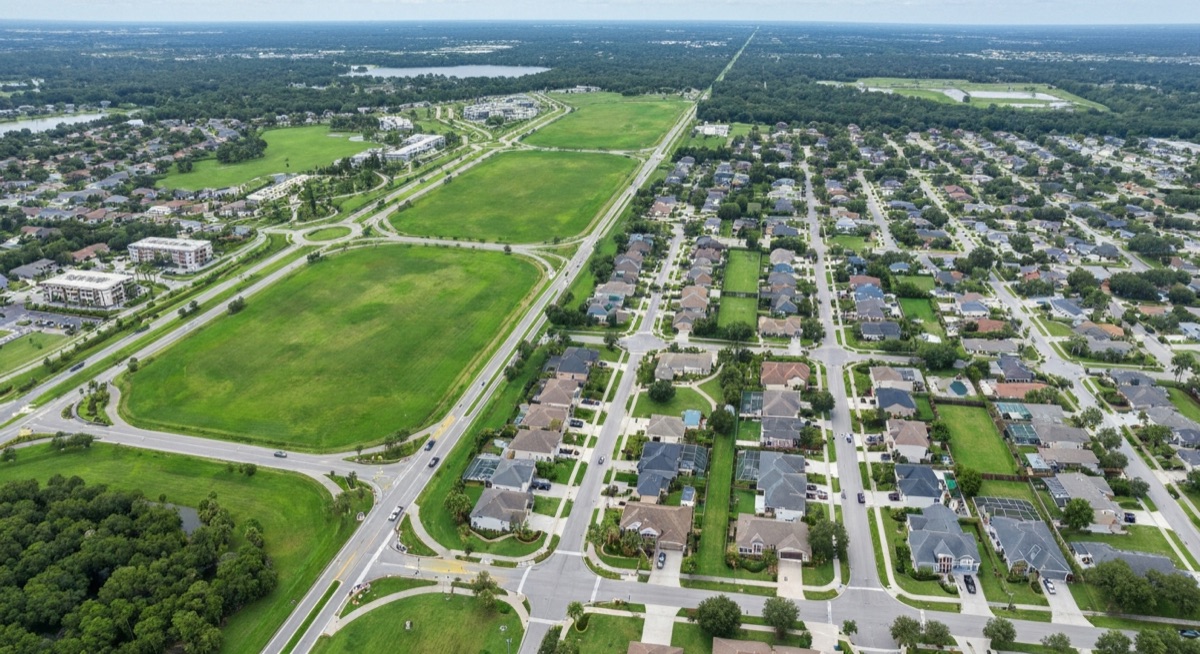
But the land story is more consequential than the price-per-foot number. Lake Nona’s master-planned communities — Laureate Park especially — are built on a new-urbanist density model. Typical lots run around 5,500 square feet. Homes sit close together. Garages are accessed from rear alleys, which looks clean in listing photos but means your yard is a defined pocket rather than a sprawling private space. For households with dogs, kids who want to kick a ball, or buyers accustomed to the wider suburban Florida lots they grew up on, this is a real adjustment. Find that out before the inspection period, not after.
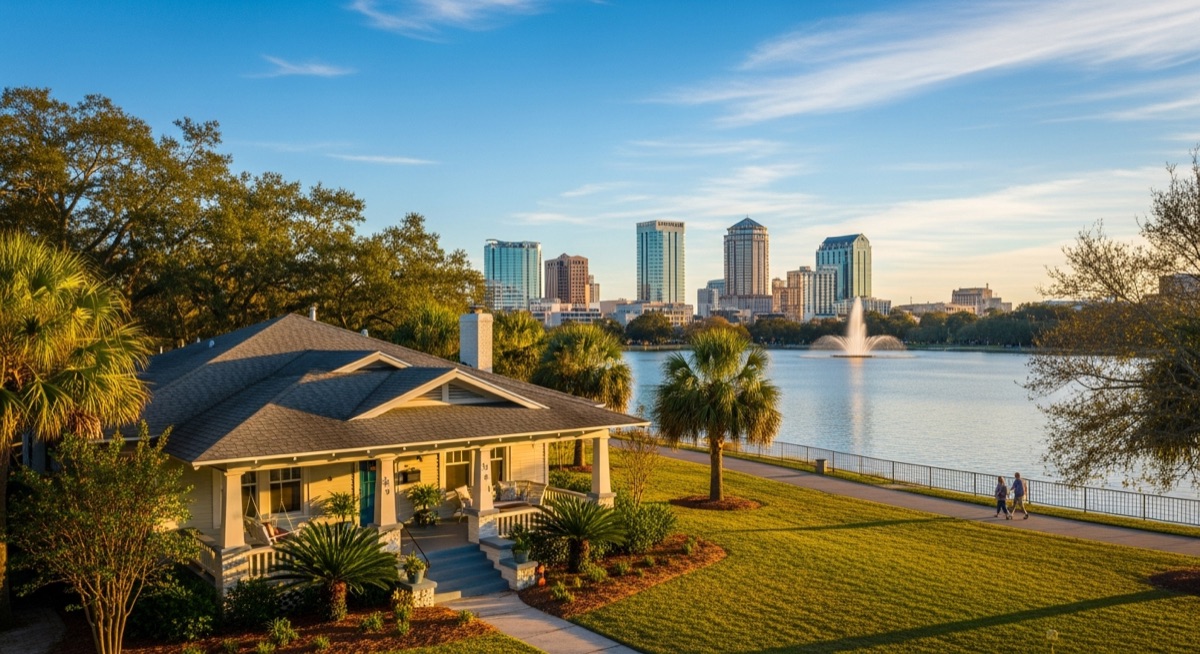
Dr. Phillips offers genuine lot-size variety. Vizcaya — the gated community off Apopka-Vineland — runs noticeably larger than the Lake Nona norm. Tivoli Woods trends toward standard suburban lots. And then there’s the Butler Chain tier: homes along Big Sand Lake and Bay Hill routinely sit on half-acre to multi-acre parcels with direct water frontage, a product category that simply doesn’t exist in Lake Nona at any price point.
If you’re buying in Dr. Phillips without lakefront, you’re paying a per-square-foot premium for established infrastructure, mature tree canopy, and proximity to Restaurant Row. Not for land. If you’re buying in Lake Nona, you’re paying for new-construction quality and community amenities, with the understanding that your outdoor space was deliberately compressed. For more context on what new construction actually delivers for buyers today, the specifics on finishes, warranties, and builder negotiations are worth reviewing before you visit a model home.
Schools, By the Numbers
Both areas fall under Orange County Public Schools, but they’re not equivalent, and the data reflects it.
Dr. Phillips High holds an A grade from the Florida Department of Education, a rating it has maintained consistently across multiple evaluation cycles. Southwest Middle, its primary feeder, has earned Bs. Palm Lake Elementary — one of the feeders depending on your specific address — has held at A. None of that is surprising. What matters more, and what no grade report captures, is what a school is like after 30 years. Dr. Phillips High has faculty who’ve been coaching the same sport for two decades, college counselors who’ve built relationships with specific admissions offices, and an alumni network that actually functions. That kind of institutional depth can’t be constructed quickly, and Lake Nona High — which opened in 2009 — is still building it.
Lake Nona High currently holds an A grade, which is a real accomplishment for a school that young, and a signal that the community’s demographic profile has translated into strong academic outcomes. Lake Nona Middle has earned Bs. Village Park Elementary, which serves the Laureate Park area, has performed at the A level. But here’s an operational detail that trips up buyers: school zones are not uniform across the Lake Nona zip code. Your address in Laureate Park may feed a different elementary than a home a mile away in Storey Park. Before making an offer anywhere in 32827, confirm the specific feeder assignment directly through OCPS — not through the developer’s marketing summary. That summary is not a legal document and has been wrong.
The honest summary: both areas can get a family into A-rated high schools. For a family moving in with a sophomore who graduates in two years, the institutional history gap probably doesn’t matter. For a family planting a decade-long flag somewhere with elementary-age kids, it does. Dr. Phillips High’s track record exists because the school has had time to build one. Lake Nona High is earning its. Those are different bets.
HOA Fees: What You’re Paying, What You’re Getting
Neither neighborhood is a single HOA. They’re collections of sub-communities with different structures, different inclusions, and significantly different monthly exposures. The math looks simple on paper. In practice, it requires reading every document in the disclosure package — all of them.
Laureate Park charges a master HOA fee in the range of $400 to $500 per month depending on home size, covering maintained trails, multiple pools, a fitness facility, community garden access, regular programming, and fiber internet infrastructure. Storey Park is lower, typically $100 to $140 per month, with a more modest amenity package.
The structural issue buyers sometimes discover mid-transaction is Lake Nona’s dual-HOA model. Many communities carry both a master HOA — covering community-wide infrastructure — and a sub-community HOA covering that specific neighborhood’s maintenance and entry features. These fees stack. A Laureate Park property might carry a $450 master fee plus a $150 sub-community fee: $600 monthly total. A lot of buyers see the master HOA number, budget around it, and then get a second bill a few months in that they weren’t expecting. Read the full disclosure package. Confirm the combined assessment before closing.
Dr. Phillips communities generally charge less in absolute terms, though the comparison isn’t apples-to-apples because billing structures and amenity sets differ. Vizcaya runs roughly $300 to $400 per quarter — not per month, which matters — covering guard-gated entry, common area landscaping, and community amenities. That’s $100 to $133 monthly, noticeably less than Laureate Park’s master fee alone. Tivoli Woods fees run around $200 to $300 per quarter. Phillips Grove, the newer gated community off Apopka-Vineland, charges roughly $150 to $200 per month.
Bay Hill deserves separate attention. The neighborhood — home to the course that hosts the Arnold Palmer Invitational — operates with a voluntary homeowners’ association rather than a mandatory assessment. Some property owners pay in; others don’t. The practical consequence is visible: variability in landscaping standards, inconsistency in entry features and common area maintenance. If you’re accustomed to the uniform curb appeal of a mandatory-HOA community, Bay Hill may look less polished than its price tier suggests it should. That’s not a reason to avoid it, but it’s a reason to walk the neighborhood on a weekday afternoon before you fall in love with a listing.
This is also a good place to flag the broader insurance picture — in our moving and real estate coverage, the relationship between HOA structure, flood zone classification, and insurer availability in Central Florida gets more thorough treatment than any single neighborhood comparison can provide.
Commute Times to the Employers That Actually Matter
Drive-time comparisons between neighborhoods mean nothing unless they’re anchored to specific destinations. Here are the four routes that matter most to buyers cross-shopping these two areas.
Orlando International Airport: Lake Nona wins, and it’s not close. From Laureate Park to OIA’s main terminal runs roughly 12 minutes at peak AM hours via SR-528. Some addresses sit about four miles from the terminal. From Dr. Phillips, navigating to I-4 and then east to SR-528, the same trip takes 25 to 30 minutes in morning traffic. For a frequent business traveler or an airline employee, that gap compounds over hundreds of trips annually.
Orlando Health Main Campus on Orange Avenue: Dr. Phillips’ advantage. Orlando Health’s primary campus is on Orange Avenue in the urban core. From Dr. Phillips via I-4 eastbound, the trip runs 15 to 20 minutes at peak hours. From Lake Nona via SR-417 north, expect 30 to 40 minutes on most weekday mornings. If you’re a clinician commuting to that campus daily, this is not a minor variable.
Downtown Orlando: Similar picture. The I-4 on-ramp at Sand Lake Road puts a Dr. Phillips commuter downtown in 20 to 25 minutes on a typical morning. Lake Nona residents face a longer route through SR-417 and downtown feeders — typically 35 to 40 minutes.
Lake Nona Medical City (UCF Health, Nemours Children’s, VA Medical Center, UF Health): This one gets framed incorrectly in marketing materials, so it’s worth being precise. If you work at one of the Medical City anchors, living in Lake Nona puts you 5 to 10 minutes from your building. That’s a genuine daily quality-of-life gain. If you’re a patient or family member with periodic appointments, the drive from Dr. Phillips via SR-528 east is longer — meaningful, but not the daily equation it is for employees.
The structural advantage here isn’t ambiguous. Lake Nona wins on SR-528 access — to the airport, to I-95, to Brevard County, to Kennedy Space Center. Dr. Phillips wins on I-4 access — to downtown, the theme park corridor, Maitland, and anything in Tampa’s direction. Before you let a real estate agent talk you into “splitting the difference,” do the math for your own workplace address. The commute difference is 20 to 45 minutes a day depending on where you’re going. Over a year, that’s real.
The Still-Building Factor
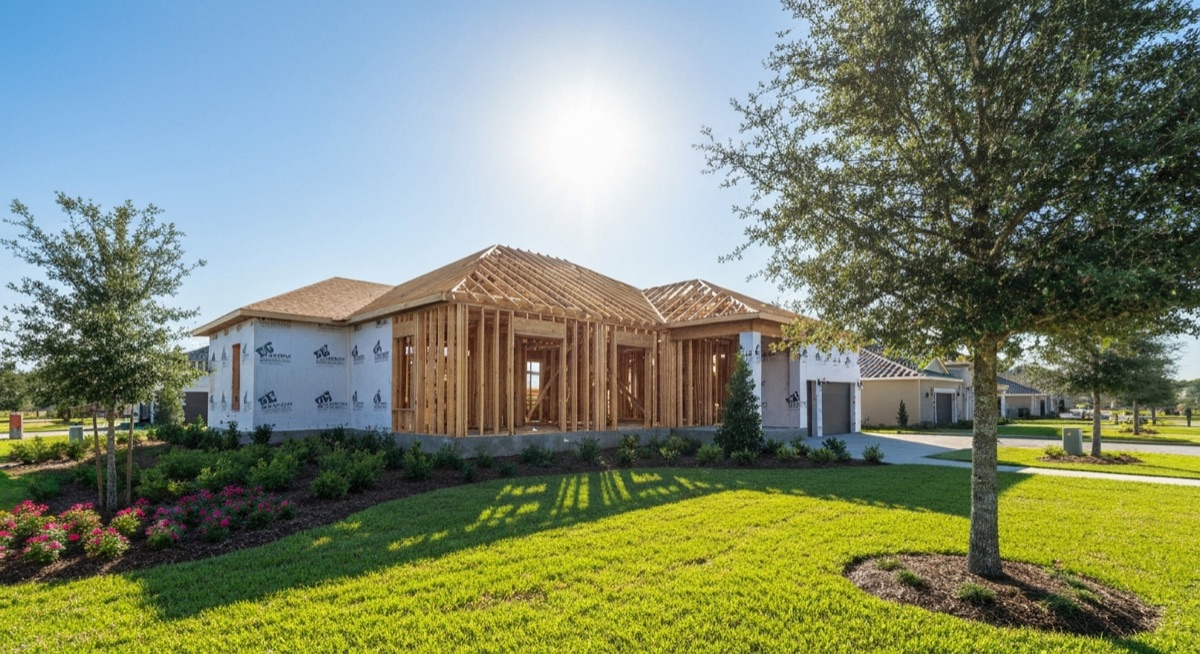
Significant portions of Tavistock’s master plan for Lake Nona remain under active construction. The Town Center buildout is ongoing. New residential phases continue to open. The road network, while improving, still routes around future development in places rather than through completed infrastructure. This means construction traffic on Narcoossee Road on weekday mornings, background equipment noise in developing sections, and a retail and dining base that’s still filling in. None of this is secret. But it’s easy to underestimate when you’re touring model homes on a Saturday.
Buyers who purchased in Laureate Park several years ago have watched their community’s amenity base improve substantially. That’s the upside of buying into a buildout early. The downside is that the neighborhood you move into today is not the neighborhood you’ll be living in at year five. If Tavistock’s timeline holds and the retail market performs, that’s a gain. If construction slips or a major tenant pulls out, that’s a complication. You’re making a bet on future value. Just know that’s what you’re doing.
Flooding requires direct attention — not buried in an inspection contingency. Following Hurricane Ian in September 2022, several lower-elevation sections in the Lake Nona area, particularly in communities along Narcoossee Road, experienced flooding that surprised residents and produced water intrusion claims. The area’s flat topography creates real stormwater management challenges, and ongoing development — which converts permeable land to hardscape — changes drainage patterns in ways the county’s stormwater infrastructure hasn’t fully caught up with. Before closing on any Lake Nona property, pull the FEMA flood map for the specific parcel, ask the seller directly about any history of water intrusion, and review the county stormwater documentation for that sub-community. “Drainage has been improved” from a developer’s sales rep is not documentation.
One more thing that almost never appears in comparison articles but is felt on every 95-degree July afternoon — and there are a lot of them in Orlando: tree canopy. Dr. Phillips’ established neighborhoods, particularly along the Butler Chain and within Vizcaya, have mature oaks that provide real shade, meaningfully lower surface temperatures, and make it possible to sit on a patio after 4 p.m. Lake Nona’s new-construction communities have young trees that are years from providing comparable cover. Summers involve more direct sun exposure and higher electric bills. In a Florida summer, this isn’t a footnote.
Lifestyle: Dining, Errands, and What You Do on a Saturday
Lake Nona’s walkable restaurant cluster at the Town Center — Canvas, Chroma, and Bacon (the diner, not the ingredient, though the name pulls double duty) — is a genuine asset. The trail system, the curated programming, the farmer’s market activations: for households that want a community identity and a walkable social scene inside their neighborhood, Lake Nona delivers. It’s legitimately good at what it’s trying to be.
What it doesn’t yet offer is the depth of external infrastructure that Dr. Phillips residents take for granted. Restaurant Row on Sand Lake Road — Seasons 52, Eddie V’s, Moonfish, The Melting Pot, and a dozen others — is one of Orlando’s best-performing dining corridors, and it’s a 10-minute drive from most of the Dr. Phillips zip code. Mall at Millenia is roughly 10 minutes. Whole Foods, Trader Joe’s, Total Wine, and a dense concentration of grocery options are all within the immediate trade area. You rarely leave the 15-minute radius without finding what you need.
For arts and cultural access — Dr. Phillips Center for the Performing Arts (which carries the neighborhood name for good reason), the Orange County Convention Center, ICON Park, Universal — Dr. Phillips residents are within 20 minutes of a broad slice of the metro’s offerings. Lake Nona residents making the same trips add 20 to 30 minutes each way. On a night at the theater, that’s an extra hour in the car. If you go to the theater once a year, it doesn’t matter. If you go monthly, it does.
Lake Nona offers a better internal community experience. Dr. Phillips offers better external access to what the rest of Orlando has built. Which matters more depends on whether you’re the kind of household that stays in the neighborhood on weekends or one that regularly leaves it. That’s not a small question. Ask it honestly before you sign anything.
Two Buyers, Two Different Calls
Marta and Daniel Chen bought in Laureate Park three years ago. Daniel is a research coordinator at UCF Health in Medical City; Marta works remotely as a UX designer. Their commute calculus was simple — Daniel’s five-minute drive to work versus what would have been a significantly longer haul from Dr. Phillips “changed our daily life in a way that’s hard to overstate,” Marta says.
What surprised them wasn’t the community, which matched their expectations, but the pace of change around it. “Every six months there’s a new restaurant or a new amenity. But there’s also always a new construction project blocking something.” Their block’s tree canopy is slowly improving, but summers still mean taking walks early, before the heat peaks. “We’re betting on what this place will be in 10 years,” Marta says. “We think that bet is right. But some of our neighbors who moved in expecting everything to be finished already have been frustrated.” That framing — conscious bet versus surprise disappointment — is probably the most useful thing a prospective Lake Nona buyer can internalize.
Kevin and Tanya Morales have three children, including a daughter who just finished her sophomore year at Dr. Phillips High. They looked seriously at Lake Nona before choosing Vizcaya. The school track record was decisive. “I wasn’t going to move my kids into an experiment,” Kevin says. “Dr. Phillips High has produced people. It has coaches and college counselors who have been doing this for 25 years.” He notes the irony without prompting: the most durable asset in a neighborhood full of gated communities and lakefront estates is a public high school. Tanya points to Restaurant Row as the lifestyle variable that sealed it. “On a Friday night, we walk to Eddie V’s. We’re not getting in the car.” That convenience, repeated 50 times a year, hits differently when it’s a walk than when it’s a drive.
Their surprise after moving in: HOA enforcement in Vizcaya is more variable than they expected. “It’s voluntary membership in some respects, so some people pay attention and some people don’t. You notice it in how the place looks in certain spots.” That’s a real observation about Bay Hill and some Vizcaya common areas, and it’s the kind of thing that doesn’t show up in a listing description.
The Bottom Line: Which Buyer Profile Fits Which Neighborhood
Lake Nona makes more sense for:
- Healthcare and research professionals employed at Medical City who commute there every workday
- Buyers who want new construction and a community that’s still evolving — and who understand that’s what they’re buying into
- Frequent fliers and airport workers for whom a 12-minute drive to OIA is a daily variable, not an occasional convenience
- Households whose social life is self-contained — trails, community pools, internal dining — rather than spread across the metro
- Buyers willing to trade compressed lot sizes for density-driven amenities and programming
Dr. Phillips makes more sense for:
- Families with high-school-age children who need a school with a long institutional track record, not a promising young one
- Professionals commuting to downtown Orlando, the I-4 corridor, or employers on the metro’s west side
- Buyers who want immediate access to the city’s restaurant and retail infrastructure without waiting for it to get built
- Buyers who want resale market depth — Dr. Phillips has decades of comparable sales and an established buyer pool
- Households with high external activity levels, for whom leaving the neighborhood is the standard weekend pattern
Before making an offer in Lake Nona: Pull the full dual-HOA disclosure and confirm the combined master and sub-community fee total. Check the FEMA flood zone classification for the specific parcel. Confirm the elementary school feeder assignment directly through OCPS. Ask about construction timeline and access changes for any active Tavistock phases near the community you’re considering. Request documentation from the seller about any water intrusion or flooding during Hurricane Ian.
Before making an offer in Dr. Phillips: Confirm whether the community has a mandatory or voluntary HOA structure — Bay Hill is the key variable. Check flood zone status for anything adjacent to the Butler Chain. Verify school zone assignments at every grade level; the corridor’s zones have shifted as enrollment patterns changed, and an address that fed one elementary five years ago may feed a different one today. For any Vizcaya property, understand what’s included in the quarterly fee versus what requires a separate membership payment.
Neither neighborhood rewards buyers who assume the marketing narrative is the complete story.
Data in this article draws from Orange County MLS records, OCPS school grade reports from the Florida Department of Education, FEMA flood mapping data, and Google Maps drive-time calculations conducted during weekday AM peak hours. Resident interviews were conducted in-person and lightly edited for length and clarity. HOA fee ranges reflect current or recently closed listings and are subject to change; confirm current assessments with the respective HOA management companies before closing.