Moving to Orlando Checklist What to Do in Your First 90 Days
A deadline-sequenced compliance and money checklist covering Florida DMV requirements, OUC vs. Duke Energy setup, homestead exemption filing, and what your first summer utility bill will actually l…

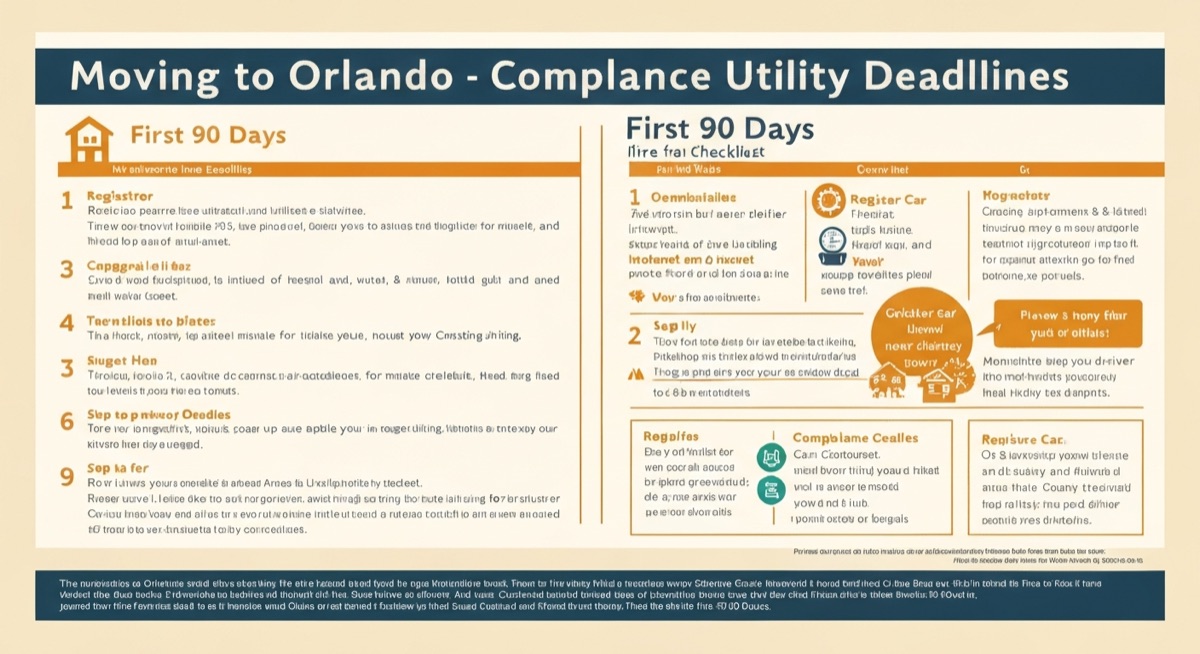
Moving to Orlando Checklist What to Do in Your First 90 Days
A deadline-sequenced compliance and money checklist covering Florida DMV requirements, OUC vs. Duke Energy setup, homestead exemption filing, and what your first summer utility bill will actually look like
If you moved to Orlando last month and haven’t swapped your out-of-state driver’s license for a Florida one, you’re already driving illegally. If you bought a house here in the fall and assume you have plenty of time to file for the homestead exemption, skip to Section 6 now. Most new-resident guides bury these facts or skip them in favor of telling you to visit the theme parks.
This is not that guide.
What follows is a compliance-and-money checklist organized by deadline. The sequence a new Orlando resident needs to follow to avoid penalties, forfeited savings, and the administrative trap that costs Orange County homeowners $700 or more in year-one property tax savings every March. Work through it in order. The calendar at the end is yours to keep.
Before You Arrive: Utilities, Insurance, and Mail
Electricity and water: look up your address first, then assume nothing
The most common utility mistake new Orlando residents make is assuming they know which electric company serves their address based on city name. They’re wrong more often than you’d expect, and it causes real problems on move-in day.
Orlando’s electric service splits between two providers, with a boundary that cuts through several zip codes. OUC—The Reliable One—serves the City of Orlando proper: downtown (32801), Thornton Park and Mills 50 (32803), South Orlando and Conway (32806), Baldwin Park (32814), and the Lake Nona corridor (32832). Duke Energy Florida covers much of unincorporated Orange County, including Winter Park (32789), Dr. Phillips (32836), most of Oviedo (32765), and Horizon West (34787).
Here’s where it gets complicated. Zip codes 32824, 32832, and 32836 contain addresses served by both utilities depending on which side of the municipal boundary your specific parcel falls. Don’t call Duke Energy because your neighbor does. Use OUC’s address lookup at ouc.com and Duke’s service-area tool at duke-energy.com before you do anything else. Both confirm your provider by street address in under a minute. There’s no excuse to guess.
Water and sewer is a separate lookup — yes, you have to do this twice. OUC handles water inside city limits. Orange County Utilities serves most unincorporated areas. Winter Park, Windermere, and the Celebration/Four Corners corridor each run independent systems. New residents most commonly forget this until they turn on the faucet on moving day and nothing happens. Call at least three business days before move-in, ideally a week.
Before arrival: confirm your electric provider by address, initiate service with that provider (OUC: 407-423-9018; Duke: see duke-energy.com when you confirm your area), confirm your water and sewer provider separately and initiate that service at the same time, and set up mail forwarding at USPS.com. You’ll need physical mail delivery confirmed at your Florida address for driver’s license and voter registration documents.
Deposits: what to expect
Duke Energy’s deposit runs about two months of estimated usage. For a typical 1,500–2,000 square foot home that’s somewhere around $300–$440, but Duke bases the actual figure on your specific property and your credit score. Customers with strong credit sometimes have it waived. Confirm when you open the account.
OUC’s residential deposit for renters is roughly $150–$200 and also considers credit history. Call 407-423-9018 to confirm your requirement when you set up service.
Insurance: don’t arrive during hurricane season without it
If you’re arriving between June 1 and November 30, have renter’s or homeowner’s insurance with wind coverage before you unload the truck. This is the one item on this list where being a week late can cost you everything. Several Florida insurers have added wind exclusions or limitations in recent years — read the declarations page before you sign, not after you smell the rain coming in. Florida’s property insurance market is genuinely unusual, and the time to find your coverage gaps is not following a storm.
Days 1–30: Your Florida Driver’s License and Vehicle Registration (This Is a Legal Requirement)
The 30-day clock: when it starts
Under Florida Statute 322.031, any person who becomes a Florida resident must obtain a Florida driver’s license within 30 days of establishing residency. The clock starts when you establish legal residency. Florida defines this broadly. Signing a lease triggers it. Enrolling a child in a Florida school triggers it. Registering to vote here triggers it. Simply declaring your intent to reside in Florida triggers it.
The 30-day window is not 30 days from when you finish unpacking. For most people moving to Orange County, the clock starts on the lease signing date or the closing date. If you’ve been here three weeks assuming there’s a grace period — there isn’t. Schedule your appointment today.
Driving with an out-of-state license after 30 days doesn’t automatically bring criminal charges for most new residents, but it creates insurance complications. Florida is explicit about this.
Where to go and what to bring
In Orange County, driver’s licenses and vehicle registrations are handled by the Orange County Tax Collector, not the DMV. Florida eliminated standalone DMV offices, which is either an improvement or an endless source of confusion depending on who you ask. Schedule an appointment at appointments.octaxcol.com. Walk-ins are accepted but branch wait times can hit two to three hours. The Tax Collector operates multiple locations including Loch Haven, South Orange, and Winter Park.
Bring originals. Photocopies are not accepted.
- Valid, unexpired out-of-state driver’s license
- Two proofs of Florida residential address (utility bill, bank statement, lease, or mortgage documents showing your name and Florida address)
- One proof of Social Security number (Social Security card, W-2, or pay stub with full SSN)
- Proof of citizenship or lawful presence (U.S. passport, birth certificate, or appropriate immigration documentation)
The standard 8-year Florida license costs $48 — check the current fee at flhsmv.gov before your appointment, since Florida adjusts these periodically.
Florida’s standard license is REAL ID-compliant, marked by a star in the upper right corner. REAL ID enforcement for domestic air travel began May 7, 2025. Your out-of-state license may or may not qualify. Find out before you’re at the security checkpoint.
Vehicle registration: same visit, same deadline
Florida requires new residents to register their vehicles within 30 days of establishing residency. Handle this at the same Tax Collector visit. You’ll surrender your out-of-state plates, transfer your vehicle title to Florida, and pay the first-year registration fee. Plan for $225–$400 depending on vehicle weight, model year, and applicable fees — check your specific vehicle’s costs at appointments.octaxcol.com or ask when you schedule.
If you’re still financing the vehicle, your lender holds the title. Call them before your appointment to confirm the title transfer process. Some lenders mail titles directly to the Tax Collector; others require you to coordinate paperwork in advance. People discover this standing at the counter. Don’t be one of them.
Days 1–30: Voter Registration (Do It While You’re at the Tax Collector)
Florida voter registration has no 30-day mandate for new residents, but handle it during your license visit anyway. You have your new Florida license in hand, your address documents are in front of you, and it takes about four minutes.
Florida is a closed-primary state. Your party designation determines which primary ballot you receive. Voters registered as NPA (No Party Affiliation) can vote in general elections but are shut out of partisan primaries unless a party opens its ballot or the race is a special circumstance. In some Orange County races, the primary is effectively the election. Make this decision before you fill out the form.
Three ways to register:
- Online at RegisterToVoteFlorida.gov, using your Florida driver’s license or state ID number
- In person at the Orange County Supervisor of Elections: 119 W. Kaley St., Orlando, FL 32806; 407-836-2070; open Monday through Friday
- At any Orange County Tax Collector branch office
Registration must be on file 29 days before any election you want to vote in. If you’re moving ahead of a municipal or statewide race, call the Supervisor of Elections to confirm the exact cutoff before you assume you’re covered.
Understanding Your Electric Bill Before Summer Hits
If you toured apartments last winter, your future landlord probably showed you reassuringly low utility bills. Enjoy that memory.
Starting in late May, when the humidity settles in and the AC runs without pause, a home in the 1,800–2,000 square foot range will see monthly bills of $150–$220 through September. I’ve heard people describe their first August OUC bill like they’d received a ransom note — and those are people who thought they’d budgeted carefully. The drivers are straightforward: continuous AC, electric water heaters in most Central Florida homes, and tiered rate structures at both OUC and Duke that charge higher per-kilowatt-hour rates once you exceed baseline usage. In summer, most households blow past the baseline threshold by the second week of the billing cycle.
The most useful thing you can do before June: enroll in budget billing. Both OUC and Duke offer it — sometimes called average billing or balanced billing — which spreads your projected annual usage across 12 equal monthly payments. Your winter bills run slightly higher, but your summer bills stop being surprises. Enroll in April or May, before the summer cycle begins. Both utilities allow enrollment online or by phone.
Save these outage contacts now: OUC at 407-423-9018 or ouc.com/outage, and Duke Energy at the outage number listed when you set up your account at duke-energy.com. After a tropical system hits, online outage portals get slow or go dark entirely. The phone number works when the website doesn’t.
Days 31–60: Homestead Exemption Filing—Don’t Miss March 1
Every year, a chunk of Orange County homeowners who moved here in the fall miss the March 1 homestead exemption deadline and forfeit $700 or more in property tax savings. Sometimes considerably more, depending on assessed value. This happens not because they forgot about the exemption — it happens because the timeline feels generous until it collapses.
To claim the homestead exemption for a given tax year, you must have owned and occupied the property as your primary residence as of January 1 of that year, and you must file with the Orange County Property Appraiser by March 1. If you closed on your home in October 2024, you satisfied the January 1, 2025 occupancy requirement. You had until March 1, 2025 to file. That’s four months — during which you’re managing moving logistics, the holidays, the driver’s license appointment, probably a new job, and everything else on this list. Buyers who close in late January or February have a window measured in days. That’s not an exaggeration; that’s the calendar.
The exemption reduces your home’s assessed value by up to $50,000, split as a $25,000 reduction applied to all taxing authorities and a second $25,000 applied to non-school millage rates. On a median Orange County home, that comes to $700–$1,100 in annual savings at current millage rates. Confirm the precise calculation with the Orange County Property Appraiser at ocpafl.org, since millage rates are set annually.
File online at ocpafl.org. Most straightforward cases can be completed without an in-person visit. You can also go to the Orange County Property Appraiser’s office at 200 S. Orange Ave., Suite 1700, Orlando, FL 32801.
You’ll need your Florida driver’s license showing your new address, Florida vehicle registration showing your new address, Social Security numbers for all owners on the deed, and either your recorded deed or prior year’s tax receipt. The address on your Florida driver’s license must match the property you’re claiming. If you got your license at a temporary apartment address and have since closed on a house, update your license address before you file. This mismatch delays applications constantly.
The OCPA administers several additional exemptions beyond the standard homestead:
- Senior exemption: additional $25,000 for residents 65 and older with limited income
- Widow or widower exemption: $500 reduction in assessed value
- Disability exemptions: varying amounts; totally and permanently disabled residents may qualify for full exemption
- Veteran exemptions: service-connected disability ratings trigger significant reductions
None of these are applied automatically. You have to ask, and most people don’t. Ask when you contact OCPA.
Save Our Homes portability: If you’re moving from another Florida property where you had homestead exemption, you may have accumulated a Save Our Homes benefit — the gap between your previous home’s assessed value and its market value, capped at 3 percent annual growth under Florida law. This benefit is portable to your new Orange County home. File Form DR-501T (Transfer of Homestead Assessment Difference) with the Orange County Property Appraiser by the same March 1 deadline. If you had a long-term homestead with significant equity at your prior Florida address, this can be worth thousands of dollars in additional assessed-value reduction. Call OCPA and ask what you’ve built up before you assume it doesn’t apply to you.
Days 31–60: School Enrollment, HOA Onboarding, and Business Registration
School zone assignments in Orange County are determined by your residential address, not your neighborhood’s name or reputation. Look up your assigned school at ocps.net using the district’s online zoning tool. Enrollment goes through the MySchoolOC portal. You’ll need proof of address, immunization records, birth certificate, and prior school records.
Orlando’s highest-growth communities — Lake Nona, Laureate Park, Horizon West, Baldwin Park, most master-planned developments in the southwest corridor — are governed by homeowners associations with architectural review requirements. These associations have real enforcement authority: fines, liens, legal action for violations that can seem minor until they aren’t. The time to read the CC&Rs is before you paint the front door or put up a basketball hoop, not after you get a violation notice. Request the complete onboarding packet and architectural review process documents from the HOA management company within your first two weeks. If the prior owner or your closing attorney didn’t hand these over, contact the HOA management company directly — the association name and manager should appear in your closing documents.
If you’re operating a business from your new Orlando address — freelancing, consulting, any taxable sales or services — register for Florida sales tax collection with the Florida Department of Revenue at floridarevenue.com. This is separate from any local business tax receipt required by Orange County or the City of Orlando for certain business types. For a broader look at the costs of formalizing a business here, our moving & real estate coverage tracks what new residents need to know about establishing roots in Central Florida.
Days 61–90: Hurricane Preparedness and Flood Insurance
Flood damage is excluded from standard homeowner’s and renter’s insurance policies. Flood coverage requires a separate policy through the National Flood Insurance Program or a private insurer. Several Orlando neighborhoods fall within FEMA-designated flood zones, including parts of Audubon Park, College Park, and portions of Lake Nona. FEMA Zone AE — the high-risk designation requiring mandatory flood insurance for federally backed mortgages — applies to specific parcels that aren’t always obvious from street level. The land around Orlando’s lakes and along its drainage corridors carries real flood risk in ordinary years, not just storm years. Orlando has a lot of lakes. The standing water has to go somewhere.
Check your property’s flood zone at the FEMA Flood Map Service Center by entering your address. If your lender required flood insurance at closing, look at what that policy actually covers and whether the limits match your home’s replacement cost.
Register for emergency notifications through Orange County Emergency Management at ocfl.net/emergencymanagement. The AlertOrange system sends alerts for weather emergencies and evacuation orders by text, email, and phone. Registration is free and takes five minutes. Identify your nearest public shelter before the season peaks — Orange County publicizes shelter locations at the same Emergency Management site.
A few things to know before you need to know them: not all general-population shelters accept animals. Orange County maintains separate pet-friendly shelter designations. If you have a household member with a disability or a medical condition requiring power continuity, contact Orange County Emergency Management about special needs shelter registration. These are not details you want to research when a named storm is 48 hours out.
Hurricane season runs June 1 through November 30. If you arrived this summer, these steps are not optional.
Mark Your Calendar: Hard Deadlines at a Glance
| Deadline | Task |
|---|---|
| Move-in day | Utilities confirmed and active; insurance policy in force |
| Day 30 from residency establishment | Florida driver’s license obtained (legally required under §322.031) |
| Day 30 from residency establishment | Vehicle registration transferred; out-of-state plates surrendered |
| While at Tax Collector (Days 1–30) | Voter registration completed or initiated |
| 29 days before any election | Voter registration must be on file to vote in that race |
| January 1 of tax year | Must be occupying property as primary residence to qualify for homestead exemption that year |
| March 1 | Homestead exemption application due at Orange County Property Appraiser — no extensions |
| March 1 (same deadline) | Save Our Homes portability form DR-501T due if transferring from prior Florida homestead |
| April–May | Enroll in budget billing with OUC or Duke Energy before summer billing cycle begins |
| June 1 | Hurricane season opens — AlertOrange registration, shelter identification, flood insurance in force |
| May 7, 2025 | REAL ID enforcement in effect for domestic air travel — confirm your Florida license carries the star |
One more note for fall buyers: if you closed between August and December, the runway to March 1 is shorter than it feels. A November closing gives you roughly three months, during which you’re still managing moving chaos and the holidays. File the homestead exemption application as soon as your Florida driver’s license reflects your new address. There is no benefit to waiting, and missing the deadline means paying a higher property tax bill for the full year — a year you can’t get back.
Verification note: Driver’s license fees, utility deposit amounts, and first-year vehicle registration costs are based on current published rates and should be confirmed directly with the relevant agency before acting, as Florida adjusts fee schedules periodically. The OUC and Duke Energy service boundary in zip codes 32824, 32832, and 32836 requires address-level confirmation through each utility’s online lookup — city name alone is not reliable. Orange County Property Appraiser millage rates are set annually; the savings estimate cited reflects recent rate levels and will vary by parcel.