Where Orlando Real Estate Prices Stand in Mid 2026
OCPA deed data, Stellar MLS figures, and local market structure map where Orange County's housing market actually stands at mid-2026 — and where it's headed.

Where Orlando Real Estate Prices Stand in Mid 2026
OCPA deed data, Stellar MLS figures, and local market structure map where Orange County’s housing market actually stands at mid-2026 — and where it’s headed.
The simplest question buyers and sellers are asking right now has two honest answers depending on which part of Orange County you’re watching. In Horizon West and the new-construction corridors pushing west toward Clermont and east into Osceola, production builders are quietly handing buyers mortgage rate buydowns and closing cost credits to clear inventory. Three miles closer to downtown, in Winter Park and Baldwin Park, resale sellers are holding asking prices firm and occasionally getting them. One metro, two markets, running simultaneously.
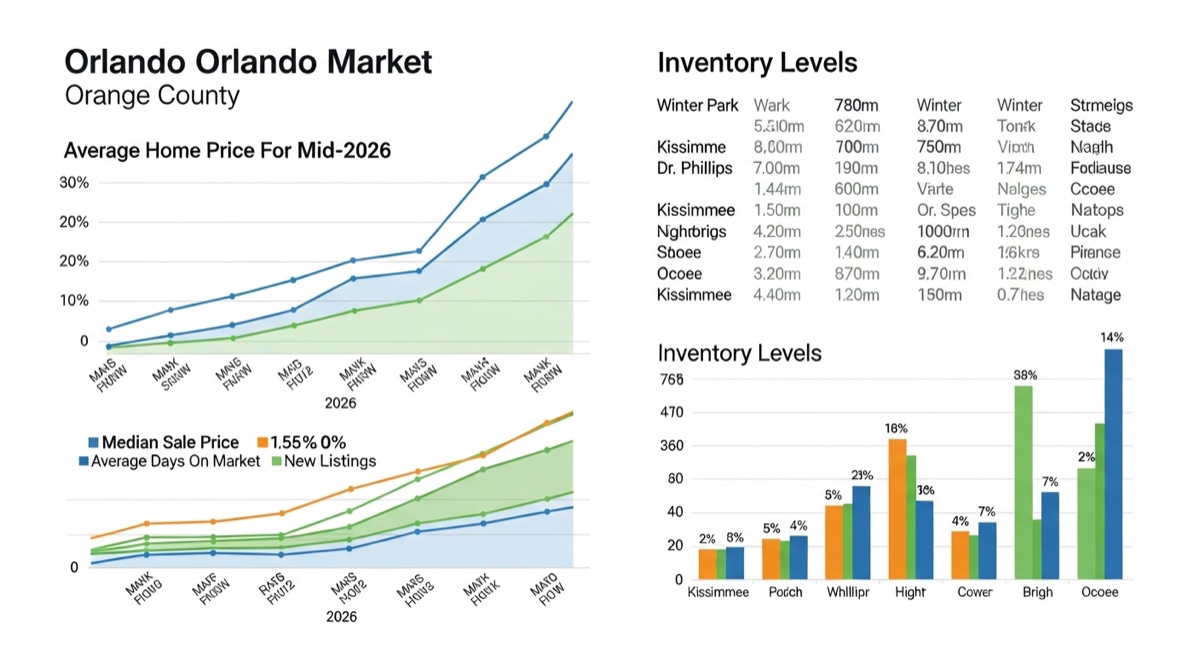
That tension is what the numbers show. Orange County Property Appraiser deed records through Q2 2026 log a countywide median single-family sale price in the high $400,000s — verify the current figure against OCPA’s recorded-sale tables at ocpafl.org, since that’s the number that actually transferred at closing, not what MLS press releases report. Stellar MLS active single-family listing counts and countywide average days on market place months of supply in balanced-to-slightly-buyer-favorable territory. Above the threshold that defined the 2021–2022 seller’s market in this metro. Well short of the level that would give buyers real negotiating power across the board.
What those figures hide is as important as what they reveal.
The Hard Numbers — And What They Actually Measure
Bad decisions get made when buyers confuse list-price medians with recorded-sale medians. I’ve seen it happen more times than I’d like, so a brief translation before the ZIP-code breakdown.
The median cited here comes from OCPA deed data — the price recorded with the county at closing. MLS-reported medians, which dominate press releases and syndicated portals, miss builder sales recorded directly through title without a co-op MLS listing. That’s a significant gap in a county where new construction accounts for a large share of closings. If you’ve been tracking Orlando prices through Zillow headlines alone, you’re working with incomplete information.
Days on market as reported by Stellar MLS measures from original list date to contract date for single-family resale. The countywide average covers a wide spread. Inner-ring resale properties in high-demand ZIP codes are contracting faster than the county average; new-construction spec homes in the outer corridors are sitting considerably longer before the builder negotiates a deal.
Months of supply is absorption rate: active listings divided by the trailing 30-day closed sales rate. At the current reading, Orange County is in balanced-to-slightly-buyer-favorable territory — the kind of market that produces flat prices rather than rapid appreciation or meaningful correction, absent a catalyst in either direction. Boring, maybe, but boring is survivable.
Buyer’s Market or Seller’s Market? The Answer Is the ZIP Code
The county supply figure is an average, and averages flatten the most important information.
Winter Park (32789) and Baldwin Park (32814) are running under fundamentally different supply conditions than the rest of the county. Active inventory in both ZIP codes sits well below the county average on months of supply. List-to-sale ratios cluster tightly around asking price. Days on market for move-in-ready product is often cut in half relative to the county median. Multiple-offer situations are common enough that buyers waiving inspections or appraisal contingencies are still present, still winning deals. If that sounds like 2022, it is — just for these specific corridors.
Dr. Phillips (32836) is a softer version of the same dynamic. The 32836 corridor carries median sale prices in the $600,000s to $900,000-plus range, and days on market remain below the county average. Proximity to Restaurant Row and the premium school assignments keeps demand steady even when broader sentiment softens.
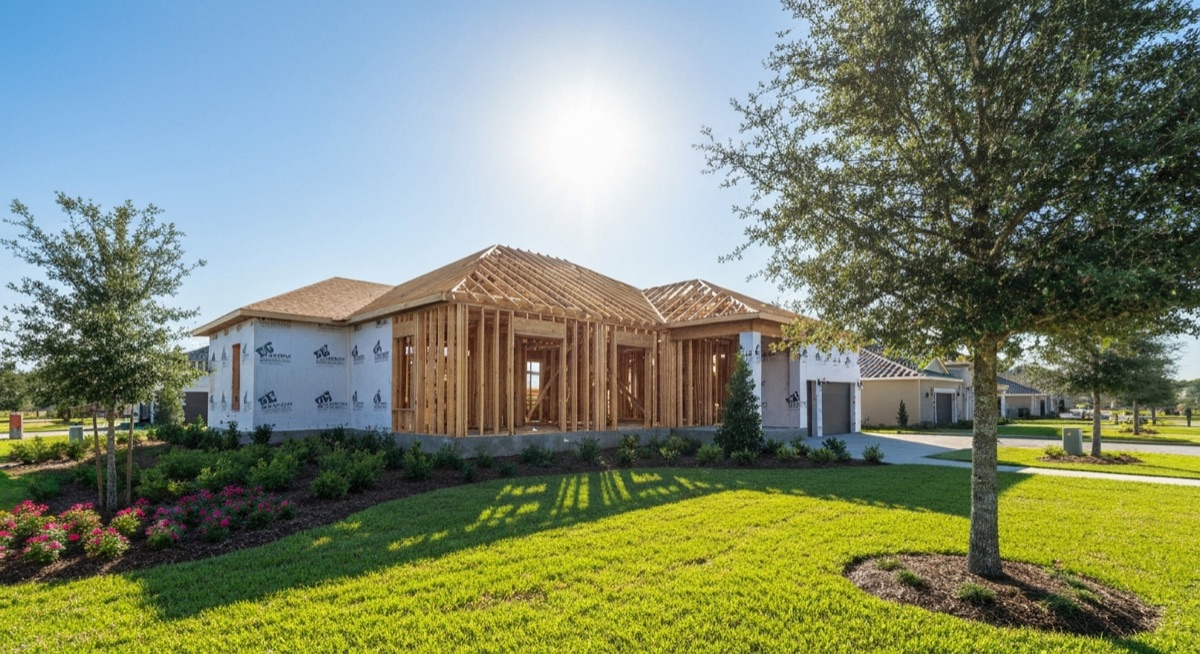
The picture is different in the western corridor. Horizon West (34787) — which covers the Villages of Horizons West, Summerlake, Waterleigh, and the communities that have absorbed the bulk of production builder activity over the past four years — currently shows months of supply above the county average when builder spec inventory is included. Days on market for resale properties in 34787 run above the county figure. For builder spec homes, the effective market time before a negotiated contract is considerably longer and often disguised by price reductions and incentive packages that never touch the MLS list price. The gap between what the data shows and what’s actually happening in those sales offices is real.
Sunbridge, DR Horton’s master-planned development straddling southeast Orange and Osceola counties, is in a similar position. Builder activity there remains aggressive. The distance from established employment nodes means demand is more interest-rate-sensitive than in closer-in ZIP codes — which matters now.
The Builder Discount Problem
Here’s something that doesn’t get discussed enough: in Horizon West and Sunbridge right now, a buyer willing to do the work can negotiate a lower effective purchase price without the list price moving a dollar.
Production builders including DR Horton, Pulte, and Meritage are using preferred lender relationships to offer rate buydowns and closing cost credits. On a purchase in the western corridor, the net present value of a negotiated buydown package over the first several years of ownership is real money. None of it shows up in the list price. None of it shows up in MLS sold data. A buyer who walks into a builder sales office unrepresented and one who brings a buyer’s agent will walk out with dramatically different effective purchase costs on the same property. The person at the sales desk works for the builder. That’s not a knock on them — it’s just the situation.
Builder incentive packages change quarterly and are tied directly to inventory position. The pipeline isn’t shrinking. Orange County Building Division permit data through Q2 2026 confirms continued high-volume permitted activity countywide, concentrated in Horizon West (34787) with secondary clusters in Lake Nona (32827) and Apopka (32712). Builder inventory will keep entering the market through at least 2027, which means the incentive environment will remain a negotiating factor for the foreseeable future. For buyers evaluating what new construction in Orlando actually delivers at this stage of the cycle, the incentive math is the most underreported part of the transaction.
The Resale Constraint — Why Longtime Owners Aren’t Listing
The low resale inventory in the inner suburbs stems primarily from Florida’s Save Our Homes assessment cap, not from seller optimism. It’s underexplained in almost every piece of Orlando housing coverage I’ve seen, and understanding it is essential to reading this market correctly.
Under SOH, a Florida homestead’s assessed value for property tax purposes can’t increase more than 3 percent per year, regardless of what market values do. An owner who bought in College Park or Maitland over a decade ago — on a property that has since appreciated substantially — may have a taxable assessed value that has grown only modestly relative to current market value. Their property tax bill reflects that capped assessment. The moment they sell and buy elsewhere in Florida, they can port their SOH benefit to the new property. But there’s a two-year window to execute the transfer, the calculation is complicated, and if they’re downsizing or moving to a different price tier, they may lose a chunk of the accumulated benefit.
The practical result: many owners who would otherwise be logical sellers — empty-nesters in oversized homes, households that would benefit from relocating closer to job changes — are doing the math and staying put. It’s a perfectly rational individual decision that collectively makes the market tighter for everyone else. This dynamic is one reason inner-suburb inventory figures look so different from the western corridor. The owners who have been in place longest are the least likely to list.
A ZIP-Code Tier Map for Buyers
Not every ZIP in Orange County deserves the same analysis. Here’s what current OCPA price-per-square-foot data and Stellar MLS activity figures show across three tiers.
Tier One — Premium Resale and Institutional Demand Zones
Winter Park (32789), Baldwin Park (32814), and Lake Nona Medical City (32827) occupy a different market category than the rest of the county, for different reasons.
Winter Park and Baldwin Park price-per-square-foot figures have been stable in recent quarters — not appreciating rapidly, but not correcting either. The floor in Winter Park is set by constrained inventory, the school district assignments, and the simple fact that it has been Orlando’s established-wealth ZIP since the early twentieth century. That doesn’t shift when mortgage rates move. Baldwin Park’s New Urbanist format — the walkable village, the grid streets, the neighborhood commercial — genuinely doesn’t exist elsewhere in Orange County at this price tier. Buyers pay for that scarcity, and the scarcity isn’t going away.
Lake Nona tells a different story. The VA Medical Center, Nemours Children’s Hospital, the USTA National Campus, and the Amazon logistics presence in the 32827 corridor have created an employment demand cluster that sustains pricing for the newer construction stock dominating the ZIP. Active listing inventory in 32827 remains tight relative to the pace of closings; days on market are among the lowest in the county. Buyers who’ve been told Lake Nona is “too far” from downtown should reconsider. The employment node has shifted far enough east to change the commute calculation — and the infrastructure investment there isn’t stopping.
Tier Two — Mid-Market Activity Zones
The UCF corridor (32826, 32817) mixes older construction from the 1980s and 1990s, investor-held rentals, and modest newer townhome product. Days on market in both ZIP codes run close to the county median. This is where buyers have the most negotiating room on resale without venturing into neighborhoods that carry perception risk. The UCF Research Park and Medical City spillover provide employment anchoring, and investors have been active here for a decade — which creates a ready exit market for anyone who needs to sell.
Oak Ridge and Meadow Woods (32837) offer comparable price-per-square-foot figures with stronger school assignment profiles in parts of the zone. This corridor has been absorbing south-Orlando relocation demand from buyers priced out of Dr. Phillips. Days on market trended modestly downward over the past two quarters. Worth watching.
Tier Three — Value and Trajectory Watch
Pine Hills has carried a crime-perception discount for years and is priced accordingly — the lowest price-per-square-foot figures in the county for residential single-family product. The trajectory in 32808 is more complicated than the headline reputation suggests. Proximity to Edgewater High School’s International Baccalaureate program and the SoDo District generates genuine demand from price-conscious buyers who know the neighborhood block by block. The risk profile is real and shouldn’t be dismissed. But the ZIP-code brand is considerably bleaker than the actual market opportunity in select streets — a gap that rewards buyers who do granular due diligence and punishes those who only look at the headline number.
Apopka (32712) is the most significant trajectory play in Orange County right now. One specific reason: the I-429 Western Beltway extension has changed commute calculus to downtown and to the SR-429 tourism corridor. New construction is entering 32712 aggressively — the permit data confirms it. Price-per-square-foot figures are closing the gap with mid-market corridors faster than most buyers realize. The risk is rate sensitivity. Apopka buyers skew toward first-time purchasers, which means monthly payment changes affect this ZIP’s demand more sharply than closer-in submarkets where cash buyers and equity-rich relocations provide a cushion. If rates spike again, 32712 feels it first.
How Orlando Stacks Up Against Tampa and Jacksonville
Orange County (Orlando) is running in the high $400,000s on countywide median single-family sale price as of mid-2026 — verify current figures against OCPA deed data and the latest Florida Realtors county-level report, as the relationship between these three metros has been consistent even as the specific numbers shift.
Hillsborough County (Tampa) has tracked near Orlando on median but at a higher price per square foot, reflecting Tampa’s older, smaller resale-dominant inventory versus Orlando’s new-construction-heavy stock. Tampa buyers are paying more per square foot for a product mix that skews smaller than what Orlando’s production-builder corridor delivers. That’s not a knock on Tampa. It’s what the product mix difference produces at equivalent price points.
Duval County (Jacksonville) has historically tracked below both markets on median, benefiting from corporate relocation activity but maintaining a gap that reflects its resale-heavy, older inventory composition.
For buyers comparing Florida metros: Orlando’s new construction value proposition — more square footage, builder incentives currently in play, continued infrastructure investment — is a genuine advantage over Tampa’s resale market at equivalent price points right now. Jacksonville offers lower entry costs but fewer of the demand drivers that support appreciation in the near term.
The Carrying-Cost Problem — What the Sticker Price Doesn’t Include
The most important number in an Orlando purchase right now isn’t the contract price. It’s the effective monthly cost of ownership after insurance and impact fees are layered in. Those numbers have moved more than most buyers expect when they sit down at a closing table for the first time.
Property insurance in Orange County is in an uncomfortable transition. Citizens Property Insurance has been executing its depopulation program under the 2022 and 2023 legislative reforms. Private carriers have re-entered the market selectively, primarily for newer construction with favorable wind mitigation ratings. For older resale product with aging components, Citizens remains the de facto option for many buyers — and Citizens premium levels in Orange County have been rising under rate filings with the Florida Office of Insurance Regulation.
A buyer purchasing a 1985 home in central Orange County will face drastically different insurance quotes than one purchasing a 2024 spec home in Horizon West. Get actual quotes as part of the purchase process. Not estimates — quotes. Guessing wrong will skew the entire ownership calculation in ways that are painful to discover after closing. Our Orlando home insurance carrier and rate coverage for 2026 breaks down which private carriers are actively writing policies and what Citizens depopulation means for resale buyers specifically.
Orange County construction impact fees — roads, schools, parks, fire — have increased in recent years and represent a real per-unit cost on new construction. In a competitive builder market, some portion is being absorbed in incentive packages. In a tighter supply environment, it gets passed through entirely.
When running the rent-versus-own calculation, build a full monthly PITI figure using an actual insurance quote, property taxes at the assessed value that will apply post-purchase, and any applicable HOA. A $410,000 purchase at 6.5 percent with $200 per month in insurance and a $1,800 annual property tax assessment is not the same carrying cost as a $390,000 home with $100 per month insurance and a $1,300 tax bill. The $20,000 price difference will be insignificant compared to the monthly cost divergence over a ten-year hold. Run that math twice.
Seasonal Context — What Mid-2026 Timing Means
Orlando’s real estate calendar has predictable rhythms and the current data is tracking on pattern. The spring listing season — Orlando’s peak window running March through May — pushed active inventory to its Q2 peak. That inventory is now into the slow summer absorption that typically runs from late June through August.
The summer window historically produces better negotiating conditions than the spring peak. Two reasons. First, families who needed to be in place before the school year are locked in; buyers entering the market in July are either investor-adjacent, relocating on corporate timelines, or genuinely flexible. Second, hurricane season psychology — however rationally assessed — suppresses buyer activity and extends days on market in ways that have nothing to do with underlying value. You can debate whether that caution makes sense. It happens every year regardless.
For sellers in the inner suburbs considering listing, the window between now and mid-August represents the last push of motivated family-formation buyers before the market goes quiet until October. In Winter Park and Baldwin Park, demand remains strong enough that waiting until fall carries limited risk. The spring urgency premium is behind you, but the floor is holding.
What a mid-summer market shows compared to April is fewer multiple-offer situations and more buyers taking the full inspection period before removing contingencies. That’s normal. It doesn’t mean the market has changed direction. The buyers active right now tend to be more deliberate — and honestly, that’s a healthier transaction environment than the waive-everything conditions of two years ago. A buyer who spends two weeks on inspections is far less likely to have regrets than one who waived contingencies to win a bidding war in April.
What Mid-2026 Data Says About Whether to Move or Wait
Buying new construction under $450,000 in Horizon West, Sunbridge, or Apopka: This is an actionable window. Builder incentives are available now and are tied to inventory position that could shift in either direction — builders don’t maintain incentive programs once absorption improves, that’s not how their business model works. Buyers who engage a buyer’s agent rather than walking into builder sales offices unrepresented will capture more of the available discount. The signal to watch: if mortgage rates decline materially before Q4, builder incentive packages will compress quickly as demand absorbs the rate relief.
Resale buying at $500,000 and above in Winter Park, Baldwin Park, or Dr. Phillips: You’re not getting meaningful concessions on well-priced, well-conditioned product in these corridors. If you’re waiting for a correction in the premium inner-suburb tier, the structural factors work against you — SOH lock-in, irreplaceable school assignments, constrained lot supply. The risk of waiting is missing a specific property, not a macro price move.
Resale selling in inner Orange County: Your market is stable. The seasonal slowdown is real but not alarming. List-to-sale ratios in your ZIP codes remain close to asking price, and the correction affecting sellers in the western corridors hasn’t arrived here. Pricing discipline matters more than it did two years ago — overpriced listings are now sitting noticeably longer even in the strongest ZIP codes. Watch your submarket’s months of supply; if it starts trending up, pricing power will follow.
Renting and doing the ownership calculation: The honest math on rent-versus-own in Orlando at current mortgage rates favors renting unless you have a five-plus-year commitment horizon and are targeting new construction with maximum builder incentives. The monthly cost gap between owning and renting a comparable unit is real in most submarkets when insurance, taxes, and maintenance reserves are properly accounted for. That gap narrows if you capture a rate buydown and hold long enough for appreciation and principal paydown to close the equation. It does not narrow if you buy and sell inside three years. No exceptions.
The market isn’t in crisis and it isn’t in recovery mode. It’s in the kind of grinding, differentiated mid-cycle that rewards precision over generalization. The ZIP-code data matters more than the county headline, and the countywide median figure that will dominate every press release this quarter tells a fraction of the story that residents making real financial decisions need to hear. For deeper context on how this fits into our moving & real estate coverage of the Orlando metro, the ZIP-level detail here is meant to be read alongside current transaction data — not instead of it.
Reporting note: OCPA Q2 2026 deed data accessed through the Orange County Property Appraiser’s online sales search (ocpafl.org). Stellar MLS active listing figures represent a 30-day pull as of late June 2026. Florida Realtors county-level comparison figures reflect the most current available reporting period at time of publication. Citizens and Florida OIR rate data drawn from publicly available rate filings. Readers should verify all specific figures against current OCPA, Stellar MLS, and Florida Realtors data at time of use, as market conditions in this report reflect mid-2026 conditions.