Winter Park vs Baldwin Park Orlando Which Neighborhood Fits You
Same high school, different HOA bills, and a lifestyle gap that's bigger than the price gap suggests.

Winter Park vs Baldwin Park Orlando Which Neighborhood Fits You
Same high school, different HOA bills, and a lifestyle gap that’s bigger than the price gap suggests.
There’s a version of this comparison on every real estate aggregator site: two side-by-side boxes, a median price, a Walk Score, a paragraph about “great schools and restaurants.” It’s almost useless. The households actually choosing between Baldwin Park and Winter Park — relocating professionals, families weighing school zones against square footage — deserve something more honest than a listicle built from zip code averages.
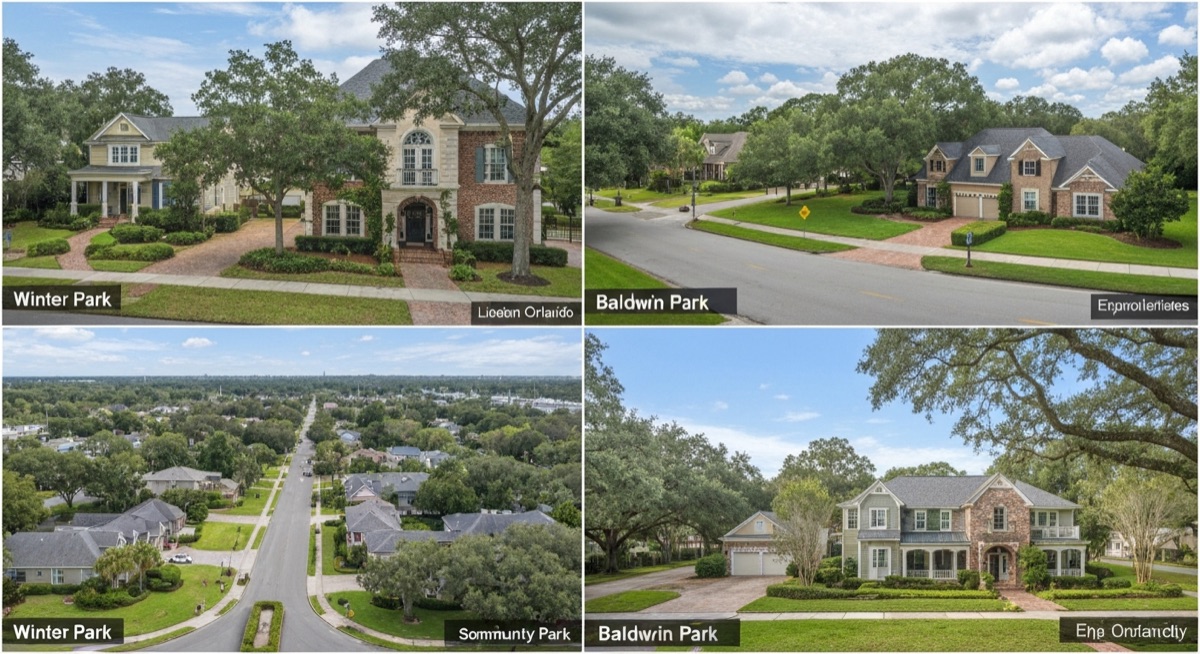
These two neighborhoods sit roughly three miles apart. They share a high school. On any given week, the same buyer’s agent might show listings in both. Yet living in one versus the other differs in ways that don’t show up in headline numbers: what you pay in fees beyond your mortgage, whether you need a car to get dinner, whether your kid walks to school or gets driven, whether you can add a deck without going before a review board. This piece works through those differences, criterion by criterion, with actual numbers attached.
What You’re Actually Paying — And Why Winter Park’s Median Lies to You
Price data sourced from Stellar MLS via ORRA; verify current figures at orlandorealtors.org before making any decision.
Baldwin Park’s inventory is legible. Townhomes and villas start around $400,000–$550,000; single-family homes on the most desirable streets push into the upper end of the market. The median for detached single-family homes has been tracking around $650,000–$750,000. That consistency is actually unusual for Orlando. Baldwin Park is a master-planned community built out over roughly two decades, and its architectural palette, lot sizes, and construction quality are intentionally uniform. Price variance comes primarily from size, phase, and proximity to the lake — not from wildly different property types scattered across the same zip code.
Winter Park operates differently, and its citywide median for 32789 — running around $700,000–$800,000 — obscures more than it clarifies. The lakefront estates on Lake Maitland, Lake Virginia, and the Chain of Lakes, properties that routinely trade at $2 million and above, drag that figure upward in ways that have nothing to do with what a relocating family with a $650,000 budget will actually find. Buyers working with a realistic entry-level budget for the walkable core near Park Avenue should expect smaller bungalows and cottages starting around $500,000 for older, renovated homes on small lots. Anything with a garage, extra square footage, or recent construction costs considerably more. Townhomes and condos near Park Avenue start in the $400,000s but compete hard with investor and second-home buyers.
Here’s the detail that trips up a surprising number of buyers: a substantial portion of addresses carrying a “Winter Park” mailing address are actually in zip code 32792, east of U.S. 17-92, outside the incorporated city. Those parcels sit in unincorporated Orange County or the City of Casselberry. Different tax structures, different utility providers, different millage rates — and in many cases, different school assignments. A buyer who thinks they’re buying into “Winter Park schools” based on a mailing address alone has made a potentially expensive assumption. Verify exact school zones through the OCPS School Locator before you’re under contract. No exceptions.
If your budget is $550,000–$750,000, you’re shopping genuinely overlapping territory. What you get at that price differs substantially, though. Baldwin Park at that number gets you a well-maintained planned-community home with predictable neighbors, consistent finishes, and covered common infrastructure. Winter Park at that number gets you older construction with more individual character, higher price-per-square-foot variability, and more homework on the specific block.
Baldwin Park’s HOA and CDD — The Fee Structure Most Buyers Get Wrong
This is the section that competing neighborhood coverage almost universally botches, and the error costs buyers real money.
Baldwin Park has two distinct cost layers. The first is the Baldwin Park Community Association (BPCA) annual HOA assessment: shared administrative costs, common-area maintenance, programming, and amenities. The BPCA assessment has historically run $400–$600 per year — lower than most buyers assume when they hear “HOA community.” It covers access to three pools (Village Center, New Broad Street, and Lake Baldwin), fitness centers, lake frontage, and the community event calendar. Verify the current figure at baldwinparkorlando.com or ask your agent to pull the HOA disclosure.
The second layer is the Community Development District (CDD) charge, and this is where buyers get surprised at closing. The CDD isn’t collected by the HOA. It appears as a line item on your annual Orange County property tax bill, which is exactly why buyers miss it during the offer process if they’re not looking carefully. Depending on phase and parcel, the CDD assessment runs roughly $1,500–$3,000 or more per year. On a $700,000 home, that changes your monthly budget math in ways you need to account for before you fall in love with a listing. I’ve heard buyers describe this moment at closing as an unpleasant surprise. It doesn’t have to be.
The CDD pays primarily for the infrastructure bonds that financed Baldwin Park’s original development — roads, streetscape, lake management, stormwater systems — and ongoing maintenance of that infrastructure.
Two other operational realities deserve explicit mention. The Design Review Board (DRB) governs all exterior changes. Repainting your house requires an approved color. A fence, a deck addition, a landscaping overhaul, a garage door replacement — the DRB has jurisdiction over all of it. For buyers who want the neighborhood to look consistent in fifteen years, this is a feature. For buyers who planned a second-story addition or any real creative latitude over their own property, it is an actual constraint, not a bureaucratic inconvenience. Know it before you’re under contract.
Airbnb and VRBO uses are prohibited by BPCA rules. This matters to a specific subset of buyers considering occasional rental income; it won’t affect most owner-occupants.
Verify current CDD assessments and phase information through the Orange County Property Appraiser (ocpafl.org). BPCA governance documents are at baldwinparkorlando.com.
Winter Park Has No HOA — What That Freedom Costs and Buys
Most residential properties in historic Winter Park — the established streets of 32789, the Park Avenue-adjacent blocks, neighborhoods north of Fairbanks and east of U.S. 17-92 inside the city limits — carry no HOA. This is a genuine and underreported financial distinction, and it doesn’t make it into most neighborhood comparisons.
No HOA means no architectural approval process for most changes. Paint your house a color that wouldn’t pass a DRB review. That’s your call. Put up a fence, tear out a lawn, add solar panels, convert your carport — in most of Winter Park’s core neighborhoods, you need a standard building permit and nothing else. No annual assessment for shared amenities you may or may not use.
What you do have, in certain designated areas, is the City of Winter Park’s historic preservation framework. The city maintains historic districts concentrated around Hannibal Square and portions of the city center. In those areas, the Historic Preservation Board has design authority over exterior changes to contributing structures. Buyers purchasing an older home on a historic-district street should check the city’s historic district map before assuming they can alter the facade or add a story without review.
Winter Park Electric is a municipally owned utility — unusual in the Orlando region, where most residents are served by Duke Energy Florida or OUC. It has a strong local reputation for reliability and responsive storm response. Whether its rates run higher or lower than comparable service depends on usage tier. Check cityofwinterpark.org for current rate schedules.
The City of Winter Park’s millage rate is distinct from Orange County’s. City homeowners pay city taxes on top of county taxes. A $700,000 home inside the city carries a different annual tax bill than a $700,000 home with a Winter Park mailing address in unincorporated Orange County. Pull the actual Orange County Property Appraiser record for any specific address rather than trusting a mailing address.
Some Winter Park townhome and condo developments near the southern and eastern edges of the city do carry HOA fees. But a buyer attracted to Winter Park’s character is typically attracted to the freestanding homes that define it — and those are largely fee-free.
Schools — Specific Assignments, Not Just “Good Schools”
Verify every assignment at the OCPS School Locator: ocps.net. School zones change. This section reflects general 2024–25 patterns and is not a substitute for an official zone check on a specific address.
For Baldwin Park, the school picture is unusually straightforward. Baldwin Park Elementary sits inside the community — a walkable distance from most homes. It holds an A rating from the Florida Department of Education. In a metro where school drop-off logistics can consume thirty minutes of a parent’s morning, having an A-rated elementary you can walk to changes your daily schedule in ways that compound over six years of elementary school. Students then feed to Glenridge Middle and Winter Park High School, which runs an International Baccalaureate program for motivated students wanting college-level coursework and internationally recognized credentials.
For Winter Park, the picture is considerably more complicated — and this is where buyers make expensive mistakes. Properties in the walkable 32789 core typically feed Lakemont Elementary or Dommerich Elementary, both well-regarded with strong parent communities. Middle school assignments from the city core generally go to Maitland Middle, then Winter Park High. But not all Winter Park addresses feed those schools. The eastern 32792 properties carrying Winter Park mailing addresses can fall into entirely different zones, sometimes with lower ratings. Buyers relying on a neighborhood name rather than an OCPS zone check on their specific prospective address are taking a gamble they probably don’t realize they’re taking.
Both neighborhoods share Winter Park High and its IB program. For families whose primary concern is high school quality, that’s a meaningful equalizer. For families with younger children, elementary school matters most, and Baldwin Park’s on-site A-rated elementary is a real advantage — probably the clearest one-sided win in this entire comparison. Families committed to private school regardless of zone should know the major local options: Lake Highland Preparatory School in Ivanhoe Village, Trinity Preparatory School in east Winter Park, and The Geneva School in Winter Park, each with distinct academic cultures and their own enrollment processes.
Walkability and Daily Life — What You Can Actually Get To Without a Car
Walk Scores fluctuate; verify at walkscore.com for a specific address before citing.
Baldwin Park’s walkability is curated and internal. The New Broad Street village center is the commercial spine: Ollie’s Public House, The Whiskey, a wine shop, a coffee option, a dry cleaner, and a handful of service businesses within a genuine walking loop. Ten minutes from the north end, fifteen from the south. Lake Baldwin Park itself is a daily-use asset — a paved trail, kayak and paddleboard access, a dog park, and the Cady Way Trail connection linking cyclists east toward UCF or west toward Mead Garden. Representative Walk Scores for Baldwin Park addresses typically run around 60–65. By national standards, that’s car-dependent. By Orlando standards, it’s meaningfully walkable for errands within the community. For a full grocery run, though, you’re getting in a car. That’s just the honest reality of the neighborhood’s geography.
Winter Park’s walkability is older and outward-facing — a genuine urban commercial district, not a lifestyle concept. The Winter Park Farmers Market on Saturday mornings at the train depot has been drawing regulars for decades. Central Park runs a green spine through the commercial district. Rollins College contributes real pedestrian energy on the southern end. Mead Botanical Garden, just off U.S. 17-92, is a quiet, undervisited asset that most people outside the neighborhood don’t know exists. The restaurant density along and near Park Avenue is the best in the immediate area: Prato for Italian, The Ravenous Pig (James Beard-recognized) for New American, Bosphorous for Turkish, Umi for sushi, Cocina 214 for elevated Mexican. Walk Scores for central Winter Park addresses typically run 75 and above.
That gap is meaningful, and if walkability matters to your household, it might be the most important number in this piece. Winter Park is walkable in the sense that a couple can decide at 6:30 p.m. to walk to dinner, stop at Publix on the way back, and browse an independent shop without once getting into a car. Baldwin Park doesn’t offer that. The community is pleasant to walk in; it just doesn’t have enough destinations to walk to.
Getting Downtown — Commute, SunRail, and the Transit Difference
Baldwin Park sits roughly three miles from downtown Orlando with no highway required. Residents take Corrine Drive or Virginia Drive south and west and are typically at the downtown edge in under ten minutes off-peak. AdventHealth Orlando, one of the region’s largest single employers, is a direct shot west on Colonial — Baldwin Park is a logical neighborhood for hospital-system employees. The friction is real, though: Corrine Drive and Bumby Avenue see genuine congestion during peaks. There’s no transit alternative. No SunRail station, no express bus worth building a commute around. If both partners work downtown, both are driving.
Winter Park’s core is roughly five miles from downtown Orlando. I-4 access at Fairbanks can be hit or miss — and if you’ve driven I-4 through downtown at 8 a.m., you know exactly what that means. The surface-street alternative via Orange Avenue or Edgewater Drive avoids the interstate’s volatility but adds time.
The significant differentiator is SunRail. The commuter rail station in downtown Winter Park, adjacent to the Amtrak depot on Morse Boulevard, is one of the few places in the entire Orlando metro where transit offers a genuinely practical commute option. Walk or bike to the station, board SunRail, arrive at Church Street or LYNX Central Station downtown. It doesn’t work for every employer location, and SunRail’s frequency remains limited compared to peer systems elsewhere. But for the right household — one partner working at a downtown employer along the corridor — this is a real asset with no equivalent in Baldwin Park.
The Costs Buyers Don’t Ask About — Flood Zones, Insurance, and Tree Canopy Risk
Baldwin Park’s adjacency to Lake Baldwin places some parcels in or near FEMA-designated flood zones. This isn’t universal, but it isn’t rare either. Flood insurance in a designated zone can add $1,500–$4,000 or more annually to carrying costs. Request a flood zone determination for any specific parcel early in the process, before the inspection period ends. The FEMA Flood Map Service Center allows parcel-level lookup.
Winter Park’s Chain of Lakes properties carry analogous exposure. Buyers experienced with lakefront ownership know this; buyers new to Central Florida often don’t.
Both neighborhoods sit within Florida’s statewide property insurance crisis — carriers exiting the market, rates spiking, Citizens Insurance straining capacity. That’s shared context, not a differentiator between the two. For more on how that affects homeowners across the metro, see our Florida property insurance rate increases and what they mean for you. For Baldwin Park specifically: the BPCA master policy may cover certain exterior building elements for attached units, particularly townhomes and villas. This affects how you structure your individual HO-6 policy. Get the master policy documents from BPCA and share them with your insurance agent before underwriting assumptions are baked in.
Both neighborhoods carry substantial mature tree canopy. It makes both feel like established communities rather than new subdivisions, and it meaningfully reduces the urban heat island effect during Orlando summers — which matters more than people from northern climates expect until they’ve survived their first August here. It also means wind and storm debris risk during hurricane season. Insurers price for it. If you’re looking at a property with large oaks close to the structure, get an arborist’s assessment. A home inspector’s opinion on tree health won’t get you there.
Who Each Neighborhood Is Actually For
The question buyers are really asking isn’t “which neighborhood is better?” It’s “which one fits our specific life?” Those are different questions, and answering the second one honestly requires accepting that the criteria aren’t universally ranked.
Baldwin Park is the right neighborhood for households who want planned infrastructure, consistent streetscape, and common-area upkeep that doesn’t depend on whether the previous owner kept up with the landscaping. It works particularly well for families with elementary-age children who want to walk them to an A-rated school inside the community. If you value a neighborhood that functions as a unit — organized events, maintained aesthetics, genuine community cohesion — this delivers. You have to accept the CDD charge as a real line item (add it to your monthly budget before you fall in love with a listing) and the Design Review Board as a real constraint. If short-term rental income matters to you, or you have a renovation project in mind that involves the exterior, this isn’t the right fit.
Winter Park is the right neighborhood for households who want architectural freedom and the texture of a city that grew organically over a century rather than being planned in a conference room. Put a high value on walkable restaurant and cultural density. The SunRail connection is a practical asset for the right commuter setup. You’ll need to do careful, address-specific school zone homework — the elementary advantage goes to Baldwin Park, and you may end up supplementing with private school options. If you’d rather own property without shared-governance overhead — no DRB approvals, no community association politics, no common-area fees for a pool you rarely use — Winter Park delivers that.
Here’s the honest version: Baldwin Park sacrifices spontaneity. The neighborhood is beautiful and functional, but it was designed that way, and you can feel it. It doesn’t have the history or the happy accidents of a place that grew over a hundred years. Winter Park sacrifices the certainty that comes with a planned community — the walkable elementary, the aesthetic consistency, the infrastructure that someone else manages and bills you a predictable amount for. Neither is inherently better. But one of them is probably better for you specifically, and getting honest about which version of the question you’re actually asking is most of the work.
As you weigh both options, our moving & real estate coverage tracks the trends, costs, and neighborhood-level details that inform decisions like this one across the Orlando metro.
Side-by-Side Comparison Table
| Category | Baldwin Park | Winter Park (City, 32789 core) |
|---|---|---|
| Median Home Price Range | Townhomes/villas ~$400K–$550K; SFH median ~$650K–$750K (Stellar MLS, late 2024; verify at orlandorealtors.org) | Wide range; SFH median ~$700K–$800K, skewed by estate inventory; practical entry ~$500K+ for non-lakefront (Stellar MLS, late 2024) |
| HOA Annual Cost | BPCA assessment ~$400–$600/yr (verify at baldwinparkorlando.com) | None in most of historic WP; some condo/townhome developments carry fees |
| CDD Annual Cost | ~$1,500–$3,000+ on property tax bill, varies by phase (verify at ocpafl.org) | None |
| Elementary School | Baldwin Park Elementary (A-rated, walkable, on-site) | Lakemont or Dommerich (32789 core); varies significantly by exact address — verify at ocps.net |
| Middle School | Glenridge Middle (verify at ocps.net) | Maitland Middle (typical 32789 core); verify by address |
| High School | Winter Park High (IB program) | Winter Park High (IB program) |
| Walk Score (representative) | ~60–65 (verify at walkscore.com for specific address) | ~75+ (verify at walkscore.com for specific address) |
| Downtown Orlando Distance | ~3 miles; ~10 min off-peak via Corrine Dr | ~5 miles; I-4 at Fairbanks or surface streets |
| SunRail Access | None nearby | Downtown Winter Park station (Morse Blvd) |
| Flood Zone Exposure | Some lakefront/adjacent parcels; verify per parcel at msc.fema.gov | Chain of Lakes lakefront lots; verify per parcel |
| Short-Term Rental | Prohibited by BPCA rules | Subject to City of Winter Park STR ordinance; no blanket prohibition for non-HOA properties |
| Architectural Review | Design Review Board approval required for exterior changes | No HOA; historic preservation overlay applies in designated districts only |
| Insurance Notes | BPCA master policy may cover certain exterior elements for attached units — confirm with BPCA | Individual homeowner policy; no master policy |
Editorial note: Every figure in this table is a snapshot. School zone assignments, HOA and CDD assessments, and MLS pricing shift — sometimes meaningfully and sometimes mid-year. Before making any decision, run the specific address through the OCPS School Locator (ocps.net), pull the current parcel tax record from the Orange County Property Appraiser (ocpafl.org), request current HOA documents from the seller, and check current pricing against ORRA market reports (orlandorealtors.org). A buyer’s agent active in both markets will flag recent developments — fee increases, new inventory, policy changes — that postdate any published comparison.
CityDesk Orlando covers local business and real estate with reporting grounded in specific local detail. If you spot an error or have updated figures, contact our editorial desk.