Best Electric Vehicles for Florida Heat and Orlando Summers
What national rankings won't tell you about range loss, battery durability, service deserts, and surviving a Central Florida summer behind the wheel of an electric vehicle.

Best Electric Vehicles for Florida Heat and Orlando Summers
What national rankings won’t tell you about range loss, battery durability, service deserts, and surviving a Central Florida summer behind the wheel of an electric vehicle.
If you’re cross-shopping EVs and your primary research tool is a national consumer ranking, you’re missing the most important variable in your buying decision: you live in Orlando, and your car is going to sit in the sun at an outdoor parking lot at 2 p.m. in August. No amount of Consumer Reports methodology designed around a hypothetical American driver accounts for what Central Florida heat actually does to a lithium-ion battery pack over three summers of commuting on I-4.
This guide is built for buyers in the Orlando metro — people driving SR-528 to the airport, doing school runs in Lake Nona, parking on the street in Thornton Park, making the SunRail connection in Sanford. The goal is to answer the questions that matter here, not in Minneapolis.
For Orlando’s sustained heat and humidity, the EVs that hold up best are those with active liquid thermal management systems: Tesla Model Y and Model 3, Hyundai IONIQ 5, Kia EV6, Chevrolet Equinox EV, Rivian R1S and R1T. The Ford Mustang Mach-E warrants scrutiny because of thermal throttling reports under DC fast charging. The Nissan Leaf, with its passive air cooling, is the cautionary tale for Florida buyers — and has been for years. Everything below explains why, and tells you what to do with that information on the dealer lot.
The Florida Heat Penalty Is Real — Here’s What Orlando Owners Actually See
AAA’s research established that EV range drops roughly 17 percent when ambient temperatures reach 95°F and air conditioning is running. That number gets cited constantly in national EV coverage. What usually gets omitted: 95°F is a conservative benchmark for an Orlando summer afternoon, and AAA’s methodology doesn’t account for sustained humidity, stop-and-go traffic, and the repeat short trips that define daily driving here.
Discussions among members of the Orlando EV Club and on r/OrlandoFL suggest the real-world penalty runs higher than the AAA figure. Owners of vehicles with active liquid cooling describe summer range noticeably below EPA estimates. Owners of vehicles with less sophisticated cooling report steeper drops. The pattern is consistent: the window sticker range is the wrong number to plan around.
A Tesla Model Y owner in Winter Park reported 18 percent range loss on a 95-degree day. An IONIQ 5 driver in Kissimmee documented 22 percent loss during a summer road trip where ambient temperatures stayed above 97°F for four hours. These aren’t outliers. They’re Tuesday in August.
Passive-cooled vehicles tell a different story, and it’s not a good one. Florida Leaf ownership forums going back nearly a decade show consistent reporting on accelerated degradation — capacity loss beyond normal cycle aging that owners attribute directly to sustained heat the air-cooled battery can’t manage. One Leaf owner in the Orlando area reported 12 percent capacity loss after four years, well above the manufacturer’s baseline degradation curve.
The mechanism is straightforward. Lithium-ion batteries operate most efficiently within a moderate temperature range. In Orlando you’re consistently above that range for five or six months of the year, which means the battery management system is working harder to keep cells from overheating — pulling energy away from propulsion. If the BMS can’t keep pace with ambient conditions, the car throttles performance, or the cells degrade faster than the manufacturer’s lifecycle projections assume.
EVs work in Florida. The absence of a winter range penalty is a genuine annual advantage over drivers in Boston or Chicago. But the thermal management architecture of the specific vehicle you’re buying isn’t a secondary spec. In this climate, it’s the first one that should determine whether a model stays on your list.
The One Spec That Matters Most Before You Sign Anything
Before you evaluate charging speed, infotainment quality, cargo space, or monthly payment, ask this: does this vehicle use active liquid thermal management or passive air cooling for its battery pack?
Active liquid thermal management circulates coolant through channels in or around the battery pack, continuously regulating cell temperature regardless of ambient conditions. Passive air cooling uses the surrounding air — which works adequately in mild climates and works poorly in Central Florida summers. The difference isn’t incremental. It’s the difference between a battery pack that maintains consistent operating temperature on an August afternoon on the Florida Turnpike and one accumulating thermal stress that will show up as degradation years before it would in a cooler climate.
Current mainstream models you’ll find in Orlando showrooms:
Active liquid thermal management: Tesla Model Y, Tesla Model 3, Hyundai IONIQ 5, Kia EV6, Chevrolet Equinox EV, Rivian R1S and R1T, Ford Mustang Mach-E, Volkswagen ID.4. Each uses a coolant circulation system designed to keep battery cells within their optimal operating window during sustained heat or fast charging.
Passive or no active liquid cooling: The Nissan Leaf, across all current generations. The design hasn’t changed in the current-generation Leaf, and years of Florida owner reporting have established what that means in practice.
The salesperson on the floor may not know the answer to this question. That’s useful information in itself. Bring the question anyway.
The Models That Hold Up — and the Ones to Watch Carefully
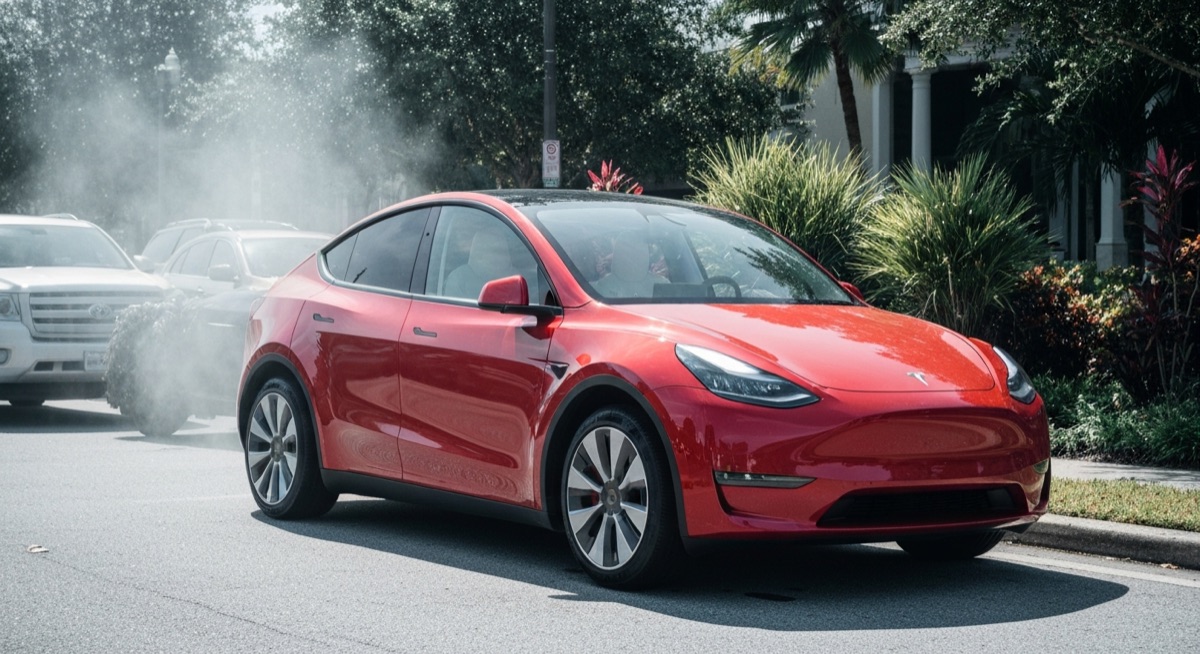
Tesla dominates Florida EV ownership by a wide margin, and there are structural reasons for that. Both the Model Y and Model 3 use active liquid cooling with BMS software that’s been refined through years of real-world data, including a lot of Florida fleet experience. Over-the-air updates mean software improvements arrive without a service appointment — which, if you’ve ever dealt with franchise dealer service scheduling, you’ll appreciate more than you expect. The Model Y Long Range is the dominant choice in the Orlando EV Club membership, and reliability feedback from local owners is consistently strong. Supercharger density in the metro is the best of any public charging network here.
The Hyundai IONIQ 5 and Kia EV6 are both solid first choices for an Orlando buyer, and I’d say that plainly. They share the same 800-volt Hyundai Motor Group platform with active liquid cooling, and both have built strong reputations in hot-climate markets. The 800-volt architecture also means faster DC charging recovery during a road trip — relevant if you’re doing an I-4 run to Tampa in August and want a short stop rather than a long one. The EV6 GT adds performance; the IONIQ 5 gives more interior space. Owner feedback from the Orlando EV Club suggests both handle Florida heat predictably, without the range surprises that affect some competing models.
The Chevrolet Equinox EV is the newest significant arrival on this list, and it carries the least accumulated Florida owner data as a result. GM’s Ultium platform uses active liquid thermal management, and the Equinox EV’s price point makes it one of the few vehicles that comfortably clears the federal tax credit’s income and MSRP thresholds. One practical issue: Ultium is still building its service infrastructure in this market, running primarily through Holler Chevrolet in the Orlando area. Before purchase, call their service department to verify EV-certified technician availability and familiarity with the platform specifically. Technician depth for newer platforms can be uneven across dealer networks, and that’s not a knock on any specific shop — it’s just where things stand with a platform that’s two years old.
Ford’s Mustang Mach-E uses active liquid cooling and performs as expected in moderate conditions. The issue for Orlando buyers is a pattern of thermal throttling under DC fast charging in high ambient temperatures — behavior reported consistently in owner communities and covered by automotive outlets including Electrek. On a 98°F afternoon, your fast-charge session may deliver substantially less than the spec sheet suggests. Ford has addressed some of this through over-the-air updates, but whether the fix is complete is still genuinely unclear. Before committing to a Mach-E, find an owner in Florida or another hot-climate state and ask directly about their fast-charging experience in summer. Don’t rely on a test drive in October.
Volkswagen’s ID.4 uses active liquid cooling and meets thermal management standards. ID.4 owners in Florida-based EV forums have raised intermittent concerns about range consistency in sustained heat, though the reporting isn’t conclusive — it may be early software issues rather than hardware limitations, and I can’t tell you definitively which from the available owner data. If you’re considering an ID.4, seek out Florida-specific owner feedback rather than national reviews, and ask your dealer about the current software version and any pending updates affecting thermal consistency.
Rivian’s R1S and R1T have strong thermal management and genuinely devoted owners who tend to push their vehicles hard. The R1S is a legitimate option for an Orlando buyer who needs cargo capacity and plans weekend trips to the Keys or the Panhandle — it handles both well. There’s a significant service caveat, though, addressed directly in the next section.
The Nissan Leaf. Passive air cooling. Years of Florida owner data showing accelerated degradation. If your budget requires a Leaf-range price point, spend more time in the used Tesla Model 3 market or looking at the Chevy Bolt EV before accepting the thermal risk here.
Where Do You Take It When Something Goes Wrong? Orlando’s Service Map
This is the section national EV guides almost never provide. It’s also the one that matters most once you actually own the vehicle.
Tesla operates a service center on Millenia Blvd and dispatches mobile service across much of the metro for repairs that don’t require the car to be brought in. Appointment availability fluctuates — call before you commit to an ownership timeline that assumes same-week service. Mobile service can run two to three weeks depending on regional demand.
Hyundai and Kia route service through franchise dealer networks, which means EV service quality varies by location and technician staffing. Hyundai of Orlando and Greenway Kia are among the major metro-area options. Call the service department directly before purchasing and ask specifically: how many EV-certified technicians do you currently have on staff, and what’s the typical lead time for a high-voltage battery concern? Dealer-network EV service has improved since 2022, but technician depth still varies. Some dealerships have invested heavily in EV training. Others are still getting there.
Chevrolet’s Ultium platform service funnels primarily through Holler Chevrolet for this market. Same verification applies — call before purchase, confirm technician availability, confirm familiarity with the Equinox EV platform specifically rather than older GM EV products.
Ford EV service runs through Lake Nona Ford and other franchise locations across the metro. Same advice applies as at every franchise dealer: verify local technician certification before you buy.
Rivian: there is no Rivian service center in the Orlando metro. Owners requiring in-person shop work are looking at a trip to Tampa or Miami, or a wait for mobile service dispatch. For routine maintenance and software-addressable issues, Rivian’s mobile service model works reasonably well. For anything requiring physical shop work — suspension repairs, collision damage, drivetrain concerns — the gap is real and worth thinking through before you sign. Orlando Rivian buyers are betting on the mobile service model holding up across their entire period of ownership. That’s a reasonable bet for some buyers and a bad one for others. The important thing is that it’s a conscious choice, not a surprise discovered six months later.
Charging Infrastructure — What the Orlando Grid Actually Looks Like
Orlando’s charging infrastructure is better than most mid-sized American cities, partly because the tourist economy created demand for it early. That said, “better than most” isn’t the same as “problem-free.”
Tesla Superchargers are the most reliable public fast-charging network in the metro, with stations around Millenia Blvd, the International Drive corridor, Lake Nona, and Kissimmee. Supercharger availability along I-4 is dense enough that you will not find yourself stranded between here and Tampa. The NACS standard transition means more non-Tesla EVs will gain access to this network — confirm your vehicle’s adapter situation before you need it on a road trip, not after.
Electrify America maintains fast-charge presence along I-4. Their reliability record nationally has been uneven, and I think that’s worth saying directly rather than burying in qualifiers. Stall counts at individual stations can be limited, and during peak tourist season weekends, expect potential waits. Their stations work when they work. They’re not the network to build a road trip entirely around.
ChargePoint and EVgo scatter Level 2 and DC fast-charge presence across shopping centers, parking garages, and employer facilities. ChargePoint is particularly useful for workplace charging and apartment complex installation — which makes it more important than most buyers realize before they own an EV, especially in Orlando’s condo-heavy residential core.
The I-4 corridor north toward Daytona is thinner than the Tampa run. A Panhandle road trip requires real planning. SR-528 to MCO and Port Canaveral is well-served, given airport and cruise traffic demand. If your regular driving includes the tourist corridor — Disney Springs, Universal, I-Drive — you’re in one of the more charger-dense parts of Central Florida, by design.
The Garage Question — Why Where You Park Overnight Affects Your Battery
National EV guides discuss cold-weather garage parking in the context of battery preconditioning for northern winters. They almost never discuss what overnight surface parking in Orlando does to a battery pack between May and October.
When an EV sits in direct sun on an exposed lot — a condo parking space in Thornton Park, a shared lot in the Milk District, street parking near UCF — the battery absorbs ambient heat continuously. Even after the car cools in the evening, a vehicle parked outdoors in Central Florida doesn’t get the thermal recovery that a garaged car does. The battery starts the next morning already warm, which means the BMS is managing heat from the first mile. Over multiple summers, this accelerates battery aging beyond what the manufacturer’s lifecycle projections assume.
This matters especially for buyers of condominiums or apartments in urban core neighborhoods — SoDo, Milk District, Colonialtown, College Park — where attached garages are the exception. It also matters for the used EV market. If you’re looking at a used EV that spent its prior ownership in outdoor surface parking in Florida, ask about parking history the same way you’d ask about accident history. A vehicle with six years of garage parking in Phoenix carries less thermal stress than one with three years of surface-lot parking in Kissimmee.
The counterbalancing point: Orlando owners don’t take a winter range penalty. An EV owner in a northern city loses significant range in January and February. An Orlando owner loses nothing in January and takes the summer penalty instead. Across a full year, the Florida range math is genuinely favorable. It just doesn’t mean a Thornton Park condo buyer should skip thinking about where their car sleeps.
Preconditioning — Why It Works Differently Here Than Anywhere Else
Preconditioning is almost exclusively discussed in cold-climate EV coverage. It warms a cold battery before a winter drive in Minnesota. An Orlando driver might reasonably skim past it.
Don’t. It just works in the opposite direction here.
In Orlando’s summer, preconditioning cools a hot battery to operating temperature before you start driving. If your EV has been sitting in a sun-baked surface lot since 9 a.m. and you’re returning at 3 p.m., the battery pack may be approaching temperatures where the BMS limits performance from the first mile to protect cell integrity. Starting the car remotely 10 to 15 minutes before departure — while still connected to a Level 2 charger if available, or drawing from the battery if not — brings the pack down to a better starting temperature and cuts the immediate air-conditioning load on the car’s systems.
Tesla’s app handles this cleanly, with scheduled departure and remote precooling that work reliably and can be automated. The IONIQ 5 and EV6 both support scheduled preconditioning through their apps. The Mach-E’s FordPass app supports remote start with climate activation, achieving the same result. In an Orlando summer, these aren’t optional features. They’re tools you’ll use constantly from June through September.
Orlando EV Club members report measurable range improvement from consistent preconditioning in summer. One local owner documented an extra 14 miles of usable range on a 98-degree afternoon by precooling for 12 minutes before departure — not dramatic in isolation, but it adds up over a summer’s worth of commutes, and it can be the difference between making a round trip without range anxiety and not. For a fuller picture of what sustained summer heat does to performance across all your outdoor activities, our coverage of Orlando’s summer heat index puts the temperature and humidity numbers in useful local context.
One practical note: preconditioning from battery power rather than grid power consumes charge. If you’re parking without a charger available, precooling will cost you some of the range it’s designed to protect. The math still typically favors doing it — cooling the battery before a demanding summer drive is a better use of stored energy than fighting heat degradation mile by mile — but it’s worth understanding the tradeoff.
Money on the Table — OUC, Duke Energy, and the Federal Credit Explained
The financial case for an EV in Orlando involves three distinct layers: federal incentives, utility programs, and one Florida-specific absence worth knowing upfront.
Qualifying new EVs are eligible for up to $7,500 in federal tax credits under the Inflation Reduction Act. Qualifying used EVs purchased from a dealer are eligible for up to $4,000. The critical word is “qualifying,” because both the vehicle and the buyer must meet eligibility requirements. Vehicle eligibility depends on battery assembly location and critical mineral sourcing — a list that has shifted as the IRA’s domestic content rules have phased in, and will likely continue shifting. Buyer eligibility depends on income caps for both new and used purchases. Verify current vehicle eligibility directly with the IRS or your tax professional before you sign. This isn’t boilerplate caution: the eligibility list has moved enough times that what was true six months ago may not be true today.
Orlando Utilities Commission serves the core city and offers time-of-use rate plans that reduce overnight charging costs significantly — sometimes 40 percent less per kilowatt-hour than daytime rates. OUC has also offered rebate programs for home charger installation. Contact OUC directly or check ouc.com for current program availability and amounts. These programs update periodically.
Duke Energy Florida serves much of the Orange County suburbs outside city limits and has offered managed charging incentives. Check Duke Energy’s website for current Orange County–specific program availability.
Florida has no personal state income tax, so there is no state-level EV tax credit to layer on top of the federal one. Worth knowing before a dealer implies otherwise.
Florida does charge an annual EV registration fee that functions as a proxy for fuel taxes EV owners don’t pay at the pump. Factor this into your annual ownership cost comparison. Verify the current fee amount with Florida Highway Safety and Motor Vehicles, since registration fees are subject to legislative change. If you’re also weighing the broader financial structure of owning and operating a vehicle in Florida — including how to set up a small business around it — the cost breakdown for starting an LLC in Orlando is worth reading alongside your purchase planning.
What to Ask the Dealer Before You Sign — A Florida-Specific Checklist
Work through every question below before you sit down with the finance manager. The answers will tell you quickly whether you’re dealing with a dealer that has real EV experience or one selling electric inventory the same way it sells any other unit on the lot.
What type of battery thermal management does this vehicle use — active liquid cooling or passive air cooling?
If the salesperson doesn’t know, ask them to look it up before you proceed. A passive air-cooled vehicle is a documented risk in this climate. This should be an easy question for anyone who has sold more than a few EVs. If it isn’t, that tells you something.
Where is the nearest authorized service center for this brand, and what is the current appointment lead time for high-voltage battery service?
For Tesla: Millenia Blvd area. For Rivian: Tampa or Miami, or mobile service with current wait times. For Hyundai, Kia, Ford, and GM: a dealer-based service network with variable technician depth. Get a specific answer, not a general reassurance. Offer to call the service department directly while you’re there. A dealer confident in their service infrastructure won’t flinch at that.
What does this vehicle’s DC fast-charge speed look like at 95 to 100 degrees ambient?
The spec sheet fast-charge speed is measured in controlled conditions. On a Central Florida parking lot in July, the BMS may throttle charge speed to protect the battery. Ask specifically whether the vehicle has known thermal throttling behavior during DC fast charging in hot weather. “It should be fine” is not an answer.
What are the exact terms of the battery warranty — what’s the capacity threshold, and how is a claim actually initiated?
Most EV battery warranties cover capacity below a threshold, but the triggering percentage and claims process matter. Does the manufacturer warrant to 70 percent capacity or 80 percent? How is capacity measured? What does the process look like at a local service center? A warranty that technically covers Florida heat degradation but requires a months-long claims process at a distant service location is worth less than its paper terms suggest.
Does the vehicle support remote preconditioning, and can your service department walk me through the setup before I leave the lot?
In Orlando’s summer, preconditioning is something you’ll use regularly. Confirm it works on the specific model and trim you’re buying. Ask whether the dealer will walk you through the setup before you drive off. If the answer is essentially “figure it out from the app,” factor that into your expectations. (A lot of owners end up learning it from YouTube in a parking garage at 2:30 in the afternoon. That’s fine, but you paid a lot of money for this car.)
Can you connect me with a current owner of this vehicle in the Orlando area?
A dealer with a meaningful local EV customer base should be able to provide at least one reference. If they can’t or won’t, take that into account when weighing how much they actually understand the local market versus national marketing materials.
What is the current software version, and are there any pending updates that affect range or thermal management?
This matters especially for the Mach-E and ID.4, where software updates have addressed known issues with varying degrees of completeness. A vehicle running current firmware is a materially different proposition than one running code from a year ago. Ask for the version number and whether any updates are pending.
The Orlando EV market has grown into something real. Look at any stretch of I-4 or any Lake Nona parking garage — this isn’t a marginal phenomenon anymore. The vehicles work here, and the infrastructure supporting them is substantially better than it was three years ago. But the buying decision is materially different than it would be in Denver or Seattle. The gap between the right EV for this market and the wrong one shows up slowly, in battery capacity readings and service appointments and summer range that keeps coming in shorter than the sticker said.
The questions above, asked before you sign, close most of that gap.
CityDesk Orlando reporting. Readers should verify all incentive figures, utility program availability, service center locations, and registration fee amounts directly with the relevant organizations before making a purchase decision, as program details change. If you’re an Orlando EV owner with summer range data or service experience to add to this reporting, reach out.