What Florida Summer Heat Does to Your Car in Orlando
Florida heat doesn't kill cars the same way northern winters do. A mechanically specific guide to what 90°F ambient temps and 150°F asphalt actually do under your hood — and which Orlando shops to …

What Florida Summer Heat Does to Your Car in Orlando
Florida heat doesn’t kill cars the same way northern winters do. A mechanically specific guide to what 90°F ambient temps and 150°F asphalt actually do under your hood — and which Orlando shops to call before it gets worse.
What Happens in July
By the time the calendar flips to July, the service bays at independent shops across Orlando are already running behind. Not because summer drivers suddenly start caring about their cars. Because their cars have stopped working.
The pattern in summer automotive repair here is consistent: failures that were accumulating slowly through April and May announce themselves in the parking lot of a Publix on a 94-degree afternoon. The mechanism isn’t dramatic until it is. A battery that tests at marginal capacity in early spring becomes a non-starter after three weeks of sitting on sun-baked asphalt. A serpentine belt that looked acceptable in March develops surface cracking by Memorial Day. An AC system that was almost out of refrigerant in the spring simply stops cooling in July when the heat index pushes past 105°F.
Orlando’s summer is not a theoretical stress test. For the many vehicles in the metro area that park outdoors full-time — in apartment complexes along Millennia Boulevard, in strip mall lots off Semoran, in the uncovered employee parking at the theme park corridors — it’s a continuous, compounding assault on every rubber, chemical, and electrochemical component under the hood. This guide explains the specific mechanisms in order of failure probability and tells you exactly where to go this week before the backlog builds further.
Why Orlando Heat Is a Different Problem Than Phoenix Heat
The comparison to Phoenix clarifies the actual threat. In Phoenix, summer heat is a desiccation problem. Seals dry out. Rubber cracks in the straightforward way you’d expect when something is baked in an oven. Fluids evaporate. The car gets hot, stays hot, and dries out.
Orlando’s threat profile is more complicated — and, frankly, more punishing across a wider range of systems. Central Florida’s average relative humidity in June, July, and August runs between 74 and 80 percent. When the air is that saturated with moisture and simultaneously generating asphalt surface temperatures of 150°F or higher — a range that’s routine here, not exceptional — you get the dry-heat damage and the moisture-intrusion damage happening at the same time. Two problems for the price of one.
Humidity drives moisture into battery housings, accelerating terminal corrosion. It swells rubber gaskets and hoses through repeated cycles: hot enough to bake them by afternoon, wet enough from the daily thunderstorm cycle to rehydrate them by evening. It contaminates brake fluid at rates national maintenance schedules simply don’t account for. Standing water under vehicles in apartment parking lots corrodes brake lines, subframes, and wheel bearing housings from below while the sun attacks from above.
Orlando receives approximately 53 inches of rain annually, with the peak concentrated in June through September. Florida’s UV index in summer ranks among the highest in the continental United States, which compounds damage to rubber seals, plastic housings, and exterior wiring conduits that might hold up fine in cloudier climates with the same temperature profile. Interior temperatures in a car parked in direct Florida summer sun regularly reach 130°F to 160°F within 20 to 30 minutes.
The driver with outdoor parking at a Waterford Lakes apartment complex, running a 2017 Hyundai with 85,000 miles, faces a different failure risk than a Phoenix driver with a garaged vehicle and 20 percent humidity. Four simultaneous stressors apply: sustained ambient heat, daily thermal cycling, high UV exposure, and continuous moisture infiltration. That framework explains everything that follows.
Battery: The Failure Most Drivers Misread
The most persistent misconception in car maintenance is that batteries are a cold-weather problem. That’s true for northern drivers. Cold reduces a battery’s ability to deliver cranking amps, which is why Minnesota drivers replace batteries after hard winters. Battery death — the actual degradation of the lead plates and electrolyte solution inside the cell — is a heat phenomenon.
Lead-acid batteries contain electrolyte fluid that conducts electricity between lead plates. Heat accelerates the chemical reactions inside the battery, which is efficient for starting but destructive over time. Sustained high temperatures cause electrolyte evaporation, warping of the lead plates, and accelerated sulfation — the buildup of lead sulfate crystals that reduces a battery’s capacity to hold a charge. AAA reports that battery lifespan in hot climates averages three to four years, compared to the five-year figure most national manufacturers publish and most owners assume. That two-year gap matters. If you replaced your battery in 2021 and figured you had two more years, test it now, not next spring.
Humidity compounds this through terminal corrosion. The bluish-white powder that accumulates on battery terminals forms faster in humid conditions. Corroded terminals increase resistance in the electrical circuit, which means the alternator works harder to compensate, which puts additional load on a battery that’s already thermally stressed. The car may start fine through June but leave you stranded in late July when the added load of running AC on a 95-degree afternoon pushes the system past its margin. Sound familiar? It’s one of the most common scenarios Orlando mechanics describe this time of year.
Slow crank on startup — that labored sound before ignition catches — is the clearest early indicator. You’ll also notice dimming headlights at idle or a battery warning light that flickers and clears. Anything that didn’t happen last fall is worth investigating now.
AutoZone, Advance Auto Parts, and O’Reilly Auto Parts all offer free battery load tests with no appointment required. Results come back in under ten minutes. AutoZone has locations on East Colonial Drive near Goldenrod, on Semoran Boulevard south of Curry Ford, and on Orange Blossom Trail near Oak Ridge Road. Advance Auto has stores on Colonial near Mills and on Semoran north of the 408. O’Reilly has locations on East Orlando and South Orlando arterials.
A mid-range replacement battery appropriate for most passenger vehicles runs $150 to $220 installed at a chain store. Independent shops in the Mills 50 and East Colonial area typically charge similarly. If the battery tests below 70 percent capacity, replace it before July. Don’t wait for the failure.
Coolant, Hoses, and Belts: The Slow Failures Under the Hood
Cooling system failures are among the most common summer tow calls in Central Florida. They’re also almost entirely preventable with a visual inspection that takes ten minutes — which makes it mildly maddening how often they happen.
Coolant — the mixture of antifreeze and distilled water that circulates through your engine to carry heat away from combustion — degrades chemically over time. The additives that prevent corrosion and lubricate the water pump break down, and in high-ambient-temperature environments they break down faster. Most manufacturers publish flush intervals of 50,000 miles or five years under “normal” conditions. Orlando mechanics familiar with the local climate recommend shorter intervals for vehicles operating in sustained 90-degree-plus ambient temperatures year-round. Coolant flushes at Orlando-area shops run in the range of $100 to $180 depending on shop and vehicle make. Confirm pricing with the specific shop before booking.
Radiator hoses and heater hoses are made of rubber reinforced with fabric, and they degrade through the same thermal cycling that hits everything else under the hood: baking when the engine is hot, cooling overnight, soaking up ambient humidity during the wet season. External cracking on the hose surface is the visible sign, and it usually means the interior is also degrading. A smooth exterior doesn’t guarantee the hose is sound. With the engine cold, squeeze the hose firmly between your fingers. A healthy hose feels firm and springs back. A hose that feels soft and spongy, collapses too easily, or has any hardness toward the ends near the clamps needs replacement. This is the kind of check you can do yourself in your parking lot before you ever call a shop.
Serpentine belts — the single ribbed belt that drives the alternator, power steering pump, water pump, and AC compressor in most modern vehicles — develop fine surface cracks along the rib valley that are easy to miss in a quick visual. Run your finger along the ribbed side. Cracks you can feel are cracks that matter. Belts in Florida often show accelerated glazing from the combination of heat and humidity. A snapping belt in traffic on I-4 turns a manageable maintenance item into a tow call and a potentially damaged engine if the water pump was driven by that belt. Serpentine belt replacement at Orlando shops typically runs $75 to $150.
AC Compressor: The Component Orlando Runs to Death
No other metro in the continental United States demands as much from an air conditioning compressor as Orlando does. In Chicago, Detroit, or Boston, the AC runs hard for ten to twelve weeks. In Orlando, it runs for ten to eleven months. That’s a mechanical load cycle that meaningfully shortens compressor service life and makes refrigerant leaks a near-inevitable eventuality on any vehicle beyond 80,000 miles that hasn’t had the system serviced. Eleven months. Think about that when you’re wondering why your AC is struggling at 85,000 miles.
The compressor is the heart of the AC system — a pump driven by the serpentine belt that compresses refrigerant so it can circulate, absorb cabin heat, and cool the air the blower pushes through the evaporator. Seals within the compressor and throughout the refrigerant circuit degrade under sustained load and thermal cycling. Refrigerant leaks usually develop gradually enough that the driver doesn’t notice until the system falls behind on a 98-degree afternoon with a 105°F heat index. By that point, the system has typically been losing refrigerant slowly since spring.
If you’ve noticed that air blows cool but not cold, or that air is fully warm on one side of the cabin in a dual-zone system, that’s worth investigating this week — not “sometime this summer.” A compressor clutch that cycles on and off rapidly rather than running steadily, or a new squealing or grinding noise when the AC is switched on, also signals trouble. Either sign means the compressor is either low on refrigerant or beginning to fail mechanically.
A full refrigerant recover, evacuate, and recharge service runs $150 to $300 at Orlando-area shops depending on refrigerant type and shop. Newer vehicles increasingly use R-1234yf refrigerant, which costs significantly more than the R-134a used in older models. Confirm which type your vehicle requires before booking and get a price accordingly.
Appointment backlog at AC-capable shops in Orlando builds fast in June. If you’ve noticed any degradation in cooling performance, call this week. Shops that are two days out now may be two weeks out by mid-July. I’ve heard that from enough shop owners in this market that it’s not a sales pitch — it’s just what happens every year.
Tires: What 150°F Asphalt Does to an Underinflated Tire
Tire pressure drops approximately one PSI for every ten-degree drop in ambient temperature. Most drivers have heard that fact. What they haven’t internalized is that the inverse is also true: pressure rises with heat. But the more immediate problem in Florida summer isn’t overinflation. It’s that many drivers arrive in summer with tires already underinflated from winter and spring neglect, and then park on asphalt conducting 150°F or more of surface heat directly into the tire’s contact patch.
Underinflated tires flex more through each rotation. Flexing generates internal heat through friction within the tire’s structure. When the ambient pavement is already at extreme temperatures, the internal heat generated by that extra flexing compounds quickly. The result is accelerated rubber degradation, tread separation risk, and in severe cases, blowout. High-mileage vehicles on high-heat corridors — including rideshare drivers running 200-plus miles per day in the theme park corridor on SR-536, World Center Drive, and US-192 — face the highest exposure. UCF’s nearly 70,000 students running older vehicles with deferred maintenance are similarly at risk. If you’ve ever driven past a shredded tire carcass on the I-4 express lanes on a July afternoon, this is usually what happened.
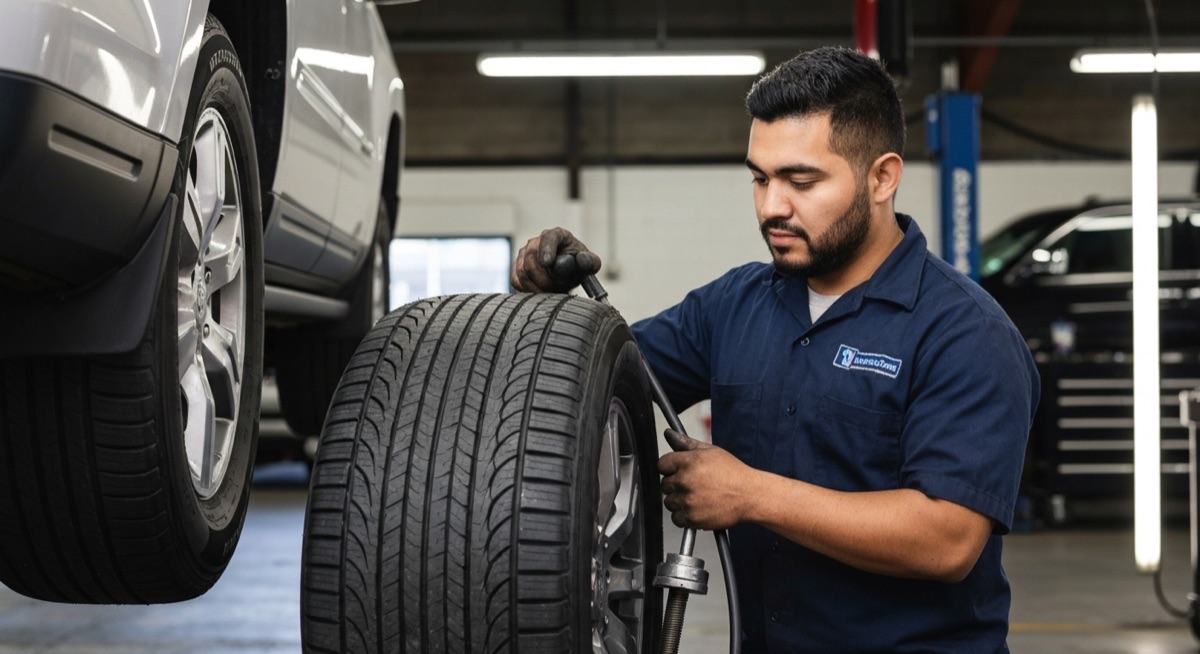
Check your tire pressure when the tires are cold, meaning the car has been parked for at least three hours. The recommended pressure is on the sticker inside the driver’s door jamb — not the maximum pressure molded into the tire sidewall, which is a different number and not what you want. If you don’t own a gauge, every full-service gas station and many quick-lube shops will check it in under five minutes. AutoZone, Advance Auto Parts, and O’Reilly will lend a tire gauge or confirm pressure at no charge. Many tire shops along the Colonial, Semoran, and OBT corridors will check pressure and visually inspect tires at no charge with a request. Tire rotation runs $0 to $25 at most shops. Confirm the specific shop’s current policy when you call. If tread depth is at 4/32 or below — the quarter test: if the top of Washington’s head shows above the tread, you’re at 4/32 or less — you’re on borrowed time in Florida summer driving conditions.
Brake Fluid: The Humidity-Specific Risk Most Drivers Have Never Heard Of
Brake fluid contamination is the most underreported Florida-specific failure mode in consumer car-care coverage. It also has the most serious safety consequences. This is the one I want you to actually remember after you’ve skimmed the rest.
Brake fluid is hygroscopic, meaning it absorbs moisture directly from the surrounding air through microscopic permeation in brake hoses, master cylinder vents, and reservoir caps. In dry climates, the rate of moisture absorption is slow enough that standard flush intervals of every two to three years are adequate. In Central Florida’s 74 to 80 percent summer humidity, that rate is materially faster.
Here’s why it matters mechanically: as water content in brake fluid increases, the fluid’s boiling point drops. During hard braking in stop-and-go traffic, brake calipers and rotors generate substantial heat. If the fluid’s boiling point is depressed by water contamination, the fluid can vaporize locally within the brake line. Vapor compresses. Fluid does not. The result is a spongy pedal that travels toward the floor before braking force is generated — what’s called vapor lock.
On Colonial Drive in August, in traffic backed up behind a light, that’s not an abstract risk. It’s a real-world scenario for anyone driving a vehicle with brake fluid that’s been in service for three or more years without a flush. Ask about brake fluid contamination at any summer inspection. A simple test strip dipped into the reservoir tells a technician the water content percentage in under a minute. This is the item most likely to be forgotten. Make it the specific question you ask at the service counter.
The June Checklist: What to Do This Week, in Order of Urgency
This is sequenced by failure probability and consequence severity for an Orlando driver with typical outdoor parking and a vehicle older than four years. For broader context on keeping your vehicle reliable through Florida’s most punishing months, this fits squarely within our automotive coverage of how Central Florida’s climate affects the cars locals actually drive.
Start with battery testing. It’s free, takes ten minutes at AutoZone, Advance Auto, or O’Reilly on any of the main corridors, and it represents the highest risk of immediate roadside failure on this list. If the battery tests below 70 percent capacity, replace it before July. No exceptions. Cost if replacement is needed: $150 to $220 installed. Same-day availability at all chains without an appointment.
Second, inspect your cooling system. This is the failure that becomes expensive if it progresses to overheating. Do the cold-engine squeeze test on radiator and heater hoses yourself. Ask for coolant condition to be checked at your next oil change, or call an independent shop for a dedicated cooling system inspection. Coolant flush if overdue: $100 to $180 depending on shop and vehicle. Same-day at many shops with an advance call; next-day at busy independents.
Schedule AC service now because backlog builds fast. If your AC isn’t cooling as aggressively as it did last October, it probably has a slow refrigerant leak. A full recover, evacuate, and recharge runs $150 to $300 depending on refrigerant type and shop. Book before mid-June. July backlogs at competent shops can stretch two-plus weeks.
Your tires need attention this week. Verify you’re at door-jamb spec pressure. If you haven’t rotated in more than 7,500 miles, do it now. Inspect the sidewalls for cracking or bubbling. If tread depth is at 4/32 or below, you’re on borrowed time in Florida summer driving conditions. Tire rotation runs $0 to $25 at most shops.
Ask about brake fluid at your next service visit. Request a water content test — it takes one minute. If the technician hasn’t seen the system in two-plus years or doesn’t know when the fluid was last flushed, flush it. This is the item most likely to be forgotten. Make it the specific question you ask at the service counter. Write it on your hand if you have to.
Where to Go in Orlando: Named Locations, Free Services, and What to Ask For
For free tests and quick services at chain locations, AutoZone has locations on East Colonial Drive near Goldenrod and on Orange Blossom Trail near Oak Ridge Road. Both are well-stocked for same-day battery testing and replacement. The Advance Auto Parts on East Colonial near Mills Avenue serves the Mills 50 and Milk District neighborhoods. AutoZone on Semoran Boulevard south of Curry Ford Road serves the Azalea Park and Conway corridor. All three chains do free battery load tests, free check-engine light code reads, and will lend specialty tools for customers doing their own work.
Tire shops along the Colonial Drive, Semoran Boulevard, and Orange Blossom Trail corridors handle tire pressure checks, rotations, and inspections. Confirm the specific shop’s current free-service policies when you call — these things change, and a phone call takes thirty seconds.
For work requiring judgment, use an independent. The chain stores are fine for free tests and commodity parts. For anything that requires judgment on a marginal component — a hose that’s deteriorating but hasn’t failed, an AC system with intermittent cooling loss, a battery that’s borderline — an independent with a neighborhood reputation is worth the trip. Shops in the Mills 50, Milk District, and East Colonial corridors serve a high-mileage, older-vehicle customer base and are familiar with the wear patterns that come with high-ambient-heat, high-humidity operation. Ask directly: Do you do AC service including leak diagnosis? and Can you check brake fluid water content? A shop that answers both questions without hesitation is mechanically current. A shop that fumbles either one — keep driving.
For Kissimmee and the theme park corridor south, the US-192 and US-441 corridors have independent shops serving the high-mileage rideshare and delivery vehicle population. These shops see compressors run to failure and cooling systems that have been deferred longer than they should be. The volume of heat-related failures gives their technicians pattern recognition that a shop in a less vehicle-stressed setting won’t have. That’s genuinely valuable.
If you’re at UCF, ask your neighbors where to go. The University Boulevard, Alafaya Trail, and SR-50 corridors east of campus have both chain auto parts stores and independent service shops. Word of mouth in student housing communities tends to surface honest shops faster than review platforms capture. Ask neighbors with high-mileage cars who they use — you’ll get a real answer in about thirty seconds.
When you get caught short of time, AAA Central Florida serves the metro and handles battery jumps, tire changes, and tows. For non-members needing roadside dispatch, tow services are also available through app-based platforms if you need faster coverage outside membership. The same sustained heat that punishes your car’s cooling system is equally dangerous to drivers once they’re outside the vehicle — worth understanding before you’re standing on a shoulder waiting for a tow.
The honest summary for any Orlando driver with outdoor parking and a vehicle older than four model years: the failure is probably already in progress. Heat damage doesn’t announce itself until the system reaches a threshold. In Orlando, that threshold arrives in late June or early July, when ambient temps combine with two months of accumulated thermal cycling and the full weight of an unrelenting AC load. A battery test, a hose squeeze, an AC performance check, and a tire pressure confirmation this week costs nothing but time. The tow call it prevents costs $150 and a ruined afternoon at minimum. A failed compressor or a blown tire on I-4 at 5 p.m. costs considerably more — not to mention the part where you’re standing on the shoulder in 96-degree heat waiting for a tow.
Get ahead of it now. The summer is already here.