Where to Find Authentic Vietnamese Food in Orlando
The families who turned a stretch of road nobody wanted into Orlando's most authentic Vietnamese dining district — and what to order when you get there.

Where to Find Authentic Vietnamese Food in Orlando
The families who turned a stretch of road nobody wanted into Orlando’s most authentic Vietnamese dining district — and what to order when you get there.
If you want authentic Vietnamese food in Orlando, the answer is Mills 50. Specifically: the stretch of East Colonial Drive running from Mills Avenue east to Bumby Avenue.
The longer answer — why this corridor exists, who built it, what to order, and how to tell the real thing from an imitation — is what this guide is for.
Why Mills 50 Is Different
Mills 50 gets a lot of coverage as a hip district. Murals. Coffee shops. Walkable blocks. The kind of neighborhood profile that lands in glossy regional magazines. That framing isn’t wrong, exactly, but it obscures what the neighborhood actually is: the commercial and cultural center of Orlando’s Vietnamese community.
It was built over four decades by refugee families who chose this particular stretch of East Colonial Drive not for its charm, but because it was affordable, accessible, and close to where they were already living.
The Vietnamese restaurant district along US-50 wasn’t curated by a developer as an ethnic food destination. It predates the boutique coffee roasters and the gallery tenants by thirty years. The pho houses and bánh mì counters and dessert cafes on Colonial Drive exist because Vietnamese families opened them, kept them open through economic cycles that shuttered more glamorous operations, and reinvested the proceeds into businesses that are now, in some cases, passing to a third generation.
That history matters when you sit down to eat. It affects what’s on the menu, who’s cooking it, and why the broth at the best spots here tastes different from what you’ll find at a suburban strip-mall Vietnamese restaurant in Lake Mary or Kissimmee. I don’t mean “different” as a vague compliment. I mean structurally, noticeably different — in the same way a sandwich made by someone who grew up eating it differs from one assembled from a laminated prep chart.
This is a reporting-based guide, not a Yelp aggregation. It’s built on walk-in visits and owner interviews along the district, cross-referenced against community history sources including the Orange County Regional History Center and the Vietnamese Community of Central Florida. Restaurant details — hours, prices, ownership, what to order — were verified on the ground.
How It Got Here
The Vietnamese presence in Central Florida dates directly to the fall of Saigon in April 1975. Federal resettlement policy in the mid-1970s distributed Vietnamese refugees across the country with the explicit goal of preventing community concentration. In practice, refugees quietly reversed that policy as quickly as transportation and savings allowed, clustering into cities where family and community networks existed.
Orlando wasn’t the primary resettlement destination. But it became a secondary settlement city by the late 1970s as families from initial placement points in other states relocated to Central Florida. Catholic Charities of the Diocese of Orlando was among the principal resettlement sponsors in the region, connecting arriving families with housing, employment assistance, and — critically — institutional community. Vietnamese Catholic parishes and Buddhist temples established along Colonial Drive in the late 1970s and early 1980s became the social infrastructure around which the commercial district grew.
The second wave of Vietnamese arrivals — the “boat people,” asylum seekers who fled by sea between 1978 and the mid-1980s, many through years in Southeast Asian refugee camps — reinforced and expanded the community. These arrivals often had different regional origins than the first wave, including a higher proportion of families from Central Vietnam (the Huế and Da Nang regions) and from the Mekong Delta. This regional mix would eventually show up on menus. It sounds like a footnote until you’re looking at a menu and wondering why bún bò Huế appears alongside a distinctly Southern Vietnamese cơm tấm plate. The geography of displacement is right there in the lunch specials.
Commercial leasing along East Colonial Drive in this period was not competitive. The stretch was underinvested and ignored by the city’s development attention, which in the 1970s and 1980s concentrated almost entirely on I-4, the tourist corridor, and downtown redevelopment. The affordable rents, combined with proximity to resettlement housing and community institutions, made the Mills-to-Bumby stretch the logical place to open a business. A grocery opened, then a restaurant, then another restaurant, then a bakery. Each new opening reinforced the district’s identity and made it more attractive to the next family considering a shop.
Orange County’s Vietnamese-American population, per 2020 Census and American Community Survey estimates, runs between 15,000 and 20,000 — a figure community organizations consider an undercount, given how consistently immigrant communities get missed in the census. That population has dispersed considerably over forty years, spreading into East Orlando, Oviedo, and unincorporated Orange County. But Colonial Drive is where the community’s commercial life is still anchored.
Who Actually Owns These Restaurants — and How to Tell
“Vietnamese restaurant” and “Vietnamese family-owned restaurant” are not synonyms. The difference matters before you spend money.
Mills 50 still has a significant concentration of genuinely family-operated restaurants — spots where the owner or a family member is physically present during service, where recipes derive from a specific family’s regional cooking tradition, and where the staff can speak to the food’s history because they’re part of it. But the district also has spots that changed hands post-COVID, spots that franchise or license a brand without the family operation behind it, and spots that present Vietnamese aesthetics with menus engineered for maximum accessibility rather than regional authenticity.
In a genuinely family-run operation, you’ll often see multi-generational presence: an older family member working the register or overseeing the kitchen, a younger one on the floor or at a prep station. This isn’t universal — some second-generation owners have built professional staff teams — but its absence at an older establishment is worth noting.
A restaurant with genuine roots will usually have dishes tied to a specific regional tradition. A menu that’s simply a greatest-hits compilation — pho, spring rolls, banh mi, a few bun bowls — without regional depth or specialty is more likely to be an Americanized construct than a family recipe operation. Look for dishes like bún bò Huế (a Central Vietnamese specialty), cháo (Vietnamese rice congee), or regional preparations of cơm tấm that indicate a cook working from a particular tradition rather than a purchasing manager working from a distributor catalog.
Ask the staff about the restaurant’s story. In a family-operated restaurant, someone can tell you where the family came from, when they opened, and what the specialty of the house is. In a newer or post-sale operation, you’ll get a blank look or a menu redirect. Not a foolproof test, but a telling one.
The COVID-19 pandemic accelerated ownership transitions across the district. Several establishments that had been family-owned for decades changed hands between 2020 and 2023 as older owners, exhausted by the operational pressure of pandemic restrictions, sold to new operators. Some of those new operators have maintained quality. Others haven’t. Older online coverage — Yelp reviews from 2018, travel magazine roundups from 2019 — doesn’t reflect these changes. The restaurants covered in detail in this guide were verified current during reporting.
The Benchmark Restaurants: Verified, Current, Family-Rooted
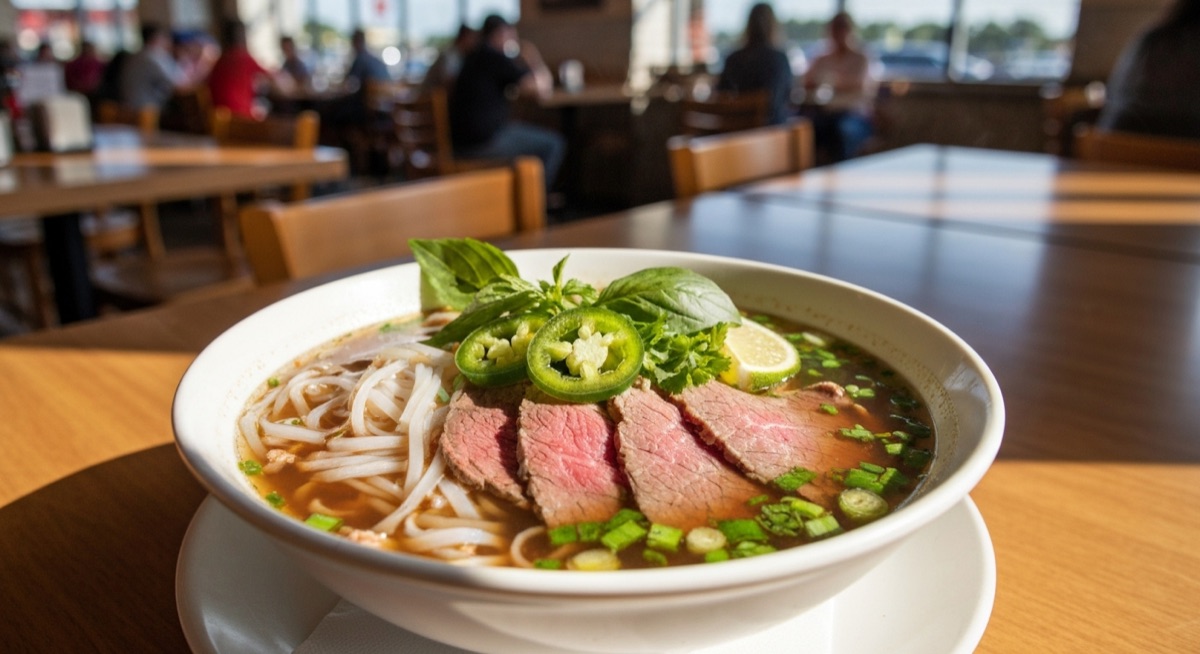
Pho 88 on E. Colonial Drive is the district’s anchor and one of its longest continuously operating Vietnamese restaurants. It gets cited as the benchmark against which other pho in the neighborhood gets measured — and having eaten there more than a few times, I’d say that reputation holds. The broth is cooked long and properly. You can see this in its clarity, and taste it in the layered depth that distinguishes a 12-hour bone broth from a commercial shortcut. Order the phở đặc biệt — the combination bowl with rare beef, brisket, and tendon — and pay attention to the broth temperature when it arrives. A properly served bowl hits the table near boiling, which finishes the rare beef slices in the bowl. Weekend morning waits are common and, honestly, expected. Call ahead on hours and cash policy; they’re not always current online.
Little Saigon Restaurant on E. Colonial Drive is the most important stop for cơm tấm. Broken rice plates. The true lunch staple of Southern Vietnamese cooking. The kitchen turns out cơm tấm sườn bì chả — broken rice with grilled pork chop, shredded pork skin, and steamed egg cake — with the precision of a family that has been making this dish for a long time. Confirm current hours and payment preferences directly; don’t rely on Google.
Đồng Khánh Restaurant on N. Mills Ave. is among the district’s earlier-opening spots. Its bún riêu — a tomato and crab-paste noodle soup with a brick-red broth and a funky, umami depth that’s genuinely hard to find elsewhere in Orlando — almost never appears in mainstream food coverage. It should. The menu is tight and Southern Vietnamese in orientation. This one merits a phone call before a dedicated trip; the district has seen recent closures, and you want to confirm it’s open before you drive across town for it.
At least two establishments that appeared in pre-pandemic roundups have either closed permanently or changed hands with significant menu changes. Do not trust a 2019 Eater roundup the way you’d trust a phone call.
Start With Pho, But Don’t Stop There
Most English-language food coverage of Vietnamese restaurants stops at pho, spring rolls, and banh mi. That leaves most of the menu unexplained.
Phở is the baseline, and it’s worth getting right. Phở bò is beef noodle soup; phở gà is chicken. Quality markers: the broth should be clear, not cloudy — cloudiness signals a rushed boil rather than a slow simmer. You want a toasted spice backbone from star anise and charred ginger. The noodles are rice-based with slight chew. The accompaniment plate — bean sprouts, Thai basil, lime, sliced chili — belongs in the bowl, not eaten separately. And don’t drown the broth with hoisin sauce before you taste it. The broth is the point. The hoisin is a condiment, not a correction.
Bún bò Huế is what serious eaters order instead of pho, and I think the gap between its quality and its reputation is underappreciated. Central Vietnamese in origin, from the imperial city of Huế, the broth draws its flavor from lemongrass and fermented shrimp paste (mắm ruốc). It’s spicier and more complex than phở, with thick round noodles instead of flat rice noodles. This is not a pho variant — it’s a completely different dish with a different flavor logic. It contains sliced pork and beef; some versions include a pork knuckle. If you’ve been eating pho for years and want to take a step sideways, this is the move.
Cơm tấm — broken rice — is the base for one of the most satisfying plates in Southern Vietnamese cooking. The standard combination, sườn bì chả, means a grilled pork chop (sườn), shredded pork skin mixed with rice powder (bì), and steamed egg and pork loaf (chả trứng hấp). It arrives with a small bowl of fish sauce (nước chấm), sliced cucumber, and pickled daikon and carrot. The working lunch of Ho Chi Minh City, translated directly to Colonial Drive.
Bánh xèo — sizzling crepe — is a rice-flour and coconut milk crepe cooked in a hot skillet until crisp at the edges, stuffed with shrimp, pork belly, bean sprouts, and sometimes mung beans. The name means “sizzling cake,” a reference to the sound it makes hitting the pan. Eat it by tearing pieces and wrapping them in lettuce or mustard green leaves with fresh herbs, then dipping in nước chấm. This dish almost never appears in English-language Vietnamese restaurant reviews. That’s a genuine loss, because it’s one of the best things you can order on this stretch of road.
Gỏi cuốn are fresh spring rolls — rice paper wrappers, uncooked, with shrimp, pork, vermicelli, and herbs, served with peanut dipping sauce. Chả giò are fried spring rolls — smaller, crispier, typically with a pork and vegetable filling. They’re not variations of the same dish.
Bún riêu is the adventurous order. Tomato-based noodle soup with crab paste (mắm cua), pork, and tofu. The flavor is tangy, savory, and slightly funky in the best way — the crab paste anchors the whole bowl. Not available everywhere. Đồng Khánh does it well.
Chè is the entire Vietnamese dessert category that most non-Vietnamese diners walk past, which is their loss. Chè can be a warm or iced sweet soup, a layered dessert drink with coconut milk and various beans, jellies, and starches, or a shaved ice preparation. Mills 50 has dedicated chè shops. Ask what’s available rather than assuming the menu lists everything — it often doesn’t.
The Coffee and Bánh Mì You Should Not Skip
Cà phê sữa đá — Vietnamese iced coffee — is one of the great things to drink in this city. It’s not replicated at chain coffee shops, and the difference isn’t subtle. Traditional preparation uses a phin, a small individual drip filter that sits over the glass and drips strong, dark-roast coffee directly over sweetened condensed milk. Poured over ice, it’s intense, sweet, cold, and will carry you through the rest of the afternoon. The shortcuts — pre-brewed concentrate, espresso-based approximations — are identifiable by their lack of the slightly bitter, chicory-adjacent depth a properly phin-brewed cup delivers. Older family operations still use the phin. Some newer or post-sale spots have switched to batch brewing. Worth asking.
Bánh mì is a French-Vietnamese sandwich built on a baguette that genuinely differs from a French baguette — thinner crust, lighter, slightly crisp. It’s filled with Vietnamese cold cuts (pâté, chả lụa, head cheese), pickled daikon and carrot (đồ chua), cucumber slices, cilantro, and sliced chili, with mayonnaise and often Maggi sauce. A properly made bánh mì costs between $4 and $7 here and delivers more flavor per dollar than almost anything else in this city. That’s not a throwaway line. The Americanized version — thicker bread, reduced herb load, substandard cold cuts — is recognizable once you’ve eaten the real thing, and you can’t un-know the difference.
For dedicated bánh mì, target a counter-service specialist or bakery with visible bread turnover. A pho house selling bánh mì as an afterthought is hit-or-miss. This kind of specificity is exactly what we track in our food and hospitality coverage.
What It Costs
Current pricing, verified during reporting:
A medium or large bowl of pho runs $12–$17 depending on the cut — a combination bowl with rare beef, brisket, tendon, and tripe lands at the higher end. Cơm tấm plates are $10–$14 for a full combination. Bánh mì at counter-service shops runs $4–$7. Bún bò Huế and other noodle soups are roughly comparable to pho.
Cash remains strongly preferred at several of the older establishments, and a few accept cash only. This reflects the practical economics of small family businesses, not an affectation. Bring cash as a default. ATMs are available near or inside several spots. Don’t be the person who discovers this at the register.
Getting There, Parking, Hours
East Colonial Drive (US-50) from Mills Avenue to Bumby Avenue is the core of the district. GPS to “Mills 50 Orlando” will place you accurately. The stretch is accessible via Colonial Drive east from I-4 or east from Mills Avenue north of downtown.
Street parking on Colonial Drive and the side streets exists but fills fast on weekend mornings. Most restaurants have small lots or share a lot with adjacent businesses — not always clearly marked. For a realistic weekend visit: arrive before 10 a.m. or plan to walk a block from side-street parking.
Pho is a breakfast and morning food in Vietnamese food culture, not just a dinner option, and the Mills 50 district reflects this. Several establishments open at 8 or 8:30 a.m. Weekend mornings are the highest-demand period. For a quieter first visit — one where you can actually read the menu and figure out what you’re doing — a weekday morning before 9:30 a.m. is ideal.
Hours posted online are chronically inaccurate at family operations. This is not an occasional problem; it’s a structural one. Call ahead, or check the restaurant’s own social media, which tends to be more current than Yelp or Google. Many family-operated spots close one day mid-week; which day varies.
The Lunar New Year, Tết Nguyên Đán, falls between late January and mid-February depending on the year. Colonial Drive celebrates with concentrated activity — events, special food preparations, higher foot traffic, and some restaurant closures for family observance. A visit timed around Tết weekend is worth planning for, but expect closures and crowds. The Vietnamese Community of Central Florida typically publicizes Tết events in advance.
The older establishments have menus that are Vietnamese-primary or Vietnamese-English bilingual, with photographs for many items. This is authentic context, not a barrier to ordering. Point at photographs confidently. The dish names in this guide are there so you can use them at the table — even pronounced imperfectly, the staff will understand.
What the Next Generation Is Deciding
The most important conversation happening in Mills 50’s Vietnamese restaurant community right now is about inheritance. Not the legal kind. The practical, emotional question of what second- and third-generation Vietnamese Americans do with a business their parents built at significant personal cost — and that the neighborhood now markets as a destination.
The operational model of a family pho house — open before dawn, closed after dinner, recipes that live in one person’s hands and not written down anywhere — doesn’t transfer automatically. Several children of corridor founders described the decision as genuinely open. Not a rejection of family heritage, but a hard-eyed assessment of whether the business as structured can survive another thirty years. Some of them are concluding it can’t, not without changes.
Some second-generation owners are making pragmatic adjustments: more payment methods, delivery platforms, streamlined menus. Their parents resisted these moves; some still do. Others are going the opposite direction, deepening the regional specificity of their menus as a differentiator against generic Vietnamese food — betting that the person who wants the real bún riêu will find them, and that the person who wants something safe and familiar will go somewhere else. That’s a real business strategy, and a defensible one.
What this means for the district’s character over the next decade is genuinely uncertain — and I don’t think anyone who tells you otherwise is paying close attention. What is clear is that the families who built this stretch of Colonial Drive starting in the late 1970s are still largely present in it, still cooking from specific regional traditions, still making the case in broth and broken rice and sizzling crepes that what they brought here after 1975 was worth building and worth keeping. Whether the next generation makes the same bet, on the same terms, is the question the district is currently living with. If you’re curious about other locally owned spots worth your dollar across the city, the best farmers markets in Orlando for 2026 offers a complementary look at how community-rooted food culture takes root and grows.
Go find out for yourself. It’s a short drive and a $15 bowl of pho.
Reporting for this piece included on-site visits to the Mills 50 district and interviews with restaurant owners and operators. Hours, prices, and ownership details reflect conditions at the time of reporting and should be confirmed directly before visiting. Reader tips and ownership updates can be sent to the CityDesk Orlando editorial desk.