Disney Springs Restaurants for Locals Worth the Trip
Before you decide whether it's worth the trip, here's what the price tags, parking clock, and wait times actually look like against what's in your own backyard.

Disney Springs Restaurants for Locals Worth the Trip
Before you decide whether it’s worth the trip, here’s what the price tags, parking clock, and wait times actually look like against what’s in your own backyard.
You live here. Someone’s visiting from Atlanta, or your coworker suggests dinner at Disney Springs, and you pause for half a second because you genuinely don’t know the answer. Is it actually good? Is it overpriced? Will you spend forty-five minutes on I-4 just to stand in a queue for a table you didn’t book three days ago?
This piece is for Orlando residents who eat out regularly and need an honest read on whether Disney Springs belongs in that rotation — or whether it’s a field trip that costs more than it delivers. The short answer: it depends on which restaurant, which night, which neighborhood you’re coming from, and how much friction you’re willing to absorb. The longer answer is worth working through carefully. The gap between Disney Springs’ best and worst options is substantial, and the local alternatives are stronger than most coverage of Disney Springs ever acknowledges.
Getting There: The I-4 Tax and What Parking Actually Costs
A Southwest Orlando or Dr. Phillips resident looking at Disney Springs on a map sees a twenty-minute drive. On a Friday evening, that’s fiction.
The stretch of I-4 near the 535 interchange — the standard approach to the Disney Springs area — routinely runs well above its nominal travel time during evening rush, and “routinely” means conservatively fifteen to thirty additional minutes in both directions on weekend evenings. That’s not a weather event. That’s just a standard weekend in November. You probably know this already if you’ve tried to make a 7pm reservation over there in any month ending in -ember.
Disney Springs offers free parking in its garage structures with a ceiling: three hours with validation from a Disney Springs merchant, including restaurants. After three hours, additional time is billed at approximately $5–6 per hour (verify current rate). Preferred parking — closer surface spots near the West Side — runs approximately $25–35 on weekends as a flat rate. Valet is available near the Landing district at a higher rate still. All of these figures are flagged for verification against current Disney Springs posted rates before publication.
The alternative that most coverage of Disney Springs simply ignores: ride-share drop-off. A designated zone exists, it works, and for a resident who doesn’t want to navigate the parking structure, an Uber from Dr. Phillips or Lake Buena Vista is genuinely reasonable for a dinner reservation. It eliminates the parking clock entirely and sidesteps the garage. I don’t know why this doesn’t come up more.
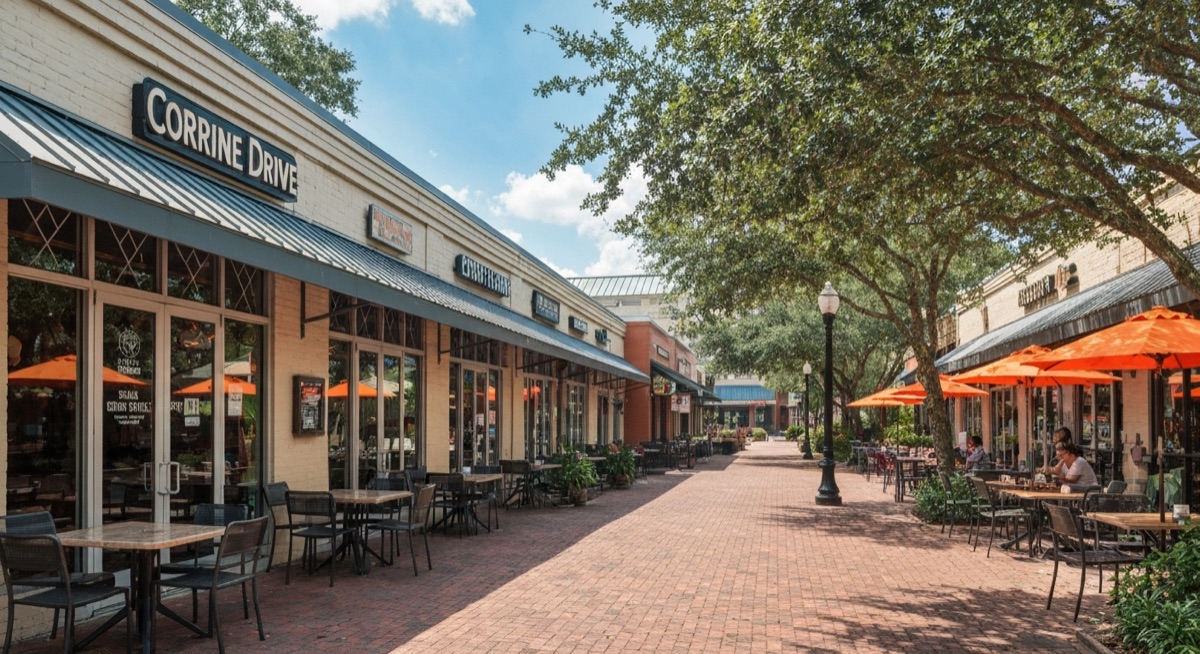
Compare that arrival experience against Winter Park, Mills 50, Thornton Park, or Restaurant Row on Sand Lake Road. In all four neighborhoods, free surface parking is the norm. No clock. No validation. No app. No garage. You park, you walk in, you eat. The I-4 variable doesn’t exist.
The 3-Hour Parking Clock as a Dinner-Shaper
Here’s the structural issue that almost no coverage of Disney Springs for locals ever addresses directly: a proper dinner out routinely takes more than three hours if you’re doing it right. Arrive, get seated, order cocktails, work through an appetizer, eat, linger over dessert and an after-dinner drink, walk around the waterfront because it’s a nice night. That’s well past three hours if you’re not rushing. At Disney Springs, that’s when the free parking expires.
This changes how you experience the meal. There’s a quiet clock running on your leisure — and once you’re aware of it, it’s hard to un-feel. At Prato in Winter Park or Reyes Mezcaleria in the Hourglass District, nobody’s timing your table. You can order another glass of wine without calculating whether you’re past the three-hour mark. The math on preferred parking or valet at Disney Springs isn’t ruinous — roughly $25–35 for an evening — but it fundamentally alters the texture of the night.
For a casual weeknight dinner where you’re in and out in under three hours, the parking question is moot. For a long birthday dinner with out-of-town guests who want to walk the dock after dessert, build in the extra cost or take a ride-share and sidestep the variable altogether.
Chains, Chef Concepts, and the One Genuine Florida Story
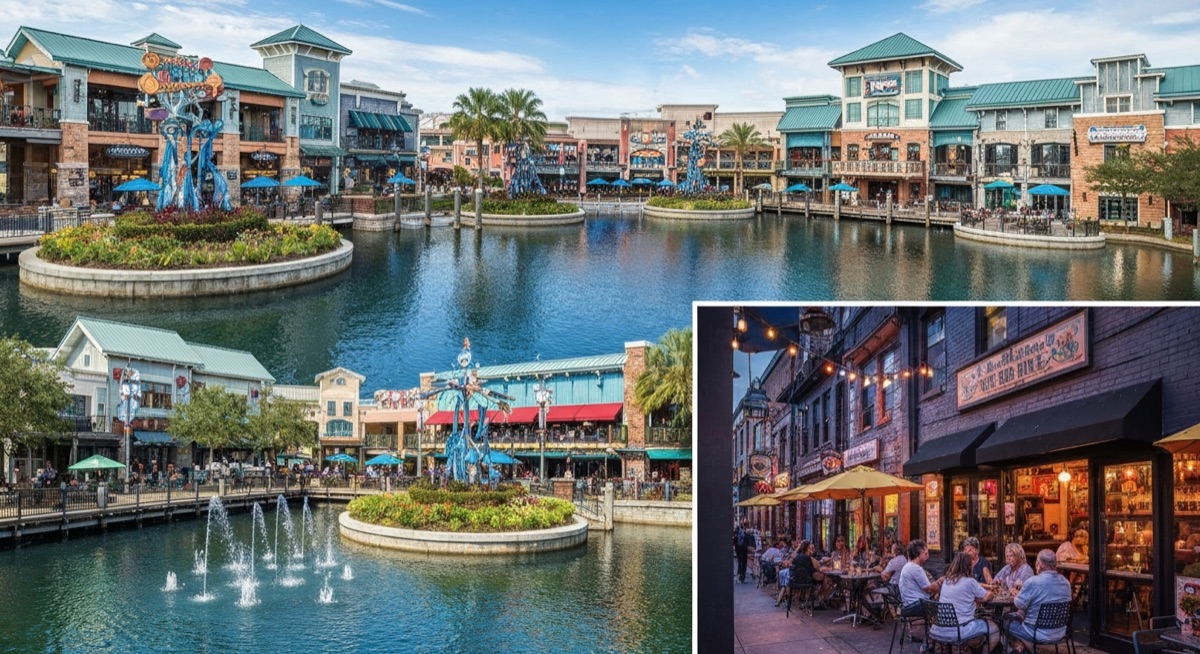
Disney Springs’ restaurant lineup is more varied than it looks from the outside. Understanding the categories matters if you’re trying to evaluate it as a dining destination rather than a shopping plaza with food attached.
STK is a national steakhouse concept with locations across multiple markets. The execution in Disney Springs is solid, but it’s the same concept you’d encounter at any other STK location. The BOATHOUSE is probably the most prominent example of a restaurant that reads like a chain despite being technically independent — a large, polished waterfront concept developed specifically for Disney Springs. The food is straightforward American: seafood, steaks, waterfront setting, done competently. It’s a big, well-produced restaurant that happens to be one of a kind, which is a strange thing to be.
Morimoto Asia, Rick Bayless’s Frontera Cocina, and Wolfgang Puck Bar & Grill all carry legitimate culinary names. Morimoto is a large-format pan-Asian dining room that benefits from Masaharu Morimoto’s restaurant legacy even if he’s not behind the line nightly. Frontera Cocina carries Bayless’s Mexican culinary framework, though as with any concept tied to a celebrity chef, the day-to-day kitchen team does the actual work. Wolfgang Puck Bar & Grill underwent a full concept refresh in 2019.
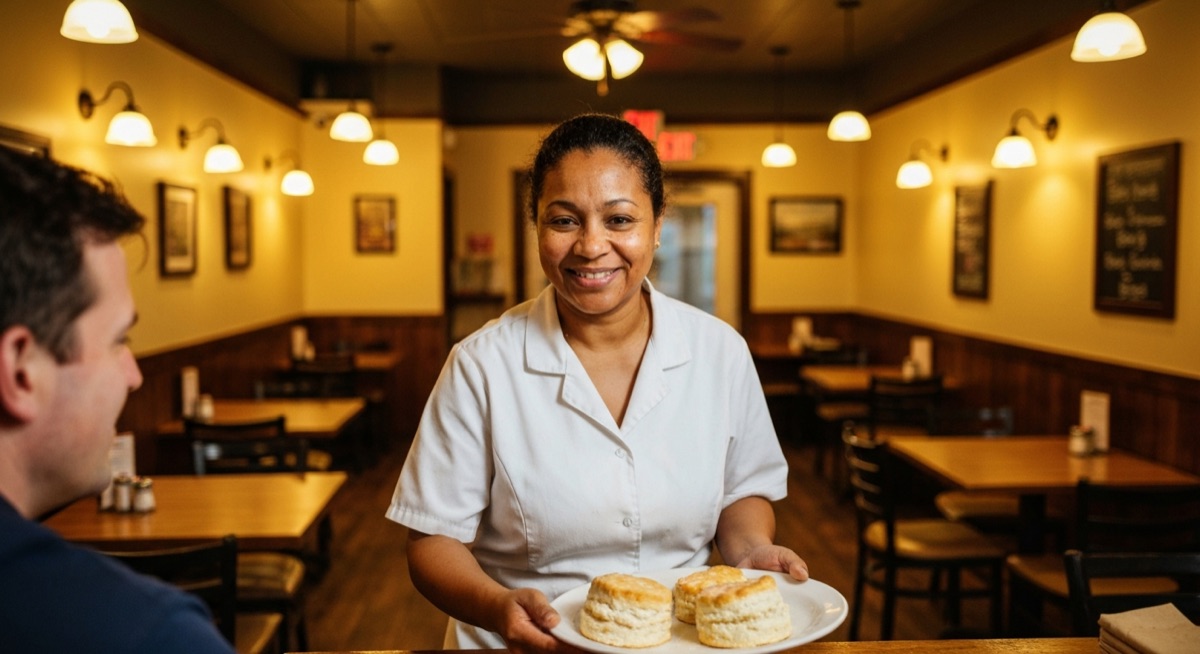
Chef Art Smith’s Homecomin’ is the most locally relevant restaurant at Disney Springs — and honestly, it’s not particularly close. Smith was born in Jasper, Florida, and is a James Beard Award winner who built his career in part on Florida roots. The menu draws from Florida Southern cooking: deviled eggs, fried chicken, shrimp and grits, and the church lady total chocolate cake. Smith also opened a location in Gainesville. Note to staff: verify Smith’s current level of hands-on menu involvement post-2023. There have been changes in his restaurant portfolio and it’s worth confirming his operational role before characterizing the concept as actively chef-driven in present tense. Homecomin’ is the right answer if a visitor wants to eat something that has a reason to exist in Florida rather than in any other Disney-adjacent market.
Price by Price: Disney Springs vs. Comparable Orlando Independents
The persistent assumption among Orlando residents who haven’t been in a while is that Disney Springs is dramatically more expensive than local dining. The reality is different — and somewhat more interesting. Disney Springs restaurants sit at a comparable price point to Orlando’s upscale independent tier, but they’re rarely cheaper, and the local alternatives typically offer easier access and no parking clock.
Here are direct pairings, with entrée price ranges noted. All figures require on-site verification before publication. Menus shift seasonally and prices have moved across the industry since 2022. As part of our food & hospitality coverage, we’ll update these figures when verified.
| Disney Springs | Approx. Entrée Range | Local Comparable | Approx. Entrée Range | Cuisine / Category |
|---|---|---|---|---|
| Maria & Enzo’s | $24–$38 | Prato (Winter Park) | $22–$42 | Italian, upscale casual |
| Frontera Cocina | verify current menu | Reyes Mezcaleria (Hourglass District) | $18–$28 | Mexican, full-service |
| Morimoto Asia | $28–$55+ | Kadence (East Orlando) | $95–$125 omakase | Japanese / sushi |
| The BOATHOUSE | $32–$75 | The Boheme (Downtown) | similar range — verify | American, upscale |
| STK | $55–$95 | Slate (Dr. Phillips) | $32–$48 | Steakhouse / modern American |
Maria & Enzo’s and Prato are close in price positioning for what they deliver. Both do Italian in a polished setting, and the choice between them comes down to convenience and preference rather than price. Frontera Cocina versus Reyes Mezcaleria in the Hourglass District is not a coin flip, though. Reyes is one of the most thoughtful Mexican dining programs in Central Florida — serious mezcal program, a kitchen with clear regional focus, the kind of place that earns loyalty from people who actually care about the food. Frontera is a good concept. Reyes competes on quality and is easier to reach for east-side residents.
The BOATHOUSE versus The Boheme at the Grand Bohemian Hotel downtown present an interesting comparison. Both are large, hotel-adjacent American concepts at a similar price tier. The Boheme has the edge on wine list per local consensus; The BOATHOUSE wins on waterfront setting and atmosphere if novelty matters to your guests. STK sits above its local comparable in Slate. Both are steakhouses, but Slate’s $32–$48 entrée range puts it in a different price category from STK’s $55–$95 spread. That gap usually reflects scale and positioning: Slate is oriented toward neighborhood regulars, while STK plays the special-occasion, high-volume game.
The Sushi Question: Morimoto vs. Kadence
Morimoto Asia is a large, high-volume pan-Asian restaurant with a solid execution floor. For a group dinner where people want a range of Japanese and Asian options and the evening calls for scale and flexibility, Morimoto works in a way that few Disney Springs restaurants can match. You can accommodate vegetarians, seafood-averse guests, and sushi skeptics at the same table without engineering three separate meal experiences. That’s genuinely useful.
Kadence is a different category of restaurant entirely. Located on Fern Creek Avenue in east Orlando, it’s an omakase counter with no menu — a set multi-course experience of Japanese preparations that’s earned national recognition. At approximately $95–$125 per person (verify current pricing), it’s a commitment, not a casual meal. Everyone at the table eats the same thing in the same sequence, and the chef controls the pacing and experience.
If you’re a local making a deliberate dinner decision and you care about Japanese food at a high level, Kadence is the answer. It’s harder to book — reservations fill weeks out — and it requires everyone at the table to be equally invested in the experience and comfortable with omakase-style dining. Morimoto works when you need to accommodate a table with divergent tastes in an environment that doesn’t demand uniform commitment. Know which situation you’re in before you make the choice. They’re not really competing for the same dinner.
Getting a Table: Reservations, the App, and Walk-Up Reality on a Weekend
If you don’t have My Disney Experience downloaded on your phone, parts of Disney Springs dining will create friction that no competing coverage of this topic acknowledges openly.
Several Disney Springs restaurants take reservations through platforms locals already use. Morimoto Asia, Maria & Enzo’s, STK, and The BOATHOUSE are bookable on OpenTable and/or Resy, the same way you’d book Osprey Tavern in Baldwin Park. Top-tier Disney Springs restaurants like Morimoto and The BOATHOUSE are bookable up to 60 days out, which means a local making a same-week reservation on a weekend may find limited availability. Homecomin’ — one of the most consistently busy restaurants at Disney Springs — uses a mobile waitlist system through the My Disney Experience app. This is not OpenTable. On a busy Saturday evening, walk-up waits at popular Disney Springs concepts run 45 to 90 minutes without a reservation or waitlist position (flag for verification: this figure is sourced from crowd reports and should be confirmed against recent 2024 resident-reported data). With the app, you can join the waitlist remotely before you arrive. But it requires downloading and using an app ecosystem built for park guests, not for a Dr. Phillips resident who wants fried chicken on a Saturday night. That’s a small but real annoyance, and it’s worth knowing about before you’re standing at the host stand.
The practical advice for locals: book ahead. Do it on platforms you already use where possible. Treat any walk-up plan on a weekend as a gamble. The difference from your neighborhood restaurant is that the gamble at Disney Springs has a parking clock attached to the wait.
When to Go (and When to Skip It): The Orlando Resident’s Calendar
Timing matters more at Disney Springs than at almost any local neighborhood restaurant, because Disney Springs’ crowd levels tie directly to park attendance patterns that don’t affect Thornton Park or Mills 50 at all.
November through January is the worst window for spontaneous visits. Thanksgiving week through New Year’s brings holiday overlay crowds — decorations, special events, park capacity that spills into Disney Springs — that make anything other than a carefully pre-booked reservation genuinely unreliable. Restaurant waits extend significantly during this window, and the novelty of the season wears thin fast when you’re waiting ninety minutes for fried chicken.
Summer demands a different calculation. Peak tourist volume is high, but Disney Springs’ covered, climate-controlled design is a practical advantage over outdoor-heavy dining neighborhoods during Orlando’s afternoon thunderstorm season. If you’ve ever sat on a Mills Avenue patio watching a wall of water approach from the west, you understand the appeal. Disney Springs is better engineered for it than an outdoor seat at a Thornton Park restaurant. You’re absorbing full tourist-volume reality in exchange, so it’s a tradeoff, not a win.
January and February are the honest best window for locals. Post-holiday, pre-spring break, low park attendance — Disney Springs restaurants are operating at their most accessible. Weekend wait times drop. Reservations are easier to come by, and the outdoor areas around the waterfront are genuinely pleasant in Central Florida’s dry-season weather. If you’re going to try Disney Springs once as a resident and want the least-friction experience, this is your window. One additional note: EPCOT’s Food & Wine Festival, which typically runs September through November, pulls considerable foodie traffic toward the park itself, which marginally eases Disney Springs congestion during that window. It’s not a dramatic shift, but it’s real.
The Honest Verdict: When Disney Springs Is Worth It for Locals
Here’s the direct answer to the question this piece was built to address.
Go if: You’re hosting out-of-town guests who specifically want some version of the Disney experience without paying park admission. You’ve booked a reservation at Homecomin’, Morimoto Asia, or Maria & Enzo’s well in advance. It’s January or February, or at minimum a shoulder-season weekday. You’re treating it as a destination evening rather than a convenience dinner, and the waterfront setting and polished environment are part of what you’re selling your guests on the night. Under those conditions, Disney Springs delivers a genuinely good meal in an environment your guests will find memorable, at prices that aren’t dramatically different from what you’d pay at an upscale local independent.
Don’t bother if: It’s Friday, you haven’t planned ahead, you live within fifteen minutes of Winter Park, Baldwin Park, or the Hourglass District, and someone floated Disney Springs as a casual dinner idea. You can eat at Prato, Osprey Tavern, or Reyes Mezcaleria at a comparable price point with free parking, no app download, no garage clock, and no I-4 variable. The food quality at those local independents is at minimum as good, and in several cases better, than their Disney Springs counterparts. There’s no version of that situation where Disney Springs is the more efficient choice. None.
It’s genuinely reasonable if: You want a solid meal in an environment that’s more polished and climate-controlled than most Central Florida neighborhood restaurants. You’ve done the reservation work. You’re comfortable treating the evening as a planned destination rather than a spontaneous night out. The parking math is baked into your budget, or you’re taking a ride-share. You’re not looking for the single best restaurant in Orlando — you’re looking for a high quality floor and a distinctive setting. Under those terms, it’s a reasonable choice, not an embarrassing one. Homecomin’ in particular deserves more respect from Orlando’s local dining conversation than it typically gets.
Disney Springs isn’t a tourist trap with bad food and inflated prices pretending to be a dining destination. It’s a corporate-curated restaurant district with a handful of genuinely strong options, a built-in atmosphere that some people value and others find a little sterile, and logistical friction that locals rarely account for until they’re already in the parking garage calculating whether they’ve been there three hours yet. Know what you’re going into. Make the reservation. For almost everything else on a normal weekend, Prato is right there.
Editorial note: Price figures, parking rates, app and reservation platform details, and all restaurant-specific claims are flagged for staff verification before publication. A full verification checklist is attached to the research brief. Art Smith’s current operational involvement at Homecomin’ and all parking rates are priority verification items.