Where to Eat in Mills 50 Orlando's Most Underrated Restaurant Corridor
Vietnamese breakfast pho on E. Colonial, bars pushing north toward Virginia Drive — what to eat, where to park, and how to build a Friday night.

Where to Eat in Mills 50 Orlando’s Most Underrated Restaurant Corridor
Vietnamese breakfast pho on E. Colonial, bars pushing north toward Virginia Drive — what to eat, where to park, and how to build a Friday night.
If you want to eat like an Orlando local, not like someone who just landed at MCO and opened a tourism app, Mills 50 is where you go. History. Specificity. $10 bowls of pho next to $22 craft cocktail menus. Restaurants where the people working the kitchen are often related to the people who started the business thirty years ago. No other corridor in the city gives you that combination, and no developer planned it that way.
This guide is for people who live here and people who’ve been told they need to go and want to know exactly what to do when they get there.
Why This Corridor Still Earns Its Reputation
Mills 50 shows up in Orlando dining roundups but rarely gets explained. The usual treatment — five restaurant names and the word “vibrant” — misses the actual story. This stretch of E. Colonial Drive is one of the only commercial corridors in Central Florida that developed an identity entirely outside the hospitality and tourism economy. It didn’t get interesting because a developer decided it should be. It got interesting because Vietnamese-American families started businesses here in the 1970s and 1980s, built a self-sustaining commercial community, and held on through road widenings, rent pressures, and a pandemic that gutted independent restaurants everywhere.
Alongside that original layer, a newer generation of chefs and bar operators has been building. Fusion concepts. Craft beer bars. A brunch-and-biscuit institution that draws lines down the sidewalk on Saturday mornings. The two layers coexist without pretending they’re the same thing — and that’s what makes a full Friday night here possible. Vietnamese soup at 7:30, cocktails at 10. Not every neighborhood can pull that off without feeling forced.
Mills 50 is not precious. It’s a working commercial strip in a dense residential neighborhood. That is exactly what makes it worth driving to.
Finding Your Way: Geography, Parking, and the Crossing Problem
The core of Mills 50 runs along E. Colonial Drive (State Road 50) from roughly the N. Mills Avenue intersection east to N. Bumby Avenue. The densest restaurant concentration sits within a few blocks east of Mills/Colonial — that intersection is your mental anchor. Virginia Drive, running parallel north of Colonial, carries the bar and café layer of the neighborhood. Evening momentum migrates there after dinner.
Parking. Don’t circle Colonial hoping for a space. The metered spots along N. Mills Ave are enforced until 10 p.m. on weekdays and Saturdays — longer than most people assume, and worth confirming with the city before you go. The real move is the residential side streets. Formosa Avenue and Woodward Street, both north of Colonial, offer free unrestricted parking within a two-minute walk of the main restaurant cluster. The strip centers along E. Colonial have surface lots behind them that are ungated and generally available in the evening.
Colonial Drive itself is a fast arterial — four to six lanes depending on the block — and crossing it after dark is genuinely unpleasant. The signalized crosswalks exist but the light cycles are long and the turn movements aggressive. The practical lesson: pick a side of Colonial before you start your night and stay on it as long as possible. The north side connects to Virginia Drive and the evening bar cluster. The south side holds several of the Vietnamese anchors. The Friday night itinerary at the end of this guide routes around the crossing problem as much as any pedestrian can.
The Vietnamese Corridor: A Brief History That Explains Why It Exists Here
The Vietnamese restaurant density on E. Colonial didn’t happen by accident, and it’s worth understanding why it’s here rather than somewhere else.
Following the fall of Saigon in 1975 and through the late 1970s and 1980s, Vietnamese refugees resettled across the United States under federal resettlement programs. Orange County received a significant Vietnamese-American population, many of whom settled in the neighborhoods south and east of Downtown Orlando. E. Colonial Drive — already a working-class commercial strip with affordable retail space — became the natural site for Vietnamese-owned businesses: grocery stores, pharmacies, jewelry shops, restaurants serving a community that needed them and a broader public that quickly recognized the food was exceptional.
By the 1990s the stretch had enough density to function as a true ethnic commercial district. A walk from Mills to Bumby today passes Vietnamese restaurants, a Vietnamese-owned supermarket, a Vietnamese bakery, businesses operated by the same families across two and three generations. You can’t replicate that by rezoning a block and putting up new signage.
What’s changed recently is the generation running things. Second-generation Vietnamese-American operators are updating some spaces — better lighting, cocktail menus, photography-ready plating — while keeping the core menus intact. In the best cases it means a restaurant that works for the family who’s been eating there since 1992 and someone who found it on Google last week. That balance is harder to strike than it looks.
The Institutions: Pho 88 and Little Saigon
Pho 88 on E. Colonial is the establishment most first-timers encounter, and it earns its reputation straightforwardly. The broth is deep and properly fatty. Service is efficient to the point of curtness, in the best Vietnamese-restaurant tradition. The menu is large enough that you could return weekly for months without repeating yourself. But order like a tourist and you’ll miss it.
The standard pho with eye round and brisket is a solid baseline. The version worth ordering is the combination pho with tendon and tripe. The tendon transforms the broth in the last third of the bowl — gelatinous, fatty, absorbing. Anyone who skips it on texture anxiety is leaving the best part on the table, and I say that as someone who was once that person. The bún bò Huế — a sharper, spicier broth from central Vietnam — draws a different crowd and is excellent here. Thicker round noodles, pork blood optional but worth it, heavier and more complex than pho. The kitchen opens as early as 9 a.m. on weekdays. Arriving for breakfast pho is worth rearranging a morning around. Cash preferred. Entrées typically $10–$18.
Little Saigon has been on this stretch long enough that locals give directions by it. The room is large and utilitarian. Tables turn fast at peak hours. The menu goes deeper into regional Vietnamese cooking than most American-facing Vietnamese restaurants will touch. Order the bún bò Huế. Full stop. It may be the best bowl of it in the Orlando metro, and I’d put money on that claim — the lemongrass and shrimp-paste-forward broth is properly funky, the heat calibrated rather than performative.
The bánh cuốn — steamed rice rolls filled with seasoned pork and mushroom, served with fried shallots and nuoc cham — is the right appetizer. The chả giò are textbook: tight, greaseless, good crunch. Arrive before 11 on a Saturday if you want to get through without a wait. Entrées $10–$18. Cash preferred.
One operational note worth flagging: ownership transitions in this corridor happen without announcement, and sometimes without visible change to signage or menu. Several longtime Colonial establishments have changed hands quietly since 2021. The two anchors above had consistent operations at time of reporting. If something about the food or pricing seems off from a previous visit, ask.
Specialized Spots: Bánh Mì, Lao Street Food, and the Grocery Store
Dao Vietnamese Sandwiches is where you go for bánh mì when you want someone who takes the bread seriously. The baguettes are properly crunchy-shelled. The ratio of liver pâté to pickled daikon to protein is calibrated. The whole thing doesn’t fall apart before you get to the car — which sounds like a low bar until you’ve had a bánh mì that failed exactly that test. Prices run $5–$9, which remains remarkable in 2024. Cash and counter, no seats to speak of, short wait at lunch. Verify current hours before visiting; this is a small operation and details shift.
Sticky Rice Lao Street Food is one of the most discussed restaurants on the corridor and one of the least covered in general-audience guides — probably because “Lao” doesn’t fit the Vietnamese-food framing that most coverage defaults to. That’s the coverage’s problem. It’s one of the only Lao-specific restaurants in the entire Orlando metro, and the food differs enough from Vietnamese or Thai cuisine that treating it as a variation on familiar themes will cause you to miss what makes it worth going out of your way for.
Order the larb first: ground pork, toasted rice powder, lime, fish sauce, fresh herbs, enough chilies to mean it. The green papaya salad (tam mak hoong) is different from the Thai version — funkier, more aggressive, with fermented fish sauce and padaek that give it a bottom note that lingers. The sticky rice comes in the small woven basket it’s supposed to come in. Go at lunch. Evening hours have been inconsistent, and routing a whole night around a restaurant that might be closed is a bad use of a Friday. Call ahead.
Tien Hung Market on E. Colonial is not a restaurant, but it belongs in this guide because it gives the corridor its everyday character. It’s a full Vietnamese-American grocery — dried goods, fresh produce, a meat counter, an aisle of fish sauces that will teach you more about regional Vietnamese cooking than most food writing. If you cook at all, go in. If you want to understand why E. Colonial became what it became, go in.
Several smaller establishments that occupied the corridor’s more affordable storefronts did not reopen after the pandemic. A few spaces sat dark through 2022 and into 2023; some have since been reoccupied. At least one former lunch counter has not been replaced with anything comparable. The corridor’s affordability has held better than most comparable neighborhoods in other Florida metros, but the pressure is real. The loss of any $8 lunch institution is worth marking, even when there’s nothing dramatic to point to.
The Other Half of Mills 50: Hawkers, Barbecue, and Brunch
Hawkers Asian Street Fare on N. Mills Ave is the original location of what has become a regional chain. The Mills Ave original still matters — the room is louder and more crowded than newer locations, which I find preferable. The cocktail list moves. Food quality has remained consistent. Start with the roti canai and the curry dipping sauce. The char kway teow — wok-fried flat noodles with egg, sausage, shrimp — is the dish to anchor around. Budget $14–$24 per person for a full meal with drinks. Reservations recommended on Fridays and Saturdays.
Pig Floyd’s Urban Barbecue on N. Mills Ave has been one of the more interesting barbecue operations in the region because it never fully committed to a single regional tradition. The house specialty is the Orlando Citrus Pork, a slow-smoked preparation that has made it an anchor for the non-Vietnamese side of Mills 50. Verify current hours before going — Pig Floyd’s has operated on a compressed schedule at various points.
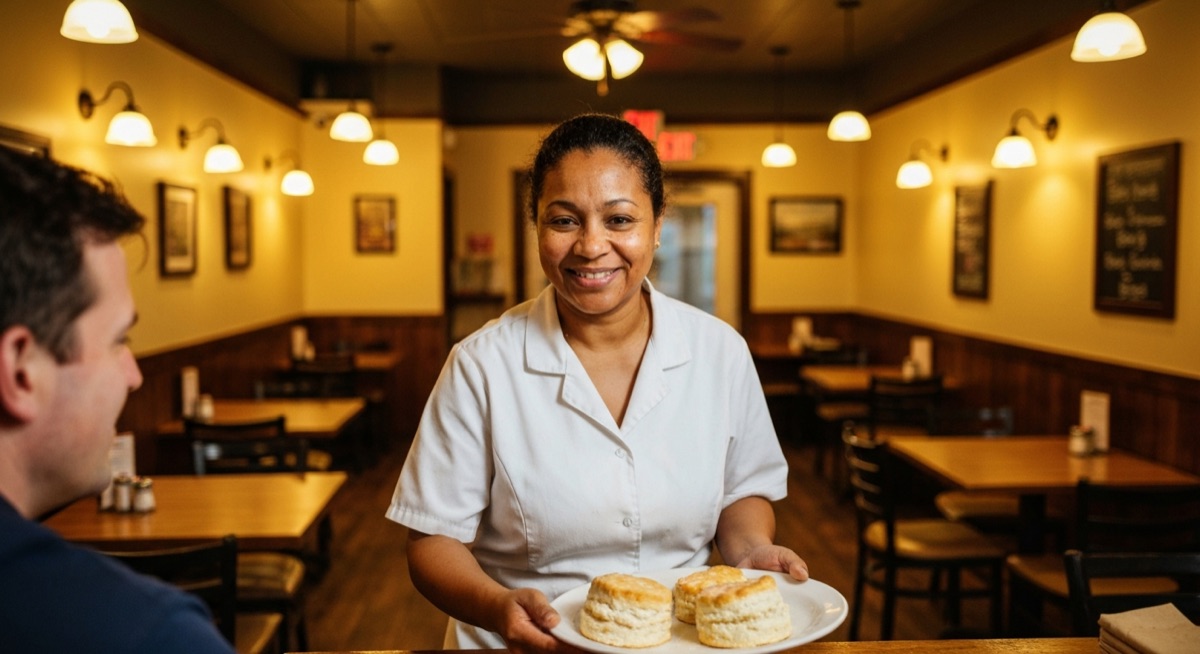
Se7en Bites on Virginia Drive is where the Saturday morning line forms. Owner Trina Gregory’s Southern-inflected bakery produces biscuits at genuinely regional-competition level. The breakfast sandwiches justify the wait. The whoopie pies are the size of a grown adult’s fist, which is either alarming or perfect depending on where you are in your morning. The space is small, the line moves, the coffee is competent. Arrive early on a Saturday if you want to get through in under 30 minutes.
Tako Cheena has had a complicated operational history since 2020, and its status should be confirmed before routing a night around it. The concept — Pan-Asian taco fusion with a tiki drink program — was genuinely fun, the kind of place that fills a specific neighborhood role nobody knew was missing until it was there. Call ahead.
What’s Opened Since 2022: The Virginia Drive Shift
The most significant recent movement in Mills 50 has been northward. Bar and café operators have been opening in the residential-commercial buildings lining Virginia Drive between Mills and Bumby — priced out of Colonial or simply more interested in the quieter street. This is how neighborhoods actually change. Quietly, one storefront at a time.
Guan’s Noodle has been one of the more discussed recent additions for hand-pulled noodle work. The corridor had genuine Vietnamese depth but didn’t previously have strong representation of Chinese regional noodle traditions, and Guan’s fills that gap. The hand-torn noodles in spicy broth reward the visit when the kitchen is running on schedule. Verify before you go.
The Virginia Drive bar corridor that has developed since 2022 is what makes a Mills 50 Friday night a full evening rather than a dinner-and-drive-home situation. A craft beer taproom running a rotating Florida-brewery tap list. A cocktail bar with a spirits program that someone clearly thought about. These are the places that give the neighborhood a reason to keep you past 10 p.m.
The cà phê format — Vietnamese iced coffee culture expressed as a sit-and-stay café concept, with condensed-milk drinks and egg coffee — has also been picking up representation on the corridor. If you haven’t had egg coffee before, it’s a Hanoi preparation: thicker and more custard-like than it sounds, and better than you’d expect. The coconut coffee is the easier entry point. For more context on Orlando’s independent food and drink scene, this corridor is one of the defining examples covered in our food & hospitality coverage.
Before You Go: Operational Facts Worth Knowing
Monday and Tuesday closures are the single most important operational note in this guide. Independent Vietnamese and Asian restaurants in the Mills 50 corridor close on Mondays and Tuesdays at rates significantly higher than the general restaurant average. Check hours before you drive out for pho on a Tuesday. Google listings are not always current. Call if you’re uncertain. I’ve made this mistake. You don’t have to.
The breakfast pho window runs early. Several Vietnamese anchors open as early as 8 or 9 a.m. and serve a lunch-dominant crowd that’s largely gone by 2 p.m. A quiet weekday morning bowl is a different experience from a Friday evening — and honestly a better one in some ways.
Most Vietnamese restaurants on E. Colonial prefer or require cash. Some have ATMs on-site. Come with cash and you won’t have a problem. Metered spots on N. Mills Ave are enforced until 10 p.m. per Orlando city code; verify current enforcement hours before you go. Free residential parking on Formosa and Woodward has no posted time limits that apply to most visitors.
Orlando from June through September is functionally hostile to outdoor dining. The heat index at 8 p.m. in July is not a joke. The Vietnamese corridor restaurants are uniformly air-conditioned. Patio dining at the Virginia Drive bar spots is the right call from October through April and a mistake the rest of the year. If you’re planning a summer visit, it’s worth knowing how Orlando’s heat index and humidity actually work before committing to an evening that includes any time outside.
Orlando Restaurant Week typically includes Mills 50 participants in its fall iteration. Check the Visit Orlando portal for current participating businesses — participation changes year to year. The non-Vietnamese restaurants are card-forward. The Vietnamese and Lao spots vary. Assume cash until told otherwise.
Build Your Friday Night: One Opinionated Walk-and-Eat Sequence
Park once. Surface lot behind the strip centers on the north side of E. Colonial, east of Mills, or a spot on Woodward Street. You are not moving your car again.
6:30 p.m. — Start at Hawkers for a round at the bar. Roti canai, a cocktail or a beer, thirty or forty minutes. You’re not eating a full meal here. You’re using the bar as a standing start, getting oriented. The room is loud and social, which is the right register for the beginning of the evening.
7:15 p.m. — Cross to Little Saigon for dinner. This is your Colonial Drive crossing for the night — get it out of the way at the signalized intersection at Colonial and Mills. At Little Saigon, the bún bò Huế is the anchor order. Add the bánh cuốn if there are two of you. Budget an hour.
8:30 p.m. — Walk east along Colonial, then north to Virginia Drive. Tien Hung Market is worth a five-minute stop if it’s still open (often closes by 8 p.m.). Walk north on Formosa — it takes you to Virginia with no Colonial crossing required. The neighborhood changes register in about two blocks, from dinner corridor to evening-out corridor, and the shift is more noticeable than the distance suggests.
9 p.m. — Settle into a Virginia Drive bar. The taproom or the cocktail spot, depending on your orientation. These places have the pacing of somewhere people intend to stay for two hours. The patio, if it’s under 85 degrees and not raining, is the right call.
If the group has energy, check whether any of the corridor’s Vietnamese restaurants are still running late. A few have pushed their weekend closing hours. A late-night bowl of pho before the drive home isn’t a detour. It’s the correct ending.
One Colonial Drive crossing. No rideshare required. No reservation at every stop. That’s the pitch.
CityDesk Orlando updates this guide on a rolling basis. If a business listed here has closed or changed hours, email the desk.