Which Orlando Food Halls Are Thriving in 2026
Two years after the post-pandemic food hall surge, CityDesk Orlando walked the floors, pulled the records, and asked the vendors what their lease actually costs them.

Which Orlando Food Halls Are Thriving in 2026
Two years after the post-pandemic food hall surge, CityDesk Orlando walked the floors, pulled the records, and asked the vendors what their lease actually costs them.
The pitch was always the same: lower startup costs than a standalone restaurant, built-in foot traffic, a chance to test a concept before committing to a full build-out. Between 2021 and 2025, Orlando added significant food hall capacity. New operators. New developments. Vendor rosters announced at ribbon cuttings with catered press events and renderings showing happy crowds.
Now there’s a track record.
CityDesk Orlando spent the past several weeks doing something the opening-day coverage didn’t: walking the floors on a Tuesday at noon, counting dark stalls, pulling Orange County business license records. We asked vendors — some on record, some not — what the numbers actually look like 18 months in.
What we found cuts deeper than the promotional materials suggest. The format is under genuine pressure. A hierarchy of halls has become clearer with time. And a real gap exists between what vendors are told during lease negotiations and what they encounter once the first full summer hits.
For diners, this is a guide to where your money is best spent. For anyone considering signing a food hall license agreement in 2026, read this before you do.
East End Market at Year 13: The Original, Revisited
The short answer on whether East End Market is still worth visiting: yes. The more complicated answer is that it has earned that standing over 13 years in ways that newer halls haven’t had to prove yet. Some of the wear shows.
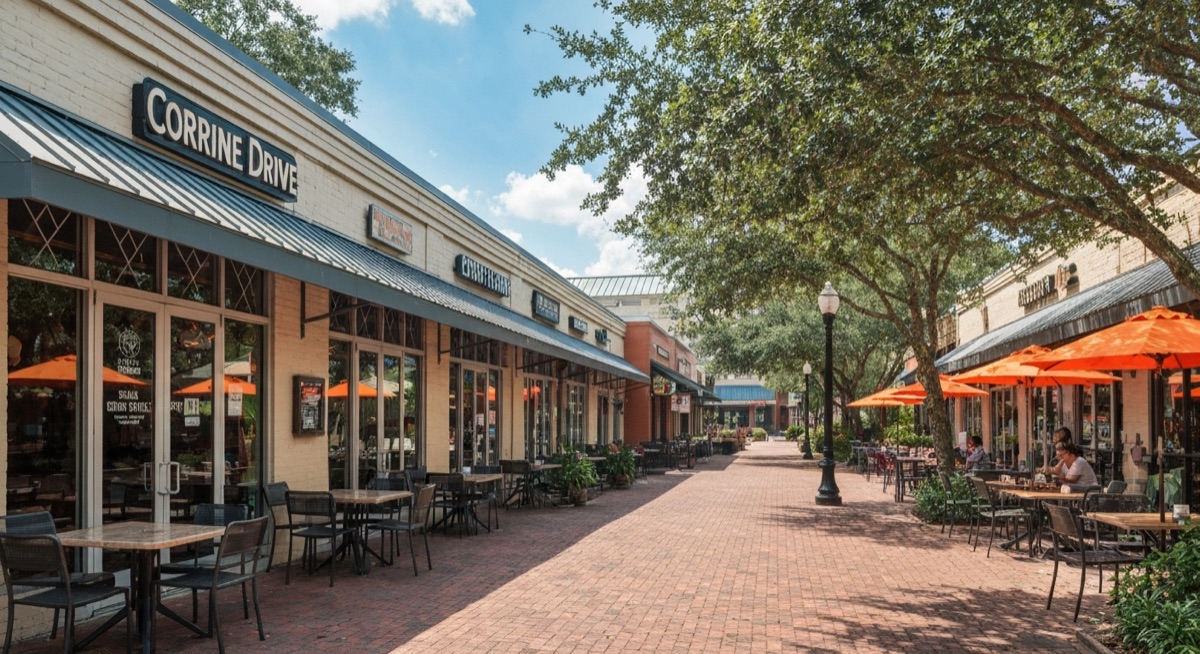
East End Market opened at 3201 Corrine Dr. in Audubon Park in 2013, when the food hall concept was still genuinely novel in Orlando — not the default pitch for every mixed-use development it would later become. Thirteen years later, the question isn’t whether it’s interesting. It’s whether it still works as a reliable destination or has coasted into nostalgia.
Mostly the former, with caveats.
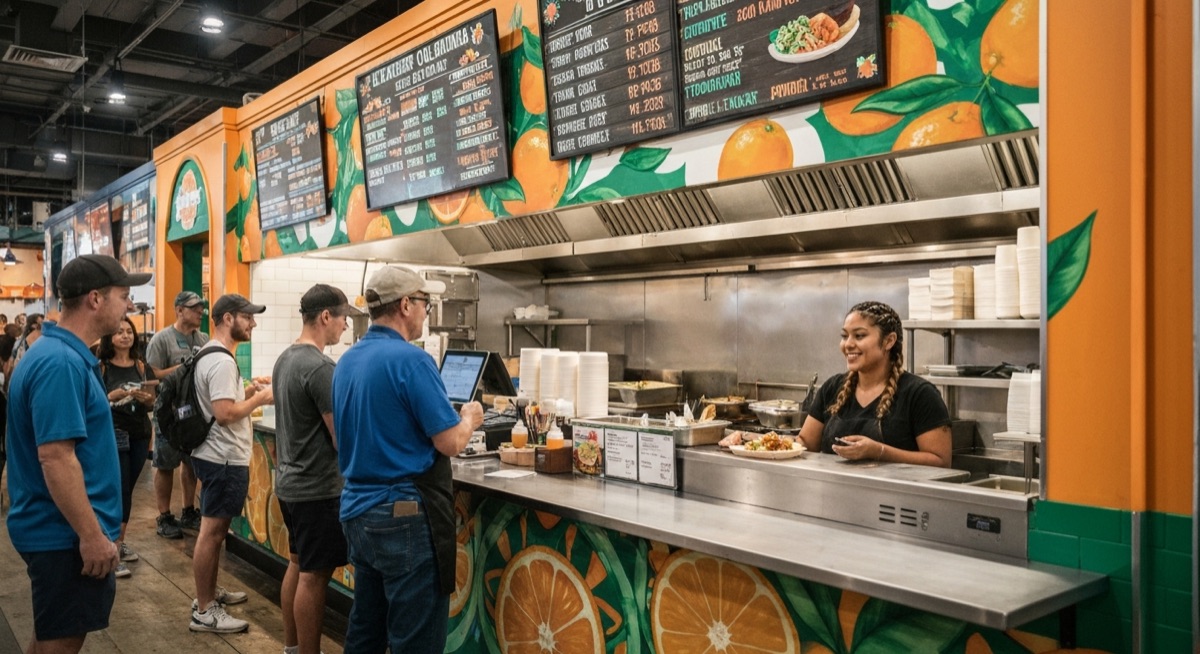
Walk the current ground-floor vendor roster and you’ll find a core of long-standing tenants who have made EEM a home rather than a launchpad. Alongside them is the usual rotation in smaller stall spaces — more turnover in the past two years than you’d see in the anchor positions, which mirrors what’s happening across the market. CityDesk wasn’t able to confirm the status of every original anchor vendor before publication. If you’re planning a visit around a specific stall, call ahead. Don’t assume.
The upstairs restaurant space has historically cycled through operators. Its current operational status couldn’t be independently confirmed before publication. A recent weekday walk-through found at least one stall position without an active tenant, with signage indicating an upcoming vendor rather than a current one.
The physical reality of EEM deserves more honest coverage than it typically gets. The parking lot is genuinely small. Street parking on Corrine fills fast on weekends. In July, the covered outdoor market space becomes uncomfortable before 10 a.m. — not a complaint, just a fact that the Instagram photos reliably omit. The neighborhood’s walkability from surrounding Audubon Park mitigates the parking problem for nearby residents. But these are fixed constraints that no operator decision can fix.
EEM works because it’s embedded in a neighborhood that walks to it and returns habitually. You can build a food hall anywhere. You can’t manufacture that.
The Turnover Audit: Counting Empty Stalls
This is the section that existing food hall coverage in Orlando consistently skips, because it requires showing up after the ribbon cutting.
A vendor position at a food hall doesn’t exist if nobody’s cooking in it. CityDesk’s walk-throughs of active Orlando food hall spaces — EEM, the Packing District’s food hall component, and the Sand Lake/Dr. Phillips corridor — found occupancy levels that don’t match the promoted capacity at every location.
At EEM, the core stalls are occupied. The hall isn’t at 100 percent of stated vendor positions, but one dark or transitional stall out of roughly a dozen is a reasonable vacancy rate for a 13-year-old operation that’s churned vendors organically. Not a crisis.
The Sand Lake/Dr. Phillips corridor tells a more complicated story. Cross-reference Orange County business license data against opening-day vendor announcements and a meaningful gap appears. Several vendors announced as part of original rosters no longer hold active licenses at those addresses. Stall spaces that were occupied at the 12-month mark have since gone dark. The halls have been inconsistent about updating promotional materials to reflect current rosters — which, frankly, should embarrass an operator more than it apparently does. On at least one floor-walk in that corridor, CityDesk found three stall positions either dark or behind paper-covered windows with no signage indicating a scheduled opening.
For diners, this matters in tangible ways. A hall running at 60-something percent occupancy feels different than one at 90 percent. Fewer choices, less energy, more uncertainty about whether a concept you planned to revisit will be there next month. For prospective vendors, the vacancy rate is the most honest available signal about whether a hall’s foot traffic projections are holding up.
EEM doesn’t aggressively promote a roster it can’t deliver. Some newer halls continue to list departed vendors on their websites months after those operators closed. That’s an integrity problem prospective vendors should weigh accordingly — and part of what we track in our food & hospitality coverage.
The Packing District: Orlando’s Newest Major Bet, Assessed at Midpoint
The Packing District — the mixed-use development organized around the Princeton/Orange Avenue area on Orlando’s northwest side — is the largest new food-and-beverage investment Orlando has made in years. It’s received the least rigorous follow-up coverage relative to its scale, which is partly understandable (it’s still in active buildout) and partly just a failure of local business journalism.
Enough is operational to make an honest interim call.
The food hall component, part of the broader Unicorp National Developments project, anchors itself on proximity to Exploria Stadium. The thesis: Orlando City Soccer match-day traffic and the stadium’s activation calendar would drive consistent foot traffic that most food halls can’t manufacture on their own. It works on paper. The honest interim finding is that match-day activation delivers when there’s a big weekend game and underdelivers on shoulder days. Weekday lunch traffic — the economic lifeblood of any food hall — is still being established, which is a polite way of saying it’s thin.
Unicorp didn’t provide on-record comment on occupancy rates or the financial model before publication.
The Packing District’s long-term viability will be decided by whether it can build a habit with Orlando’s northwest-side residential base independent of stadium programming. That process isn’t complete. This is the hall to watch through 2027 — genuinely, not as boosterism. Whether stadium adjacency is a structural advantage or just a good story will be clearer once the surrounding development finishes filling in.
The Vendor’s Math: Why a Stall That Looks Busy Can Still Lose Money
The financial model that food halls use isn’t self-explanatory, and the version operators describe during lease negotiations isn’t always the version vendors experience once they’re in.
Most food hall arrangements in Orlando fall into one of three structures: a flat monthly license fee, a revenue-share, or a hybrid that sets a base fee with revenue-share kicking in above a threshold. The flat fee is most common here. Stall license fees run roughly $1,500 to $4,500 per month depending on size, location, and the hall’s perceived desirability — this comes from vendor interviews and hasn’t been confirmed on the record by hall operators. Stall sizes typically run between 150 and 400 square feet.
The structural costs are where the real surprises live. The Florida Department of Business and Professional Regulation requires individual food service licensing per stall. The hall’s operator permit doesn’t cover vendors. That licensing process takes time and money that operators frequently don’t factor into pre-opening budgets, and the DBPR isn’t known for moving quickly.
Florida’s prepared-food sales tax treatment means most food hall sales are taxable. Vendors who haven’t structured their point-of-sale systems correctly can find themselves with a tax liability they didn’t account for in their pro forma. Build-out costs are almost universally the vendor’s responsibility, and they’ve been a consistent shock to first-time operators. That capital cost sits on the vendor’s balance sheet while they’re still in ramp-up.
Then there’s labor. Florida’s minimum wage reaches $15 per hour in September 2026 — a scheduled increase that’s been on the calendar for years, but some vendors who signed two-year agreements in 2024 didn’t build it into their break-even math. In a 200-square-foot stall that typically needs two people to run at service volume, the labor line has moved significantly since those agreements were signed.
One former food hall vendor operated a lunch-focused concept at a hall in the Sand Lake corridor for 14 months before closing. They asked to be identified only by first name, as they’re considering re-entering the market. Here’s what their final month actually looked like:
Gross revenue: approximately $18,000. License fee: $2,800. Food cost: approximately $7,200 — 40 percent, high for the format but driven by their menu. Labor for two part-time employees: approximately $3,900. Supplies, payment processing, incidentals: approximately $1,100. That left roughly $3,000 before their own draw. In a month when they needed to be at roughly $28,000 to make the format work.
“The hall told me their average vendor was doing $28,000 a month,” they said. “I never hit that. I hit it once in December and never again.”
That gap — between the number you’re shown during negotiations and the number you actually run — is the story of food hall economics in this market right now. And to be clear: $3,000 pre-draw isn’t a business. It’s a hobby that’s also exhausting.
Why Vendors Close in Year One
The pattern is consistent enough across multiple conversations that it’s a structural feature of how food halls operate here, not a series of individual failures.
During lease negotiations, prospective vendors are typically shown foot traffic projections or described the hall’s average vendor revenue. These figures are almost always drawn from top performers or best days. It’s not dishonest in a narrow legal sense. But it’s genuinely misleading when presented as typical. A food hall with two anchor vendors doing $35,000 per month and six vendors doing $12,000 to $15,000 has an “average” that describes the experience of almost nobody in the building. You’ve probably run into this kind of math before in other contexts. It doesn’t get less frustrating here.
The gap between projected and actual daily covers is the most consistent grievance CityDesk heard from former operators. “They said we’d see 400 to 500 covers a day across the hall,” said one former vendor who closed in late 2024. “On a good Saturday we might get 300. Weekdays were closer to 150.” At a 15-vendor hall, 150 daily covers breaks down to roughly 10 customers per vendor per day. That’s not viable for any format.
Shared kitchen infrastructure disputes surface repeatedly. Food halls typically provide shared prep space, dish facilities, or storage as part of the license arrangement. When those facilities are inadequate — underpowered ventilation, insufficient cold storage, scheduling conflicts over shared equipment — vendors absorb the cost. Wasted product, longer prep times, staff overtime. These conflicts tend to escalate in year one, when vendors are most reliant on the hall’s infrastructure and least positioned to absorb the friction.
The revenue ceiling is structural and permanent. Your stall is 200 square feet. You have one service window. You can turn covers faster. You can raise prices modestly. But you can’t expand to meet demand the way a restaurant can open a second dining room. The operators who survive food hall economics long-term are almost uniformly those who’ve hit a high-volume, low-complexity format — a single-protein bowl, a focused beverage concept — or who use the stall primarily as marketing for a catering or wholesale operation where the real margin lives. The stall as billboard: that’s the model that actually pencils out for a lot of people, and the model that food hall operators are conspicuously quiet about during recruitment.
Location Is the Business Model
Orlando has two distinct food hall setups, and coverage has consistently failed to distinguish between them.
The first is the walkable-neighborhood model, which EEM in Audubon Park exemplifies. The customer base is local and returns habitually. Lunch traffic is driven by nearby office workers and residents; weekend traffic by the neighborhood’s density of engaged food consumers. This model is less dependent on marketing, events programming, or tourism cycles. It’s also geographically limited — there are a finite number of Orlando neighborhoods that can generate this kind of organic, habitual foot traffic, and most of them already have EEM or a similar anchor.
The second is the destination model, which describes most of what’s been built since 2021. The Sand Lake/Dr. Phillips corridor halls compete in a restaurant-dense tourist-adjacent market where customers make discrete dining decisions rather than form habits. The tourist trade brings volume but also brings churn — visitors who came once and won’t return. The convention calendar at the OCCC adds meaningful bumps when a major event is running. But the January-February dead zone hits destination halls harder than neighborhood halls, and Q1 vendor departures cluster accordingly. If you’ve spent time in that corridor in February, you know the feeling: half-empty tables, operators who look like they’re doing the math.
Orlando’s climate matters more than most coverage acknowledges. A food hall with an outdoor component has roughly four or five months a year when that component is genuinely comfortable — October through February, with March and April on the margins. From June through September, an outdoor seating area is a deterrent, not an amenity. Halls that positioned outdoor space as a key feature have consistently found that it inflates the attractiveness of a lease proposal while contributing relatively little to 12-month revenue. You’re marketing something that works half the year. The other half, it’s an oven.
The Packing District’s stadium adjacency attempts to solve the destination model’s event-dependency problem by tying the hall to a more reliable event calendar than tourism or conventions alone. It’s a sounder structural bet than pure tourist-corridor positioning. But the Orlando City Soccer match calendar isn’t sufficient on its own. The surrounding development needs to generate its own habitual traffic independent of match days, and that takes time it hasn’t had yet.
The Verdict
East End Market remains the most reliable answer to “Is there a good food hall in Orlando worth going to?” It’s earned that through 13 years of operation, genuine neighborhood integration, and a vendor roster with real longevity. The caveats are real — it’s not large, parking is a nuisance, it’s not worth a special trip from Lake Nona. But the quality floor is higher than anywhere else in this market, and the vendors who’ve stayed multiple years are there because the economics work for them. Go on a weekday morning or early afternoon. The operators have more time, the parking isn’t a problem, and the experience is more relaxed than the weekend scrum suggests.
The Packing District is worth a visit with appropriate expectations. If you’re going to an Orlando City match, tacking on a stop before or after works well. If you’re making a special trip for the food hall alone, wait another year for the roster to stabilize and the neighborhood gravity to develop. There’s no shame in that. Being early to a food hall that’s still figuring itself out mostly means eating surrounded by parking-lot energy.
The Sand Lake/Dr. Phillips corridor halls present a genuine dilemma. Individual stall quality can be excellent — this market has attracted some talented operators — but the occupancy volatility means the vendor you visited six months ago may not be there next week. Before making a specific trip, check whether the vendor you want still holds an active county license at that address. That step shouldn’t be necessary. But the hall operators haven’t earned the trust that would make it unnecessary.
For prospective vendors, the ranking is starker. EEM is the only Orlando food hall with a demonstrated multi-year track record of vendor stability and neighborhood foot traffic. It’s also the hardest to get into, precisely because operators who get in tend to stay. If you can land a stall at EEM with a concept that fits the neighborhood, the risk profile is materially lower than anywhere else.
The Packing District is a reasonable early-mover opportunity for operators who have the runway to weather an 18-to-24-month establishment period and whose concept has genuine match-day appeal. Get specific occupancy rates in writing. Get actual foot traffic counts from operating days, not projections. Understand the shared infrastructure arrangement before you sign.
The Sand Lake corridor halls should be approached with real skepticism about any revenue projections offered during lease negotiations. Ask for actual vendor revenue data, not averages. Ask for the current vacancy rate. Ask how many vendors from the original opening roster are still operating. If the operator can’t answer those questions — or won’t — that is your answer.
Before You Sign a Food Hall License Agreement in Orlando
Every point below corresponds to a failure mode documented in vendor interviews. None of this is hypothetical.
On the financial model: Is the fee structure flat, revenue-share, or hybrid? Get specific percentages and thresholds in writing. What is the current median monthly gross revenue per vendor — not the top performers, the median? Ask for documentation. What is the current occupancy rate, and what has it been over the past 12 months? Demand this in writing as a representation in the agreement. What fees are charged above the license fee — utilities, shared equipment, marketing contributions, a cut of events revenue?
On build-out and startup: Who is responsible for stall build-out costs, and what is the hall’s realistic estimate for your size? What shared infrastructure is provided — prep space, cold storage, dish facilities — and what are the specific terms and scheduling of that access? Who pays the license fee during the build-out period before you open?
On licensing and compliance: You need your own Florida DBPR food service license for your specific stall. The hall’s permit doesn’t cover you. Factor the time and cost into your startup runway. Florida prepared-food sales are taxable at the state rate plus applicable Orange County surtax — confirm your point-of-sale system handles this before opening, not after your first quarterly filing. Florida’s minimum wage reaches $15/hr in September 2026. Model your labor costs at that rate for the full term of your agreement.
On exit terms: What is the minimum term, and what are the early-termination penalties? What happens to your build-out investment if you exit or aren’t renewed? Under what conditions can the hall terminate your agreement, and with how much notice?
The one question that matters most: ask the operator to give you contact information for three vendors who have been in the hall for more than 18 months. If they can’t produce that list, the occupancy track record doesn’t support the pitch they’re making.
If you’re weighing a food hall stall against launching a standalone operation, the cost to start an LLC in Orlando in 2026 is worth understanding before you commit to either path — the entity structure affects your tax exposure and personal liability in both scenarios.
CityDesk Orlando made multiple attempts to reach operators at the Sand Lake corridor food halls and Unicorp National Developments for comment before publication. East End Market management did not return a request for comment. Vendor interviews were conducted in person and by phone; some sources are quoted anonymously at their request due to concerns about future business relationships in the Orlando hospitality market.