Where to Find Ethiopian and West African Food in Orlando
A practical guide to what's open, where to go, and what to order — covering two culinary communities that most Orlando food writing ignores.

Where to Find Ethiopian and West African Food in Orlando
A practical guide to what’s open, where to go, and what to order — covering two culinary communities that most Orlando food writing ignores.
If you’ve searched for African food in Orlando and come up mostly empty, or followed a two-year-old listicle to a shuttered storefront, this guide is for you.
Orlando has real Ethiopian and West African dining, anchored by immigrant communities in Pine Hills, along Colonial Drive, and out into Apopka. Coverage of it has been thin, outdated, and almost always limited to Ethiopian food. The West African side — Nigerian, Ghanaian, Senegalese cooking — gets almost no print attention despite having storefronts, active food trucks, and a large diaspora customer base. That gap is strange given the size of these communities. This guide tries to fix it.
Here’s what this covers: what’s operating, where it is, roughly what it costs, what to order if you’ve never eaten either cuisine, and how to confirm things are still open before you drive. These aren’t novelty spots. They’re serious restaurants.
The Ethiopian Anchor: Colonial Drive
The most established Ethiopian dining in Orlando clusters on or near East Colonial Drive — historically the city’s most diverse restaurant corridor, running roughly from downtown out past SR 50.
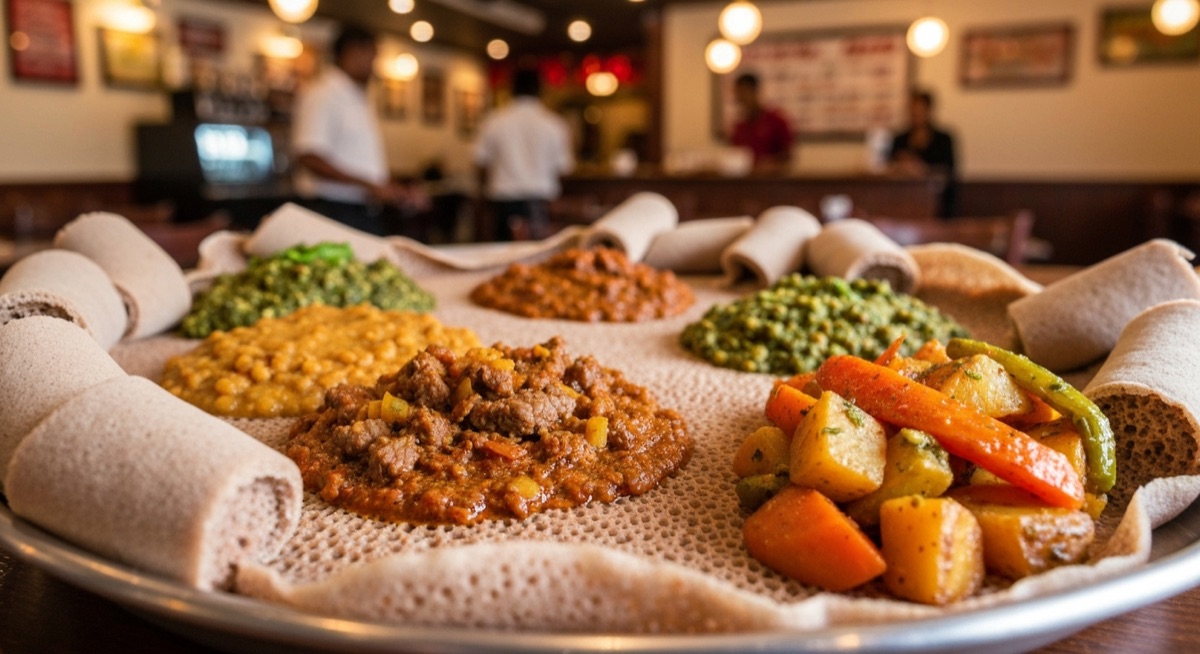
Nile Ethiopian Restaurant, on East Colonial, has been one of the most consistent Ethiopian operations in the city for years. The menu centers on combination platters built around injera, the spongy fermented teff flatbread that functions as both plate and utensil. The platters come ringed with wots (slow-cooked stews) and tibs (sautéed meat dishes). There’s a full vegetarian combination. Platters run in the mid-to-upper teens and low twenties — call to confirm current pricing — and the format is designed to be shared.
Queen of Sheba is the other anchor on the corridor. Full-service, combination platters and individual entrées, and the coffee ceremony is reportedly available. The ceremony — coffee prepared and served through multiple rounds, with incense, the full ritual — is one of the more distinctive experiences in Orlando dining. Do it at least once, whether or not you’d call yourself a coffee person. Call ahead to confirm it’s being offered that day.
Both restaurants draw diaspora regulars, UCF students, and first-timers. Staff at both are used to explaining the food. Neither is formal. The whole format is communal by design, and the staff generally want you to enjoy it — which helps when you’re eating with your hands for the first time and not entirely sure you’re doing it right.
Call before you go. Numbers are on Google Maps, and the listings are usually current.
West African in Orlando: Nigerian, Ghanaian, and Beyond
The West African food scene here works differently than Ethiopian.
The Nigerian and Ghanaian communities in Pine Hills and Apopka have built a food infrastructure that includes storefronts, catering, and food trucks — but with varying degrees of formal presence. Some of the most consistent West African cooking in Orlando comes from operations that don’t maintain prominent Google profiles or Yelp pages. That’s frustrating if you’re used to finding dinner through a five-star search, but it’s the reality.
Pine Hills is where to start. Nigerian and Ghanaian restaurants occupy strip malls and freestanding buildings along Pine Hills Road and the surrounding commercial corridors. Some operate under names that reference home communities or ingredients rather than a branded concept. Hours tend to be more limited than a standard American restaurant. A number run a hybrid model: full restaurant service on weekends, catering and pre-order during the week.
Food trucks serving jollof rice, fried plantains, egusi soup, and suya appear in Orlando — at community events, around UCF, occasionally along Pine Hills Road. These are hard to track by address and are best found through community Facebook groups. The Orlando Nigerian Community and Orlando Ghanaian Community groups function as real-time directories: members post new openings, closures, event vendors, catering contacts. More useful than any static guide.
Apopka has a growing Nigerian and Ghanaian population and some small restaurant operations have followed. Less concentration than Pine Hills, but worth knowing if you’re already in northwest Orange County.
Here’s the honest limitation of this guide: it can’t list every operating West African restaurant by name with confidence in their current hours. This segment changes. What it does is tell you where to look, what to look for, and how to verify — which holds up longer than any address list will.
Know Your Neighborhoods
Colonial Drive is where Ethiopian restaurants cluster because it’s been Orlando’s most established international dining corridor for decades. The demographic base is mixed: longtime immigrants, longtime Orlando residents, students. Ethiopian operators have found the rent, foot traffic, and community access on this stretch workable in a way that more expensive parts of Orange County aren’t.
Pine Hills is the West African corridor. One of Orlando’s largest African immigrant populations — Nigerian and Ghanaian communities primarily — lives here, and the commercial strip reflects it. African grocery stores selling yam flour, suya spice blends, and palm oil sit alongside West African hair salons, African Christian churches, and restaurants, all in the same strip malls. The Pine Hills Road and Silver Star Road intersection is a useful anchor for navigating the area. This is also where you’ll find African grocery retail, which matters if you want to cook any of this at home.
Apopka is a younger cluster. The communities there have grown and small food operations — some formal, some not — have followed. Less dense than Pine Hills.
International Drive is the wrong place to look. Built around theme park tourism, priced at tourist margins. There’s no authentic Ethiopian or West African food there, and searching that corridor wastes time. Same goes for the commercial zones around Disney and Universal. Don’t bother.
First Timer’s Guide: Ethiopian
Ethiopian food is designed to be shared. The combination platter — a large round of injera covered in portions of various wots and salads — is both the practical and culturally correct way to start. It’s also just the best way to understand the cuisine in one sitting.
Start with the vegetarian combination. Ethiopian cuisine has a deep vegetarian tradition rooted in the Ethiopian Orthodox fasting calendar, and the results are genuinely remarkable. This isn’t “vegetarian as a compromise.” The vegetarian combo typically includes yemisir wot (red lentils in berbere spice), gomen (collard greens), tikel gomen (cabbage and carrots), and ayib (fresh white cheese). It gives you the full range of flavors and introduces you to the berbere spice framework — earthy, hot, complex — in a way that doesn’t overwhelm. It’s also fully vegan on fasting days.
Injera is the fermented teff flatbread that lines the platter and comes stacked separately on the side. No utensils. Tear a piece, use it to scoop stew, eat both together. The bread is slightly sour, slightly spongy, and porous — it’s designed to absorb the wot sauces. The food is built around the bread. If you reach for a fork your first time, you’re not alone, but set it down.
For meat, start with doro wot — slow-braised chicken and hard-boiled egg in deeply spiced berbere sauce. It’s the national dish for good reason. Rich, complex, distinctly Ethiopian, but coherent rather than disorienting on a first visit.
Kitfo is Ethiopian beef tartare: finely minced raw beef seasoned with mitmita, a hot and aromatic spice blend, served raw, slightly warmed, or fully cooked. It’s extraordinary. Skip it on your first visit if raw beef concerns you. Come back for it. It’s worth coming back for.
Tej, Ethiopian honey wine, is the traditional pairing — essentially mead, sweet and slightly funky. If you don’t drink alcohol, hibiscus drinks work better with this food than soda does. Ethiopian coffee at the end is obligatory.
First Timer’s Guide: West African
West African menus vary by country, and Orlando’s skew primarily Nigerian and Ghanaian.
Order jollof rice and fried plantains. Whatever else you get, order these. Jollof rice — long-grain rice cooked in a tomato, pepper, and onion base with stock and spices — is one of the best rice dishes available in this city, full stop. Fried plantains (dodo in Nigerian cooking, kelewele in Ghanaian) are sweet, caramelized, and almost universally loved by first-timers. These two dishes together tell you whether the kitchen knows what it’s doing.
Fufu is a starchy paste made from pounded or processed cassava, yam, or plantain, formed into portions and served with soup. You pinch off a piece and use it to scoop. It’s not strongly flavored on its own — it’s a vehicle. The flavor lives in the soup. Egusi soup (ground melon seeds, leafy vegetables, palm oil, meat or fish) is common and a reasonable entry point. Groundnut soup — peanut-based, more common in Ghanaian cooking — is sweeter and more immediately familiar to American palates. Start with one of those two. Pepper soup is clear and intensely spiced; save it for a return visit once you have context.
Ghanaian menus are more likely to feature waakye — rice and beans cooked with sorghum leaves, served with various accompaniments — and kelewele. Nigerian menus lean toward moi moi and suya.
Get suya. Thinly sliced beef, skewered, grilled over charcoal with a dry rub built around ground peanuts, served with raw onion and tomato. In Orlando, suya appears most reliably at community events and some Pine Hills operations; availability varies. When you find it, order more than you think you need.
Bissap — deep red hibiscus drink, tart and floral, sometimes sweetened, sometimes with ginger — is the right drink with all of this. Order it.
Halal, Vegetarian, and Dietary Context
The Ethiopian Orthodox fasting menu is fully vegan — no meat, no butter, no dairy — and is available most days at restaurants that maintain fasting menus. The vegetarian combination at Nile and Queen of Sheba is prepared without animal products on fasting days. Confirm when you order. It’s also, incidentally, some of the best vegan food in Orlando — real cooking that happens to be plant-based, not an afterthought.
For Muslim diners at Ethiopian restaurants: most Orlando locations serve alcohol, and halal status depends on meat sourcing, which varies by restaurant. Call and ask specifically whether the meat is halal-slaughtered. Don’t assume.
Orlando’s West African restaurants reflect a mix of Muslim and Christian ownership. Some Pine Hills operations are explicitly halal and post certification. Others aren’t. Call before you go. The Orlando Nigerian and Ghanaian Community Facebook groups are reliable here — members answer these questions directly and can point you to operators whose practices they know personally.
For vegetarians and vegans eating West African: it’s harder. Palm oil, smoked fish, and animal-based stocks appear in many preparations that look vegetable-based. Jollof rice can be made without meat stock but often isn’t by default. Fried plantains are reliably plant-based. Ask specifically about stock and seasoning before ordering.
What This Food Costs
Ethiopian dining in Orlando is genuinely affordable. Combination platters at the Colonial Drive restaurants run in the mid-to-upper teens and low twenties per person — call Nile and Queen of Sheba to confirm current pricing. Two people sharing a combination platter, which is the traditional approach, makes for an accessible full meal before drinks and tip. The coffee ceremony, when offered, runs around $10 to $15 per person in comparable Florida markets; confirm with the restaurant.
West African pricing varies more because the range of formats is wider. A plate of jollof rice with protein at a Pine Hills storefront typically runs $14 to $20. Fufu with soup is in a similar range, sometimes higher depending on the protein. Catering minimums for West African operators vary; most small operators start somewhere around $300 to $500, but ask.
Several Ethiopian and West African restaurants appear on DoorDash and Uber Eats. Use that as a backup, not a default. Ethiopian combination platters suffer on delivery — the injera keeps absorbing moisture in transit, and the eating-by-hand experience degrades. For Ethiopian food specifically, sitting down is materially better than the box arriving at your door. West African rice and stew dishes travel better.
The Community Behind the Food
These restaurants don’t exist in isolation. The Nigerian and Ghanaian communities in Pine Hills are organized through churches, community associations, and diaspora networks that predate any of these restaurants. UCF and Valencia College have significant African student populations in east Orlando, which creates a consistent customer base for food businesses across Orange County.
Orlando’s African community holds cultural events year-round. Food vendors — including restaurant operators and food trucks — show up at these events, and they’re often the best places to find West African cooking from people who don’t have storefronts. Suya grilled over an actual charcoal setup at a community event hits differently than anything delivered in a box. Worth planning around.
For diaspora readers, and as part of our food & hospitality coverage more broadly: the Pine Hills corridor — its churches, African grocery stores, hair salons, community businesses, and restaurants — gets almost no local press coverage proportional to its size. It’s not a food destination for adventurous diners. It’s where people live, eat, worship, and run businesses. The restaurants there reflect that, which is precisely why the food is good.
How to Stay Current
This guide was written carefully, but it has a structural limitation: small immigrant-owned restaurants in Orlando close, pause, relocate, and shift hours more often than businesses that maintain polished Google profiles. Some names that appeared in Orlando food coverage three years ago are gone. Some restaurants that opened in the past year have no press coverage at all.
Before you drive anywhere: call. Thirty seconds, confirms whether the place is open tonight. True for Colonial Drive, doubly true for Pine Hills and Apopka.
The Orlando Nigerian Community Facebook Group and the Orlando Ghanaian Community Facebook Group are the most current sources for West African restaurant and vendor information in the metro. Orange County’s business search tool (through the county’s official website) lets you verify whether a business license is active at a given address — useful when you’re not sure if an operation is still running. On Google Maps, check the date on the most recent review. If the newest one is 18 months old, call before assuming anything.
CityDesk Orlando will update this guide as we receive verified information about new or changed operations. If you know a West African or Ethiopian restaurant, food truck, or catering operation we’ve missed, reach out. Getting this right requires the community’s help, and frankly the community knows this scene better than we do.
Pricing and hours reflect information available at time of publication. Call ahead before visiting.