Where Orlando Locals Actually Eat
Five corridors, zero theme park adjacency, and how to tell a real neighborhood restaurant from a tourist trap dressed as one

Where Orlando Locals Actually Eat
Five corridors, zero theme park adjacency, and how to tell a real neighborhood restaurant from a tourist trap dressed as one
Your Zip Code Matters More Than Any “Best Of” List
Orlando draws tens of millions of tourists every year. Most of them eat on International Drive, near a theme park entrance, or inside a hotel complex. Most of the restaurant coverage that ranks on Google was built to serve that audience. Search “best restaurants in Orlando” and you’ll scroll past a dozen TripAdvisor-optimized lists before you find anything written for the 2.7 million people who actually live here, pay property taxes here, and would like to eat a solid weeknight dinner without fighting a parking garage shared with a 400-room Marriott.
This is not a Yelp repackage. Not a “hidden gems” listicle either. This is a neighborhood-by-neighborhood guide to where Orlando’s residents—including a substantial population of service industry workers who know bad food on sight and won’t waste their one day off on it—actually spend their dining dollars. Every neighborhood covered here has been visited for this piece, with attention to ownership structure, price reality, crowd composition by daypart, and parking logistics. Operating status of anchoring restaurants was verified before publication. The post-pandemic turnover rate in this city is high enough that trusting an article from 2021 is a genuine mistake.
The answer: Mills 50, Audubon Park Garden District, College Park, Thornton Park, and Ivanhoe Village. These five neighborhoods form a loose arc running north and east of downtown. None of them are on or near I-Drive. All five have active, locally owned dining scenes. They are not interchangeable, and understanding the differences will save you time, money, and the particular frustration of paying $32 for a plate of pasta across from a tourist who is never coming back.
How to Read Orlando’s Food Geography Before You Pick a Neighborhood
Before walking into any of the five neighborhoods, you need a mental map of what you’re orienting away from.
The I-Drive corridor—roughly 11 miles of chain concentration running from Sand Lake Road north to Universal Boulevard—is the tourist dining baseline. The closer a restaurant is to a theme park entrance or convention hotel, the higher the probability that its menu was engineered for guests with no hometown loyalty to protect and no reason to care if the food is mediocre. That incentive structure produces predictable food. The further you are from theme park entrances, the better your odds. It’s not complicated, but it’s also not the kind of thing any “Best of Orlando” roundup leads with.
The five neighborhoods in this guide operate in a different economy. The resident who eats at a Vietnamese spot on Mills Avenue on Tuesday will eat there again Thursday. The owner of a family restaurant on Edgewater Drive knows her regulars by name and knows that a bad stretch of Fridays has direct consequences. That feedback loop—the basic mechanism of a neighborhood restaurant—functions in these corridors in ways it simply does not near a theme park gate.
Two distinctions matter as you read through the neighborhood breakdowns.
Ownership type. There’s a real difference between a sole-proprietor family operation (one location, the owners are present), a local multi-unit operator (Orlando-based, still regional in identity), and a regional chain in local clothing (the concept name suggests independent, but ownership is a hospitality group with locations in four states). All three exist in these neighborhoods. The third type is worth identifying before you sit down, because it changes what you’re supporting with your money and what quality standard you’re actually being held to.
Crowd composition by daypart. A room full of neighborhood families and off-duty restaurant workers on a Tuesday night is a different signal than a room full of hotel keycards and convention lanyards, even if both rooms are full. This distinction matters more in some neighborhoods than others.
Orlando’s independent restaurant scene has experienced significant ownership churn since 2020. Pandemic closures, rent increases from downtown development pressure, and a tight labor market have changed things in every one of these neighborhoods. Several “institutions” you may have read about elsewhere have closed, changed ownership, or changed concepts entirely. Any restaurant named in this piece has been verified for current operation. For anything else, Florida’s Sunbiz.org—more on this in the practical section—will tell you who actually owns it.
Mills 50 — The City’s Highest Concentration of Immigrant-Owned, Family-Run Restaurants
The Mills Avenue and Orange Avenue corridor between Colonial Drive and Virginia Drive has been the center of Orlando’s Vietnamese and broader Southeast Asian dining for decades. Several of the Vietnamese operations here are now in their second generation of family ownership. The signs are unglamorous. The storefronts are not designed to be photographed. This functions as a natural tourist filter, and I mean that as a genuine compliment to the neighborhood.
The food economics are clarifying. A full Vietnamese meal—pho, bún bò Huế, bánh mì, a plate of cơm tấm—costs $10 to $18 at the core Vietnamese and pan-Asian spots. Paying more than that for a bowl of noodle soup on Mills Avenue means you’re either at a newer American-eclectic concept (a legitimate category here, running $18 to $28 for entrées) or you’ve made a wrong turn. The price tells you immediately which kind of place you’ve found.
Weeknight evenings, the Vietnamese spots fill with Vietnamese-American families and service industry workers—covered in detail below, but their presence is a consistent quality signal worth noting here. Weekend nights, the mix gets younger and more broadly local. Lunch is mostly residential and office.
Hawkers Asian Street Fare opened on Mills Avenue and has since expanded to multiple states. It’s a local origin story, not a current local experience. Eating at Hawkers on Mills means eating at the flagship of what is now a regional chain—fine, but a different thing from eating at the family-owned Vietnamese spot three doors down that has no second location and never will.
One practical note: street parking on the avenue itself is genuinely difficult after 7pm on Friday and Saturday. The workaround is side streets—the residential blocks east of Mills, between Colonial and Virginia. An extra three-minute walk beats circling the same four blocks. I’ve done both, many times. The walk wins.
Audubon Park Garden District — An Independent Commercial Corridor
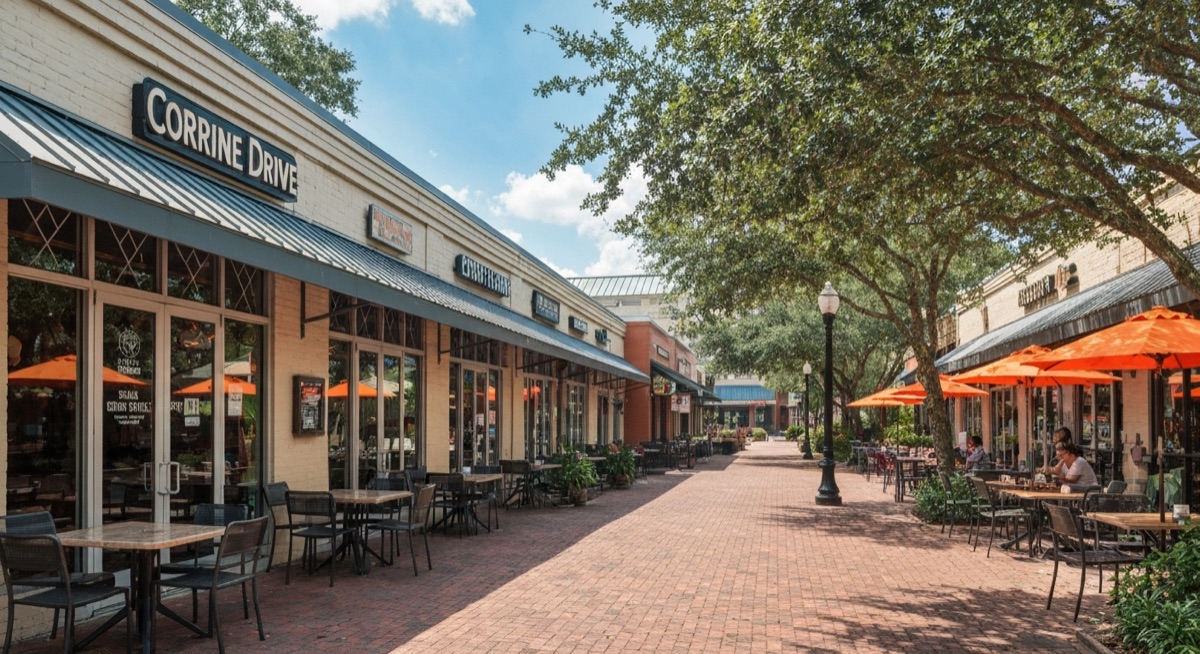
The Corrine Drive strip between Primrose Avenue and the Winter Park curve is the most consistently independent short commercial strip in the city. There’s no specific zoning that has kept chains out. What exists is an informal culture of local ownership that has compounded over time, each new business taking cues from what already exists and who already eats there. It didn’t happen by accident, but it also didn’t happen by committee—which is part of why it works.
East End Market, the food hall and culinary incubator that opened on Corrine Drive in 2013, is worth understanding separately. It has genuinely launched standalone restaurants—vendors who developed their concepts inside the hall, built a following, and eventually opened their own storefronts. Nothing else in Orlando operates at this scale. If you want to know what the city’s dining scene does next, pay attention to what’s incubating there now. For a complementary picture of where local producers and vendors fit into this ecosystem, Orlando’s farmers market circuit in 2026 covers the weekly markets that feed into the same network of independent food businesses.
Corrine Drive draws young families and dog-walkers at lunch. It’s walkable from surrounding residential blocks in a way few Orlando commercial streets are. Evenings are couples and neighborhood regulars, notably less bar-scene energy than Mills 50 or Ivanhoe. This is not a late-night neighborhood. It runs on a dinner-at-seven, sit-on-the-patio-with-a-bottle-of-wine schedule. Show up expecting anything rowdier and you’ll be confused.
Full-service dinner runs $15 to $30; East End lunch formats tend to fall in the $10 to $16 range. These are owner-operated prices, not chain margins.
The outdoor advantage here is real and seasonal. The live oak canopy running the length of Corrine Drive provides genuine shade—and a degree of ambient cooling that actually matters from October through March, and during summer evenings after the heat breaks. The shoulder months, October through November and into March, are the sweet spot. If you’ve only eaten here in August, you haven’t really eaten here.
The Garden District stays under-the-radar because there’s no hotel within walking distance and no landmark to pull tourists toward it. This is unlikely to change. It’s the easiest of the five neighborhoods to recommend to a resident who wants a non-tourist experience without doing significant research first. Walk Corrine Drive on a Friday evening and you’ll see almost no one checking a Google review link.
College Park — Where “Neighborhood Restaurant” Actually Means Something
Mills 50 is the city’s most serious dining neighborhood. Audubon Park is its most deliberately independent. College Park is the most functional. It’s the neighborhood residents actually return to twice a week—the kind of relationship with a place that most of Orlando, being a relatively young city built around cars and theme parks, has never quite figured out how to replicate.
The Edgewater Drive corridor between Princeton Avenue and Par Avenue is the spine of it. Parking is angled streetside on Edgewater itself—the most materially easy parking of any of the five corridors. That distinction matters more than it sounds when you’re deciding whether to go out on a Wednesday. Residents in the surrounding blocks walk to dinner here, a genuinely pedestrian dynamic that the other corridors mostly lack. You’re not traveling to get food; you’re walking outside and finding it.
The restaurant turnover rate on Edgewater has historically been lower than in the other four neighborhoods, which has produced a core of long-running independents with actual institutional knowledge of their regulars. The crowd reflects the neighborhood—older homeowners mixed with young families, less student density than Mills 50, less upscale posturing than Thornton Park. Weekend brunch on Edgewater is a local institution, not a tourist-facing weekend activity. The people in line at 10am on a Saturday largely live within a mile.
Prices: casual spots run $12 to $20 per person; sit-down dinner with a drink is $25 to $40, often with wine lists that are small, sensibly chosen, and not priced for a hotel bar.
College Park’s absence from food media is worth naming directly. It’s boring to travel writers. Nothing about it generates Instagram content. There’s no specific cuisine concentration that creates a trend hook. What it has instead is reliable, owner-operated restaurants with consistent quality and a customer base that will tell them immediately—and loudly—when something declines. If you want a dependable meal rather than a discovery experience, Edgewater Drive is the most consistent answer in the city.
Thornton Park — Beautiful, Worth It, Requires Some Navigation
Thornton Park, the Washington Street and Summerlin Avenue area east of Lake Eola, is the most upscale-casual of the five. It’s also the one requiring the most care—and I say that as someone who genuinely likes it and eats there regularly. Lake Eola provides a backdrop no other Orlando dining neighborhood can match. But it also has the highest tourist-crossover risk of the five, compounded by one specific structural problem: proximity to downtown hotels.
The Sunday Lake Eola Farmers Market (roughly 10am to 3pm, city-permitted, ongoing) draws significant non-local foot traffic into what is otherwise a resident neighborhood. The market itself is legitimate—functioning produce and food vendors worth visiting—but it creates a market-to-brunch pipeline that fills the surrounding restaurants with a noticeably different crowd on Sunday mornings. Brunch at a Thornton Park restaurant on a Sunday is a different experience than dinner there on a Tuesday. Both can be good. They’re operating in different economies, and you should know that going in.
The patio and cocktail culture here is strong. Upper-end entrées run $22 to $42; cocktails at the better bars, $14 to $18. In most cases those prices reflect something real—quality ingredients, a serious bar program, a patio location that justifies the rent. The problem is that accelerated discovery since 2020, driven by downtown hotel development and a meaningful remote-worker influx, has created margin pressure that expresses itself in certain restaurants as tourist-margin pricing in local clothing. The check looks like a neighborhood restaurant’s; the experience was calibrated for someone who won’t be back.
My read: Thornton Park on a weeknight, at an owner-operated restaurant you’ve identified ahead of time, is a legitimate and often excellent neighborhood dining experience. Thornton Park on a Sunday morning or during a downtown convention week is a different gamble. The neighborhood hasn’t been captured by the tourist economy—but it’s the closest of the five to that edge, and the gap has been closing. Worth going. Worth being specific about when and where.
Ivanhoe Village — Highest Upside, Highest Verification Requirement
The Orange Avenue corridor north of downtown is an arts-community and creative-industry district that came to food and drink relatively recently, and the dining scene still reflects that. It’s the youngest and most volatile of the five corridors. Highest turnover rate. Highest reward for residents willing to track it actively.
The wine-bar model dominates here. The $40-per-person-on-bottles dynamic is real, and it’s the right template for understanding how the neighborhood works. You come to Ivanhoe to drink thoughtfully and eat something good, not to have a three-course dinner as the main event. The food programs at the wine bars tend to be small and specific—charcuterie, cheese, carefully sourced small plates. Expect full restaurant experiences at every address and you’ll be frustrated. Adjust your expectations and you’ll probably have a great night. Food at these spots runs $12 to $22.
Stardust Video & Coffee is worth naming as a neighborhood anchor even though it’s not a restaurant. It’s a coffee shop, a community gathering space, and the institution that most clearly signals what kind of people live and work nearby: artists, musicians, service industry workers, Orlando residents who are genuinely uninterested in the theme park economy. The restaurant choices in the immediate area reflect that population. In this city, that’s rarer than it should be.
The late-night kitchen culture in Ivanhoe is specific. Service industry workers from across the city come here after their own shifts end—typically after 10pm on Fridays and Saturdays. Several spots maintain kitchen hours past midnight with this in mind. A kitchen that professional cooks choose on their night off is operating at a quality level that is very difficult to fake.
The honest caveat: turnover here is real. Concept names that were accurate when a piece published six months ago may no longer be accurate. Verifying operating status before visiting isn’t optional in Ivanhoe—it’s the baseline practice. I’ve shown up at places in this neighborhood that had ceased to exist in their previous form, which is annoying in the moment but is also, genuinely, what makes it interesting. The churn is what keeps it new. The reward for staying current is access to some of the most creative independent food and beverage work in the city before it either becomes an institution or closes.
The Industry Worker Signal — What It Tells You About a Restaurant
Orlando has one of the largest hospitality workforces in the country. The theme parks, convention infrastructure, and hotel density that produce the tourist economy also produce tens of thousands of people who work in kitchens, dining rooms, and bars. These workers eat out on their days off with a professional standard of judgment that has very little patience for mediocrity.
They cluster in Mills 50 and Ivanhoe. When a Vietnamese spot on Mills Avenue fills with back-of-house workers at 11pm on a Friday—people who have spent their entire shift in a commercial kitchen and know exactly what good and bad food costs and tastes like—that’s information no Yelp star count can give you. It’s an observable, real-time signal. You just have to look at the room.
If you’re trying a new spot in Mills 50 or Ivanhoe and want a fast quality read, look at who’s eating there after 9pm on a Friday or Saturday. A room with a meaningful proportion of people who look like they just came off a shift—comfortable in their clothes, ordering confidently, clearly regulars—is telling you something important. This signal works in both directions. A restaurant in these neighborhoods that fills exclusively with a tourist crowd at 11pm on a weekend is sending an equally clear message. Not the same one. This is exactly the kind of local street-level intelligence you’ll also find in our food & hospitality coverage of Orlando’s dining and business scene.
Practical Guide — How to Avoid Tourist-Trap Restaurants in Orlando
The 3-mile filter. Restaurants within three miles of a theme park entrance or on I-Drive are statistically more likely to be operating in the tourist economy, regardless of branding. Not a hard rule—legitimate independent spots exist within that radius—but a useful default screen when evaluating an unfamiliar name. Most of the neighborhood restaurants in this guide sit outside that radius by default.
The parking lot rule. A large dedicated surface parking lot is a marker of a chain or tourist-model operation. Neighborhood restaurants are embedded in neighborhoods—street parking, small adjacent lots, shared infrastructure. A 200-space dedicated lot attached to the building is worth noting. It should look familiar by now.
Sunbiz.org. Florida’s Division of Corporations maintains a searchable public database of all registered business entities at Sunbiz.org. Search a restaurant’s legal name and you’ll see who actually owns the entity, where it’s incorporated, and whether it’s part of a larger group. A “local” restaurant owned by a Tampa-based hospitality group with eight concepts isn’t lying to you, exactly—but it’s a different thing from a sole-proprietor family operation. Five minutes of work. I’ve done it more times than I can count.
OpenTable and Resy placement. Heavy presence in those platforms’ editorial features and “top restaurants” lists correlates with tourist-facing operations more than locally rooted ones in this city. The best Vietnamese restaurants on Mills Avenue don’t need to be discoverable by a Chicago businessperson booking a table for a conference dinner. The ones that show up prominently in those platforms have, in many cases, optimized for exactly that audience.
Seasonal timing. October through March is Orlando’s outdoor dining season. The heat is manageable, the afternoon thunderstorms that roll through from May to September are mostly absent, and patio culture works the way it’s supposed to. (If you’ve tried to eat outside in Orlando in July, you understand why this matters.) Holiday weeks—Thanksgiving, Christmas through New Year’s, spring break, and the June–August theme park peak—push tourist traffic into neighborhoods that are usually more insulated from it. During those periods, early seatings before 6:30pm or late ones after 9pm in Mills 50 and Ivanhoe will more reliably reflect those neighborhoods’ actual character.
A calibrated price baseline. In these five neighborhoods, under $20 per person for a full meal is genuinely affordable and not a marker of low quality—it’s the price point where much of the best food in Mills 50 operates. A full-service dinner with a drink at a sit-down independent typically runs $25 to $40. Spending $50 or more is a real splurge in this context. When you do it, you should understand clearly what you’re paying for: a specific wine program, an exceptional kitchen, a justified patio premium. If you’re spending $50 per person and you’re not sure why, you’re almost certainly in a tourist-margin situation.
These five neighborhoods aren’t the only places in Orlando where residents eat well. Milk District, Winter Park’s Park Avenue, and Sanford’s downtown all have their own independent scenes that deserve separate coverage. But Mills 50, Audubon Park, College Park, Thornton Park, and Ivanhoe represent the clearest answer to the resident’s actual question: where can I eat like someone who lives here? The answer is within a few miles of wherever you are, almost entirely off the tourist map, and in most cases cheaper than a mediocre meal in a hotel lobby. The main work is knowing which neighborhoods to look in and how to evaluate what you find. That’s what this is for.