What to Know Before Hiring a Licensed Contractor in Orlando
From the DBPR database to assignment-of-benefits paperwork, here's what Orange County homeowners need to know before the repair work starts — and before the scams begin.

What to Know Before Hiring a Licensed Contractor in Orlando
From the DBPR database to assignment-of-benefits paperwork, here’s what Orange County homeowners need to know before the repair work starts — and before the scams begin.
The wind is still gusting when the truck pulls up.
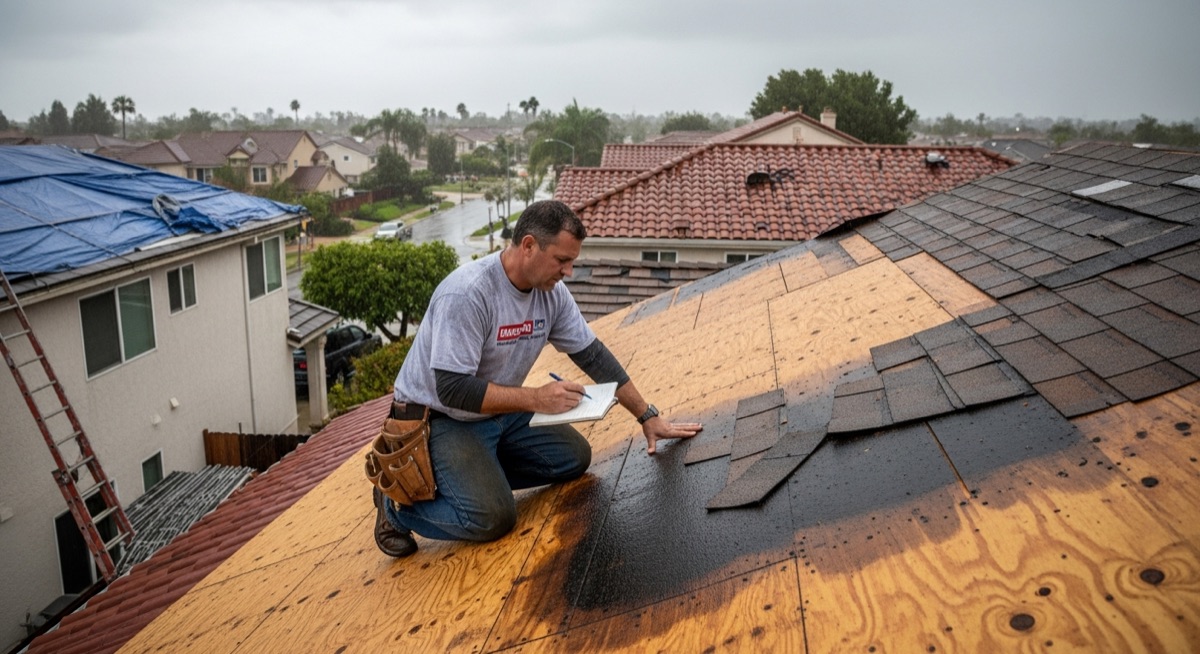
It happened all across Pine Hills, Azalea Park, and Bithlo after Ian, after Irma, and after every named storm that has hit Central Florida in the past decade. Before the debris is off the street, before most local roofers have returned calls, before your insurance adjuster has confirmed a date — a contractor you’ve never seen before is standing on your porch, clipboard in hand, pointing at damage on your roof and telling you to sign something today or lose your place in line.
This is when the scam begins. Not when the check bounces, not when the work turns out shoddy — right here, when you’re stressed, your house is compromised, and someone who sounds confident is offering to make the problem disappear.
The guide below walks Orange County homeowners through every verification step, explains Florida’s specific legal rules, and tells you exactly what paperwork should and shouldn’t cross your hands before any work begins.
Step One: Look Up the License Before You Do Anything Else
The Florida Department of Business and Professional Regulation maintains a public license verification portal at myfloridalicense.com. Every licensed contractor in Florida is in this database. Use it before signing anything — including a basic inspection authorization.
Go to myfloridalicense.com and click “Verify a License.” Enter the contractor’s name or business name. You can also search by license number if they’ve handed you a card or contract; legitimate contractors will have it printed there.
The search returns the license type, number, current status, issue date, and expiration date. The license number prefix tells you something important:
- CGC — Certified General Contractor (state-certified, can work anywhere in Florida)
- CCC — Certified Roofing Contractor (state-certified)
- CBC — Certified Building Contractor (state-certified)
- RG — Registered General Contractor (state-registered, not state-certified)
That distinction matters enormously after a storm. A state-certified contractor holds a license recognized statewide and can pull permits in any Florida county. A state-registered contractor has cleared a lower bar — registration rather than examination-based certification — and their authority to work is tied to a specific local jurisdiction.
Here’s what that means practically: a state-registered contractor licensed through Polk County has no legal authority to pull permits in Orange County. When a registered contractor from Daytona Beach shows up in Conway, their license does not entitle them to work there. They need either a state-certified license or a local registration in Orange County.
If the status reads anything other than “Active,” stop. A license that is “Delinquent,” “Null and Void,” or “Inactive” is not valid for contracting in Florida. Don’t let anyone tell you it’s a paperwork issue they’re resolving. Walk away.
Step Two: Read the Full DBPR Record, Not Just the Status
Most homeowners find “Active” and close the tab. That’s the mistake.
Click on the contractor’s name to open the full record. Scroll down and look for disciplinary history — complaints filed, administrative actions taken by the Construction Industry Licensing Board, fines, suspensions, voluntary compliance settlements. A contractor can carry an “Active” license and still have a trail of consumer complaints and unfinished jobs. Active just means they haven’t lost the license yet.
Workers’ compensation exemption status deserves specific attention. Florida allows sole proprietors and officers of small corporations to file a workers’ comp exemption, meaning they’ve opted out of carrying coverage. This sounds like their business problem. It isn’t. If an exempt worker or uninsured subcontractor is injured on your property, you can be held liable for medical costs and lost wages.
Before any work begins, ask the contractor directly: “Are you carrying workers’ comp, or do you have an exemption filed?” Then verify it in the DBPR record. Make sure the exemption is current and covers the individuals doing the work, not just the company principal who may never set foot on your roof.
Separately, ask for a current certificate of liability insurance and verify it by calling the insurer directly. A contractor can hand you an expired or fraudulent certificate — it happens. A two-minute call eliminates that risk.
Step Three: File Your Insurance Claim Before You Hire Anyone
File your claim first. The sequence gets scrambled fast when someone’s on your porch with a contract, but the order matters legally.
Florida law requires homeowners to provide “prompt notice” of a loss to their insurer. Your policy almost certainly contains the same requirement. Hiring a contractor and allowing significant repair work before your adjuster has documented the damage can compromise your claim. Your insurer has a legal right to inspect the damage as it existed after the storm, not after someone has altered, covered, or partially repaired it.
Under Florida Statute §627.70132, your insurer must acknowledge your claim within 14 days of receipt and must pay, deny, or issue a partial payment within 90 days. You’re entitled to that window. Don’t let a contractor collapse it.
Emergency mitigation is a real exception. If your roof has a hole in it, if windows are shattered, if water is actively entering your home, you are not expected to sit on your hands for two weeks. Tarping exposed roof sections and boarding broken windows is appropriate — most insurers expect it and will cover it.
What you must prevent is emergency mitigation quietly becoming full replacement before an adjuster arrives. This is precisely how the more organized post-storm fraud operations work. They get authorization to tarp. By the time your adjuster shows up, the damaged material is gone and they’re holding a contract for complete re-roofing. Photograph every mitigation step. Get an itemized receipt for any emergency work. Notify your insurer immediately, by phone and in writing, describing exactly what was done.
Step Four: Understand What You’re Signing Before Any Paperwork Changes Hands
If a contractor presents you with paperwork in the first few hours after storm damage — before your claim is filed, before an adjuster has visited — there’s a real chance that paperwork includes an Assignment of Benefits clause, whether or not those words appear in the title. Sometimes it’s buried in paragraph seven of a two-page authorization form. Read the whole thing.
What AOB is: Assignment of Benefits is a legal mechanism by which you transfer your insurance claim rights to a third party, typically the contractor. Once signed, the contractor can negotiate directly with your insurer, receive payment directly from your insurer, and file suit against your insurer in their own name — without your involvement or approval. You’ve handed over the steering wheel on your own claim.
Why Florida became the national center of AOB abuse: For roughly a decade before legislative reform, Florida’s one-way attorney fee statute created a powerful financial incentive for contractors and attorneys to pursue inflated claims through litigation. Insurers who lost AOB suits paid the plaintiff’s attorney fees. The abuse was concentrated most heavily in South Florida, though Central Florida was not spared.
What the 2023 reforms changed: Florida’s SB 2A and HB 837 (both signed by Gov. DeSantis in March 2023) eliminated the one-way attorney fee statute and gutted the AOB litigation mechanism that had driven abuse statewide. The financial jackpot for contractor-driven AOB fraud is gone.
What they didn’t fix: The document still exists. Contractors are still presenting it. Signing it still transfers control of your claim. A homeowner who signs an AOB agreement loses the right to manage their own claim, loses visibility into what the contractor bills the insurer, and risks being caught in the middle if a dispute develops. The litigation windfall may be gone for the contractor, but the headache lands on you just the same.
Watch for this language in any contract or authorization form: “Assignment of benefits,” “Direction to pay,” “Authorization to act on my behalf in all insurance matters,” “Right to pursue payment directly from insurer,” or any clause granting the contractor authority to “execute, negotiate, or settle” your insurance claim. If you see any of these phrases, stop signing. Call your insurer directly and describe the document before you go further.
Step Five: Know the Red Flags Specific to Post-Storm Orlando
The Florida CFO’s Division of Consumer Services publishes a list of contractor fraud warning signs. The ones below aren’t generic — they map to specific tactics that have appeared in Orange, Osceola, and Seminole County after recent storms.
Legitimate local contractors are slammed after a major storm. They’re returning calls from existing clients, managing stretched crews, dealing with material shortages. A contractor who appears at your door within 24–48 hours — especially one who drove in from out of state or from a distant Florida county — is working on volume. That alone doesn’t make them fraudulent, but it makes verification mandatory, not optional. No exceptions.
Under Florida Statute §489.126, a contractor who collects a deposit and must apply for a permit is required to do so within 30 days of receiving payment. Demanding half or more of the job in cash upfront, before a single permit is obtained, is outside normal practice for any legitimate job. Anyone insisting on it is telling you something.
Check the business address on any contract or license record. A P.O. box as the only Florida address, or a home-state address in Georgia or Texas with a Florida license obtained for storm season, means no local accountability. If the work stops midway, there’s no office to walk into, no local bond to claim against, no business reputation in your community at stake. They’ll be gone by spring.
“FEMA is coming and you’ll lose your eligibility if you don’t sign today.” “The county is red-tagging houses next week.” “I’ve only got one crew left in Central Florida.” These are pressure levers designed to burn the 20 minutes it would take you to verify a license and call your insurer. Any contractor who won’t give you 24 hours for basic due diligence is telling you exactly how they intend to do business with you.
One Red Flag That’s Actually a Crime: The Deductible Waiver
This deserves its own section. The psychology behind it is effective — which is why it keeps working.
Florida homeowners with hurricane coverage carry percentage-based deductibles rather than flat ones. Depending on your insurer and policy, your hurricane deductible may be 2–5 percent of your dwelling coverage. On a home insured for $350,000, that’s $7,000 to $17,500. Many homeowners don’t learn this number until a storm hits, which is the worst possible moment to absorb it.
When a contractor offers to “waive your deductible,” “work with your deductible,” or “make it so you pay nothing out of pocket,” they are not being generous. Under Florida Statute §817.234, a contractor who offers to waive, absorb, or rebate an insurance deductible as an inducement to sign is committing insurance fraud. That’s a felony.
The mechanics: the contractor inflates the insurance claim by the amount of the deductible so the insurer covers both the legitimate repair and the contractor’s absorbed portion. Your insurer pays a fraudulent bill. The cost gets distributed across the insurance market through higher premiums. You — and every other Florida homeowner — pay for it eventually.
The contractor exploits the sticker shock of that deductible number. This section exists to remove that surprise before the truck shows up. Find your hurricane deductible on your declarations page right now, before the next storm. When a contractor offers to make it disappear, you’re hearing a felony solicitation. Report it to the Florida CFO hotline at 1-877-693-5236.
Orange County and City of Orlando: Local Permits Matter Too
Central Florida homeowners face a two-track approval system, and mixing up the tracks is expensive.
Track one is state DBPR licensing — the contractor’s professional credential, verified at myfloridalicense.com. Track two is local permit authority — the jurisdiction that must approve and inspect the actual work on your home. Depending on your address, that’s either the Orange County Building Division (ocfl.net) or the City of Orlando Permitting Services (orlando.gov).
In Orange County, permits are required for structural repairs, full or partial roof replacement, and electrical or HVAC work. When in doubt, call the relevant building division and describe the scope of work before it begins. Five minutes now versus years of headaches later.
Unpermitted storm repair work creates a cascade of problems. If your insurer discovers structural repairs were made without required permits, they have grounds to dispute or deny related future claims. An unpermitted roof replacement that develops problems in year two may not be covered. Unpermitted work surfaces in title searches and home inspections — buyers’ attorneys look for it, lenders require it to be resolved before closing, and remediating it after the fact typically costs far more than the original permit would have.
Post-storm permit backlogs are real. After Ian and Irma, Orange County and City of Orlando permitting offices were processing applications weeks behind schedule. That’s not a knock on those offices — it’s just what happens when a major storm hits a metro this size. A legitimate contractor will acknowledge the backlog, commit in writing to pulling the permit before structural work begins, and plan the job accordingly. A contractor who says “we’ll handle the permit later” is either planning to skip it or doesn’t know local requirements. Neither belongs on your roof.
One more layer if you’re in Baldwin Park, Celebration, Laureate Park, or similar master-planned communities: your HOA or CDD architectural review board may require separate approval for exterior material changes — roof color, window style, siding — even when county permits are in order. Post-storm is not an exemption. Proceed without HOA approval and you risk fines and forced remediation. Confirm the requirements before work starts.
Where to Report Fraud and What Remedies You Have
If you’ve already signed a contract with a contractor who has defrauded you, or if you suspect fraud in progress, here’s the action map for Orange County residents.
DBPR Construction Industry Licensing Board: File a formal complaint at myfloridalicense.com. The CILB investigates unlicensed activity, disciplinary violations, and consumer complaints against licensed contractors. Disciplinary actions are searchable by county, so you can check whether a contractor working in Central Florida has already been flagged somewhere else in the state before you ever let them on your property.
Florida Attorney General’s Office: The AG’s consumer protection division handles contractor fraud. File at myfloridalegal.com. The AG has pursued enforcement actions against storm-chaser networks operating in Central Florida following prior storms; documented complaints help establish the patterns that trigger those investigations.
Florida CFO’s Division of Consumer Services: Handles insurance fraud and AOB abuses. File online at myfloridacfo.com or call 1-877-693-5236. Use this number if a contractor has offered to waive your deductible.
Construction attorney: A licensed contractor who abandons a job, does defective work, or commits fraud has civil exposure beyond regulatory action. The Florida Bar’s Lawyer Referral Service (floridabar.org) includes referral panels for Orange County construction law. Florida Statute §489.129 provides homeowners with specific grounds for disciplinary action and civil recovery against contractors who violate the licensing statutes.
Quick-Reference Checklist: Five Things to Confirm Before Any Contractor Begins Work
Print this out. Keep it near your insurance documents.
1. DBPR license verified — including disciplinary history. Go to myfloridalicense.com, then Verify a License. Status must be “Active.” Click through to the full record and review any disciplinary history, complaints, and administrative actions. State-certified (CGC, CCC, CBC) for statewide authority; state-registered (RG) requires local jurisdiction authorization.
2. Workers’ comp coverage or valid, current exemption confirmed. Ask directly. Verify in the DBPR record. Request a certificate of liability insurance and call the issuing insurer to confirm it’s active. If a crew member is injured on your property without coverage, your homeowner’s insurance — or your personal assets — may be exposed.
3. Insurance claim number on file with your insurer. The claim is filed before work begins. You have an active claim number. Your insurer has been notified of any emergency mitigation already performed and what it covered.
4. Permit pulled or committed to in writing before structural work starts. Verify requirements with Orange County Building Division (ocfl.net) or City of Orlando Permitting Services (orlando.gov). Get the commitment in the contract with a timeline.
5. No AOB language in the contract. Read every line. Look for “assignment,” “direction to pay,” “authority to act on my behalf,” or any clause transferring your claim rights to the contractor. If you find it, don’t sign. Call your insurer first.
Storm damage is a genuine emergency, and the verification steps above take roughly half an hour. Contractors who pressure you to skip them are counting on exactly that — that the urgency of a damaged house will feel more real than the paperwork risk. It won’t, until the paperwork problem becomes your new emergency.
If you suspect contractor fraud in Orange County, contact the Florida CFO’s insurance fraud hotline at 1-877-693-5236 or file a complaint with the DBPR’s Construction Industry Licensing Board at myfloridalicense.com.