What to Know About the Orlando Real Estate Market in 2026
ORMLS data from Q1–Q2 2026 shows prices are still up year-over-year across the metro, but days on market are climbing, inventory is recovering, and the story looks very different depending on your …

What to Know About the Orlando Real Estate Market in 2026
ORMLS data from Q1–Q2 2026 shows prices are still up year-over-year across the metro, but days on market are climbing, inventory is recovering, and the story looks very different depending on your zip code.
The short answer to the question every Orlando buyer and seller is asking right now: prices are higher than a year ago, but the advantage has shifted toward buyers in most of the metro. In some submarkets, decisively. The Orlando market is not crashing. It’s also not the frenzied, offer-stacked market of 2021 through 2023. What it is, as of mid-2026, is a transitional market with genuinely different conditions depending on whether you’re buying in Horizon West, Lake Nona, Winter Park, or downtown. The headline metro number obscures more than it reveals — and it’s actively misleading if you’re trying to make a real decision.
The Metro Picture: Prices Up, But the Engine Has Downshifted
According to Orlando Regional REALTOR® Association data for Q1–Q2 2026, metro-wide median sales prices for single-family homes remain above year-ago levels. The pace of appreciation is a fraction of the annual gains that defined the pandemic-era run.
Inventory tells a parallel story. Active listings across the metro have recovered considerably from the historic lows of 2021–2022, when buyers were routinely competing against a dozen or more offers on a single home. Even so, active inventory remains below the 2018–2019 baseline — years when the market was considered reasonably balanced. Buyers are in a better position than three years ago without the data yet qualifying this as a textbook buyer’s market.
Closed sales volume is down modestly year-over-year. That’s less a function of weak demand than of the affordability ceiling imposed by rates and insurance costs. Sellers who priced correctly in Q1 2026 still moved homes. Sellers who tested aspirational prices are sitting on listings with cuts.
Neighborhood by Neighborhood: Where the Market Is Moving and Where It Has Stalled
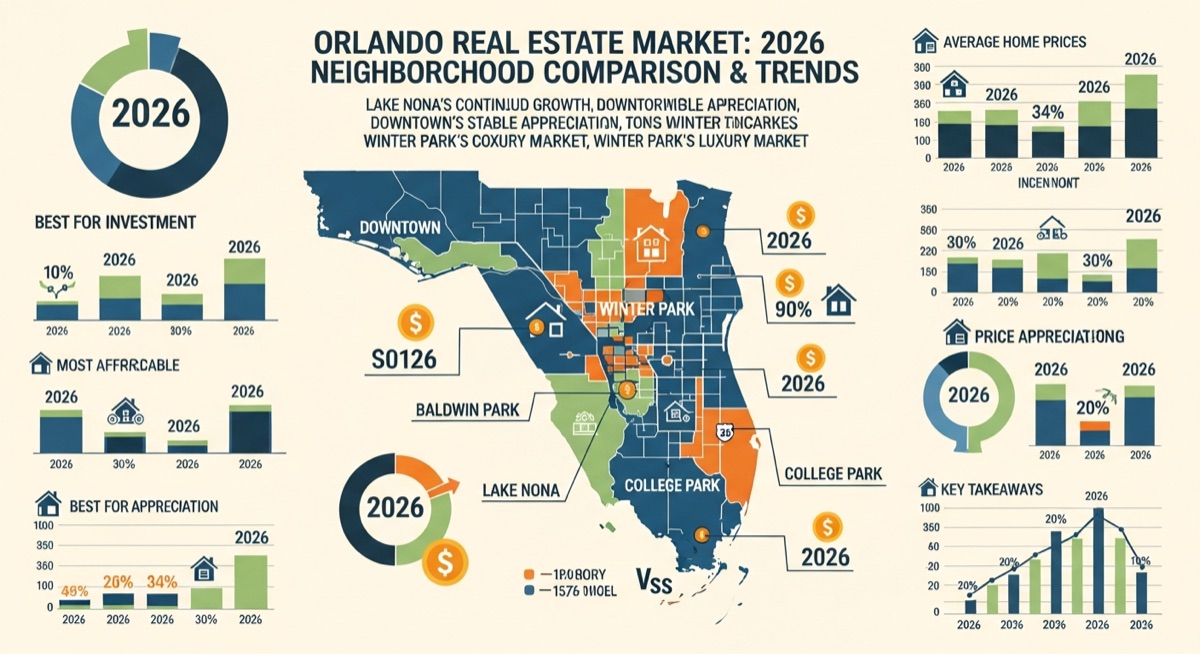
The metro median is useful for context. It’s useless for decisions. Here’s what the ORMLS zip-code data shows across the four submarkets that tell the Orlando story most clearly.
Horizon West (34787)
The shift from seller’s to balanced market is most visible in Horizon West. Appreciation in 34787 through Q1–Q2 2026 is among the flattest of any high-growth submarket in the metro. Days on market have climbed noticeably year-over-year, and a significant share of active listings have taken at least one price reduction before going under contract.
Resale sellers here aren’t losing to a lack of buyers. They’re losing to builder competition, which reshapes the entire pricing calculation in this corridor. More on that below.
Lake Nona (32832)
Lake Nona is more complicated. Year-over-year appreciation in 32832 is running ahead of both Horizon West and the metro average, driven largely by the Medical City employment hub. Nemours Children’s Hospital, UCF Lake Nona Medical Center, the VA Medical Center, and the cluster of life sciences employers nearby generate steady demand from relocating professionals whose household incomes can absorb current rates more easily than median-income buyers can.
The upper end of the Lake Nona market has softened more noticeably than the mid-range. That’s the part worth sitting with: the employment anchor effect is real, but it doesn’t protect luxury pricing the way it supports mid-market demand.
Winter Park (32789 / 32792)
Winter Park is the most resilient submarket in the metro, and the data support that without qualification. Appreciation in 32789 and 32792 through Q1–Q2 2026 is the strongest of the four submarkets tracked here. Days on market in the 32789 core average well below the metro figure. Seller concession rates are lower here than anywhere else.
The durability comes down to structural scarcity. Established homes within the Winter Park school district near the Park Avenue corridor and Rollins College don’t get replicated — there’s no equivalent of a Horizon West builder pipeline here. Out-of-state buyers, particularly from the Northeast and Midwest, remain active in this corridor in a way that has moderated elsewhere. School district reputation plus limited supply plus steady transplant demand: that combination has held up better than sentiment-based metrics would predict, and I don’t see it changing.
Downtown Orlando (32801 / 32803)
Downtown’s single-family and townhome market is performing broadly in line with the metro. The condo market — covering Thornton Park, the Milk District, and Colonialtown — is a different and more complicated story that gets its own section.
New Construction’s Role: Builder Competition Is Reshaping Resale in Horizon West and Lake Nona
You can’t read Orlando’s resale market without accounting for the builder pipeline. Nowhere is that more true than in Horizon West and Lake Nona. D.R. Horton, Toll Brothers, David Weekley, and Meritage Homes are actively selling new construction in both corridors. Tavistock Development Company controls significant land in Lake Nona with an ongoing pipeline of new product. These builders are competing hard.
Current builder incentives as of Q2 2026 include waived lot premiums on select inventory homes, closing cost contributions, and — most significantly — builder-financed mortgage rate buydowns through preferred lender partnerships including D.R. Horton Mortgage and Pulte Financial. When a builder can hand a buyer a rate two points below prevailing market on a new home, the resale seller has to compensate for that monthly payment differential or give the buyer little reason to choose the existing home. That’s not a minor inconvenience. It’s a structural pricing problem for resale in those corridors.
The practical effect on Horizon West resale shows up clearly in days-on-market figures. Sellers who would have commanded full ask in 2022 are accepting below-list pricing, offering closing cost credits, or waiting through longer marketing periods. A resale home in the Horizon West corridor is competing against new construction nearby with a rate buydown and a full builder warranty. That’s a hard pitch to win, and most sellers there right now are finding out the hard way.
In Lake Nona, the builder effect is real but partially offset by employment demand. Tavistock’s ongoing development simultaneously pressures resale sellers and signals continued long-term investment in the submarket — a genuinely mixed posture that keeps the pricing dynamic from collapsing the way it might without the employment anchor.
The Rate Problem: What Elevated Mortgage Rates Actually Cost an Orlando Buyer
National mortgage rate coverage treats elevated rates as an abstraction. They’re not an abstraction for someone buying a home at Orlando’s current median — they’re the number that determines whether the payment works.
Buyers who purchased in 2021 locked in rates that in many cases were 3 percentage points or more below what today’s buyers face. On a $450,000 home with 10 percent down, that gap translates to roughly $700 to $800 more per month in principal and interest alone. That’s the number that explains why transaction volume is down even though prices haven’t crashed. People aren’t waiting for a deal. They’re waiting to be able to afford the monthly payment.
Local credit unions — Fairwinds Credit Union and CFE Federal Credit Union in particular — sometimes offer below-market products worth a direct inquiry. Builder lender programs can materially undercut prevailing rates on new construction. Those aren’t footnotes; for some buyers, they’re what makes a deal pencil out at all.
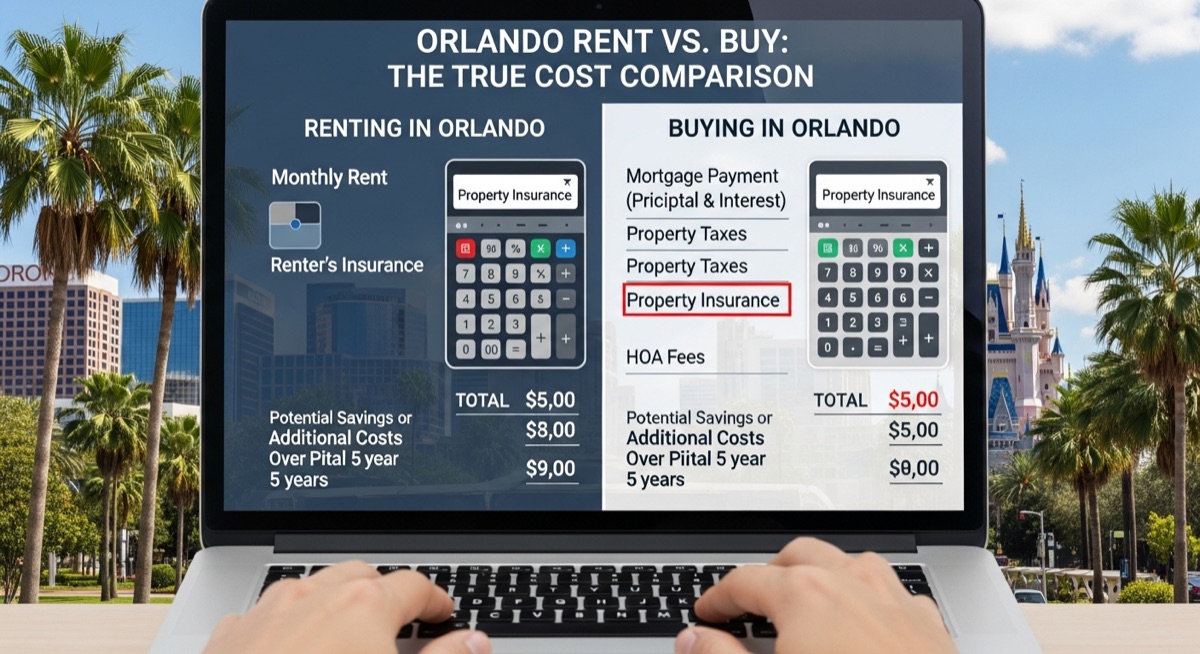
Florida homeowners insurance compounds the problem. Citizens Insurance has shed policies and repriced aggressively. Private carriers have exited or repriced the state following multiple hurricane seasons. Insurance costs for a single-family home in Orange County are running $3,000 to $6,000 annually in many areas where $1,800 was normal in 2020 — and if you haven’t pulled a current quote recently, the number may genuinely catch you off guard. As we note in our home & property coverage, insurance costs have become one of the most volatile line items in the Florida ownership calculation.
Then there are HOA fees. Lake Nona and Horizon West master-planned communities typically charge $200 to $450 monthly for amenities, landscaping, and community infrastructure. For a buyer comparing a $450,000 home with no HOA against a $450,000 home carrying a $350 monthly HOA bill, the felt affordability is thousands of dollars apart annually even though the sticker price is identical.
The combined effect: total monthly carrying costs for an Orlando home have risen substantially faster than headline price appreciation suggests. Prices are up only modestly year-over-year, but financing and carrying costs have made ownership feel considerably worse than the appreciation figure alone implies. That’s why so many buyers feel like the market is harder than the numbers say — because for them, measured in monthly dollars, it is. For a full breakdown of how these costs add up against renting, the costs that don’t show up in the calculator lays out the complete picture.
Days on Market Are Rising: The Most Actionable Signal in the Data
For buyers and sellers currently negotiating, days on market is the single most useful metric in the current ORMLS data. More useful, in many respects, than median price.
Metro-wide, median days on market have risen year-over-year in Q1–Q2 2026. Winter Park’s core zip remains among the fastest in the metro; Horizon West is among the slowest. But the directional trend is consistent: homes are taking longer to sell across the board.
This shift is reshaping negotiating dynamics. In 2022 and 2023, sellers routinely rejected inspection and financing contingencies from competing buyers. Both are now standard in most Orlando offer packages. Seller concessions — closing cost credits, repair allowances, rate buydown contributions — are appearing in a meaningful share of closings metro-wide, compared to a fraction of that at the market’s peak. In Horizon West, the majority of active listings reflect at least one price reduction from original list price.
If you’ve been watching a listing sit, the data explains why.
The Downtown Condo Market Has Its Own Problem
The condo market in downtown Orlando is navigating a challenge that most national outlets aren’t covering. It’s one of the most significant local-market stories in the state right now, and it’s going to get bigger.
Florida Senate Bill 4-D (2022) and House Bill 1021 (2023), passed in the wake of the Champlain Towers South collapse in Surfside, impose mandatory structural milestone inspections on condominium buildings three stories or higher that are 30 years old or older. More consequentially, they require condominium associations to fully fund structural reserves. The longstanding Florida practice of waiving reserve requirements by owner vote is ending. Many downtown associations are already receiving engineering assessments and discovering deferred maintenance liabilities that now have to be funded — and in some buildings, the numbers are severe.
For buyers in 32801 and 32803, this creates concrete due-diligence requirements that didn’t exist two years ago. Before making an offer on any pre-2000 condo building downtown: get the most recent milestone inspection report, review the association’s current reserve study and funded reserve percentage, and read the minutes from the last several board meetings. Any building that hasn’t completed its required inspection or is significantly underfunded on reserves is carrying financial exposure that should be reflected in your offer price — not ignored because the unit itself looks nice.
Seller pressure is already visible in some buildings. Owners in older downtown condos who planned to hold and rent are reconsidering, particularly those who can’t absorb a special assessment call. That pressure is creating real buying opportunities in specific buildings. I’d be cautious about calling it pure upside, though. You’re inheriting whatever the association’s deferred liability turns out to be, and in some cases that number isn’t fully known yet.
Buyer’s Market or Seller’s Market: The Honest Answer for 2026
It depends on where you are. Anyone who gives you a single answer for all of Orlando isn’t paying attention.
Winter Park sellers in the 32789 core are still in a favorable position. Inventory constraints and structural scarcity support pricing. Sellers pricing correctly can expect competitive timelines with limited concession pressure. That’s unlikely to change in the second half of 2026.
Lake Nona sellers in the mid-price band near employment anchors are in a market that’s balanced to slight-seller’s-favor. Not the 2022 peak, but not a market that requires panic pricing.
Horizon West resale sellers are in the most challenging position in the metro. Builder competition is real, active inventory is elevated, and days on market are the highest of any major submarket. Sellers competing directly against new construction need to price with that in mind — aggressively on list price, prepared to offer concessions, or both. Pricing based on 2022 comps will cost you time and money. That’s not a prediction; it’s already happening to the listings sitting right now.
Downtown condo sellers face a submarket-within-a-submarket driven by the legislation. Buildings with completed inspections, healthy reserves, and professional management are holding value. Buildings that haven’t completed required compliance steps are seeing buyer hesitancy that is growing, not stabilizing.
For buyers, the market as of mid-2026 offers more negotiating room than at any point since 2019. Contingencies are accepted. Concessions are available. Price reductions are common. The constraint isn’t availability or leverage — it’s affordability, in the form of rates and insurance costs that make the monthly math genuinely difficult even as headline prices have moderated. Those are two very different problems with very different solutions.
What to Watch in the Second Half of 2026
Hurricane season runs June through November and historically affects buyer psychology in ways that are consistent if hard to model. A significant storm affecting Orange or Osceola County directly would accelerate the insurance repricing cycle and likely dampen out-of-state buyer interest through the winter. A quiet season has the opposite effect and could push activity higher in Q4. FEMA flood map updates remain a real friction point for buyers in parts of Orange and Seminole counties — worth confirming before you’re deep into a contract.
Orange County impact fee adjustments bear watching for anyone buying new construction. Any significant increase flows through to builder pricing and could narrow the cost gap between new and resale in Horizon West and Lake Nona — modestly, but meaningfully over time.
The condo legislation compliance calendar isn’t done reshaping the downtown market. The next wave of required milestone inspections and reserve-funding deadlines will generate additional seller pressure in older buildings over the next 12 to 18 months. Buyers who understand that calendar will have real information advantages.
Q3 seasonal softness is a regular feature of the Orlando market. Summer heat and back-to-school timing slow buyer traffic every year. This year, with elevated days on market already baked in, that seasonal softening may be more pronounced than in prior years. Sellers who need to move homes should be weighing whether to price aggressively now or wait for the seasonal rebound that typically follows in October and November. Buyers willing to shop during August and September will likely find the most negotiating room of any point in the current cycle.
The Orlando market in 2026 is not a headline. It’s a zip code. Follow the ORMLS data by neighborhood, understand what rates and insurance are doing to real monthly costs, and treat any single metro number as context — not conclusion.
CityDesk Orlando will update this analysis with Q3 2026 ORMLS data when released.